When a family is grappling with the loss of a loved one due to someone else's negligence, the legal process can feel like an impossible burden. One of the first and most practical questions people ask is about wrongful death settlement amounts, which often range from hundreds of thousands to millions of dollars. These settlements are meant to provide financial stability for the immense losses families are forced to endure. We're here to offer some helpful information about how these outcomes are determined.
What Is a Wrongful Death Settlement?
A wrongful death settlement is a formal, legally binding agreement reached between the surviving family members and the at-fault party (usually their insurance company). This agreement resolves the legal claim without the need for a full, public trial. It’s a structured way to provide financial compensation for the family's sudden and devastating loss.
Of course, no amount of money can ever assign a value to a human life. Instead, a settlement is designed to deliver a measure of justice and relieve the tremendous financial pressures that come with a loved one’s death. This includes everything from final medical bills to replacing the income that person would have earned for their family over a lifetime.
The Building Blocks of a Settlement
It helps to think of a settlement as being built from different types of compensation, which lawyers call "damages." Each type of damage addresses a specific loss the family has suffered. While every case is unique, recent legal analysis shows that wrongful death settlements in the U.S. average between $500,000 and $1 million. You can find more details on how these claims are structured and valued with these wrongful death claim insights.
The main categories of damages include:
- Economic Damages: These are the clear, measurable financial losses. This covers lost wages, future earning capacity, funeral and burial costs, and any medical expenses incurred before death.
- Non-Economic Damages: These address the intangible but profoundly real human losses. This includes the family’s grief and sorrow, the loss of companionship, and the loss of guidance a parent would have provided to their children.
- Punitive Damages: In some Georgia cases involving extreme negligence or intentional harm, an additional amount may be awarded. These damages are not meant to compensate the family but to punish the wrongdoer and deter others from similar conduct.
This diagram helps visualize how these different components come together to form the basis of a wrongful death claim.
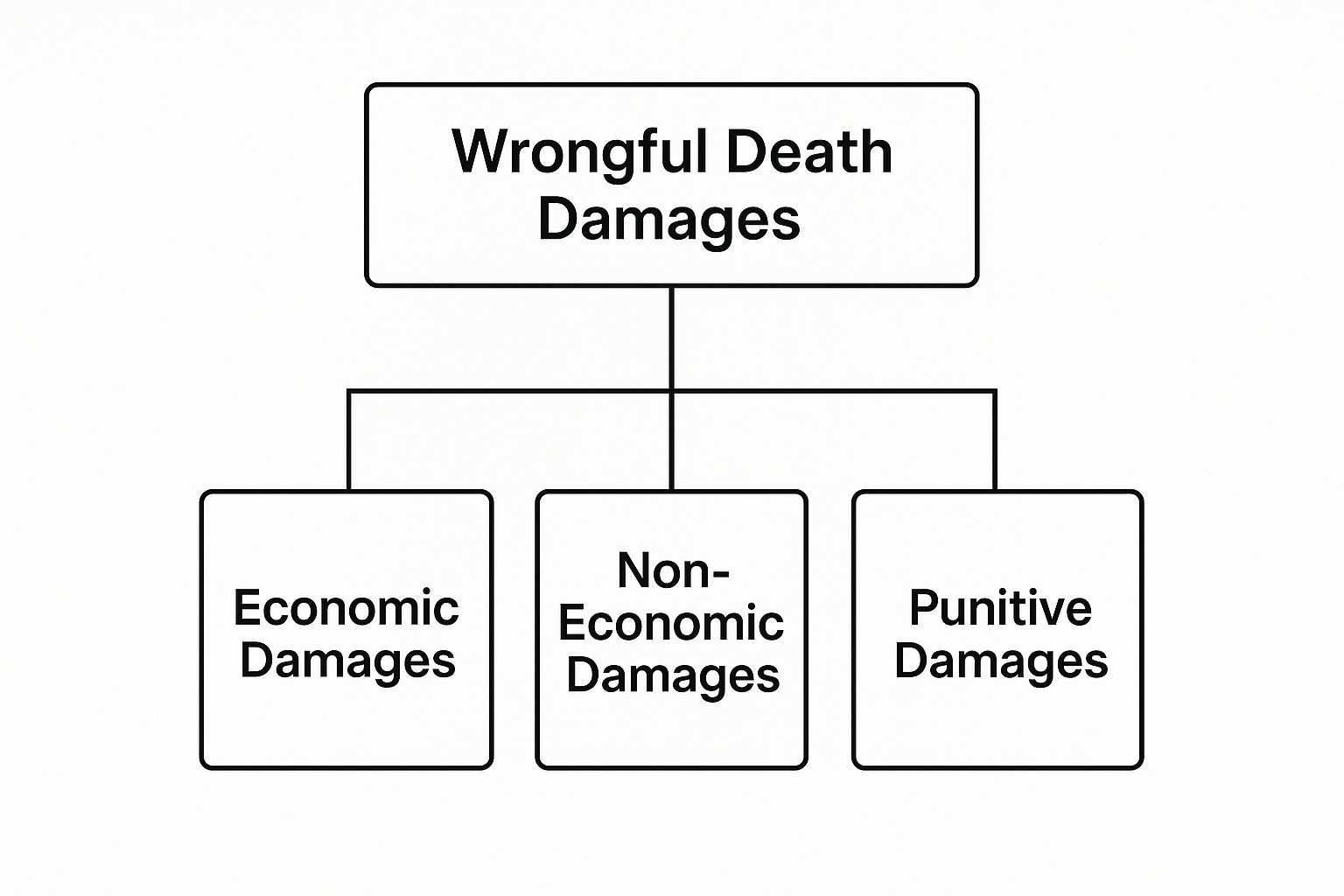
As you can see, a final settlement is a combination of these distinct parts. Each one is calculated to address a different aspect of your family's loss. Understanding this structure is the first step toward clarifying how final wrongful death settlement amounts are determined in a real-world case.
How Wrongful Death Payouts Are Calculated
When a family is dealing with a sudden, tragic loss, one of the most pressing questions is how a settlement amount is even determined. There’s no simple calculator or one-size-fits-all formula. Instead, the final figure is meticulously built by combining two very different types of losses. Think of it as constructing a complete picture of the family's loss, piece by painful piece.
The first category covers what are known as Economic Damages. These are the measurable, tangible financial gaps left behind by a person’s death. You can track these with receipts, pay stubs, and financial projections. They have a clear paper trail.
The second category is for Non-Economic Damages. This is where the law attempts to acknowledge the profound, human cost of the loss—the kind that doesn't come with an invoice but is felt every single day by the surviving family members.
Breaking Down the Damages
Let's look closer at how these two categories fit together to form the basis of a wrongful death claim.
-
Economic Damages (The Financial Impact):
- Final Medical Bills: This includes any costs for the medical treatment your loved one received for the fatal injury or illness right before they passed.
- Funeral and Burial Costs: These are the direct, out-of-pocket expenses for the funeral, burial, or cremation services.
- Lost Income and Future Earnings: Often the largest part of the economic damages, this is a calculation of the wages, salary, retirement benefits, and health insurance the person would have earned throughout their working life. It represents the financial support they would have continued to provide.
-
Non-Economic Damages (The Human Impact):
- Loss of Companionship: For a spouse, this is the irreplaceable loss of their partner and confidant.
- Pain and Suffering of Survivors: This acknowledges the family’s deep mental anguish, grief, and sorrow.
- Loss of Parental Guidance: When children lose a parent, this compensates for the loss of their love, support, nurturing, and guidance.
The legal system formally recognizes this distinction. As defined by experts at Cornell Law School's Legal Information Institute, a wrongful death action is designed to compensate the survivors for the specific losses they have suffered.

As this screenshot shows, the claim is brought by the survivors for their own damages, not on behalf of the person who died. Each of these economic and non-economic factors is carefully weighed. By adding them all together, a lawyer and the courts can begin to form a comprehensive picture of the family's total loss, which becomes the foundation for negotiating a fair settlement.
Variables That Influence the Final Payout

While we can talk about the building blocks of a claim, it’s the specific, human details of a person's life—and the circumstances of their death—that truly shape the final wrongful death settlement amounts. No two cases are ever the same because no two lives or families are identical. It’s these unique variables that explain why one settlement might be valued in the hundreds of thousands while another reaches well into the millions.
A person's age and overall health, for instance, are primary factors. The loss of a young, healthy parent with decades of earning potential still ahead of them carries a much higher economic value than the loss of an elderly retiree. It’s a pragmatic, though difficult, look at the financial future that was stolen from the family.
Personal and Economic Contributions
Beyond age, the deceased person's earning capacity is a huge piece of the puzzle. This isn't just a guess; it's calculated by looking at their education, job skills, and established career trajectory. A higher-earning individual, like a doctor or an engineer, would have provided more substantial financial support over their lifetime. A settlement must reflect that lost income.
The number of dependents also plays a vital role. A settlement for someone who was the sole provider for a spouse and three young children will look vastly different from a case involving someone with no dependents. The calculation aims to account for the financial support each of those dependents has now lost for good.
In essence, the legal process involves painting a complete financial picture of what the future would have looked like for the family. This isn't just about a lost salary. It includes lost benefits like health insurance, retirement contributions, and pensions.
The At-Fault Party’s Actions and Evidence
The nature of the defendant’s actions can dramatically alter a settlement. There is a clear legal line between a simple mistake (negligence) and a reckless or willful disregard for safety (gross negligence). When the at-fault party's conduct is particularly outrageous, Georgia law allows for punitive damages, which are designed to punish the wrongdoer and deter similar behavior.
Several other key elements also come into play:
- Strength of Evidence: A strong, well-documented case with undeniable proof of fault is much more likely to result in a favorable settlement. Weak or disputed evidence can significantly lower the potential value.
- Insurance Policy Limits: In many cases, a settlement is practically limited by the amount of insurance coverage the at-fault party carries.
- Jurisdiction: The specific laws in the state and even the county where the claim is filed can influence the outcome. Georgia law, for example, has unique provisions for calculating the “full value of the life,” which you can learn more about from resources like the Official Code of Georgia Annotated (O.C.G.A.).
Each of these variables is painstakingly analyzed to arrive at fair wrongful death settlement amounts that genuinely reflect the full scope of a family’s loss.
Real-World Scenarios and Settlement Examples
Abstract legal concepts are one thing, but seeing them play out in real life is what makes it all connect. The specific circumstances of a tragedy are what ultimately drive wrongful death settlement amounts.
Let's walk through a few common scenarios to see how different factors create vastly different outcomes. While these are hypothetical, they’re grounded in the types of cases we handle right here in Atlanta.
The Impact of Negligence on Case Value
Picture this: a construction worker is killed on a job site. The company had ignored multiple safety warnings and failed to provide basic safety gear. This isn't just a simple mistake—it's a clear pattern of severe negligence. The family’s claim would cover the worker's lost lifetime income and the profound emotional grief they are now forced to endure.
More importantly, the company's reckless conduct could open the door to punitive damages. These aren't meant to compensate the family but to punish the wrongdoer and deter similar behavior in the future.
Now, think about a case involving a defective product, like a faulty medical device or asbestos exposure that leads to mesothelioma years later. A settlement for a mesothelioma victim must account for enormous medical bills, immense suffering, and the tragic loss of companionship. Because these cases often involve large corporations with a history of putting profits over people, multi-million-dollar settlements are not uncommon.
These examples bring us to an important point:
The degree of negligence is a massive driver of settlement value. A simple accident is valued very differently from a death caused by gross negligence or a company's willful disregard for human life.
In some cases, the facts are so shocking that juries award staggering amounts. For instance, a Texas jury awarded $640 million to the family of a pipefitter killed in a construction accident. This included $160 million in compensatory damages and almost $500 million in punitive damages, showing just how much a defendant's terrible actions can amplify a verdict. You can learn more about these kinds of major wrongful death verdicts and their details.
By looking at different scenarios, you start to see how the unique facts of a case—from the type of accident to the defendant's conduct—are pieced together. These details are what ultimately determine a fair and just settlement for a grieving family.
Case Study Wrongful Death Payouts
The table below gives you a clearer picture of how different wrongful death cases can vary in value based on the key factors involved.
| Case Type | Key Factors | Reported Payout Range |
|---|---|---|
| Medical Malpractice | Surgical error, misdiagnosis, failure to monitor, hospital negligence. | $250,000 to $1.5 Million+ |
| Car Accident | Drunk driver, distracted driving, commercial truck involvement, clear liability. | $500,000 to $3 Million+ |
| Workplace Accident | Safety violations (OSHA), defective equipment, third-party negligence. | $900,000 to $5 Million+ |
| Defective Product | Corporate negligence, dangerous design, failure to warn, mass tort (e.g., asbestos). | $1 Million to $10 Million+ |
As you can see, cases involving corporate or commercial defendants often result in higher payouts, especially when there's evidence of gross negligence or a pattern of misconduct. These figures are not guarantees but illustrate how different elements can shape the final outcome.
Understanding a Settlement Versus a Trial Verdict
When a family is facing a wrongful death claim, the terms “settlement” and “verdict” often get tossed around. It’s easy to think they’re the same, but they represent two completely different legal paths. Making the right choice between them is important, especially when you’re already dealing with a difficult time.
A settlement is a private agreement. It's negotiated directly between your family’s attorney and the at-fault party, which almost always means their insurance company. The entire process happens outside of a courtroom, ending in a confidential resolution.
A trial verdict, on the other hand, is the decision a judge or jury hands down after a public trial. This path is formal, often lengthy, and plays out in open court for all to see.
The Certainty of a Settlement
The biggest advantage of a settlement is certainty. Your family agrees to a specific, guaranteed amount of compensation, and that’s the end of it. No surprises. This route is typically faster and far less emotionally draining than going to trial, which can force a family to relive their trauma on the witness stand.
A trial is a gamble. While it’s true that some jury verdicts are massive, there’s also a very real risk that the jury could award less than what was offered in a settlement—or award nothing at all.
For instance, wrongful death settlements for mesothelioma cases often land between $1 million and $1.4 million. These are negotiated amounts that provide families with security. While a jury once awarded $10.99 million to one laborer's family, those headline-grabbing verdicts are the exception, not the rule. Many families would rather take the guaranteed outcome. You can see more details on these specific mesothelioma case results.
The decision to settle or go to trial comes down to weighing a guaranteed, private resolution against the risks and potential rewards of a public court battle.
Ultimately, the right strategy depends on the unique facts of your case, the strength of your evidence, and what your family truly needs to find closure. Understanding these two distinct paths is the first step toward securing justice and a fair financial recovery.
Answering Your Questions About Wrongful Death Claims

Dealing with a wrongful death claim brings up a lot of questions. It's an unfamiliar and emotional process for any family. We've compiled direct answers to some of the most common questions we hear, aiming to provide clarity when you need it most. Our goal is to help you understand the key legal realities behind wrongful death settlement amounts and the claims process in Georgia.
How Long Do I Have to File a Wrongful Death Lawsuit in Georgia?
Georgia law sets a strict time limit, known as the statute of limitations, for filing a wrongful death claim. Families generally have two years from the date of their loved one's death to initiate legal action.
This two-year deadline is an essential point. Missing it almost certainly means forfeiting your right to seek compensation forever. While very narrow exceptions can "toll" or pause the clock, relying on them is a significant risk. The most prudent course of action is to consult with an attorney well before the deadline to ensure your family's rights are protected.
This deadline is codified in state law. You can find the specific legal language in the Official Code of Georgia Annotated (O.C.G.A.) Title 9, Chapter 3, which governs time limits for civil actions.
Is Wrongful Death Settlement Money Taxable?
This is an important question, and the answer is generally favorable for families. In most cases, compensation from a wrongful death settlement is not considered taxable income by the IRS. This applies to damages for non-economic losses like grief, sorrow, and loss of companionship.
However, certain parts of a settlement can be taxed:
- Lost Wages: If a portion of the award is specifically designated as replacement income your loved one would have earned, that amount may be taxed.
- Punitive Damages: Any funds awarded specifically to punish the defendant for egregious negligence are almost always taxable.
- Accrued Interest: If the settlement amount earns interest, that interest is typically subject to taxes.
The IRS provides detailed guidance in publications like Publication 4345 on Settlements. Because every financial situation is unique, it's always wise to discuss the tax implications with a qualified tax professional after securing a settlement.
Who Can Receive the Settlement Money in Georgia?
Georgia law is very clear about who is entitled to receive settlement funds. The state establishes a specific order of priority to ensure the compensation goes to the family members most directly impacted by the loss.
The legal hierarchy is as follows:
- The Surviving Spouse: The primary beneficiary is the deceased person’s spouse.
- The Surviving Children: If there is no surviving spouse, the settlement is distributed among the children.
- Spouse and Children Together: If both a spouse and children survive, they share the award. Georgia law mandates that the spouse receives at least one-third of the total amount in this scenario.
- The Surviving Parent(s): If the deceased had no spouse or children, the settlement funds pass to their surviving parents.
This structure is defined by O.C.G.A. § 51-4-2, which outlines who has the legal right to file the claim.
What Does 'Full Value of the Life' Mean in a Georgia Claim?
Georgia’s approach to wrongful death is unique due to a legal principle called the “full value of the life of the decedent.” This is a powerful standard that looks beyond just lost income.
The "full value of the life" is a two-part measure of loss from the perspective of the person who died. It includes both the tangible, financial contributions they would have made and the intangible value of the life they were deprived of living.
The two components break down like this:
- The Economic Value: This represents the total income the person would have earned over their lifetime, calculated without subtracting their personal living expenses.
- The Intangible Value: This is the immeasurable part—the value of life itself. It includes the joy of living, future experiences, hobbies, relationships, and all the fulfillment they will never get to have.
This distinct Georgia standard is a core factor in determining the final wrongful death settlement amounts for families in our state.