Getting a notice from the court can be jarring, especially when it's filled with legal terms you don’t hear every day. As an Atlanta personal injury attorney, I've seen how terms like "dismissed without prejudice" can cause confusion. If your case received this notice, you’re probably wondering what it means for your personal injury claim. So, what does dismissal without prejudice mean?
Think of it as a pause button, not a stop sign. A dismissal without prejudice means the lawsuit is temporarily stopped, but you have the right to fix the problem and file it again. It’s not a final decision on the strength or weakness of your case.
Instead, it's a procedural move a judge makes when there's a fixable error, like a simple filing mistake or an issue with how legal documents were delivered. This action preserves your ability to seek justice once you've corrected the underlying problem. Knowing the difference between this and a permanent dismissal is the first step toward understanding your options.
The two types of dismissals have completely different outcomes for your ability to pursue a claim.
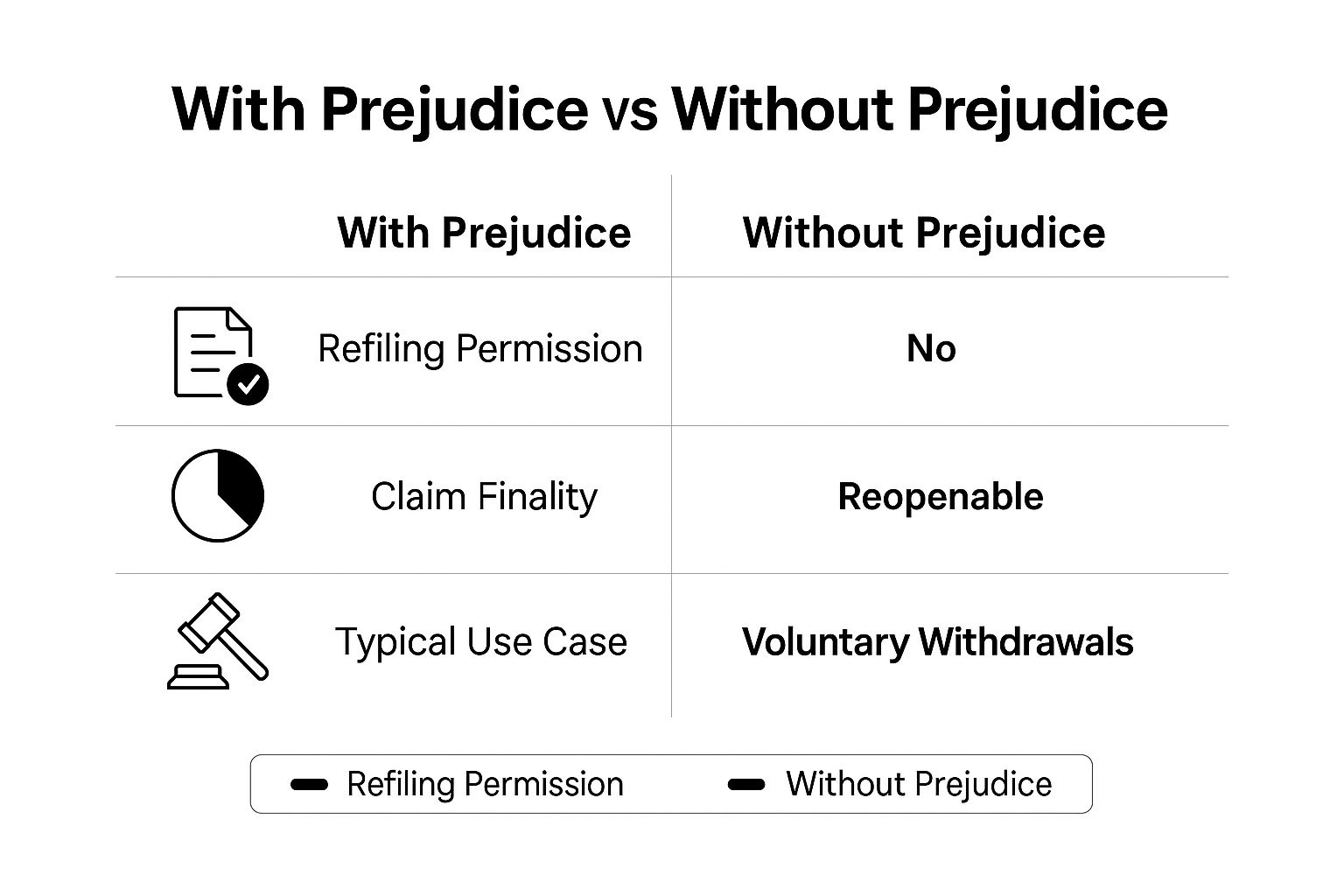
As you can see, a dismissal without prejudice keeps the door open for you to try again. A dismissal with prejudice, on the other hand, closes it for good.
Dismissal Without Prejudice vs With Prejudice At a Glance
To make the distinction crystal clear, let's break down the key differences in a quick comparison table. This will help you see exactly how each type of dismissal impacts your ability to refile your claim.
| Attribute | Dismissal Without Prejudice | Dismissal With Prejudice |
|---|---|---|
| Can you refile? | Yes. You can correct the error and file the lawsuit again. | No. The case is permanently closed. |
| Why it happens | Usually due to procedural errors (e.g., wrong court, service issues). | Based on the merits of the case or serious misconduct. |
| What it means | The court is giving you a second chance to get it right. | The court has made a final decision on the matter. |
| Legal implication | Your legal claim is still alive. | Your legal claim is extinguished. You cannot sue again on the same grounds. |
The bottom line is simple: "without prejudice" offers a path forward, while "with prejudice" is a legal dead end for that specific claim.
The Purpose of a Non-Permanent Dismissal
So, why does the court even use this "pause button" approach? It all comes down to fairness and judicial efficiency. The legal system recognizes that minor, technical mistakes shouldn't permanently block someone from having their case heard.
The purpose is to allow a plaintiff to correct a procedural defect in their case without being forever barred from seeking relief. This ensures cases are decided on their actual facts and merits, not on technicalities.
Some of the most common reasons a judge might issue this type of dismissal include:
- Filing the lawsuit in the wrong county or court (improper venue).
- Failing to properly serve the defendant with the lawsuit papers.
- The court lacking proper authority to hear the case (lack of jurisdiction).
Each of these issues is fixable. This dismissal gives you and your attorney the chance to resolve the problem and get your case back on track, preserving your right to pursue your claim.
Understanding Dismissal With Prejudice
To really get a handle on what a dismissal without prejudice means for you, it’s helpful to look at its much more permanent sibling: a dismissal with prejudice. When a judge dismisses your case with prejudice, that's it. It’s over. The legal road has come to a dead end, and you are permanently blocked from bringing that same claim against that same person ever again.
This isn't a decision a judge makes lightly. It's a final, conclusive action reserved for very specific situations where the case needs to be closed for good.
When a Dismissal Becomes Permanent
So, when does a court drop the hammer with a dismissal with prejudice? It usually happens in a few key scenarios:
- A Final Ruling on the Merits: The judge has looked at all the facts and the evidence and has made a definitive decision about who wins and who loses. The case has been heard and decided.
- Serious Misconduct: This is a big one. If a party or their lawyer does something that fundamentally undermines the court process—like deliberately hiding evidence or repeatedly ignoring court orders—a judge can end the case permanently as a penalty.
- A Settlement Agreement: Both sides have worked out a deal to resolve their dispute. As part of that agreement, they jointly ask the court to close the case permanently, ensuring the matter can't be revisited.
Essentially, a dismissal with prejudice means the legal system has spoken its final word on the matter. It’s a completely different animal from a dismissal without prejudice, which is more of a procedural timeout. A dismissal without prejudice lets a court clear a case from its calendar because of fixable errors, but it leaves the door open for the plaintiff to try again later. Under Cornell Law’s definition, a dismissal without prejudice leaves the merits of the claim untouched — the court is clearing a procedural issue, not ruling on whether you have a valid case.
Think of it this way: a dismissal without prejudice is like a temporary detour on your road trip. You hit a snag, have to back up and fix your route, but you can still get to your destination. A dismissal with prejudice is a permanent road closure. There's no alternate route. The trip is over.
Grasping this fundamental difference is everything. It’s the key to knowing whether your legal fight can continue or if the book has been closed for good. That's why it's so important to understand exactly what does dismissal without prejudice mean in the context of your own case.
Common Reasons for a Dismissal Without Prejudice
When you’re trying to understand what dismissal without prejudice means, it really helps to know why a judge would choose this path. A court doesn't dismiss a case this way because your personal injury claim is weak. It’s almost always due to a procedural rule—a technicality designed to keep the legal process fair for everyone involved.
Think of it this way: these issues are temporary roadblocks, not dead ends. They're problems that can, and must, be fixed before your case can proceed.
Procedural Hiccups That Lead to Dismissal
So, why would a court hit the pause button on a case instead of issuing a final judgment? The reasons are usually quite straightforward and, importantly, fixable.
Here are some of the most common reasons a Georgia judge might dismiss a case without prejudice:
- Improper Venue: This simply means the lawsuit was filed in the wrong place, like the wrong county. For example, you can't file a case in Fulton County if the accident happened and the defendant lives in Gwinnett County. The case belongs where the event occurred or where the defendant resides.
- Improper Service of Process: This is a big one. The law is extremely strict about how legal documents (the summons and complaint) are delivered to the defendant. If that delivery, or "service," isn't done by the book, it violates the defendant's right to due process, and the case will be stopped until it's done correctly.
- Lack of Jurisdiction: The court you filed in doesn't have the legal power to hear the case. This can happen for a few reasons, such as the defendant living out of state or the incident itself happening outside the court's geographical reach. When the court you filed in does not have the legal jurisdiction to hear the case — because the defendant lives out of state or the incident happened outside its geographical reach — the case must be refiled in the correct court.
It's important to remember that each of these issues is a solvable problem. The dismissal is not a judgment on the strength of your injury claim.
Another common reason is a voluntary dismissal. This is when you, the plaintiff, actually ask the court to dismiss the case. You might do this if you realize you need more time to gather important evidence or if you've decided to switch to a different attorney.
Understanding exactly what dismissal without prejudice means in your specific circumstances is the first step toward fixing the issue and getting your case back on track.
What to Do After a Dismissal Without Prejudice
If a judge dismisses your personal injury case "without prejudice," it's natural to feel a mix of confusion and maybe even some relief. The most important thing to understand is this: your case isn't over, but you absolutely must take the right steps, and quickly. Think of it as being handed back your paperwork with a note attached—you have to fix the mistake before you can resubmit.
Your first move is to find out precisely why the case was dismissed. Was it a clerical error on a form? Did you file the lawsuit in the wrong court? Once you pinpoint the exact problem, the path forward becomes much clearer. The solution often involves correcting documents, gathering more evidence, and then filing a completely new complaint.
The Clock Is Still Ticking
Here’s a detail you cannot afford to ignore: the statute of limitations. This is the legal deadline for filing your specific type of claim, and it doesn't stop or pause just because your first case was dismissed. If you don't refile before that deadline expires, you could permanently lose your right to seek compensation.
This legal principle of allowing a refile didn't just appear out of thin air. It's the result of a long history of courts trying to balance their own efficiency with basic fairness to the person bringing the claim. The U.S. Supreme Court has repeatedly confirmed that these types of dismissals are not final judgments on the merits of your case, which is what gives you the opportunity to correct your errors and try again. You can learn more about this legal doctrine and its effect on your refiling rights by exploring legal blogs and resources.
The key takeaway is this: A dismissal without prejudice gives you a second chance, but it doesn't give you unlimited time.
Taking swift, informed action is the only way to get your claim back on solid ground. Understanding exactly what dismissal without prejudice means for your case is the first step in protecting your legal rights and continuing the fight for the justice you deserve.
The Purpose of This Rule in the Justice System

You might think a dismissal without prejudice is just a small procedural step in your personal injury case, but it plays a much bigger role in the justice system as a whole. Think of it as a tool for managing the courts’ massive workload. It helps clear cases that just aren't ready for trial, preventing the entire system from getting bogged down by lawsuits with technical—but fixable—problems.
At its heart, this rule is about fairness. It reinforces the core principle that everyone deserves their day in court, and a case should be decided on its actual merits, not thrown out forever because of a simple procedural slip-up.
Upholding Fairness and Efficiency
The legal system has specific guidelines in place, like Rule 41 of the Federal Rules of Civil Procedure, that give judges the authority to dismiss a case this way. The rule is basically a safety valve.
A dismissal without prejudice strikes a balance: it keeps court dockets moving efficiently while making sure a simple mistake doesn't permanently block someone from seeking justice.
While the default assumption is often that a dismissal is final (with prejudice), judges have a lot of leeway. For instance, in federal civil cases, it's estimated that around 10-15% of all dismissals are without prejudice. Courts frequently take this path to avoid penalizing a plaintiff unfairly for a clerical error, giving them a chance to correct the issue.
This approach gives everyone a fair shot. When you see the dismissal as a standard part of the legal process—not a catastrophic setback—it becomes clear the system is just trying to make sure things are done by the book. Once you truly grasp what does dismissal without prejudice mean, you’ll see it not as an end, but as a tactical opportunity to regroup and bring your case back stronger.
Frequently Asked Questions About Case Dismissals
As an Atlanta personal injury attorney, I’ve seen the word "dismissal" cause a lot of panic for clients. It sounds final and scary, but that’s not always what it means. Let's clear up some of the most common questions I hear about what dismissal without prejudice means for your case.
Can a Case Dismissed Without Prejudice Be Dismissed Again?
Yes, it absolutely can. If you refile your lawsuit but haven't fixed the original mistake, the other side can—and likely will—ask the judge to dismiss it again. Even a brand-new error in the corrected paperwork could trigger another dismissal.
A judge might grant a second dismissal without prejudice, giving you another shot. But you can't count on it. Repeated mistakes test a judge's patience, and if it looks like you're not taking the court's rules seriously, the next dismissal could be with prejudice. That one is permanent. It's why getting it right the second time is so important.
Does a Dismissal Without Prejudice Affect My Deadline to File?
Yes, and this is a point you cannot afford to miss. A dismissal without prejudice does not stop or pause the statute of limitations. That clock keeps right on ticking.
In Georgia, the clock for most personal injury claims is two years from the date of the injury. If your case gets dismissed one month before that two-year deadline, you only have that single month left to fix the error and refile correctly.
While Georgia law offers a "renewal statute" (O.C.G.A. § 9-2-61) that can sometimes provide an extra six months to refile, you should never treat it as a safety net. The only safe approach is to act with urgency and respect that original deadline.
Is a Dismissal Without Prejudice a Sign My Case Is Weak?
Not at all. This is a common myth that causes a lot of unnecessary stress. A dismissal without prejudice is almost always about a procedural mistake or a technicality—it says nothing about the strength of your actual claim.
The judge hasn't evaluated your evidence, heard from witnesses, or made any decision about who was at fault. The dismissal is simply the court's way of saying, "This paperwork isn't quite right. Fix it and come back."
Think of it as a procedural hiccup, not a final judgment. Understanding what does dismissal without prejudice mean is realizing it's a chance to correct your course, not a sign of defeat.