To get the compensation you deserve after an accident, you first have to understand what goes into pain and suffering settlement amounts. This isn't just about a physical injury; it's about the entire, often devastating, impact an accident has on your life. Understanding how compensation for your non-economic damages is determined is a key part of the personal injury claim process.
What Pain and Suffering Really Means in Your Atlanta Claim

In a personal injury case, "pain and suffering" is the legal term for the human cost of an accident. It’s the part of your claim that goes beyond itemized bills and receipts to account for the physical pain and emotional turmoil you were forced to go through.
Think about it this way: your medical records show the cost of treatment, but they don’t capture the sleepless nights, the anxiety of getting behind the wheel again, or the profound sadness of missing out on family events. That’s what pain and suffering damages are designed to recognize.
The Two Sides of Suffering
These damages are typically broken down into two main categories, which together paint a full picture of what you’ve lost:
- Physical Pain and Suffering: This covers the actual, physical hurt from your injuries. It accounts for everything from the initial trauma of the accident to chronic pain, permanent scarring, or any long-term physical disabilities you now have.
- Mental Pain and Suffering: This is about the psychological fallout. It can include depression, anxiety, a new-found fear of driving, insomnia, or even post-traumatic stress disorder (PTSD) that develops after a traumatic event.
For instance, a broken leg has an obvious physical component—the sharp pain of the fracture and the long, difficult recovery. But it also has a significant mental component, like the deep frustration and loss of independence that comes from being unable to walk, work, or even take care of your own home.
In Georgia, the law acknowledges that an injury’s true impact isn’t just financial. It recognizes that the disruption to your daily life, your emotional well-being, and your ability to enjoy life are all real, compensable losses.
It’s important to know that these settlement values can vary dramatically from one case to the next. For minor injuries like sprains and strains, a settlement might be in the $5,000 to $15,000 range. For severe, life-altering injuries, however, compensation can easily reach into the hundreds of thousands or even more. Grasping this concept is the foundation for understanding how your final pain and suffering settlement amounts are ultimately calculated.
How Insurance Companies Calculate Your Settlement
When you hear about pain and suffering settlement amounts, it’s natural to wonder how anyone puts a price on something so personal. It feels impossible, right? But insurance adjusters don't just pull numbers out of thin air. They lean on specific formulas to get a starting point, translating your experience into a dollar figure.
If you understand their methods, you'll have a much better idea of what to expect and where the negotiations will begin. In Atlanta and across the country, insurance companies typically rely on two common methods to get their initial valuation. Remember, these are just starting points—not the final offer.
The Multiplier Method
This is the go-to approach for most adjusters. First, they add up all your concrete, provable economic damages. This includes your medical bills, physical therapy costs, lost income, and any other out-of-pocket expenses. This total is often called your "specials."
They then multiply this total by a number, usually between 1.5 and 5.
- For minor injuries with a quick and full recovery, like soft tissue sprains, the multiplier might be low—think 1.5 or 2.
- For more serious injuries that are permanent or life-altering, such as a traumatic brain injury or paralysis, the multiplier could be 4, 5, or even higher in catastrophic cases.
Let's say you had $10,000 in medical bills and lost wages from a car wreck that left you with a broken arm requiring surgery. An adjuster might apply a multiplier of 3 to your specials. This would calculate your pain and suffering at $30,000 ($10,000 x 3), making the total initial settlement figure $40,000.
The Per Diem Method
Another tool in the adjuster's kit is the "per diem" method, which is just Latin for "per day." This approach assigns a daily rate for every single day you experienced pain and suffering because of your injury.
So, how do they pick a daily rate? Often, it's based on your daily earnings, with the argument being that the struggle of enduring daily pain is at least comparable to the effort of a day's work. The clock starts on the date of the accident and keeps running until you reach what doctors call Maximum Medical Improvement (MMI). This is the point where your condition has stabilized and isn't expected to get any better. For a deeper dive on MMI, you can find helpful definitions on medical resource sites like Wikipedia's MMI page.
Example: If you earned $200 per day and your doctor determined you were in pain for 150 days before reaching MMI, the per diem calculation for your pain and suffering would be $30,000 (150 days x $200/day).
So, which method will they use? And what factors push the numbers up or down? It's never just one thing.
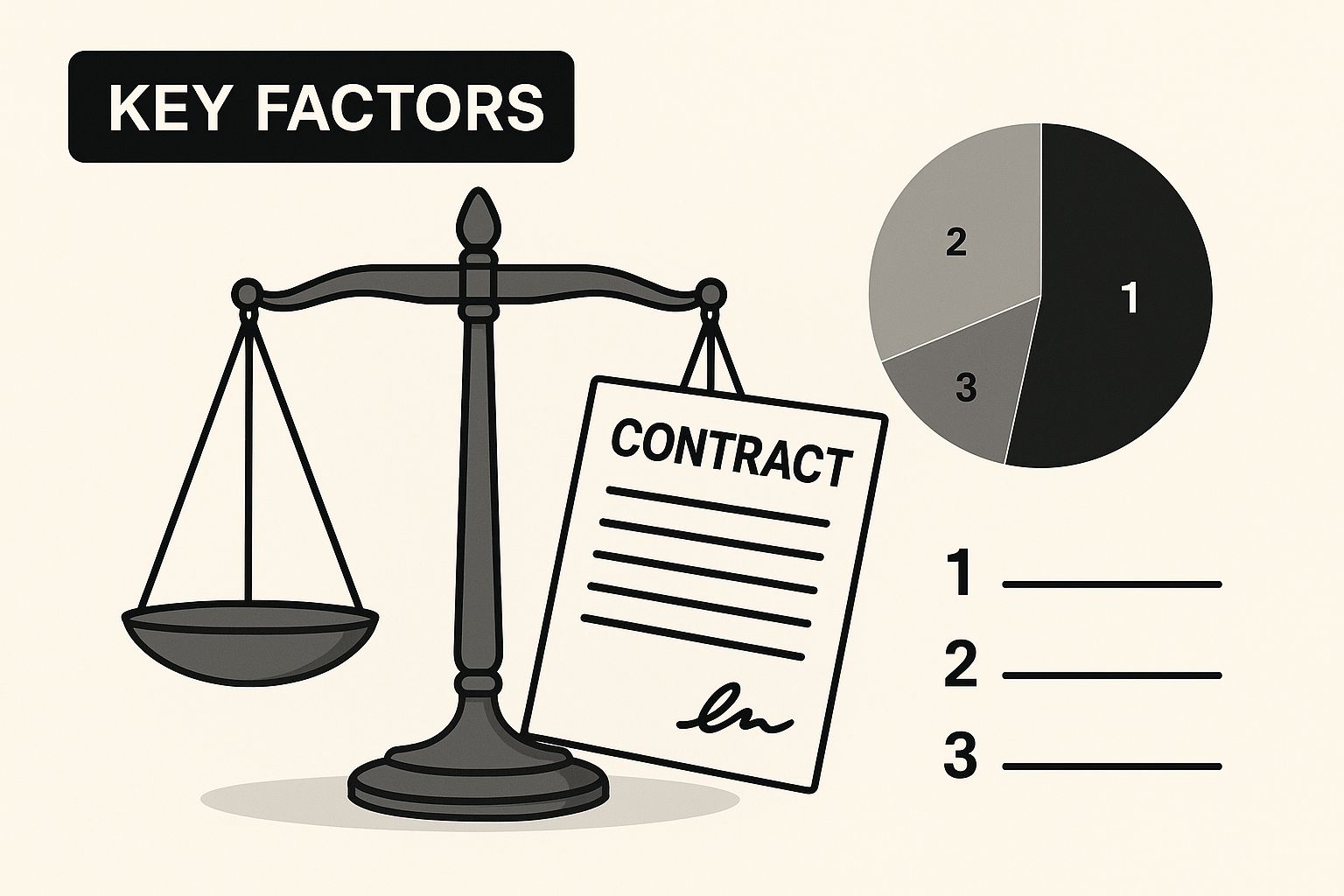
As you can see, the final value is a balance of many moving parts. The severity of your injury and the strength of the evidence you provide are always the most important factors in determining your final pain and suffering settlement amount.
Insurance companies use these formulas as a baseline, but they are by no means the final word. Here is a quick comparison of the two methods.
Two Common Methods for Calculating Pain and Suffering
| Calculation Method | How It Works | Best For | Example |
|---|---|---|---|
| Multiplier Method | Total economic damages (medical bills, lost wages) are multiplied by a number (typically 1.5-5) based on injury severity. | Cases with significant medical bills and clear, long-term impacts. Good for capturing the overall effect of a serious injury. | $20,000 in medical bills x a multiplier of 3 = $60,000 in pain and suffering. |
| Per Diem Method | A daily rate (often based on your daily wage) is assigned for each day of recovery until you reach Maximum Medical Improvement (MMI). | Cases with a long but finite recovery period where the daily impact is easy to define. Good for injuries with a clear healing timeline. | $250/day daily wage x 120 days of recovery = $30,000 in pain and suffering. |
Ultimately, both the Multiplier and Per Diem methods are just tools to start a conversation. An experienced attorney knows how to challenge these initial, often low, calculations by highlighting the true human cost of an injury—something a simple formula can never fully capture.
Key Factors That Influence Your Settlement Amount

While formulas give insurance adjusters a place to start, they rarely tell the whole story of what your pain and suffering settlement amounts should be. The real value of your claim is found in the specific, human details that show the true scope of your losses.
No two accidents are identical, and these are the factors that truly move the needle. It's less about a rigid calculation and more about building a powerful, evidence-backed story of what you went through.
The Severity of Your Physical Injuries
This is the bedrock of any personal injury claim. A minor sprain that heals in a few weeks will naturally have a much lower value than a catastrophic event like a spinal cord injury or a traumatic brain injury (TBI) that creates lifelong challenges.
Insurance companies and, if necessary, juries need to see objective medical evidence to grasp just how serious your condition is.
- Type of Injury: A verifiable injury, like a compound fracture requiring surgery, is valued much more highly than a soft tissue injury that doesn't show up clearly on an X-ray.
- Duration of Recovery: A long, difficult recovery period signals a higher degree of suffering. Complications like infections or the need for multiple surgeries also significantly drive up the claim's value.
- Permanence of Injury: Will you be left with a permanent limp, chronic pain, significant scarring, or a disability? Any lasting impact on your physical health is a powerful factor. Government resources like the National Center for Health Statistics provide data that helps contextualize injury severity.
The Impact on Your Daily Life
Beyond the raw physical pain, how has this injury completely upended your life? This is where the undeniable human element of your claim comes into sharp focus.
We always start by asking a key question: What has this accident taken from you? If you can no longer play with your kids, enjoy a favorite hobby, or even handle basic chores without pain, that loss has very real value.
This "loss of enjoyment of life" is a huge component of your claim. It proves that the consequences of the accident go far beyond medical appointments and strike at the core of your daily happiness and independence.
Strong documentation is what ties all of these pieces together. Your case is built on detailed medical records, bills, a personal pain journal, and even statements from family and friends who witnessed your struggle. This evidence transforms your personal story into a persuasive case for the true value of your pain and suffering settlement amounts.
Typical Settlement Amounts for Different Injury Types
Clients always ask about typical pain and suffering settlement amounts. It’s a fair question, but the truth is, there’s no magic number. In personal injury law, compensation has to match the harm done. That means the value of any claim is tied directly to the severity of the injury.
To give you a realistic perspective, let's break down how settlement values generally align with different levels of injury. While no two cases are identical, these categories will help you understand what to expect.
Minor Injury Settlements
These are the cases where the injuries, while painful and disruptive, heal relatively quickly and completely. Think of things like:
- Whiplash or neck strain from a fender bender
- Minor cuts, scrapes, and bruising
- Soft tissue sprains that clear up after a few weeks of physical therapy
With these injuries, the medical bills are usually on the lower end, and the impact on your life is temporary. The settlement here is designed to cover that specific period of discomfort and inconvenience. Because there are no long-term or permanent consequences, the final numbers don't reach the higher figures.
Moderate Injury Settlements
A settlement grows substantially when an injury is more serious. These injuries have a much bigger effect on your life, often requiring extensive medical treatment and a long road to recovery. They might even leave a lasting, though not catastrophic, impact.
The key difference here is the disruption. If an injury requires surgery, keeps you out of work for months, or forces you to give up a hobby you love, the compensation will reflect that greater loss.
Examples of moderate injuries include:
- A broken arm or leg that needs surgery and a cast
- A concussion that causes lingering headaches or cognitive problems for several months
- A herniated disc leading to chronic back pain that requires ongoing management
Catastrophic Injury Settlements
For the most severe injuries, settlements can and absolutely should be significant—often reaching seven figures or more. This is because a catastrophic injury changes a person's life forever.
These settlements must account for a lifetime of medical care, permanent disability, lost earning capacity, and the profound loss of quality of life. Landmark cases show just how high these values can go. For instance, some of the largest personal injury payouts have included an $85 million settlement for a pedestrian struck by a bus and $71 million for a victim with a spinal cord injury.
These large-scale awards highlight the immense value the justice system places on lifelong care and suffering. You can see more examples of how these major cases are valued by reading about the biggest personal injury settlements in U.S. history. The entire purpose of these high-value pain and suffering settlement amounts is to provide financial stability for a future that has been permanently and fundamentally altered.
Proving Pain and Suffering: How to Document Your Case
When it comes to getting fair pain and suffering settlement amounts, your word alone isn't enough. You have to prove it. Insurance adjusters are trained to be skeptical, and a strong claim is one backed by undeniable evidence. Without it, you're just another number in their system.
Think of it this way: medical bills show the financial cost of your injury, but solid documentation shows the human cost. It’s the difference between saying you're in pain and proving exactly how that pain has turned your life upside down.
Keep a Detailed Daily Journal
One of the most powerful tools you have is a simple daily journal. This isn't just a diary for your thoughts—it's an important piece of evidence. Memories fade, but what you write down is permanent.
Your journal is where you capture the day-to-day reality of your recovery. Be specific. Be honest.
- Track Your Pain Levels: Use a 1-to-10 scale. Where does it hurt? Is the pain sharp, dull, throbbing, or shooting? What time of day is it worst?
- Log Your Emotional State: How are you feeling? Anxious, depressed, irritable, or just plain frustrated? Are you struggling to sleep? Write it down.
- Detail Daily Limitations: This is where you connect the injury to your life. Document every single thing you couldn't do or struggled with. Couldn't lift your child? Had to skip walking the dog? Couldn't cook a meal or even button your own shirt? Did you miss a wedding, a birthday party, or your kid's soccer game? These specific examples paint a vivid picture of your "loss of enjoyment of life."
Be Completely Honest with Your Doctors
Every time you talk to a doctor, therapist, or any other medical provider, be brutally honest about every symptom. Don't minimize your pain or leave anything out, no matter how insignificant it seems.
What you tell your doctor becomes part of your official medical record. Insurance adjusters scrutinize these records. If what you claim later doesn't match your doctor's notes, they will use that inconsistency to attack your credibility and devalue your claim.
Get Statements from Friends and Family
The people who know you best are often your most compelling witnesses. Ask close friends, family members, or even a trusted coworker to write down what they’ve seen since your accident.
Their statements provide powerful third-party validation of your struggle. A spouse can describe changes in your personality or your inability to help with chores. A friend can testify that you’ve stopped showing up for your weekly golf game. Independent testimony like this makes it much harder for an insurer to claim you're exaggerating.
For those interested in the rules governing how evidence is used in legal proceedings, resources like the Cornell Law School's Legal Information Institute offer detailed explanations. Each piece of documentation—your journal, medical records, and witness statements—works together to build a powerful case for the pain and suffering settlement amounts you deserve.
Landmark Cases That Shaped Injury Compensation
To really understand what personal injury law can do, it helps to look at some of the major legal battles that came before. These landmark cases weren't just about big numbers; they established legal principles that still shape how courts and insurance companies handle liability and compensation today. They're the foundation for how we calculate pain and suffering settlement amounts.
One of the most powerful examples is the Tobacco Master Settlement Agreement of 1998. This was a historic fight where 46 states banded together to take on the four largest tobacco companies. The result? A jaw-dropping $206 billion settlement to be paid out over 25 years. The money was earmarked to cover the massive public healthcare costs from smoking-related diseases and to fund campaigns to stop people from smoking.
Now, this case was unique—it addressed a massive public health crisis, not just one person's injury. But it stands as a monumental example of holding corporations accountable for the incredible amount of suffering they caused. You can learn more about the sheer scale of this historic agreement and other major cases.
A Lasting Effort for Public Health
The work from that settlement didn't just stop once the agreement was signed. The National Association of Attorneys General (NAAG) continues to manage the funds, proving the long-term impact of this kind of litigation.
This ongoing work shows a commitment to preventing future harm and funding public health initiatives across the country, all stemming from that one legal battle.
These monumental cases prove that the law has the power to deliver real justice, even when going up against the most powerful corporate giants. They reinforce a core principle that's central to every personal injury claim: causing harm comes with a profound responsibility. That's the very idea that gives weight to pain and suffering settlement amounts today.
Common Questions About Pain and Suffering Claims
When you're trying to make sense of pain and suffering settlement amounts, it’s completely normal to have questions. The whole process can feel overwhelming, especially when you're supposed to be focused on getting better. My goal here is to give you clear, straight answers to the questions I hear most often from my clients here in Atlanta.
Think of this as a starting point. Getting good information is the first step toward making the right decisions for you and your family.
Is There a Cap on Pain and Suffering Damages in Georgia?
For most personal injury cases in Georgia—like those from car wrecks or a slip and fall—the good news is no, there is no cap on pain and suffering damages. A jury has the authority to award an amount it believes is fair and just, based on the evidence of what you’ve been through.
It's important to know there are some exceptions, though. Certain medical malpractice claims, for instance, may have specific limits on these types of non-economic damages.
Do I Have to Pay Taxes on My Pain and Suffering Settlement?
This is a fantastic question and one that comes up all the time. Generally, the answer is no. The Internal Revenue Service (IRS) states that money you receive for physical injuries or sickness isn't considered taxable income. This protection almost always extends to the pain and suffering portion of your settlement.
But be careful. If your damages are for purely emotional distress without a related physical injury, that part of your settlement could be taxable. Tax laws can be tricky, so it's always smart to run this by a tax professional once you receive your award.
How Long Do I Have to File a Claim in Georgia?
In Georgia, there's a strict deadline for filing a personal injury lawsuit, known as the statute of limitations. For the vast majority of cases, you have just two years from the date of your injury to file a claim in court.
If you miss that two-year window, you will almost certainly lose your right to seek any compensation. While there are a few very rare exceptions, it is absolutely essential to act quickly to protect your legal rights.
Understanding these key rules helps take some of the mystery out of the process. It also puts you in a much stronger position to fight for the fair pain and suffering settlement amounts you deserve.
At Jamie Ballard Law, we believe your story deserves to be heard and your suffering fully acknowledged. If you are struggling after an accident in Atlanta, we're here to help you get the support and compensation needed to move forward. Contact us today for a free, no-obligation case evaluation.