When your world is turned upside down by the sudden loss of a family member, daily life feels impossible. Dealing with legal matters on top of that is just overwhelming. Understanding how to prove wrongful death can feel like a huge challenge, but at its heart, it’s about showing that your loved one’s death was caused by someone else’s carelessness or wrongful act. It's the first step toward seeking justice and accountability for your family.
What It Takes to Prove a Wrongful Death Claim in Georgia
Losing someone is a profound tragedy. When that loss could have been prevented, the grief is often tangled with questions and a deep need for answers. In Georgia, a wrongful death claim is a civil action—completely separate from any criminal charges—that allows certain family members to hold a negligent party responsible.
It's about much more than just showing a death occurred. The real work is in building a case that draws a clear, undeniable line from the actions (or inaction) of another person or company directly to the fatal outcome. Understanding how to prove wrongful death is the key to this process.
The Four Pillars of a Wrongful Death Case
Every wrongful death case in Georgia is built on four core legal elements. I often tell my clients to think of them as the four legs of a table—if even one is missing, the whole claim will collapse.
To succeed, you must prove each of these four points.
The Four Elements of a Wrongful Death Claim
| Legal Element | What It Means in Plain English | Example Scenario |
|---|---|---|
| Duty of Care | The at-fault party had a legal responsibility to act with a certain level of caution to keep your loved one safe. | Every driver on an Atlanta highway has a duty to follow traffic laws. A doctor has a duty to provide care that meets accepted medical standards. |
| Breach of Duty | The at-fault party failed to meet that responsibility through a careless or reckless act. | A truck driver texting behind the wheel runs a red light. A surgeon leaves a foreign object inside a patient during a procedure. |
| Causation | The breach of duty was the direct and primary cause of the fatal injury. It's the "but for" test: "But for" their negligence, your loved one would still be alive. | The collision caused by the distracted truck driver resulted in fatal internal injuries. The infection from the surgical mistake led to deadly complications. |
| Damages | Your family suffered specific, calculable losses because of the death. These are the harms the lawsuit seeks to compensate. | This includes lost future income, medical bills before death, funeral expenses, and the loss of care, companionship, and counsel. |
Proving these four elements is not just a legal formality; it's how we tell the story of what happened. It provides the foundation for the investigation, the evidence gathered, and the case presented to show why your family deserves justice.
To put it simply, proving wrongful death means methodically establishing that another party's negligence, recklessness, or intentional act caused the fatal outcome. For context on the scale of these preventable tragedies, the National Safety Council provides vital statistics on preventable injuries and deaths.
Grasping these four points is the essential first step in understanding how to prove wrongful death. They are the foundation upon which every successful claim is built.
Establishing the Four Pillars of a Wrongful Death Case
To build a strong, solid wrongful death case, you have to build an argument that can stand up to intense scrutiny. Your entire case rests on four distinct pillars.
Mastering how to prove wrongful death really comes down to understanding these core concepts: Duty, Breach, Causation, and Damages. Let's talk about what these mean in the real world.
Pillar 1: Duty of Care
First, we have to show that the person or company responsible had a Duty of Care. This is a legal way of saying they had a responsibility to act in a way that wouldn’t put others in harm's way.
A commercial truck driver hauling an 80,000-pound rig down I-285 in Atlanta, for example, absolutely owes a duty to every other person on that road. Their duty is to drive safely, stay alert, and follow all federal trucking regulations. It's not a suggestion; it's a requirement.
Similarly, a hospital has a clear duty to its patients to provide a competent standard of medical care. That means everything from proper staffing levels to sterile equipment. This duty exists before anything goes wrong—it’s the baseline for safe, responsible behavior.
Pillar 2: Breach of Duty
Once we’ve established that duty, the next step is to prove it was breached. A breach is a specific failure to live up to that responsibility. It can be a careless action or a failure to act when a reasonable person would have.
Let's go back to that truck driver. If they were texting and driving, they breached their duty to operate their truck safely. In a hospital, a breach could be a doctor who misreads a CT scan and fails to diagnose a life-threatening condition that any other reasonably skilled doctor would have caught.
It’s that specific act—or failure to act—that violates the standard of care and sets the legal process in motion.
A breach of duty isn't just a simple mistake; it's a failure to meet a standard of care that society reasonably expects. It is the moment when carelessness turns into a cause for legal action, forming the link between the responsible party and the tragic outcome.
This is where we start connecting the dots between who was involved and who is legally responsible.
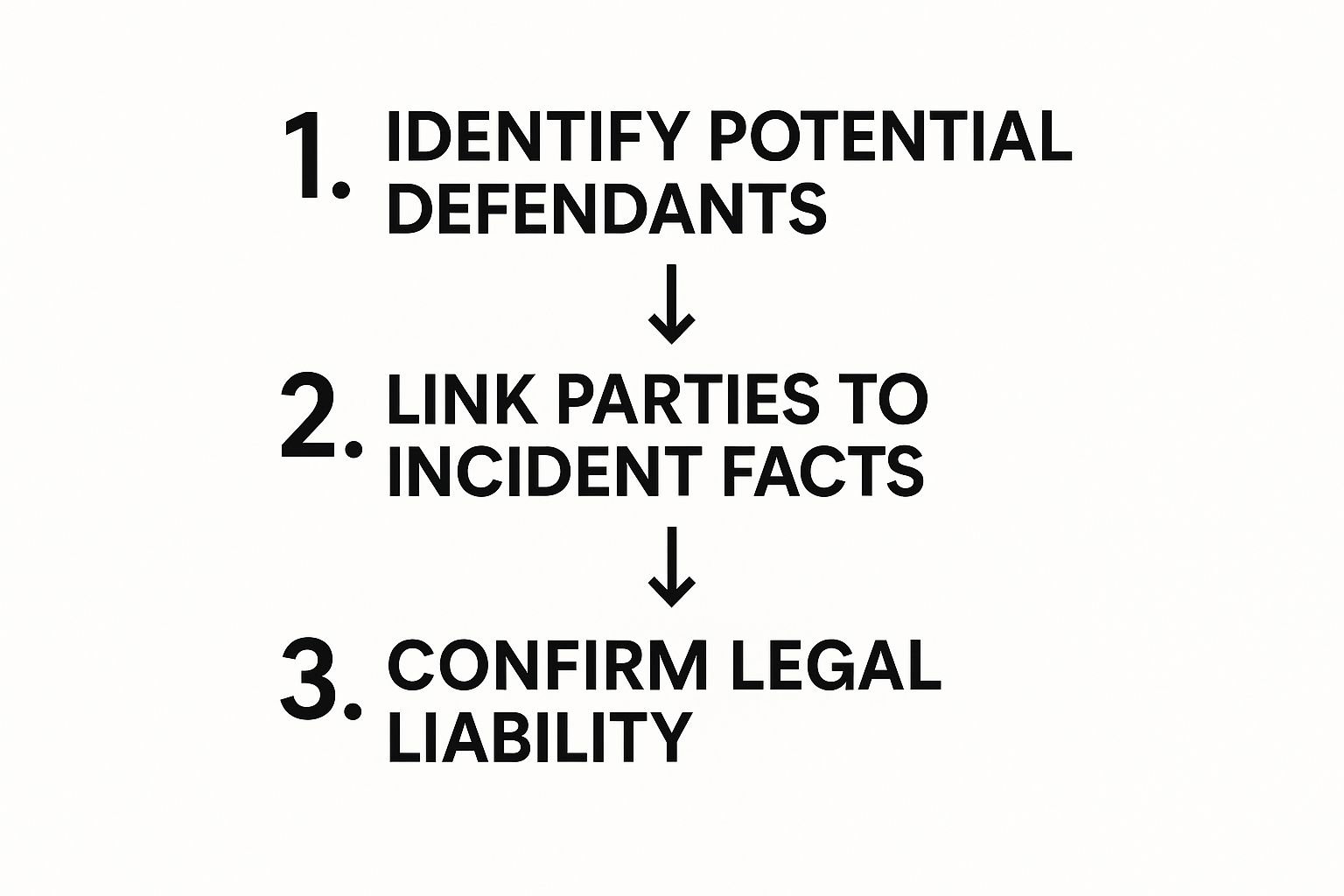
The process shown here is how we move from a list of potential defendants to pinpointing exactly who is liable for the harm caused. It’s methodical and evidence-driven.
Pillar 3: Causation
This pillar is often straightforward, but it's absolutely non-negotiable. We must draw a direct, unbroken line from the defendant's breach of duty to the death. This is causation.
It’s not enough to show a driver was speeding. We have to prove that the speeding directly caused the fatal crash. If a property owner failed to fix a broken handrail, we must demonstrate that specific failure led to a fatal fall, not some other factor.
The question we have to answer is simple: "But for the defendant's negligent act, would my loved one still be alive today?" If the answer is yes, we've established causation. For a deeper dive into the legal principles of causation, educational resources like Wikipedia's page on legal causation) can provide more context.
Pillar 4: Damages
The final pillar is Damages. These are the measurable and immeasurable losses your family has endured as a result of your loved one's death. Georgia law splits damages in a wrongful death claim into two main categories.
First, there is the “full value of the life of the decedent.” This isn't just a number; it tries to capture a life's worth and includes:
- Economic losses: This is the tangible financial support your loved one would have provided, including future income, benefits, and retirement savings.
- Intangible losses: This is the profound, personal value of their presence—the loss of companionship, guidance, advice, and the simple joy of having them in your life.
Second, the estate can pursue a separate but related claim for the direct costs of the incident itself. This often covers:
- Medical bills from the time of the injury until death.
- Funeral and burial expenses.
- The conscious pain and suffering your loved one experienced before they passed away.
Proving these four pillars—Duty, Breach, Causation, and Damages—is the blueprint for how to prove wrongful death. Each one builds on the last, creating the solid foundation needed to secure justice for your family.
Gathering Evidence to Build a Strong Claim
Once we've established the four core elements of a wrongful death claim, our work shifts to gathering the proof needed for each one. This is where knowing how to prove wrongful death moves from legal theory to the practical task of collecting and organizing information.
A claim is only as strong as the evidence supporting it. This stage is where we meticulously piece together the story of what happened—and why the at-fault party is legally responsible.
Official Reports and Medical Documentation
The foundation of any solid case is built on official, impartial records. These documents carry immense weight because they provide a third-party account of the incident and its tragic aftermath.
We always begin by tracking down every official report related to the incident. These records are often the very first objective account created.
- Police Accident Reports: For a fatal car or truck crash, the police report is indispensable. It contains the officer's initial assessment of fault, scene diagrams, witness information, and any citations issued.
- OSHA Investigation Findings: In a workplace death, a report from the Occupational Safety and Health Administration (OSHA) is invaluable. It can pinpoint the specific safety violations and employer failures that contributed to the tragedy.
- Incident Reports: For cases on private property, like a deadly fall in a store, the business’s own internal incident report can offer key details about the conditions and hazards present at that exact moment.
Just as important are the complete medical records. We need to obtain every document from the moment the injury occurred until your loved one passed away. These records create a clear medical timeline, drawing a direct line from the injuries suffered in the incident to the ultimate cause of death.
Preserving Physical Evidence
Some of the most compelling evidence isn't on paper at all—it’s physical. It is absolutely essential to preserve any physical items from the incident before they can be lost, altered, or destroyed.
A quick tip from experience: After a fatal crash, insurance companies move fast to take possession of the wrecked vehicle. It's so important to prevent this until your legal team can have an expert inspect it. That vehicle holds a story in its dents, skid marks, and mechanical data.
Important physical evidence can include things like:
- The vehicle involved in a car accident.
- A faulty piece of machinery from a workplace incident.
- The broken handrail or step that caused a fatal fall.
- Any defective product that led to the injury.
Photographs and videos of the scene and this physical evidence are just as vital. In the immediate aftermath, photos taken with a smartphone can capture details that disappear within hours—things like weather conditions, warning signs (or a lack thereof), and the position of debris.
Essential Evidence Checklist for Your Wrongful Death Claim
This checklist outlines the important documents and information you'll need to collect to build a powerful wrongful death claim.
| Evidence Category | Specific Examples | Why It's Important |
|---|---|---|
| Official Reports | Police accident report, OSHA report, internal incident report. | Provides an objective, third-party account of the incident and potential fault. |
| Medical Records | Ambulance/paramedic records, ER reports, hospital bills, coroner's report. | Establishes the link between the incident, the injuries, and the cause of death. |
| Physical Evidence | Wrecked vehicle, defective product, broken equipment, torn clothing. | Offers tangible proof of negligence or a defect that caused the fatal injury. |
| Visual Documentation | Scene photos/videos, property damage photos, surveillance footage. | Captures the conditions at the time of the incident before they can be altered. |
| Eyewitness Information | Names, contact information, and statements from anyone who saw what happened. | Corroborates official reports and provides a human perspective on events. |
| Financial Documents | Pay stubs, tax returns, W-2s, proof of benefits (health insurance, pension). | Helps calculate the full extent of financial losses, including lost income and support. |
Having these items organized and ready will significantly strengthen your position when negotiating with insurance companies or presenting your case in court.
The Power of Eyewitness and Financial Evidence
What people saw and the financial void left in your family are the final, important pieces of the puzzle. Eyewitness testimony can bring a sterile police report to life by offering a human perspective on what unfolded.
If you or anyone else was able to, getting the names and phone numbers of people who saw the incident is incredibly helpful. Their account might confirm key details, like a driver running a red light or a property owner knowing about a dangerous condition and doing nothing.
Finally, we have to prove the financial losses your family has endured. This requires gathering documents that paint a clear picture of your loved one’s financial contributions. This includes pay stubs, tax returns, and information on employment benefits, all of which an economist will use to calculate the full value of the life. As you can see, understanding how to prove wrongful death is about being thorough and methodical in collecting every single piece of evidence available.
Proving Negligence in Common Wrongful Death Scenarios
While the four pillars of a wrongful death claim are universal, the path to proving your case depends entirely on how your loved one’s death occurred. The evidence we need for a fatal car crash on I-285 looks nothing like the proof required for a medical malpractice claim at a hospital. Let's walk through a few real-world examples to see how we build these cases.
It's a heartbreaking fact that car crashes are a primary source of wrongful death claims, both because they are so common and because most are preventable. Globally, motor vehicle collisions were responsible for almost 1.2 million deaths in a single recent year, cementing them as a major category of avoidable fatal injuries. You can learn more about these global safety issues from the World Health Organization's fact sheet on injuries and violence.
Fatal Car and Truck Accidents
When a collision on one of Atlanta’s highways turns fatal, proving negligence means showing the other driver violated their duty of care. The official police report is just the starting point.
To build a truly compelling case, we dig much deeper for evidence like:
- Accident Reconstruction Reports: We bring in experts who use skid marks, vehicle damage, and other physical evidence to scientifically recreate the crash, proving exactly how the at-fault driver caused it.
- Cell Phone Records: If we have reason to believe the other driver was distracted, we can subpoena their phone records. This can pinpoint texting, calls, or app usage at the precise moment of impact.
- "Black Box" Data: Modern cars contain an Event Data Recorder (EDR) that captures key information—speed, braking, steering—in the seconds before a crash. This data is often undeniable.
Medical Malpractice Deaths
Wrongful death claims involving medical malpractice are in a league of their own. The entire case hinges on proving that a doctor or hospital’s care fell below the accepted standard of care—the level of skill another competent professional would have provided in the same situation.
A bad medical outcome isn't enough. We must establish that a different, proper medical decision would have likely saved your loved one's life. The line connecting the error to the death must be direct and unshakable.
This is impossible to prove without expert medical testimony. We must retain a qualified physician from the same field to review all medical records and testify that the defendant’s negligence was the direct cause of death.
Unsafe Property (Premises Liability)
If someone dies from a dangerous condition on another person's property—maybe a fall at a retail store or a drowning at an apartment complex pool—our job is to prove the owner knew (or should have known) about the hazard but did nothing to fix it or warn visitors.
Key evidence in these cases often includes:
- Maintenance and Inspection Logs: These records can reveal if the property owner knew about a problem, like a broken handrail, and for how long it was ignored.
- Surveillance Footage: Video evidence can capture the incident as it happened, leaving no doubt about the dangerous condition.
- Previous Complaints: Nothing proves an owner's knowledge better than evidence of prior complaints about the very same hazard.
Workplace Accidents
In fatal workplace accidents, we have to show that the employer failed in their legal duty to provide a safe environment. This means tying the death to a specific, preventable safety failure.
Evidence in these cases often comes down to official records and what co-workers saw. We would gather:
- OSHA Inspection Records: A history of citations from the Occupational Safety and Health Administration can show a clear pattern of safety neglect.
- Co-worker Statements: Testimony from fellow employees about known hazards, a lack of training, or faulty equipment is incredibly powerful.
- Company Safety Manuals: These documents prove the employer knew the correct safety protocols but failed to follow or enforce them.
The screenshot below from the Georgia Governor's Office of Highway Safety shows the state’s focus on serious issues like drunk driving and speeding.
This focus highlights a key point: most fatal "accidents" aren't accidents at all. They are the direct result of negligent choices. Each of these scenarios demands a unique strategy, but the mission is always the same: to collect indisputable proof that negligence caused a death. Understanding what kind of evidence your specific case requires is the first step in knowing how to prove wrongful death.
The Role of Expert Witnesses in Strengthening Your Case

Sometimes, the evidence we gather can only tell part of the story. While police reports and medical records are foundational, they often don’t explain the complex "why" or "how" behind a tragedy. This is where knowing how to prove wrongful death involves bringing in highly specialized professionals known as expert witnesses.
An expert witness is someone with specialized knowledge, skill, experience, or training who can translate complicated technical information into clear, understandable testimony for a jury. In many wrongful death cases, their input isn't just helpful; it's absolutely necessary.
Their job is to provide objective, credible opinions that connect the dots between the defendant’s negligence and your family’s loss in a way that is hard to dispute.
Common Types of Experts in Wrongful Death Claims
Depending on the specifics of your case, we might call upon a variety of experts to analyze evidence and provide testimony. Each one plays a unique and vital role in building a powerful case.
Here are a few of the most common types of experts we work with:
- Medical Professionals: A doctor, surgeon, or medical examiner can testify about the specific cause of death, explain complex medical records, and confirm whether the injuries sustained were consistent with the incident. In malpractice cases, they establish the standard of care that was violated.
- Accident Reconstructionists: Think of these experts as detectives for car and truck crashes. They use physics, engineering, and evidence from the scene to scientifically recreate the collision, demonstrating fault with data-driven precision.
- Engineers: If a death was caused by a defective product or a structural failure, an engineer can analyze the item in question to explain precisely how it failed and why it was unsafe.
- Economists: An economist is essential for calculating the "full value of the life." They analyze factors like the deceased’s age, earning capacity, and benefits to project the total financial loss your family will suffer over a lifetime.
The right expert can make all the difference. Their testimony isn't just another piece of evidence; it's the glue that holds the entire case together, providing the authoritative voice needed to explain complex issues to a judge and jury.
How Experts Strengthen a Workplace Fatality Case
The importance of experts is especially clear in cases involving workplace fatalities. A significant number of wrongful death claims stem from hazardous working conditions, with 5,283 workers dying from traumatic injuries on the job in 2023 alone. Despite safety laws being in place for decades, these tragedies persist. You can explore more on these statistics with a report from the AFL-CIO on worker safety.
In a case like this, we would bring in an industrial safety expert. They can inspect the site, review company training manuals, and testify about the specific OSHA violations that led to the death. Their analysis can definitively show that the employer failed to provide a safe environment, directly causing the fatal incident.
This expert testimony turns a tragic event into a provable case of negligence. Ultimately, understanding how to prove wrongful death means knowing when to bring in the right expert to make your case undeniable.
Common Questions About Georgia Wrongful Death Claims
When your family is reeling from an unexpected loss, the legal process can feel overwhelming. It's completely natural to have questions. Below are straightforward answers to the questions we hear most often from families in Atlanta, which can bring some clarity as you consider your next steps.
How Long Do I Have to File a Wrongful Death Lawsuit in Georgia?
This is the most pressing, time-sensitive question we get, and for good reason. In Georgia, the statute of limitations for most wrongful death claims is two years from the date your loved one passed away.
This deadline is absolute. If you try to file a lawsuit even one day after the two-year period expires, the court will almost certainly dismiss your case. This permanently closes the door on your family's right to seek compensation.
While a few rare exceptions exist that can pause—or "toll"—this deadline, like a pending criminal case related to the death, you can't count on them applying to your situation. The only safe strategy is to act well before the deadline. You can find the official text in the Official Code of Georgia Annotated (O.C.G.A.) § 9-3-33.
Who Can Receive Compensation From a Wrongful Death Claim?
Georgia law is very specific about who has the legal right to bring a wrongful death claim and receive the proceeds. The statute, O.C.G.A. § 51-4-2, lays out a strict hierarchy.
The order of priority is:
- The Surviving Spouse: The primary right to file belongs to the husband or wife.
- The Surviving Children: If there is no spouse, the right passes to the decedent's children.
- Shared Recovery: If there is a surviving spouse and children, they share the recovery. The law guarantees the spouse receives at least one-third of the total amount, no matter how many children there are.
- The Surviving Parents: If there is no spouse or children, the right to file passes to the surviving parent(s).
- The Estate Representative: In the rare case that none of the above relatives are living, the personal representative of the estate can file. Any recovered funds are then distributed to the next of kin.
This structure is designed to ensure compensation goes to those most directly impacted by the loss.
These rules are not flexible—they are set by law. The legal system in Georgia dictates a clear order of succession for who can file and benefit from a wrongful death claim, removing any ambiguity.
What Kind of Damages Can Be Recovered in a Wrongful Death Case?
In a wrongful death claim, "damages" refers to the compensation your family can seek for all the losses you've suffered. Georgia law separates damages into two main categories, each with a different purpose.
Category 1: The "Full Value of the Life of the Decedent"
This is the core of the wrongful death claim and is measured from the perspective of the person who died. It is meant to compensate for what they lost and includes two components:
- Tangible Value: This covers the concrete financial losses, like the future income, benefits, and retirement savings your loved one would have earned. It's a calculation of the economic value they can no longer provide.
- Intangible Value: This is the non-economic side of life—the loss of joy, experiences, relationships, and the simple fulfillment your loved one was deprived of. It acknowledges the profound value of just being alive.
Category 2: The Estate's Claim
This is a separate, but related, claim filed by the deceased person's estate to recover specific financial costs tied to the fatal injury. An estate claim can include:
- Medical Expenses: All medical bills from the moment of injury until death.
- Funeral and Burial Expenses: The costs associated with laying your loved one to rest.
- Conscious Pain and Suffering: This compensates for any physical pain, fear, or emotional trauma your loved one endured between the time of their injury and their passing.
Properly calculating these damages requires a meticulous analysis, often with help from financial experts, to ensure every aspect of your family’s loss is accounted for.
At Jamie Ballard Law, we understand the immense pain and confusion you are feeling. If you are grappling with the loss of a loved one and have questions about your family's rights, we are here to provide clear, compassionate answers. Reach out for a free, no-obligation case evaluation to discuss your situation at https://jamieballardlaw.com.