Let’s get right to it: What is legal malpractice?
From my experience helping folks in Atlanta, legal malpractice happens when a lawyer's negligent action, a serious mistake, or a clear failure to do their job causes you, the client, real and significant harm. It's important to understand this isn't just about being unhappy with how your case turned out. Losing a case doesn't automatically mean malpractice occurred. A successful claim requires much more than just a disappointing outcome.
Defining Legal Malpractice and the Standard of Care

Think of it this way: when you hire an attorney, you have every right to expect a certain level of professional skill and diligence. This is known in the legal world as the “standard of care.” This standard is the baseline—it’s the level of competence that a reasonably careful attorney in the same community would provide under similar circumstances.
When a lawyer’s performance falls below this accepted standard and directly causes you financial or legal damage, you may have a valid claim. For a closer look at specific terms you might hear, our firm’s legal dictionary is a helpful resource.
This isn't about demanding perfection. Attorneys are human, and a simple error in judgment or a strategic choice that doesn't work out isn’t always malpractice. The real question is whether their conduct was a major departure from what is considered professionally acceptable.
It’s More Than Just a Bad Outcome
One of the biggest misconceptions I see is people thinking that losing their case is automatic proof of malpractice. That simply isn’t true. Even the best, most prepared attorneys can lose cases for reasons completely outside of their control.
A legitimate claim requires you to prove that your lawyer’s specific failure—not just the disappointing result—is what caused your harm. That distinction is everything.
To have a case, you must connect a specific, negligent act or omission by your attorney directly to a negative outcome you would have otherwise avoided. The harm must be a direct result of the attorney’s failure to meet the professional standard of care.
Key Characteristics of a Potential Claim
To make this clearer, here are a few red flags that often point toward actual attorney negligence, not just a bad day in court:
- Failure to Act: Your attorney misses a major deadline, like the statute of limitations, which gets your case thrown out for good.
- Lack of Knowledge: The lawyer handling your case clearly doesn't understand the area of law involved, leading them to make fundamental mistakes in strategy or court filings.
- Communication Breakdown: Your attorney never tells you about a settlement offer from the other side, and you lose the chance to resolve your case.
- Ethical Lapses: The lawyer has a clear conflict of interest they didn't disclose, or worse, they misuse the funds you trusted them with in a client account.
These examples show a clear breach of the professional duties an attorney owes to their client. Understanding what is legal malpractice means recognizing it’s all about provable negligence and direct harm—not just being let down by a verdict.
The Four Pillars of a Successful Malpractice Claim
To really understand what is legal malpractice, you have to know how a claim is built. It isn't enough to just feel like your lawyer let you down; you must be able to prove it. A successful claim stands on four specific elements, often called pillars. Think of it like a sturdy table—if even one of its four legs is weak or missing, the whole thing comes crashing down. The same is true for a malpractice claim.
Let's walk through each of these four pillars. This will give you a solid grasp of what it takes to build a valid case.
Pillar 1: Duty
The first pillar you have to establish is Duty. This simply means proving that an official attorney-client relationship existed. If you can't show there was a formal relationship, the lawyer never legally owed you a professional duty of care.
How do you prove it? This part is usually straightforward. The evidence often includes:
- A signed fee agreement or engagement letter.
- Canceled checks, credit card statements, or other proof of payment for legal services.
- Emails or letters where the attorney gives legal advice or confirms they are handling your case.
This pillar is the foundation. It confirms the attorney was officially your legal counsel and, as a result, had a professional and ethical obligation to protect your best interests.
Pillar 2: Breach
Once you’ve established the attorney owed you a duty, the next pillar is Breach. This is the heart of any negligence claim. Here, you must show that your lawyer failed to meet the required professional standard of care. Put simply, you have to prove your lawyer made a mistake that a reasonably competent attorney in the same field wouldn't have made.
This isn't about criticizing a legal strategy that just didn't work out. It’s about identifying a clear, undeniable error. For instance, every competent lawyer knows they must file a lawsuit before the statute of limitations runs out. Failing to do so is a classic breach of their duty.
Pillar 3: Causation
The third pillar, Causation, is often the toughest one to prove. It's not enough to show your lawyer messed up; you also have to demonstrate that their specific mistake directly caused you harm. This means proving that but for your attorney's error, you would have gotten a better result in your original case.
This concept is often called the "case-within-a-case." You essentially have to re-litigate your original lawsuit inside the malpractice claim to show what should have happened. You must prove you would have won the underlying case or secured a better settlement if not for the lawyer's negligence.
For example, if your lawyer missed a filing deadline and your personal injury case got thrown out, you’d need to prove that your original injury claim was strong enough to win and that you would have recovered damages. This is a significant and often difficult hurdle. If your original case was weak from the start, it will be very hard to prove the lawyer's mistake was the real cause of the loss.
Pillar 4: Damages
The final pillar is Damages. After proving duty, breach, and causation, you must show you suffered actual, measurable financial losses because of the attorney's mistake. Guesswork about what you might have lost won't cut it; the harm has to be quantifiable.
Damages can include:
- The money you would have won in the original lawsuit.
- The value of a settlement offer you were forced to reject or lost out on.
- Extra legal fees you incurred to fix the mistake.
These four pillars—Duty, Breach, Causation, and Damages—aren’t just guidelines; they are mandatory requirements. All four must be firmly proven for a legal malpractice claim to succeed. Understanding them helps you see if the frustrating experience you had with your lawyer actually rises to the level of actionable malpractice. You can see how these elements work in real-world scenarios by reviewing our detailed information on personal injury claims.
This infographic shows the common grounds from which legal malpractice claims arise.
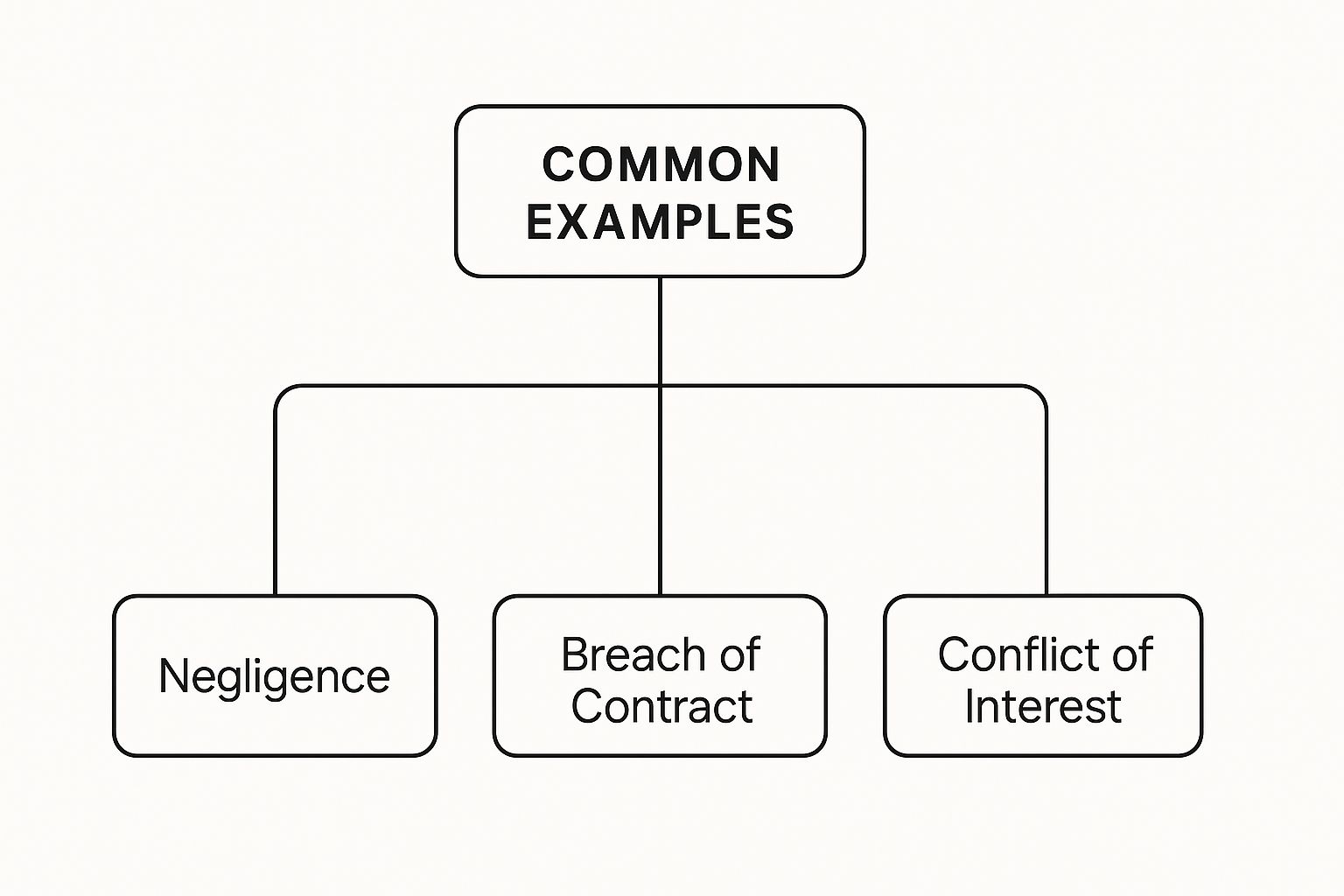
The visual makes it clear that while general negligence is a big category, specific problems like breach of contract and conflicts of interest are also major reasons for claims against attorneys.
These claims aren't as rare as you might think. A 44-year study of legal malpractice in Florida found 4,533 claims filed between 1978 and 2021, with insurers paying out on 3,178 of them. The average payout was about $154,000, and the average time to resolve a case was 2.9 years, showing that these are often long and involved fights. Coming to terms with these realities is part of fully grasping what is legal malpractice.
Common Examples of Attorney Negligence

Sometimes the clearest way to understand a concept like attorney negligence is to see how it plays out in the real world. Moving past legal theory helps show what kinds of mistakes and misconduct can lead to a valid claim. It’s a key part of knowing what is legal malpractice.
These aren't minor slip-ups; they are significant failures that can destroy an otherwise solid case. We can group these examples into a few clear categories to help you see if your situation fits a common pattern.
Missing Deadlines
The legal system runs on a strict calendar. Missing a key deadline is one of the most clear-cut, and devastating, forms of attorney negligence. These failures can have irreversible consequences for a client.
The most catastrophic example is when an attorney fails to file your lawsuit before the statute of limitations expires. This is a law setting a firm deadline for initiating legal action. If your lawyer misses this window, your claim is permanently barred—no matter how strong it was. While general information on these time limits is available from resources like the Cornell Law School's Legal Information Institute (LII), your attorney has a duty to know the specific deadline for your case.
Other examples include:
- Failing to respond to a motion to dismiss, causing the court to rule against you.
- Missing the deadline to name expert witnesses, which can prevent you from using essential testimony at trial.
- Not filing an appeal on time after an unfavorable verdict.
These aren't strategic miscalculations; they are fundamental errors. The harm is direct and usually easy to prove because the case was lost for a reason that had nothing to do with its merits.
Poor Communication and Lack of Consent
An attorney has a fundamental duty to keep you informed and to get your consent on major decisions. When communication breaks down, it's not just frustrating—it can be malpractice if it causes you tangible harm.
Imagine your lawyer gets a settlement offer from the other side but doesn't tell you about it. Weeks later, the offer expires. You just lost a valuable chance to resolve your case because of their failure to communicate. That's a serious breach of duty that directly cost you money.
A core duty of any attorney is to ensure their client can make informed decisions. When an attorney makes a key decision, like accepting or rejecting a settlement or discontinuing a case, without the client's knowledge or consent, it can be a significant act of negligence.
For instance, a lawyer might decide to drop part of your claim without discussing it with you first, thinking it weakens the overall case. If that part of the claim had merit and potential value, making that unauthorized decision could be malpractice.
Inadequate Case Handling and Investigation
This category covers a wide range of errors that happen while preparing and litigating a case. It all comes down to an attorney failing to do the basic work required to build a strong argument for their client.
Case mishandling can look like this:
- Failure to Investigate: Your attorney doesn’t track down and interview key witnesses, or they fail to gather important evidence like police reports, medical records, or surveillance footage.
- Incompetent Discovery: The lawyer doesn’t properly request documents from the other side or fails to take depositions from important parties, leaving your case weak and unprepared for trial.
- Poor Trial Performance: The attorney shows up to court unprepared, doesn't object to improper evidence, or doesn't know basic court procedures, leading to a disastrous outcome.
These aren't just bad strategic calls. They represent a failure to exercise the reasonable skill and diligence expected of a legal professional. Without proper investigation and preparation, even a winning case can fall apart.
Conflicts of Interest and Ethical Violations
Finally, some of the most serious examples of attorney negligence involve clear ethical violations. The State Bar of Georgia, like all state bars, has strict rules of professional conduct that every lawyer must follow. Breaching these rules can cause severe client harm.
A conflict of interest happens when a lawyer's duty to you is compromised by their responsibilities to another client, a former client, or their own personal interests. A blatant example is an attorney trying to represent both the plaintiff and the defendant in the same lawsuit.
Other serious ethical breaches include:
- Misusing Client Funds: An attorney must keep client money in a special trust account. Using that money for personal or business expenses is a severe violation called misappropriation.
- Breaching Confidentiality: Your lawyer cannot reveal information related to your case without your consent. Doing so can damage your case and is a breach of a core ethical duty.
These actions go beyond simple mistakes and into the realm of professional misconduct. They show a disregard for the fundamental duties of loyalty and honesty an attorney owes their client, which is central to understanding what is legal malpractice.
Why Malpractice Claims Are Becoming More Serious
A major trend is developing in the legal profession: the financial stakes of legal malpractice claims are skyrocketing. While the total number of claims filed each year remains fairly steady, the severity of these claims—measured in dollars—has grown immensely. This shift is fundamental to understanding **what is legal malpractice** today and why these cases demand such serious attention.
We’re no longer talking about small settlements. Payouts in major cases are now hitting tens, and even hundreds, of millions of dollars. This trend shows just how seriously large law firms and their insurers are treating these claims. The sheer size of these numbers proves that a single mistake by an attorney can have catastrophic financial consequences.
What’s driving this? It's largely a combination of economic pressures and the massive financial scope of modern legal cases and business deals. When a corporate merger is worth billions, a lawyer’s error can trigger staggering losses, which naturally leads to much larger malpractice claims.
The Growing Scale of Malpractice Payouts
Recent data from the insurance industry paints a stark picture. A 2022 survey covering about 80% of the largest U.S. law firms revealed a startling pattern. Out of eleven major insurers, ten had paid out on at least one claim exceeding $50 million in the previous two years.
Even more striking, four of those insurers were involved in legal malpractice payouts that topped $300 million during that same timeframe. You can dig into the specifics from Atheria Law P.C. by reviewing their full 2022 legal malpractice claims report.
This spike in high-value claims is happening against a backdrop of economic uncertainty and high inflation. These factors don't directly cause malpractice, but they can increase the risk of litigation and raise the financial expectations of clients who have been harmed.
The screenshot below, taken from the report, visually illustrates the high-stakes environment law firms are now operating in.
This data makes it crystal clear: the real story isn't just about how often malpractice happens, but about the massive financial damage a single case can cause.
Why This Matters for Your Claim
This isn't meant to intimidate you, but to give you a realistic picture of the landscape. It underscores why having an experienced attorney is non-negotiable, especially if your lawyer's mistake resulted in a significant financial loss for you or your business.
Pursuing a legal malpractice claim is a serious undertaking, but it's often the only path to justice and recovering what you lost due to professional negligence. The growing severity of these cases shows that the harm caused by attorney errors is finally being recognized at the highest levels.
This trend isn’t unique to legal malpractice. We see similar principles in other fields involving professional negligence. For a related perspective, you can read our guide on how medical malpractice cases work, which touches on the same core themes of professional duty and client harm.
Ultimately, knowing just how serious what is legal malpractice has become reinforces why holding negligent professionals accountable is a vital part of our justice system.
What to Do If You Suspect Legal Malpractice

Realizing that the attorney you trusted may have damaged your case is a gut-wrenching experience. It’s natural to feel angry, confused, and unsure of what to do next. But you aren’t powerless. There are concrete, methodical steps you can take to evaluate the situation and protect your rights.
The key is to move from a feeling of being wronged to a position of proof. Taking decisive action is important, and it starts with getting your facts in order.
Step 1: Gather All Your Records
Your first job is to become the archivist of your own case. This means methodically collecting every document and communication you have. Don't dismiss anything as unimportant; even a brief email could prove valuable later.
Make sure you have copies of the following:
- The Fee Agreement: This is the contract that established the attorney-client relationship and defines what your lawyer was supposed to do for you.
- All Correspondence: Collect every email, text message, and letter exchanged between you and the law firm. This paper trail documents the advice you were given and the decisions that were made.
- Pleadings and Court Filings: Get copies of every document filed in your case, including the complaint, motions, and any orders from the judge.
- Evidence: Gather all the evidence you gave your attorney, such as medical records, accident photos, or contact information for witnesses.
Having this information organized is the single most effective way to prepare for a consultation with another lawyer.
Step 2: Create a Detailed Timeline
With your documents in hand, your next task is to build a clear, chronological timeline of events. This process turns a chaotic mix of memories and paperwork into a coherent story that another attorney can quickly understand.
Start from your very first meeting with the lawyer and proceed to the present day. For each significant event, note:
- What happened? (e.g., "Received settlement offer from my attorney.")
- When did it happen? (e.g., "June 5, 2023.")
- Who was involved? (e.g., "Email from Jane Doe.")
This timeline is invaluable. It helps pinpoint exactly when and where the potential error occurred and shows how that mistake directly led to the harm you suffered.
It is vital to be aware of the statute of limitations, which is the strict legal deadline for filing a lawsuit. Each state has its own time limits for legal malpractice claims, and missing this deadline means you lose your right to sue forever. While you can find general information on these time limits from resources like the Cornell Law School's Legal Information Institute (LII), only a new attorney can advise on the specific deadline for your case.
Step 3: Seek a Second Opinion
Finally, you must get a second opinion from an attorney who concentrates specifically on legal malpractice claims. This is a highly specialized field of law, not something for a general practitioner. You need an expert who lives and breathes these unique cases.
The core principles of proving professional negligence are similar across different fields. For example, you can read our guide on how medical malpractice cases work to see how the elements of duty, breach of duty, and resulting harm are applied in a different context.
A skilled malpractice attorney will review your records and timeline to provide an objective assessment. They can determine if your previous lawyer’s conduct fell below the required professional standard and whether you have a legitimate, provable claim. Acting quickly is essential to preserve your legal options.
Legal Malpractice FAQs
After explaining the fundamentals of what is legal malpractice, it’s helpful to tackle the real-world questions that clients bring to me. These are the kinds of practical, direct inquiries that arise when someone is trying to make sense of a difficult and often confusing situation. My goal here is to give you clear, straightforward answers.
These are a few of the questions I hear most often.
Losing a Case Isn't Automatically Malpractice, Is It?
That’s exactly right, and it’s probably the most important distinction to grasp. A bad outcome, on its own, does not equal legal malpractice. The justice system is filled with uncertainty; even the most skilled and dedicated lawyers can lose cases everyone thought were a sure thing.
To build a valid malpractice claim, you have to prove more than just a loss. You must demonstrate that your lawyer’s actions fell below the professional standard of care—in other words, they made an error that a reasonably competent attorney in the same situation would not have made. On top of that, you must prove that this specific mistake is what caused you to lose.
A competent lawyer can lose for a dozen different reasons. Malpractice is about a loss that happened because of your lawyer's provable negligence.
How Long Do I Have to File a Malpractice Lawsuit?
This is an extremely time-sensitive issue governed by something called the statute of limitations. This law sets a hard deadline for filing a lawsuit, and it’s different in every state. If you miss that deadline, your right to sue is gone forever, no matter how strong your case might be.
Typically, the clock starts running either when the malpractice happened or when you discovered it (or reasonably should have discovered it). While resources like Wikipedia's overview of statutes of limitations can give you a general idea, these rules are specialized. It is absolutely essential to consult a new attorney immediately to figure out the exact deadline for your specific case.
What Kind of Evidence Will I Need?
A strong malpractice claim is built on a foundation of solid proof. It’s not enough to just say your lawyer made a mistake; you have to prove it with evidence.
Here’s what you’ll typically need to gather:
- Your Complete Case File: This includes every pleading, motion, and piece of correspondence from your original attorney.
- Written Communication: All emails, letters, and even text messages between you and your former lawyer are vital.
- The Fee Agreement: This contract spells out what your lawyer was hired to do.
- Expert Witness Testimony: This is often the cornerstone of a malpractice case. You’ll almost certainly need another attorney to act as an expert witness. This expert will review the file and testify that your first lawyer’s conduct was, in fact, negligent and fell below the standard of care.
Should I Report My Lawyer to the State Bar Instead?
This is a great question. The answer is that you can do both, but you need to know they serve two completely different functions.
Filing a complaint with the State Bar of Georgia (or your state’s equivalent) triggers a disciplinary investigation. The bar’s job is to see if the attorney violated ethical rules. If so, they can impose punishments like a reprimand, suspension, or even disbarment. This process is about policing the legal profession.
A legal malpractice lawsuit is a civil claim filed in court. Its purpose is entirely different: to recover financial compensation for the harm and damages you suffered because of the lawyer's negligence. One process punishes the lawyer; the other seeks to make you financially whole.
An important distinction: The state bar's primary function is to protect the public by upholding professional standards. A civil lawsuit's primary function is to secure financial recovery for an individual client who has been harmed. You can pursue both avenues at the same time.
Can I Sue if My Lawyer Settled My Case Without My Permission?
Yes, absolutely. This can be a very clear basis for a legal malpractice claim. Your lawyer has a fundamental duty to keep you informed and get your consent for major decisions—and there’s no decision more major than settling your case. The final say on whether to accept a settlement offer belongs to you, not your attorney.
If your lawyer accepted a settlement without your approval or failed to tell you about an offer, you may have been financially harmed. This is a serious breach of trust and a common reason for a successful malpractice suit, especially if their action resulted in you getting a worse outcome. Understanding what is legal malpractice means recognizing these severe violations of a lawyer's duty.
If you believe an attorney’s negligence has harmed you, you need guidance from a firm that understands this unique area of law. At Jamie Ballard Law, we help clients in Atlanta hold professionals accountable and fight for the compensation they are owed. We offer a free case evaluation to help you understand your options with no obligation. Visit us at https://jamieballardlaw.com to learn more.