Losing someone you love is a devastating, life-altering event. When you're grieving, legal action is the last thing on your mind, but learning how to file a wrongful death claim can be the first step toward getting answers and securing your family's future. This guide is here to help you understand the process.
At its heart, a wrongful death claim is a civil action that can be filed when one person's careless or intentional act causes another person's death. It is not about putting a price on a life. Instead, it is about holding the responsible party accountable and seeking justice for a future that was taken away.
What to Do First After an Unthinkable Loss
When you're grieving, the thought of legal paperwork can feel overwhelming. But knowing where to start can bring a small sense of control back into your life.
Many of the families I work with feel completely lost in the beginning. The journey starts by understanding the fundamental parts of a valid claim. This isn't just a legal process; it's a way to honor your loved one by making sure the person or company at fault answers for their actions.
The Four Pillars of a Wrongful Death Claim
To build a successful case, you must prove four key elements. I think of them as the foundation of a house—if one is missing, the entire structure is unstable.
We can break down these legal requirements into simple, understandable terms.
Core Elements of a Wrongful Death Claim
This table outlines the four legal requirements needed to build a wrongful death case, explained in plain English.
| Legal Element | What It Means in Plain English | Real-World Example |
|---|---|---|
| A Duty of Care Existed | The at-fault party had a legal responsibility to act with reasonable caution toward your loved one. | A commercial truck driver has a duty to follow traffic laws and hours-of-service regulations. |
| The Duty Was Breached | The person failed to meet that responsibility through a negligent or reckless act. | The truck driver was texting while driving and ran a red light. |
| Causation Links the Breach to the Death | You must clearly connect the negligent act directly to your loved one’s death. | The collision caused by the distracted truck driver resulted in fatal injuries. |
| Damages Resulted from the Loss | The death caused measurable harm—both financial and emotional—to the surviving family members. | This includes funeral expenses, lost future income, and the loss of companionship and guidance. |
Essentially, you have to show that the at-fault party had a responsibility, failed to meet it, and that failure directly caused the death and your family's resulting damages. While the specifics can vary by jurisdiction, this setup is the backbone of every wrongful death claim. Wrongful death lawsuits can arise from many situations, from medical malpractice to car accidents. You can find more insights on the legal standards for these claims from legal resources like consumershield.com.
Taking the Very First Step
The most practical first step is often the hardest: asking for help. You shouldn't have to go through this alone while also dealing with immense grief. A simple, supportive conversation can clarify your rights and outline the path forward without any pressure.
Taking action isn’t about moving on; it’s about moving forward with purpose. It’s a way to channel your grief into a fight for accountability and protect your family’s future.
We know every family's situation is different. The weight of this process is enormous. If you just have questions or need to understand your options, our team is here to listen. You can get in touch with us for a free and confidential conversation whenever you're ready.
Knowing how to file a wrongful death claim begins with getting the right support from day one.
Who Can File a Wrongful Death Claim in Georgia

One of the first, most important questions families face is who actually has the legal standing to file a wrongful death claim. Georgia law is very specific about this, establishing a clear hierarchy to keep the process orderly. Answering how to file a wrongful death claim always starts here—with identifying who has the right to act on a loved one's behalf.
This isn't just a legal technicality. The system is designed to protect the rights of those most directly impacted by the loss. Understanding this structure is the first step toward seeking accountability.
Georgia’s Hierarchy of Eligibility
The state lays out a precise order of priority for who can file. This ensures a designated person or group represents the interests of the deceased and their survivors.
-
The Surviving Spouse: The deceased’s husband or wife is always first in line. The surviving spouse holds the primary right to file the claim for themselves and any minor children.
-
The Children of the Deceased: If there is no surviving spouse, the right to file passes directly to the deceased's children. They can bring the action collectively.
-
The Parents of the Deceased: In the tragic event that the deceased was unmarried and had no children, their surviving parents are next in line and may file the claim.
This succession is written in the Official Code of Georgia Annotated, specifically § 51-4-2. This statute is the definitive guide for determining who is eligible to file.
What if There Is No Surviving Spouse or Children?
Let's walk through a scenario we see all too often. Imagine a young, unmarried adult with no children is killed in a preventable workplace accident. In this situation, their surviving mother and father would have the legal right to file a wrongful death claim to seek justice for their child.
Even if the parents are divorced, they still hold this right jointly. The law views them as a single entity for this purpose.
The Role of the Estate’s Personal Representative
But what happens when none of the immediate family members listed above exist? This is where the deceased's estate comes into play.
If there is no surviving spouse, child, or parent, the personal representative of the estate can step in to file the claim. This individual is usually named as the executor in the deceased’s will or is appointed by a probate court.
When the personal representative files the claim, any compensation recovered becomes part of the estate. From there, the funds are distributed to the next of kin according to Georgia's inheritance laws. This ensures that more distant relatives, like siblings or cousins, might still receive the benefits even though they couldn't file the claim themselves.
It's important to understand a key distinction here. When an immediate family member files, they are seeking damages for the "full value of the life of the decedent." But when the estate files, it is often to recover specific financial losses like final medical bills and funeral expenses.
Ultimately, these rules exist to bring order to an incredibly difficult situation. By clearly defining who can act, the law helps families understand the first steps in holding responsible parties accountable.
Gathering Essential Documentation and Evidence

Once you’ve confirmed who is eligible to file, the next important phase in understanding how to file a wrongful death claim is collecting proof. A strong claim isn’t built on emotion; it’s built on a foundation of credible, factual evidence. Think of it as telling a story with documents—a story that clearly shows what happened and the profound void left in your family.
Every piece of paper, every report, is a building block. Getting organized from the very beginning can make a world of difference as the case progresses.
Official Records That Establish the Facts
Your starting point should always be the official documents that create an undeniable record of the incident and its immediate aftermath. Courts and insurance companies view these records as highly credible, and they form the objective backbone of any claim.
Here's the essential paperwork you'll need to track down first:
- The Official Death Certificate: This is the cornerstone document. It records the date, location, and official cause of death. You can request copies from the Georgia Department of Public Health's Vital Records office.
- Police or Accident Reports: If the death was the result of a car wreck, a workplace accident, or any other event that law enforcement investigated, this report is vital. It contains the officer’s initial findings, witness contact information, and often a preliminary opinion on who was at fault.
- Medical Records: You need a complete picture of the medical care leading up to the death. This includes everything from the initial paramedic reports and hospital admission forms to surgical notes and doctor's consultations.
- Autopsy Report: If an autopsy was conducted, this report provides a detailed medical explanation of the cause of death. In cases where causation is disputed, it can be your most powerful piece of evidence.
Documenting the Full Financial Impact
Proving what happened is only half the battle. You also have to demonstrate the tangible financial toll the loss has taken on your family. This isn't just about bills; it's about the economic stability and future that was taken away.
A wrongful death claim in Georgia aims to recover the "full value of the life." This includes both the tangible, economic losses and the intangible value of the person's companionship and guidance. Documenting the financial side is the first step in quantifying that loss.
To paint a full picture of the economic damages, you'll need to gather:
- Proof of Income: Collect recent pay stubs, W-2 forms, and tax returns for your loved one. This documentation is essential for calculating lost earning capacity. According to the U.S. Bureau of Labor Statistics, a person's lifetime earnings can easily reach into the millions, a loss that must be fully accounted for.
- Records of Bills and Expenses: Compile every receipt and invoice related to final medical treatments, funeral services, and burial costs. These are direct, out-of-pocket expenses the family or estate has shouldered.
- Information on Benefits: Don't overlook lost benefits. This includes health insurance coverage, retirement contributions (like a 401(k)), and pensions the family would have relied on in the future.
This financial evidence is important. It provides the hard numbers needed to calculate a significant portion of the compensation your family is rightfully owed.
Preserving the Intangible, Human Story
Perhaps the deepest loss isn't financial at all. It’s the loss of love, companionship, guidance, and support. While no amount of money can replace these things, capturing this side of the story is absolutely essential to showing the true "full value" of your loved one's life.
This is where you move beyond legal documents and tell the human story.
- Photographs and Videos: Family photos, home videos, and even social media posts can powerfully illustrate your loved one’s personality and their close bonds with family.
- Personal Journals or Communications: Letters, emails, or journal entries from family members can convey the depth of grief and the immense void left behind.
- Statements from Friends and Family: Written statements from friends, coworkers, or neighbors help show the wide-reaching impact your loved one had on their community.
This type of evidence transforms the case from a name on a file to a real person who was cherished and is now deeply missed. It helps an insurance adjuster, a judge, or a jury understand who you lost, not just what happened.
Georgia's Statute of Limitations for Wrongful Death

Time is one of the most unforgiving factors in a wrongful death claim. In Georgia, the law sets a strict deadline, known as the statute of limitations, for filing a lawsuit. This isn't a suggestion—it's a hard and fast rule that can permanently block your family from seeking justice if you miss it.
As a general rule, the family has two years from the date of the person's death to file. It's important to understand that this two-year clock starts ticking on the day your loved one passes away, not necessarily the date of the accident that caused the fatal injuries. If you miss this deadline, the court will almost certainly dismiss your case, no matter how strong it is.
Exceptions That Can Change the Timeline
While the two-year deadline is the standard, Georgia law acknowledges that some situations aren't so cut and dry. A few specific circumstances can "toll" or pause the clock, giving a family more time to act.
- Pending Criminal Cases: If the death was the result of a crime, like a DUI crash or homicide, the statute of limitations can be paused. The clock stops while the criminal case against the at-fault party is active and won't start again until that case is officially over.
- Discovery of the Cause of Death: Sometimes, the real cause of death isn't obvious right away. This often happens in medical malpractice cases where a fatal mistake might not be discovered for months or even years. In these scenarios, the clock may not start until the cause of death was discovered or reasonably should have been discovered.
- The Deceased’s Estate Is Unrepresented: If there's a significant delay in appointing a personal representative for the estate, the statute of limitations can be paused for up to five years.
These exceptions are highly technical and require careful legal analysis. It's always safest to assume the standard two-year deadline applies and act quickly. For a wider view on legal time limits, you can review this guide on the general lawsuit statute of limitations.
How the Deadline Works in Real-World Scenarios
Let's look at how this plays out in a couple of different situations.
Scenario 1: The Car Accident
A man is killed in a head-on collision on May 1, 2024. The cause of death is immediate and clear. His family has until May 1, 2026, to file a wrongful death lawsuit against the negligent driver.
Scenario 2: The Medical Malpractice Case
A woman has surgery on June 10, 2024, and dies a week later from what the hospital calls "unforeseen complications." Eight months later, in February 2025, another doctor reviewing her medical records finds a clear surgical error was the true cause. Here, a strong argument can be made that the two-year clock didn't start until February 2025, the date the negligence was actually discovered.
The statute of limitations isn't meant to punish grieving families. Its purpose is to ensure claims are filed while evidence is still available and witness memories are fresh. But for a family dealing with a sudden loss, two years can feel like no time at all.
Understanding these important deadlines is fundamental. If you have more questions about how these timelines work in different injury cases, we've covered the statute of limitations for personal injury in GA in another detailed article.
Understanding Compensation in a Wrongful Death Case
While no amount of money can ever replace a family member, Georgia law provides a way for seeking financial justice and stability after such a profound loss. This isn't about putting a price tag on a life. It's about holding the responsible party accountable and providing for the future your family was supposed to have.
The process involves two distinct types of claims, each designed to address a different aspect of the loss.
The Full Value of the Life of the Decedent
This is the core of a Georgia wrongful death claim and is unique to our state. The law allows the family to recover the "full value of the life of the decedent," a powerful legal concept that goes far beyond just lost wages. It’s composed of two parts.
First is the tangible (economic) value. This is the more straightforward component, calculating the income your loved one would have earned over their lifetime. It includes wages, benefits, retirement contributions, and any other financial support they would have provided.
Second, and perhaps more importantly, is the intangible (non-economic) value. This is where the law acknowledges that a life is infinitely more than a paycheck. This part of the claim seeks to measure the immeasurable—the joy of living, the value of their companionship, the love shared with a spouse, and the guidance of a parent. To build this part of the case, we look at your loved one’s hobbies, relationships, and role in the community to paint a full picture of the vibrant life that was cut short.
This concept is profound. It says the loss isn't just about the money a person would have earned; it's about the experiences they'll never have and the relationships that are now gone forever. It's a legal recognition of the human cost of negligence.
Damages Recoverable by the Estate
Running parallel to the wrongful death claim is a second claim brought by the personal representative of the deceased's estate. This is often called a "survival action."
This claim focuses on the specific, measurable financial losses the estate itself suffered as a direct result of the wrongful death.
These damages typically include:
- Final Medical Expenses: Any hospital bills, ambulance transport, or other medical costs incurred between the injury and the time of death.
- Funeral and Burial Costs: The direct expenses for the funeral, cremation, or burial.
- Pain and Suffering of the Deceased: In certain situations, the estate can recover damages for any conscious pain and suffering your loved one experienced before they passed away.
Wrongful death settlements and verdicts can vary dramatically based on the case specifics, including the defendant's degree of negligence. For example, a $10.5 million verdict was awarded in one state after a fatal truck crash where the jury considered the family’s loss of society, mental suffering, and lost financial support.
To help clarify what can be recovered, here is a breakdown of the different types of damages available under Georgia law.
Types of Damages in a Georgia Wrongful Death Case
| Type of Damage | What It Covers | Who Receives It |
|---|---|---|
| Full Value of Life (Economic) | The deceased's projected lifetime income, including wages, benefits, and retirement contributions. | Surviving spouse and/or children, or other designated family members. |
| Full Value of Life (Non-Economic) | The intangible value of life, such as companionship, guidance, joy, and personal relationships. | Surviving spouse and/or children, or other designated family members. |
| Medical Expenses | All medical bills from the time of the injury until the time of death. | The estate of the deceased. |
| Funeral & Burial Expenses | Costs associated with the funeral, cremation, or burial services. | The estate of the deceased. |
| Pain & Suffering of the Deceased | Compensation for any conscious pain and suffering the loved one endured before passing away. | The estate of the deceased. |
Understanding these two parallel claims—one for the family and one for the estate—is essential for pursuing complete financial justice. A successful claim hinges on meticulously documenting both categories of loss.
For a broader overview of how damages work in other contexts, you can learn more about the personal injury claims process in our related guide.
The Legal Process From Filing To Resolution
Once you've decided to move forward, understanding how to file a wrongful death claim shifts from theory to action. This process isn't a single event but a structured legal journey designed to uncover the facts, prove who was responsible, and secure a just result for your family. It all kicks off with a comprehensive investigation and filing a formal complaint in the proper Georgia court.
That initial filing is what officially starts the lawsuit. From there, the case moves into a vital stage known as discovery. Discovery is a mandatory period of transparency where both sides must exchange all relevant information and evidence. Think of it as putting all the cards on the table—it allows everyone to see the strengths and weaknesses of each side of the argument.
Key Stages Of Discovery And Resolution
The discovery process is an active investigation, not just a paper shuffle. It's how we build a complete, fact-based picture of what happened.
- Depositions: These are sworn testimonies taken outside of court. We question witnesses, defendants, and other involved parties under oath, and a court reporter records everything. This testimony is powerful and can be used later at trial.
- Expert Witnesses: We frequently bring in highly credentialed specialists, like accident reconstructionists or medical examiners, to analyze complicated evidence. Their expert opinions are essential for supporting our arguments. Part of this phase also involves digging into legal precedent, and knowing how to find case law is helpful for building a rock-solid case.
The infographic below breaks down how we calculate the total value of a claim by combining both tangible economic damages and intangible non-economic losses.
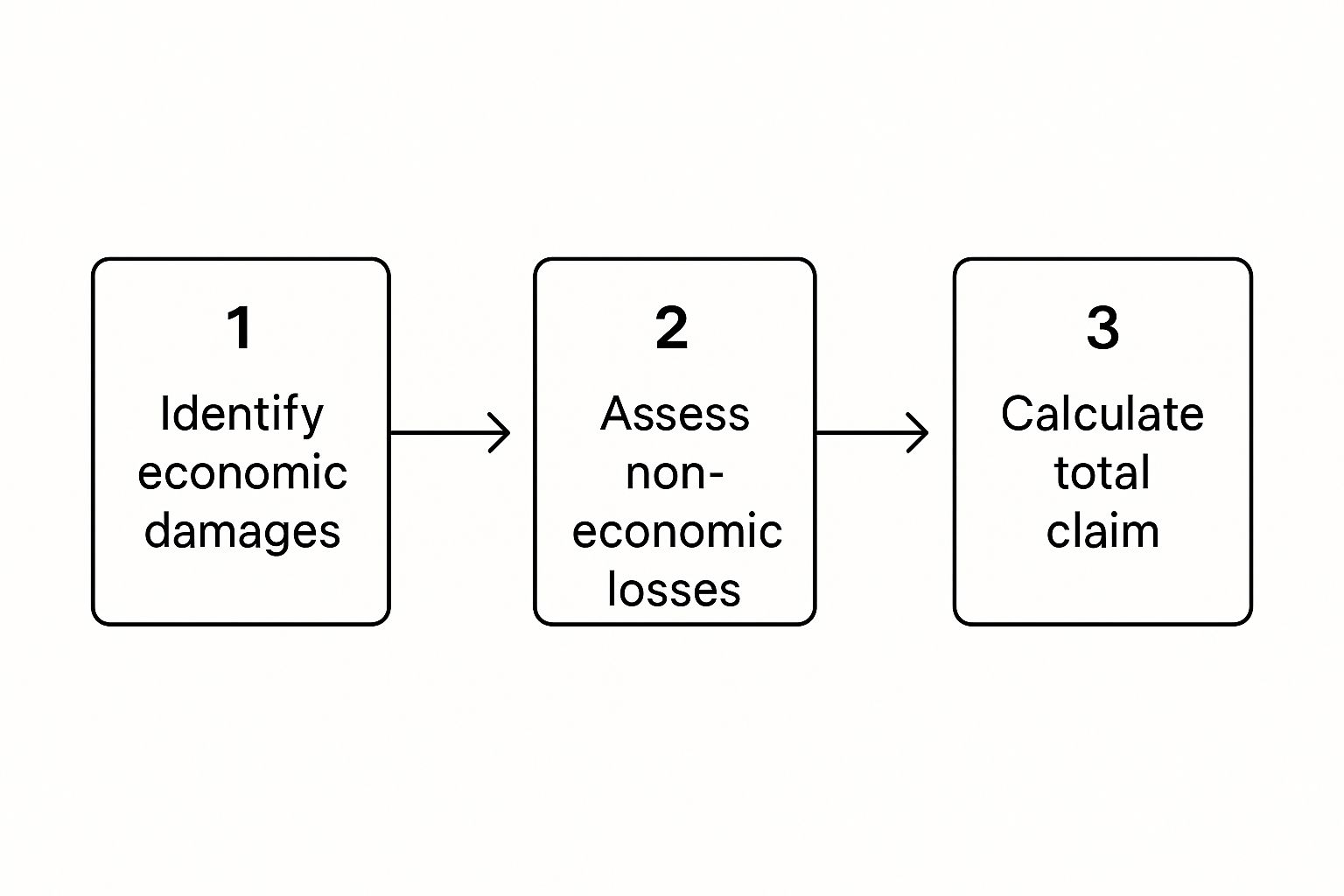
As you can see, determining a claim's full value is a methodical process. It requires identifying every financial loss while also placing a value on the profound, personal losses your family has endured.
The ultimate goal is resolution. While a trial is always an option, the vast majority of wrongful death cases are resolved through negotiation or mediation long before a courtroom is necessary.
Most cases find their resolution in one of three ways:
- Settlement Negotiations: This involves direct discussions between our legal team and the defendant's insurance company to land on a fair compensation amount without going to court.
- Mediation: We'll sit down with the opposing side in a formal negotiation session guided by a neutral third-party mediator. Their job is to help everyone find common ground.
- Trial: If a fair settlement just isn't on the table, we're fully prepared to present your case to a judge and jury, who will make the final decision.
This journey can take time, but having a trusted legal guide means you can focus on what matters most: your family. To see how an Atlanta wrongful death attorney can manage these steps for you, visit our dedicated page. Knowing what to expect is the first step in understanding how to file a wrongful death claim with confidence.
Common Questions About Wrongful Death Claims
After a devastating loss, it's natural to have questions. Families often come to us with similar concerns about the process, so I’ve answered a few of the most common ones we hear when discussing how to file a wrongful death claim in Atlanta.
How Long Does a Wrongful Death Case Take to Resolve?
This is probably the most frequent question, and the honest answer is: it depends.
Some cases can settle in just a few months. This usually happens when the evidence is overwhelming and the at-fault party’s insurer is ready to negotiate fairly from the start.
However, many cases are more involved. If there are disputes over what happened, multiple defendants involved, or the case has to go to trial, it could easily take two years or even longer to reach a resolution. The most important thing is to get started quickly to protect your rights under Georgia's statute of limitations.
Can I File a Claim if My Loved One Was Partially at Fault?
Yes, in many cases, you absolutely can. Georgia operates under a legal rule known as "modified comparative negligence."
What this means is that a family can still recover damages as long as their loved one was found to be less than 50% at fault for the fatal incident. The final compensation award is simply reduced by your loved one's percentage of fault. For example, if they were found to be 20% responsible, the total damages would be reduced by that 20%.
This rule is a key battleground. Insurance companies will often try to shift as much blame as possible onto your loved one to minimize what they have to pay. Our job is to build a case that tells the true story and assigns fault where it belongs.
What if the At-Fault Person Also Faces Criminal Charges?
A wrongful death claim is a civil lawsuit, and it’s completely separate from any criminal charges the state might file. You can and should move forward with your civil case to recover monetary damages, no matter what happens in the criminal courts.
The outcome of one doesn't dictate the outcome of the other. The standard of proof is much lower in a civil case ("preponderance of the evidence") than in a criminal one ("beyond a reasonable doubt"). So, even if the person is acquitted criminally, you can still win your civil case.
In fact, a criminal conviction can sometimes strengthen your wrongful death claim. It’s also important to know that a pending criminal case can sometimes pause the two-year statute of limitations—an important detail to discuss with your attorney.
At Jamie Ballard Law, we know the immense weight you're carrying. If you have more questions or just need someone to listen, we're here for you 24/7.
Contact us for a free, no-obligation consultation to discuss your family's specific situation. Let us help you find the answers and support you deserve.