As an Atlanta personal injury attorney, I've sat with many families trying to understand if a terrible hospital experience was grounds for a lawsuit for hospital negligence. When you place your trust in a medical facility, you expect a certain level of competent care. The core of any claim is determining if the hospital and its staff upheld that fundamental promise, often called the 'standard of care.' It’s not about guaranteeing a perfect result, but about providing the reasonable, safe treatment every patient deserves.
Distinguishing a Bad Outcome from True Negligence

It’s completely understandable to feel confused and hurt after a negative medical event. The line between an unfortunate, but unavoidable, complication and actual negligence can seem blurry.
The defining factor is whether the hospital or its staff acted in a way that another reasonably prudent medical professional or facility would not have under the same circumstances.
What Is the Standard of Care?
Think of the standard of care as the basic set of rules and protocols a hospital must follow. It's the baseline for safe, effective medical treatment. When this standard is violated—or breached—it can lead to devastating consequences for patients and their families.
For example, a patient developing a known side effect from a correctly administered medication is likely a bad outcome, not negligence. But if a patient has a severe reaction because a nurse administered ten times the prescribed dose? That is a clear breach of the standard of care.
A breach of the standard of care occurs when a healthcare provider's actions—or lack thereof—fall below accepted medical practices, directly resulting in patient injury. This is the pivot point where a bad outcome becomes a potential case for medical malpractice.
This distinction is what separates a tragic event from a legally actionable one. The impact of these failures is significant, costing healthcare institutions over $1.4 billion annually in the United States. A telling 65% of these lawsuits are initiated by patients' families, which shows the wide-reaching effect of these errors. The most frequent setting for these claims is the emergency department, making up 35% of all hospital malpractice cases. You can explore more hospital lawsuit statistics to understand the full scope of the issue.
To build a successful case, your legal team must prove these four elements existed.
Four Elements of a Hospital Negligence Claim
| Legal Element | What It Really Means | A Real-World Example |
|---|---|---|
| Duty of Care | The hospital had a professional obligation to provide you with competent medical care. | A patient is admitted to a hospital for surgery, creating a formal doctor-patient relationship. |
| Breach of Duty | The hospital or its staff failed to meet that standard of care. | A surgeon leaves a sponge inside the patient during the operation. |
| Causation | This failure directly caused your injury or made your condition worse. | The retained sponge causes a severe internal infection, requiring another surgery. |
| Damages | You suffered actual harm (physical, emotional, or financial) as a result. | The patient incurs additional medical bills, lost wages, and endures significant pain and suffering. |
Proving all four is essential for a valid claim. If even one element is missing, the case will likely fail.
Common Examples of Hospital Negligence
To give you a clearer picture, let's look at some real-world scenarios that often point toward a breach in the standard of care. These aren't just mistakes; they are failures that a reasonably competent hospital system should prevent.
- Medication Errors: This could be giving the wrong drug, the wrong dosage, or administering it to the wrong patient. A simple check of a patient's wristband against the medication order can prevent this, and failing to do so is a clear error.
- Failure to Monitor a Patient: After surgery, a patient's vitals must be watched closely. If a patient shows clear signs of distress—like a plummeting heart rate—and the nursing staff fails to notice or act, that inaction is a form of negligence.
- Hospital-Acquired Infections: While not all infections are preventable, many are. If an infection spreads because staff didn't follow basic hand-washing protocols or used unsterilized equipment, the hospital can be held responsible.
- Surgical Errors: These are among the most shocking mistakes, including operating on the wrong body part, leaving a surgical instrument inside a patient, or causing nerve damage unrelated to the procedure.
Understanding these examples helps clarify when a negative experience might be grounds for a lawsuit for hospital negligence. It’s about identifying a preventable error that caused real, measurable harm.
How to Document Everything for Your Case

From the very moment you suspect that something went wrong with your medical care, what you do next can define the strength of a future lawsuit for hospital negligence. Solid documentation is the foundation of any successful claim, and it's something you can—and should—start building immediately.
The first order of business is to get your hands on every single piece of paper related to your care. This is a lot more than the simple discharge summary they give you on your way out.
Securing Your Complete Medical File
You have a legal right to your medical records, but you have to formally request your entire chart from the hospital's records department to get it. Most people are shocked by the sheer volume of information these files contain.
Your complete chart is a treasure trove of evidence and should include:
- Physician’s Orders: These are the direct commands from doctors for your tests, medications, and treatments.
- Nurse’s Notes: In my experience, these are often the most revealing documents. They provide a running, minute-by-minute account of your condition, what you told the staff, and how—or if—they responded.
- Test Results: All lab work, imaging reports like X-rays or CT scans, and any other diagnostic findings.
- Medication Administration Records (MAR): This is the log showing exactly what drugs were given, when, and by whom.
Under the Health Insurance Portability and Accountability Act (HIPAA), federal law protects your right to access this information.
The U.S. Department of Health & Human Services website offers clear guidance for patients on how to exercise these rights.
This resource from HHS.gov confirms that you are entitled to copies of your records and that providers must respond to your request, typically within 30 days. Don't be discouraged if they delay; be persistent. Getting these records is a vital first step in uncovering what really happened.
Create a Detailed Timeline of Events
While medical records tell the hospital's side of the story, your personal memory provides the essential human context. As soon as you are able, sit down and write out a timeline of everything you can remember.
Start from the moment you arrived at the hospital. Document every interaction, every conversation, every symptom. Just get the facts down on paper without worrying about perfection.
My Personal Advice: Don't filter yourself. Write down everything, no matter how small it seems. A nurse’s dismissive comment or a long wait for someone to answer a call bell might feel insignificant, but these details often establish a powerful pattern of substandard care.
Your timeline should aim to answer key questions:
- Who were the specific doctors and nurses you saw?
- What did you tell them about how you were feeling?
- How did they respond to your questions and concerns?
- When did you first realize something was wrong?
- Was anyone else—a family member or friend—present for important conversations?
This timeline isn't just a tool for your attorney; it’s for you. It helps organize your thoughts and preserves important details that will inevitably fade over time.
Keep a Daily Journal of Your Recovery
Finally, start keeping a simple daily journal. The purpose here isn't to rehash the incident of negligence but to document its aftermath. This journal becomes a powerful, running account of your "damages"—the real-world toll the hospital's error has taken on your life.
Each day, just make a few short notes covering:
- Your pain level on a scale of 1 to 10.
- Medications you needed to take for your injuries.
- Medical appointments or physical therapy sessions you went to.
- Daily activities you were unable to do, like going to work, cooking a meal, or playing with your kids.
- Your emotional state—documenting feelings of frustration, anxiety, or depression.
This consistent record is priceless. It turns abstract legal terms like "pain and suffering" into a concrete, day-by-day story of your struggle, which is absolutely essential when pursuing a lawsuit for hospital negligence.
Proving Your Claim with Evidence and Experts

Your personal account of what happened is powerful, but in a legal setting, it’s just one side of the story. To win a lawsuit for hospital negligence, we have to translate your experience into objective, compelling legal proof.
This is where highly qualified medical experts become the MVPs of your case. We don’t just find any doctor; we find the right medical professional who can review your records and give an unbiased, authoritative opinion on where the standard of care fell short.
The Role of the Medical Expert
A medical expert’s job is to act as a detective. They meticulously review every page of your chart, analyze the sequence of events, and pinpoint the exact moment the hospital's team made a mistake.
Their work isn't just a casual opinion. In Georgia, it forms the basis of a document called an Affidavit of Merit (or Expert Affidavit). This is a sworn statement from a qualified expert confirming that, in their professional judgment, medical negligence likely occurred.
Without a strong, credible Affidavit of Merit, a medical malpractice case in Georgia is dead on arrival. This is a non-negotiable legal requirement designed to filter out claims that lack legitimate medical support.
The expert’s testimony is what connects the dots for a judge and jury. They can explain precisely how a nurse's failure to report a drop in blood pressure directly caused a preventable stroke, turning medically detailed facts into a clear story of cause and effect.
Digging for Internal Hospital Documents
While the expert is focused on the medical chart, my team gets to work uncovering what was happening behind the scenes. We use a legal process called "discovery" to request internal documents that often reveal systemic failures.
We aren't necessarily looking for one "smoking gun." Instead, we're building a pattern of evidence. Key documents we demand include:
- Internal Policies and Procedures: We want to see the hospital’s own rulebook. Did the staff even follow their own protocols for patient monitoring or medication administration?
- Staffing Schedules and Ratios: Understaffing is a huge problem. These records can prove that the nurses on your floor were overworked and responsible for too many patients, making mistakes almost inevitable.
- Incident Reports: When an error occurs, hospitals often require staff to file internal reports. These documents can provide a candid, real-time account of what went wrong.
- Employee Personnel Files: We look for patterns. Had the doctor or nurse involved in your care been disciplined for similar mistakes in the past?
Combining an expert's sharp medical analysis with the hospital's own internal records creates an ironclad foundation for your case. If you're facing this situation, understanding what makes a strong Atlanta medical malpractice lawyer is a good next step.
Real-World Consequences of Negligence
When hospitals fail in their duties, the consequences are devastating—and the jury awards can reflect that. One well-known case involved James Sada, who died from a heart attack after a hospital delayed his transfer to a cardiac facility. A jury awarded his family $45 million, finding that the hospital prioritized its own interests over the patient's life.
Here in Georgia, a jury awarded $70 million to Jessica Powell, who had to have both legs amputated above the knee due to negligent care for sepsis. These verdicts underscore the immense responsibility hospitals carry and the severe accountability they face for their failures.
Building a powerful case requires solid evidence and unshakable expert testimony. It's the only way to hold these institutions accountable in a lawsuit for hospital negligence.
The Legal Journey from Filing to Settlement
Once we've confirmed you have a strong case for hospital negligence, we transition from investigation to formal legal action. Knowing what to expect during this journey can make an overwhelming process feel much more manageable.
One of the first and most important hurdles is the statute of limitations. This is a non-negotiable legal deadline for filing your lawsuit. In Georgia, the clock starts ticking the moment the negligence happens or when you first discover the injury. You can find a detailed breakdown of these time limits in our guide on the statute of limitations for personal injury in GA.
If you miss this window, your right to seek compensation is gone forever, no matter how clear the hospital's fault was. This is precisely why we urge clients to contact us as soon as possible.
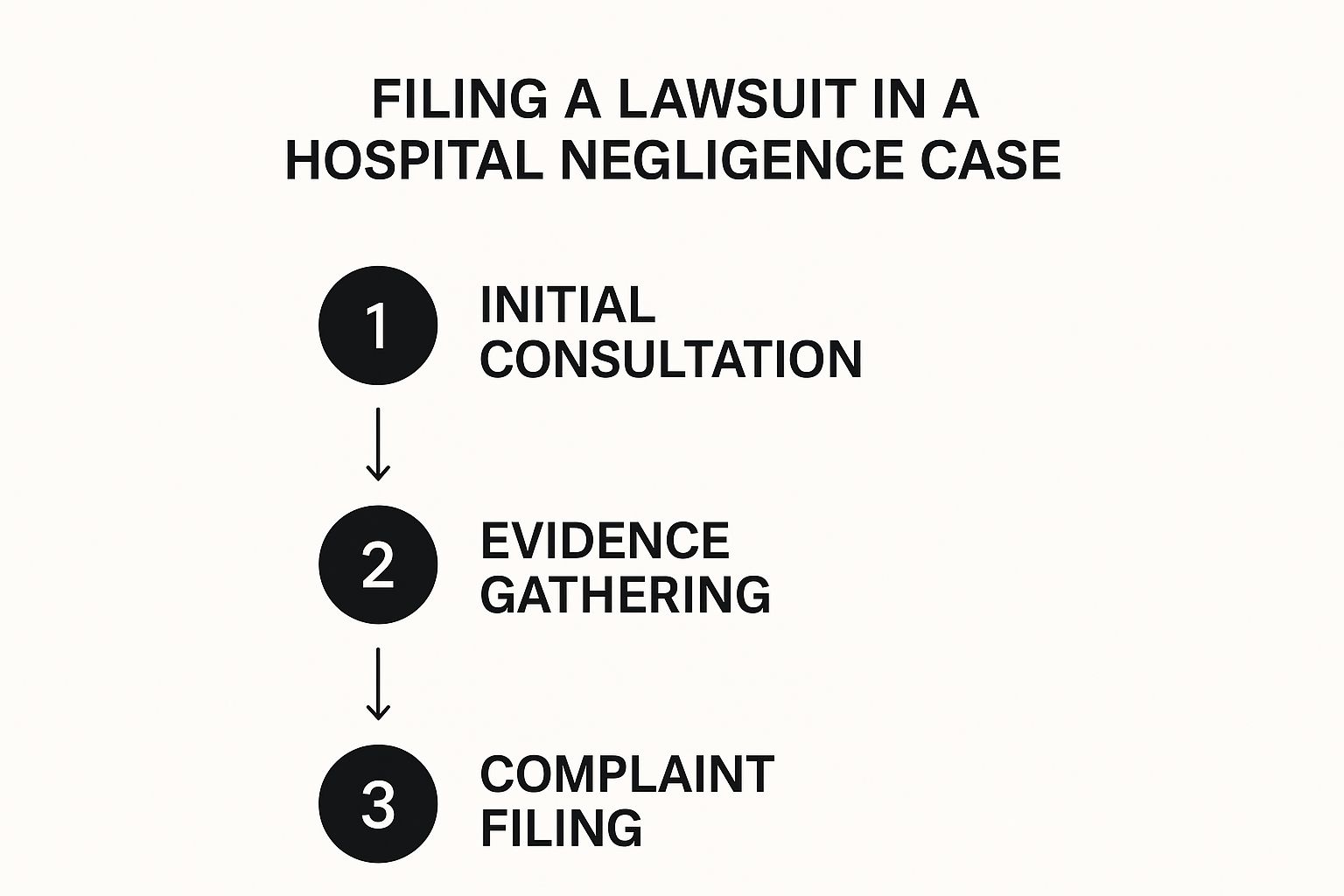
As you can see, the formal lawsuit is preceded by important groundwork—the initial consultation and intensive evidence gathering. These initial steps are the foundation of your entire case.
The Discovery Phase: Uncovering the Facts
After the lawsuit is officially filed, we enter a phase called "discovery." The name says it all. This is a structured process where both sides are legally required to exchange all relevant information about the case. It's designed to prevent any "gotcha" moments at trial and ensure everyone is working from the same set of facts.
Discovery involves several key tools:
- Interrogatories: We send formal written questions that the hospital’s attorneys must answer under oath. We might ask for the names of every staff member on duty during your procedure or for a list of prior incidents involving a specific piece of equipment.
- Requests for Production: This is our formal demand for documents. Think internal safety protocols, employee training manuals, maintenance logs, or even internal emails discussing your care.
- Depositions: This is often the most revealing part of discovery. We conduct in-person, under-oath interviews with the doctors, nurses, and hospital administrators involved in your case. A court reporter transcribes every word, and this testimony becomes powerful evidence.
This phase is a marathon, not a sprint. It can easily last for months, sometimes over a year. We meticulously piece together the evidence, building a factual narrative that demonstrates the hospital's negligence.
Negotiation and Mediation: Reaching a Resolution
It's a common myth that every lawsuit ends in a dramatic courtroom showdown. In reality, the vast majority of hospital negligence cases are resolved long before a trial begins. National data indicates that only about 7% of these claims are ever decided by a jury.
The legal system is built to encourage settlements. Trials are expensive, time-consuming, and unpredictable for both sides. This creates a powerful incentive to find common ground through negotiation and mediation.
All the hard work done during discovery pays off here. We leverage the evidence we’ve gathered to build a compelling argument and negotiate a fair settlement with the hospital's insurance company.
If those direct talks hit a wall, mediation is often the next step. A neutral, third-party mediator joins the process to help facilitate a resolution. The mediator can’t force a decision but is skilled at guiding the conversation and helping both parties find a path to a mutually acceptable agreement.
Calculating Your Fair Compensation
A settlement isn't just about covering your current medical bills; it’s about calculating the full, lifetime impact of the hospital’s mistake. We fight to ensure your compensation reflects the total harm you've suffered.
A fair settlement in a lawsuit for hospital negligence will typically include:
- Past and Future Medical Expenses: This covers everything from the initial hospital bills and surgeries to ongoing physical therapy, in-home care, and any medical equipment you'll need for the rest of your life.
- Lost Income and Earning Capacity: We calculate not just the paychecks you've already missed but also the future income you'll lose if you can no longer work or have to take a lower-paying job.
- Pain and Suffering: This is compensation for the non-economic damages—the physical pain, the emotional trauma, and the loss of your ability to enjoy life as you once did. While it’s harder to put a number on, this is a very real and significant component of your claim.
Our goal is simple: to secure a settlement that provides for all your long-term needs, giving you the financial stability to focus on what truly matters—your recovery.
When you’re reeling from the consequences of a medical mistake, the thought of a lawsuit for hospital negligence can feel like too much to handle. It's completely understandable. But knowing what a successful case can accomplish is about much more than money—it’s about getting your life back on track and making sure no one else has to go through what you did.
A fair resolution is designed to make you "whole" again in the eyes of the law. This is done through financial compensation, known legally as damages, which are calculated to cover the full range of losses you've suffered.
Restoring Your Financial Stability with Economic Damages
The most straightforward part of any settlement is what lawyers call economic damages. This is money meant to reimburse you for every single dollar the hospital’s error has cost you, both today and for the rest of your life.
This isn't a ballpark figure. We bring in financial experts and life care planners to map out a detailed projection of your needs. This compensation is built to cover:
- All Past and Future Medical Bills: This includes everything from the initial corrective surgeries and hospital stays to long-term physical therapy, medications, and any necessary medical equipment like a wheelchair or in-home care.
- Lost Wages and Income: We calculate the paychecks you've already missed because you couldn't work. Simple as that.
- Diminished Earning Capacity: If the injury forces you into a lower-paying job or prevents you from working at all, this part of the settlement covers the future income you'll lose throughout your career.
These damages are there to ensure one mistake doesn't spiral into financial ruin for your family.
Acknowledging the Human Cost with Non-Economic Damages
Just as important are the non-economic damages. While no check can undo the harm, this compensation is the legal system's way of recognizing the profound human toll the negligence has taken on you.
This part of the claim addresses the invisible injuries—the daily struggles that don't come with a receipt but are every bit as real. It provides a measure of justice for your personal suffering and loss.
These damages are deeply personal and different for everyone. They might include compensation for:
- Physical Pain and Suffering: For the actual, physical pain you've had to live with and may continue to face.
- Emotional Distress and Mental Anguish: This covers the anxiety, depression, PTSD, and trauma that so often follow a serious medical error.
- Loss of Enjoyment of Life: This acknowledges your inability to do the things that once brought you joy, whether it’s playing with your kids, hiking, or simply living without constant pain.
Understanding the full scope of what you can recover is a helpful part of evaluating all types of personal injury claims and is essential to achieving a fair result.
Driving Meaningful Change for Patient Safety
Beyond your own recovery, a successful lawsuit for hospital negligence does something more. It sends a clear, powerful message. When a hospital is held accountable for its failures, it creates a serious financial incentive for them to fix what's broken.
Your case can be the very thing that forces a hospital to update dangerous protocols, improve its staff training, or invest in better safety measures. It means your fight can help prevent another family from suffering the same tragedy. For many of my clients, this is one of the most important reasons they decide to move forward.
FAQ: Common Questions About Hospital Negligence Claims
As an attorney in Atlanta, some questions come up again and again when people are considering a lawsuit. Here are straight answers to the most frequent ones.
How Long Do I Have to File a Hospital Negligence Lawsuit in Georgia?
In Georgia, the general deadline, known as the 'statute of limitations,' is two years from the date of the injury or the date you reasonably should have discovered it. However, there’s also a hard cutoff of five years from the date the negligent act happened, called the 'statute of repose.' There are a few rare exceptions, like cases involving minors or when a foreign object is left inside a patient. These deadlines are incredibly strict, so the best thing you can do is speak with an attorney right away to protect your right to file. For more information, you can check out Georgia's official code on medical malpractice time limits at O.C.G.A. § 9-3-71.
What Happens If the Patient Died from the Negligence?
If a hospital's error led to the death of a loved one, the family can file a wrongful death claim. Under Georgia law, this allows certain family members (usually a spouse or children) to seek compensation for the "full value of the life of the decedent." This includes both the financial contributions the person would have made and the intangible value of their presence, guidance, and companionship. The person's estate can also file a separate claim to recover for the medical bills and suffering they endured before they passed.
Can I Sue Both the Doctor and the Hospital?
Yes, and it’s very common to name both in a lawsuit. A hospital can be held liable for an employee’s mistake under a legal doctrine called 'respondeat superior' (a Latin term meaning "let the master answer"). On top of that, a hospital can be found negligent on its own for systemic failures. Think things like failing to properly credential its doctors, chronic understaffing that puts patients at risk, or not having the right safety protocols in place. A good attorney will dig deep to identify every single party that shares responsibility for the harm you suffered.
At Jamie Ballard Law, we understand the immense weight you carry after being harmed by a medical provider you trusted. We are here to listen to your story, answer your questions, and provide the clear guidance you need. For a free, no-obligation case evaluation, please contact us today at https://jamieballardlaw.com.