When you're hurt because of someone else's carelessness, your entire personal injury claim rests on a legal idea called "negligence." But you don't need to be intimidated by legal terms. This guide breaks down exactly how to prove negligence by showing another party was responsible for what happened to you. Think of it less as a legal puzzle and more about basic fairness. Proving that another person's actions—or lack of action—caused you harm is the foundation of getting the help you deserve.
What Does Proving Negligence Really Mean?
To get the compensation you're entitled to, we have to build a case that proves four specific elements. This isn't just about what you know happened; it's about creating a clear, factual story that shows how another person's failure to act responsibly led directly to your injuries. Understanding these four pillars is the most important first step in any claim.
This legal standard for negligence is the bedrock of personal injury law, a standard defined by authoritative resources like the Cornell Law School Legal Information Institute.

The legal definition breaks down into the core components we have to prove: duty, breach, causation, and damages. In simple terms, negligence is a failure to use the level of care that a reasonable person would have in the same situation.
The Real-World Impact of Negligence Claims
The need to prove these elements isn't just academic—it has a massive real-world impact, especially in high-stakes areas like medical malpractice. Just look at the numbers. In 2023 alone, there were 11,440 medical malpractice claims filed, which resulted in settlement payouts of roughly $4.8 billion.
While the average payout hovered around $420,000, nearly 28% of those claims settled for under $100,000, and about 11% resulted in payouts over $1 million. You can dig deeper into these medical malpractice statistics and see for yourself how the strength of the evidence directly shapes the final compensation.
At its heart, proving negligence is about demonstrating a basic truth: someone had a responsibility to act with care, they failed to do so, and you were harmed as a direct result.
Your journey to a fair outcome begins with a solid understanding of these principles. Successfully establishing these four elements is precisely how to prove negligence and hold the responsible party accountable for the harm they caused.
The Four Pillars of a Negligence Claim
To win a personal injury case, you have to prove the other party was negligent. But what does that actually mean in a courtroom? It’s not just about pointing fingers. From a legal standpoint, negligence is a structure built on four essential pillars: Duty, Breach, Causation, and Damages.
Think of it like building a house—if you're missing even one of these supports, the whole claim can come crashing down. Let's break down what each pillar means for you and your case, right here in Georgia.
To make this crystal clear, I've put together a simple table outlining these core concepts.
The Four Pillars of a Negligence Claim
| Element | What It Means | Example in a Car Accident |
|---|---|---|
| Duty | The other person had a legal obligation to act with reasonable care to avoid harming you. | Every driver on I-285 has a duty to follow traffic laws and pay attention to the road. |
| Breach | They failed to meet that obligation through a careless action or a failure to act. | A driver texting on their phone and running a red light on Peachtree Street has breached their duty. |
| Causation | Their specific failure (the breach) is what directly caused your injuries. | The collision from the driver running the red light is the direct cause of your broken arm and whiplash. |
| Damages | You suffered actual, measurable harm or losses as a result of the injury. | You have medical bills, lost wages from time off work, and ongoing pain from your injuries. |
Now, let's dig a little deeper into how we prove each of these elements in a real-world Atlanta personal injury claim.
Duty of Care
First, we have to show the person who hurt you had a duty of care. This is just a legal term for a responsibility to act in a way that doesn’t put others in danger. For most situations, this duty is just common sense.
For example, every single driver on Georgia's roads has a duty to everyone else out there—other cars, cyclists, and pedestrians. That means obeying the speed limit, stopping at stop signs, and generally operating their vehicle like a reasonably careful person would. Likewise, the owner of a grocery store in Buckhead has a duty to keep their floors dry and free of hazards for shoppers.
Breach of Duty
Once we’ve established a duty exists, the next step is proving the other person breached it. This is the "oops" moment—the specific mistake they made. A breach happens when someone fails to live up to their legal responsibility, either by doing something careless or by not doing something they should have.
So, what does this look like in practice?
- The driver who was so busy texting that they blew through a red light? That’s a breach.
- The store manager who knew a freezer was leaking for hours but never bothered to clean up the puddle or put out a warning sign? That’s a breach, too.
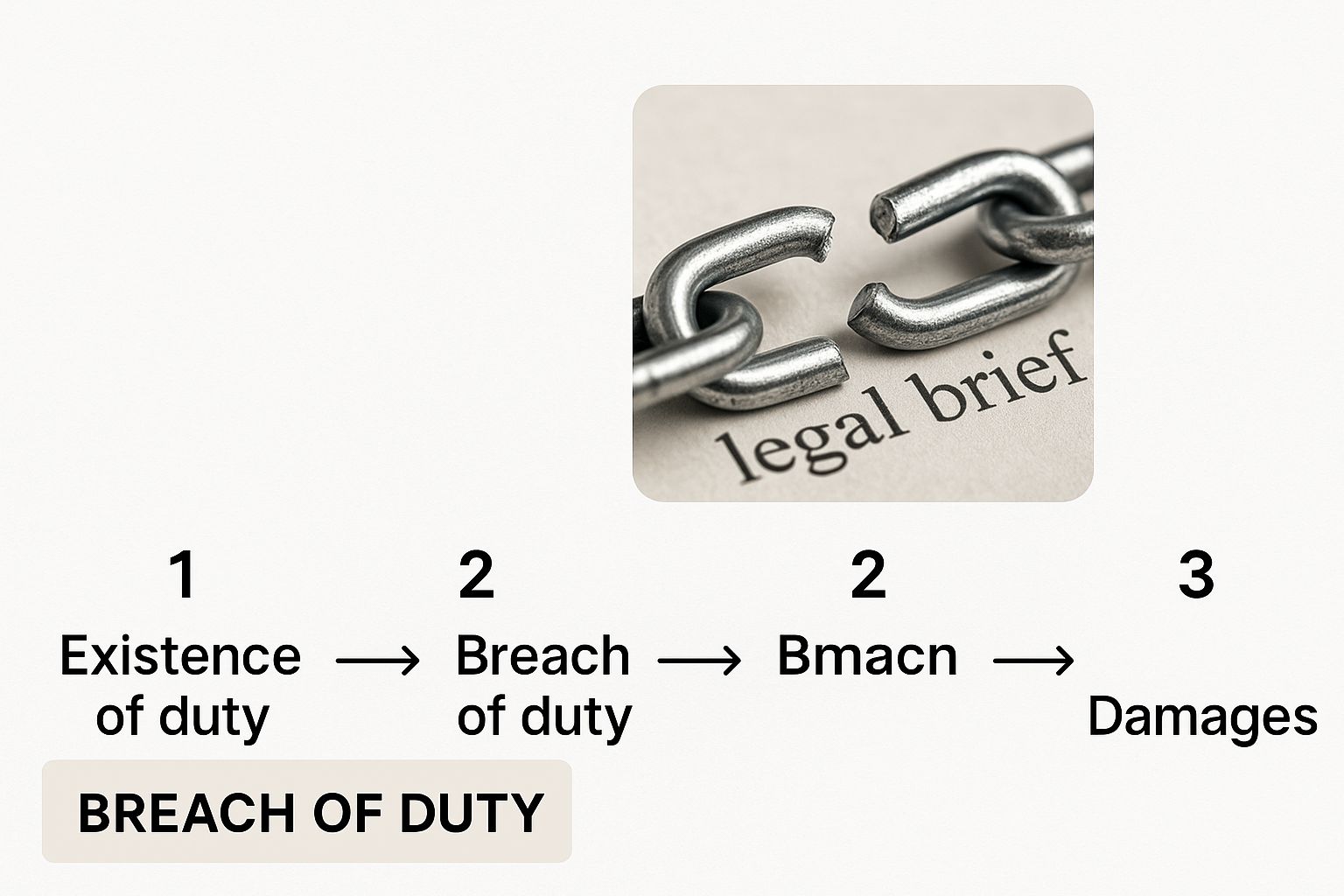
This image of a broken chain is a perfect visual for a breach of duty. It’s the single weak link that breaks the entire chain of responsibility, leading directly to an accident and your injuries.
Causation
This pillar is all about connecting the dots. It’s not enough to show someone was careless; you have to prove their carelessness is the direct reason you got hurt. We have to draw a straight line from their breach of duty to your injuries.
Legally, this involves two parts: "actual cause" and "proximate cause." Actual cause means that but for what they did, you wouldn't have been injured. Proximate cause means your injury was a predictable result of their action. Don't get too hung up on the legal jargon—in most car accidents, it's pretty straightforward. If someone runs a red light and T-bones your car, the causation is clear.
Damages
Finally, we have to prove you suffered actual harm, which we call damages. Without damages, you don't have a personal injury claim, even if the other person was clearly negligent. Damages are the real-world, measurable losses you've suffered because of the accident.
These can include a wide range of things:
- Medical Bills: The cost of the ambulance, ER visit, surgeries, follow-up appointments, and physical therapy.
- Lost Wages: The income you couldn't earn because your injuries kept you out of work.
- Pain and Suffering: Compensation for the physical pain and emotional trauma you’ve had to endure.
- Property Damage: The cost to get your car fixed or, if it's totaled, its replacement value.
It is absolutely important to start tracking these losses from day one. And remember, Georgia law puts a strict time limit on your right to file a claim. You can learn more about the statute of limitations for personal injury in Georgia to make sure you don't lose your chance to seek justice. Successfully proving these four pillars is exactly how you build a winning negligence claim.
Gathering Evidence to Show a Breach of Duty

Once we’ve established that someone owed you a duty of care, the next important step is proving they breached that duty. This is where the case moves from a legal concept to a collection of hard facts. We need solid, tangible evidence showing exactly how the other party failed to act with the reasonable care they were legally required to provide.
This evidence isn't just a formality; it's the very foundation of your claim. It's what turns your side of the story into a legally provable reality.
Capture the Scene Immediately
The minutes right after an incident are often the most valuable for evidence gathering. If you are physically able to do so, your smartphone is your most powerful tool.
- Photos and Videos: Don't just take one picture. Document everything from multiple angles. In a car crash, that means getting shots of the damage to all vehicles, any skid marks on the road, nearby traffic signs or signals, and the general layout of the intersection.
- The Specific Hazard: For a slip and fall, the most important photo is of whatever caused you to fall—be it a puddle, an icy patch of sidewalk, or a broken staircase. Just as important is documenting the absence of any warning signs.
- Environmental Conditions: What was the setting like? Was it raining? Were the streetlights working? Was a store aisle dim and poorly lit? These details add vital context and can help paint a clear picture of what happened.
Visual proof is incredibly persuasive. It provides a direct, unbiased look at the conditions and helps prevent key details from being disputed or forgotten later.
Official Reports and Witness Statements
Beyond what you can capture yourself, other records are essential for demonstrating a breach of duty.
A police report from a vehicle collision or an incident report from a business provides a formal, third-party account of what happened. While not the final word, these documents often contain important observations, witness contact information, and sometimes an initial assessment of who was at fault.
It's also vital to identify anyone who saw the incident. Get the names and contact information of any witnesses on the scene. An independent statement from someone with nothing to gain can be a powerful tool to corroborate your account and show that the other party was indeed careless.
The sheer volume of these cases highlights the importance of strong evidence. Across the U.S., nearly 400,000 personal injury claims are filed each year. A huge portion stems from motor vehicle accidents where proving a breach of duty—like distracted driving—is the central challenge.
By systematically gathering photos, official reports, and witness statements, you build the strong foundation needed to prove a breach of duty and hold the negligent party accountable.
Connecting the Breach to Your Injuries
Proving someone was careless isn't where the story ends. To have a successful claim, you must draw a direct and undeniable line from that person’s mistake to the specific injuries you suffered.
This important link is called causation, and from my experience, it’s the element insurance companies scrutinize the most. They will look for any opportunity to argue your injuries came from something else.
To build this connection, the law requires us to establish two separate but related ideas: cause-in-fact and proximate cause.
Think of it like this:
- Cause-in-Fact: This is the simple "but-for" test. But for the other driver running that stop sign, would you have a broken leg? If the answer is no, we’ve established cause-in-fact. It’s the direct, factual link.
- Proximate Cause: This test asks a different question: was your injury a foreseeable result of the careless act? A car crash causing whiplash is absolutely foreseeable. A car crash causing a meteor to fall from the sky and hit you? Not so much.
For most personal injury cases, like a distracted driver causing a pile-up on GA-400, both types of causation are fairly straightforward. The driver's breach of duty directly and foreseeably caused the collision and your resulting injuries.
Building an Undeniable Link
To make the connection between the incident and your harm undeniable, we rely on cold, hard facts. Your medical records are the bedrock of this proof.
Detailed notes from your doctor, reports from the emergency room, and diagnostic results like MRIs or X-rays all work together to create a medical timeline. This timeline must clearly show that your injuries appeared after the incident and are consistent with the type of accident that occurred.
Sometimes, an opinion from a medical expert is needed to cement this link. They can explain in precise medical terms how the force of the impact led directly to your specific condition, leaving no room for doubt.
The challenge of proving causation is starkly illustrated in medical malpractice cases. While medical errors are estimated to be a leading cause of death in the U.S., accounting for thousands of tragic losses, only about 1% of these events ever result in a claim.
This massive gap often exists because of the difficulty in legally proving that a specific medical error, and not an underlying condition, was the direct cause of harm. The economic fallout is staggering, with these mistakes costing the nation around $55 billion annually, according to research highlighted on ConsumerShield.com.
This data underscores just how high the bar is for proving every element of a negligence claim, especially causation.
In the most severe cases where negligence leads to a fatality, proving this link is absolutely paramount. Understanding your rights in these devastating situations is essential, and you can learn more from our dedicated guide on wrongful death claims in Atlanta. Successfully establishing causation is a non-negotiable part of winning your case.
Documenting the Full Extent of Your Damages
The final piece of a successful negligence claim is proving damages—the total, quantifiable harm you suffered from the incident. Without clear, documented damages, even a case with obvious carelessness has no legal path to compensation. This is where we build the complete picture of how the other party’s actions have impacted your life.
Thinking about damages goes far beyond the first hospital bill. To build a strong claim, you have to track every single loss, big and small. It's about creating a comprehensive inventory of the harm you've endured.
Tracking Financial and Property Losses
The most straightforward damages to document are the ones with a clear price tag attached. In legal terms, we call these economic damages. Your job here is to become a meticulous record-keeper.
Here’s a practical checklist to get you started:
- Medical Expenses: Gather every bill, receipt, and statement related to your care. This includes the ambulance ride, ER visit, surgeries, doctor appointments, physical therapy, prescription medications, and even assistive devices like crutches.
- Lost Income: Keep copies of your pay stubs from before the accident. We can use these to show the wages you lost while out of work. A letter from your employer confirming your rate of pay and the dates you missed is also powerful evidence.
- Future Medical Needs: If your doctor indicates you will need future treatments—like another surgery or long-term physical therapy—these projected costs must be included in your claim.
- Property Damage: For a car accident, this means getting repair estimates or documentation showing your vehicle was declared a total loss.
Damages are broken down into "economic" losses with a clear dollar value and "non-economic" losses, which are more subjective but just as real.
Capturing Pain and Suffering
Just as important are the non-economic damages. These are meant to compensate you for the physical pain and emotional distress caused by the injury—the kind of harm that doesn't come with a receipt.
So, how do you prove something so personal? The best tool is often a simple daily journal.
Taking just a few minutes each day to write down your physical pain levels, emotional state, and the ways the injury is limiting your daily activities can become incredibly powerful evidence. It creates a consistent, firsthand account of your suffering that is difficult for an insurance company to dismiss.
Documenting these losses is a vital step in all types of personal injury claims. By building a complete picture of your damages—both economic and non-economic—you are creating the factual foundation needed to demand fair compensation. Properly documenting your losses is essential when learning how to prove negligence.
Common Questions About Proving Negligence in Georgia
When you're trying to heal from an injury, the last thing you want is to be bogged down by confusing legal questions. It’s a lot to handle at once, and having clear information can make all the difference. To help, I’ve put together some plain-English answers to the most common concerns we hear from folks here in Georgia.
My goal is to give you direct answers that build your confidence about your rights. Understanding these key points is fundamental as you figure out how to prove negligence in your own situation.
What Happens if I Was Partially at Fault for My Accident?
This is one of the first questions people ask, and for good reason—it can directly impact whether you can recover money for your injuries. Georgia law has a specific rule for these situations called “modified comparative fault.”
In simple terms, it means you can still recover damages from the other party as long as a court or jury finds you to be less than 50% responsible for what happened. If your share of the blame hits 50% or more, Georgia law bars you from recovering anything at all.
If you are found to be partially at fault (but less than 50%), your final compensation award is simply reduced by your percentage of responsibility.
Here’s a real-world example: Imagine you’re awarded $100,000 in damages from a car accident, but the other side proves you were 20% at fault for being slightly over the speed limit. Under Georgia's rule, your $100,000 award would be reduced by that 20% ($20,000), meaning your final recovery would be $80,000.
This rule is officially laid out in the Official Code of Georgia Annotated (O.C.G.A.) § 51-12-33. It makes documenting the other party’s full share of the blame absolutely essential to your case.
How Long Do I Have to File an Injury Claim in Georgia?
Every state puts a strict deadline on the books for filing a lawsuit. It’s known as the statute of limitations. If you miss this deadline, you lose your legal right to seek compensation forever, no matter how strong your case is.
In Georgia, the statute of limitations for most personal injury claims is two years from the date of the injury. That might sound like a long time, but building a solid case requires a thorough investigation. Evidence disappears, and witnesses’ memories fade surprisingly fast.
While there are a few rare exceptions that can change this deadline, for the vast majority of cases—like car accidents, slip and falls, or dog bites—that two-year window is firm. The best way to protect your rights is always to act quickly.
Do I Always Need an Attorney to Prove Negligence?
Legally, you have the right to represent yourself. But in practice, proving negligence is a formal legal process with very specific rules.
If you handle a claim on your own, you’re responsible for:
- Collecting all the legally required evidence to prove every element of negligence.
- Understanding and following strict court procedures and filing deadlines.
- Negotiating with experienced insurance adjusters whose entire job is to pay out as little as possible.
- Accurately calculating all of your damages—past, present, and future.
An experienced personal injury attorney knows exactly what it takes to build a case that stands up to intense scrutiny. We handle the paperwork, the investigation, and the back-and-forth with the insurance company so you can put your energy where it belongs: on your recovery. Having a professional advocate fighting for you can dramatically improve your chances of a fair outcome.
At Jamie Ballard Law, we know you're going through a difficult time and need straightforward answers and compassionate support. If you've been injured and have more questions, we are here to help you understand your options with a free, no-obligation case evaluation. Let us help you get the justice and compensation you are entitled to. Contact us 24/7 for a free consultation.