As an Atlanta personal injury attorney, I often get the question, "what is res ipsa loquitur?" It's a Latin phrase that might sound formal, but its meaning is simple: "the thing speaks for itself." This legal idea is a helpful tool that allows injured people to show negligence even when there's no direct evidence explaining exactly how an accident happened.
A Simple Explanation of Res Ipsa Loquitur
Imagine walking down a street in Atlanta when a piece of scaffolding from a construction site falls and injures you. You didn't see anyone push it, and there are no cameras. So, how can you show someone was careless?
This is where res ipsa loquitur comes in. It allows a jury to infer negligence just from the nature of the accident itself.
The core thought is that some accidents are so unusual they just wouldn't happen unless someone made a mistake. The situation "speaks for itself." Instead of needing direct proof, the circumstances of your injury create a strong assumption that a party was at fault. In legal terms, this principle is a recognized form of circumstantial evidence.
The key idea is that the principle applies when an event ordinarily wouldn't occur without negligence, and the defendant had exclusive control over whatever caused the harm.
To make this even clearer, here is a quick summary of the main ideas.
Res Ipsa Loquitur at a Glance
| Concept | Simple Explanation |
|---|---|
| "The Thing Speaks for Itself" | The accident itself is strong evidence that someone was negligent. |
| No Direct Evidence Needed | You don't need a witness or video; the event implies fault. |
| Defendant's Exclusive Control | The person you are suing must have been in control of the object or situation that hurt you. |
| Shifts the Burden | It forces the defendant to prove they were not negligent, rather than you having to prove they were. |
This principle helps ensure that victims aren't left without a remedy just because the negligent act happened out of sight.
A Quick Look at Its History
This isn't a new concept. The principle of res ipsa loquitur has been a part of negligence law since it was first clearly defined in an 1863 British case, Byrne v. Boadle.
In that famous incident, a pedestrian was hit by a barrel of flour that fell from a shop window. The court decided that the accident itself was enough to assume negligence, establishing a legal precedent that is still used today.
Essentially, this principle provides a path to justice when the specific negligent act is hidden from view. While it's a helpful tool, it's just one of many important concepts in personal injury law. For more definitions of legal terms you might encounter, feel free to check out our firm's legal dictionary. Understanding what is res ipsa loquitur is the first step in seeing how it might apply to real-world situations.
The Three Elements You Must Prove
To successfully use res ipsa loquitur, your case has to meet three specific conditions. It’s not enough to just have a gut feeling that someone was careless; the situation must pass a clear legal test. Think of them like ingredients in a recipe—if one is missing, the whole argument may not hold up.
Let's walk through each one with real-world examples to make them easy to understand.
1. The Incident Doesn't Normally Happen Without Negligence
First, the event that led to your injury has to be the kind of thing that doesn't ordinarily happen unless someone was careless. A surgical sponge isn’t supposed to be left inside a patient after an operation. An elevator shouldn't suddenly plummet three floors. These situations just scream that a duty of care was breached.
The law allows for common sense here. While bizarre, one-off accidents can happen, some incidents are so far outside the norm they almost automatically point to a failure of responsibility. This element is what separates a true, unavoidable accident from an incident caused by obvious carelessness.
2. The Defendant Had Exclusive Control
Second, you must show that the thing that hurt you—whether it was an object or a situation—was under the defendant's exclusive control. This is a very important point. If a chair in a restaurant breaks the moment you sit on it, the restaurant owner had exclusive control over its inspection and maintenance. You, as the customer, had none.
This decision tree helps visualize the logical steps for determining if res ipsa loquitur is a good fit for an accident.
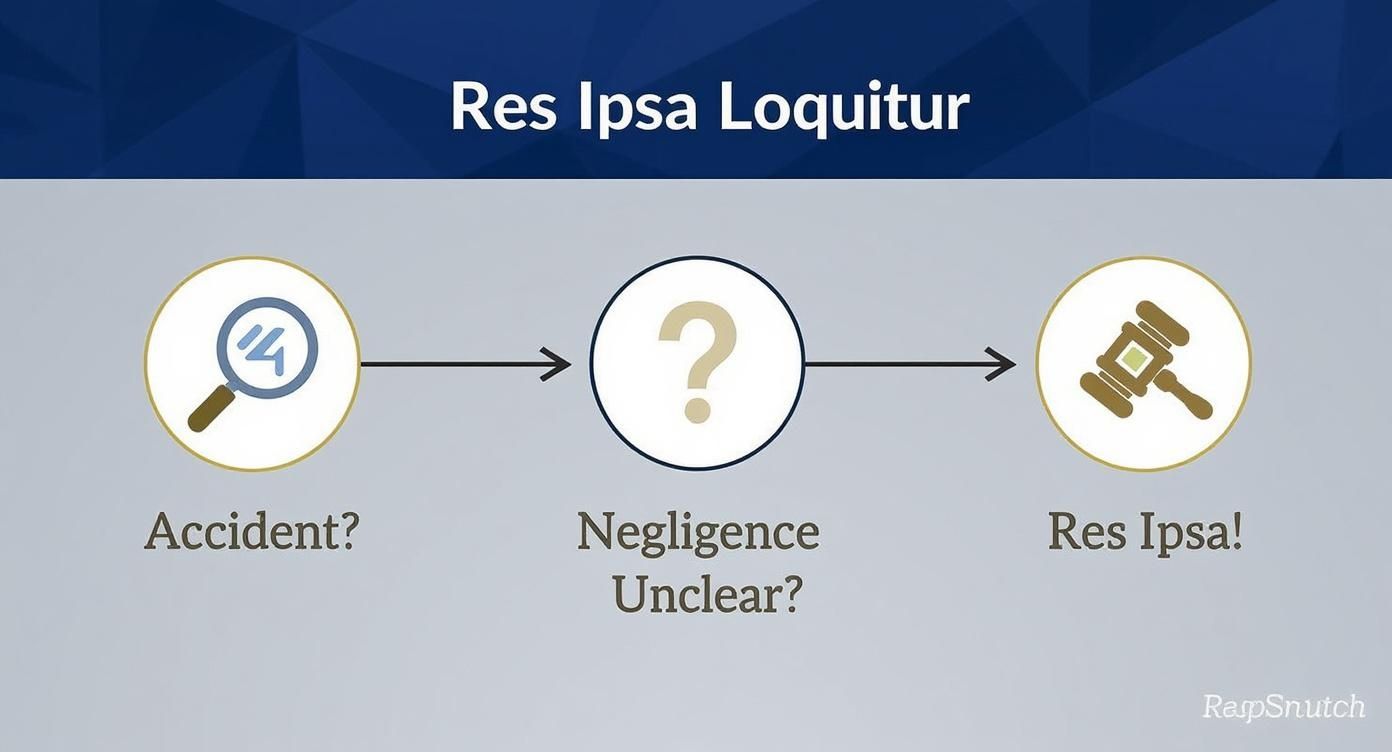
As the diagram shows, the principle is a logical path forward when you don't have direct proof, but the circumstances strongly suggest who is at fault. Essentially, establishing control pinpoints responsibility. If multiple people had control, it gets much harder to make the case. For a deeper dive, resources like the Legal Information Institute at Cornell Law School offer more detail on these principles.
3. You Did Not Contribute to the Injury
Finally, it must be very clear that you did nothing to cause or contribute to your own injury. Your role has to be completely passive.
- You were a passenger in an elevator that malfunctioned.
- You were unconscious on an operating table when a surgical mistake was made.
- You were walking on a public sidewalk when a piece of equipment fell from a construction site.
In each scenario, the injured person didn't bring the harm upon themselves. This final requirement ensures the principle is used fairly, focusing the blame squarely on the party whose negligence was the most likely cause. Understanding these three elements is the first step in deciding if you can use the helpful tool of res ipsa loquitur.
How This Doctrine Shifts the Burden of Proof
In a typical personal injury lawsuit, the person who was hurt—the plaintiff—has the entire burden of proof. This means it's your job to present evidence convincing enough to show a judge or jury that the other party was negligent and caused your injuries. That can be a tall order, especially when you don't have all the facts.
But when res ipsa loquitur comes into play, the dynamic changes. The principle creates a powerful legal inference of negligence. Once your attorney successfully shows the three required elements we discussed, the legal responsibility flips.
The Defendant Is Now on the Defensive
Instead of you having to prove exactly what the defendant did wrong, the burden shifts to them to prove they were not negligent. Suddenly, they're the ones who have to explain precisely what happened and provide evidence showing they acted with reasonable care.
This shift can be a real game-changer. It essentially tells the defendant, "This accident strongly points to your fault. Now, it's your turn to prove otherwise." This is incredibly valuable in cases where the victim was powerless or lacked information—like being unconscious during a medical procedure or getting hurt inside a secure area they didn't control.
This legal principle is formally recognized across the country. In the United States, for instance, California’s Evidence Code Section 646 codified the doctrine back in 1970, defining res ipsa loquitur as a presumption that affects the burden of producing evidence. After a plaintiff meets the initial criteria, the defendant must present evidence to rebut the presumption of their negligence. You can discover more about how this legal presumption works and its long history in American law.
Strengthening Your Claim for Compensation
Flipping the usual burden of proof can dramatically strengthen your claim for compensation. It stops a defendant from simply staying quiet and winning by default just because you can't produce the specific, direct evidence to pinpoint their mistake.
The core function of shifting the burden is to create a fair playing field. It acknowledges that the party in control of the situation is also the one with the most information about what went wrong.
Ultimately, this legal tool holds defendants accountable by forcing them to come up with answers. It ensures that when an accident truly "speaks for itself," the responsible party can't hide behind a lack of direct proof. Understanding this process is fundamental to grasping what is res ipsa loquitur and why it's so important for achieving justice.
Real-World Examples of Res Ipsa Loquitur Cases
Abstract legal concepts can be confusing, but seeing them in action makes all the difference. To really grasp what res ipsa loquitur means, let's move beyond the definition and look at a few scenarios where this principle is a game-changer in a personal injury case.
These aren't just hypotheticals; they're situations that happen every day, showing how the three key elements come together to build a strong claim.
Sometimes, the injury itself tells the whole story, pointing directly to negligence even when no one saw exactly what went wrong.
Medical Malpractice Mishaps
Nowhere is this principle more important than in a hospital or operating room. When a patient is unconscious, they are completely vulnerable and have no way to know what happened if they wake up with an unexpected injury.
Picture a patient named David who goes in for a routine appendectomy. He comes out of surgery with severe and permanent nerve damage in his left arm, a part of his body completely unrelated to the procedure. He was healthy going in, unconscious during the event, and now faces a lifelong impairment. The surgical team is silent.
Here’s how the principle applies:
- Injury Doesn't Happen Without Negligence: A patient undergoing appendix surgery shouldn't suffer arm nerve damage. Common sense tells us this kind of injury only happens if someone was careless in positioning or monitoring him.
- Defendant Had Exclusive Control: While David was under anesthesia, the surgeon, anesthesiologist, and nurses had complete control over his body and the entire operating room. No one else did.
- Patient Did Not Contribute: David was unconscious. It was impossible for him to have caused his own injury.
In cases like this, the injury itself becomes the evidence. These claims can be very involved, which is why it’s important to understand your rights. An experienced Atlanta medical malpractice lawyer can be essential in investigating what really happened behind closed doors.
Premises Liability Incidents
Property owners are required to keep their spaces reasonably safe for guests and customers. When something happens that simply shouldn't occur without some kind of oversight, res ipsa loquitur can give an injured victim a clear path forward.
Imagine a family enjoying dinner on a restaurant's outdoor patio. Without warning, a heavy light fixture breaks free from the ceiling and crashes onto their table, injuring a diner. There was no earthquake, no storm, and no one was tampering with it.
The core idea here is that objects like heavy ceiling fixtures, when properly installed and maintained, do not just fall on their own. The event itself creates a strong inference of a safety failure.
This situation fits the principle perfectly. The restaurant owner had exclusive control over maintaining the building and its fixtures. The diners, on the other hand, did absolutely nothing to cause the fixture to fall.
Product Liability Failures
Sometimes a product is so dangerously flawed that its failure can only be explained by a mistake made during manufacturing.
Let's say a homeowner buys a brand-new toaster from a well-known department store. The very first time she plugs it in and uses it according to the instructions, it sparks, bursts into flames, and gives her a serious burn. She didn't misuse it or modify it in any way.
The elements line up cleanly:
- A new toaster shouldn't catch fire during its first normal use.
- The manufacturer had exclusive control over the product's design, assembly, and quality checks.
- The homeowner did nothing to contribute to the malfunction.
The fire "speaks for itself," pointing to a defect that was present when the product left the factory. In all these examples, res ipsa loquitur acts as a valuable tool, creating a pathway to justice when direct proof is impossible to find.
Common Defenses and Potential Limitations
Just because an accident seems to "speak for itself" doesn't mean it's an automatic win. Using res ipsa loquitur is a helpful tool, but you can be sure the defendant will have a legal team ready to fight back and explain why they weren't at fault. Understanding their common defenses and the principle's roadblocks is key to seeing the full picture of a personal injury claim.
An experienced defense attorney will immediately look for ways to dismantle the inference of negligence. Their job isn't necessarily to prove exactly what happened, but to introduce enough evidence to create reasonable doubt about their client's responsibility.
Common Arguments a Defendant Might Use
When faced with a res ipsa loquitur claim, a defendant’s strategy is almost always to attack one of the three core elements required for the principle to apply. They want to show the court that the situation isn't as clear-cut as you claim.
Here are some of the most frequent arguments you'll encounter:
- Act of God: The defense might argue the accident was caused by a natural event completely beyond their control. For instance, if a securely fastened sign fell during an unprecedented tornado, they would claim the storm—not their negligence—was the sole cause. An "Act of God" is a legal term for events outside of human control, for which no one can be held responsible.
- Shared Control: They may try to show they did not have exclusive control over the object or situation. If a piece of rental equipment malfunctions and causes an injury, the defendant could point to the rental company or a third-party maintenance crew as also having control, effectively muddying the waters of responsibility.
- Your Contribution to the Injury: A defense attorney will always hunt for evidence that you, the injured party, contributed to the accident. If they can show you ignored clear warning signs or used a product improperly, they will argue your own actions were the true cause of the harm.
Limitations of the Doctrine
Beyond these direct defenses, res ipsa loquitur has its own built-in limitations. The biggest challenge often appears when multiple parties could potentially be at fault.
When several different contractors work on a construction site, for instance, pinpointing who had exclusive control over the specific area where an accident occurred can be a major hurdle.
This is precisely why a thorough investigation from day one is so important. Relying on the principle alone without gathering hard, supporting evidence is a risky move. The court needs a clear, logical path to infer negligence, and any ambiguity will weaken your position.
A defendant can also present their own evidence of reasonable care—like detailed maintenance logs or proof of adherence to industry safety standards—to counter the claim that the event could only happen due to negligence. This shows why a true understanding of what is res ipsa loquitur requires knowing both its strengths and its very real weaknesses.
Practical Steps to Take After an Injury
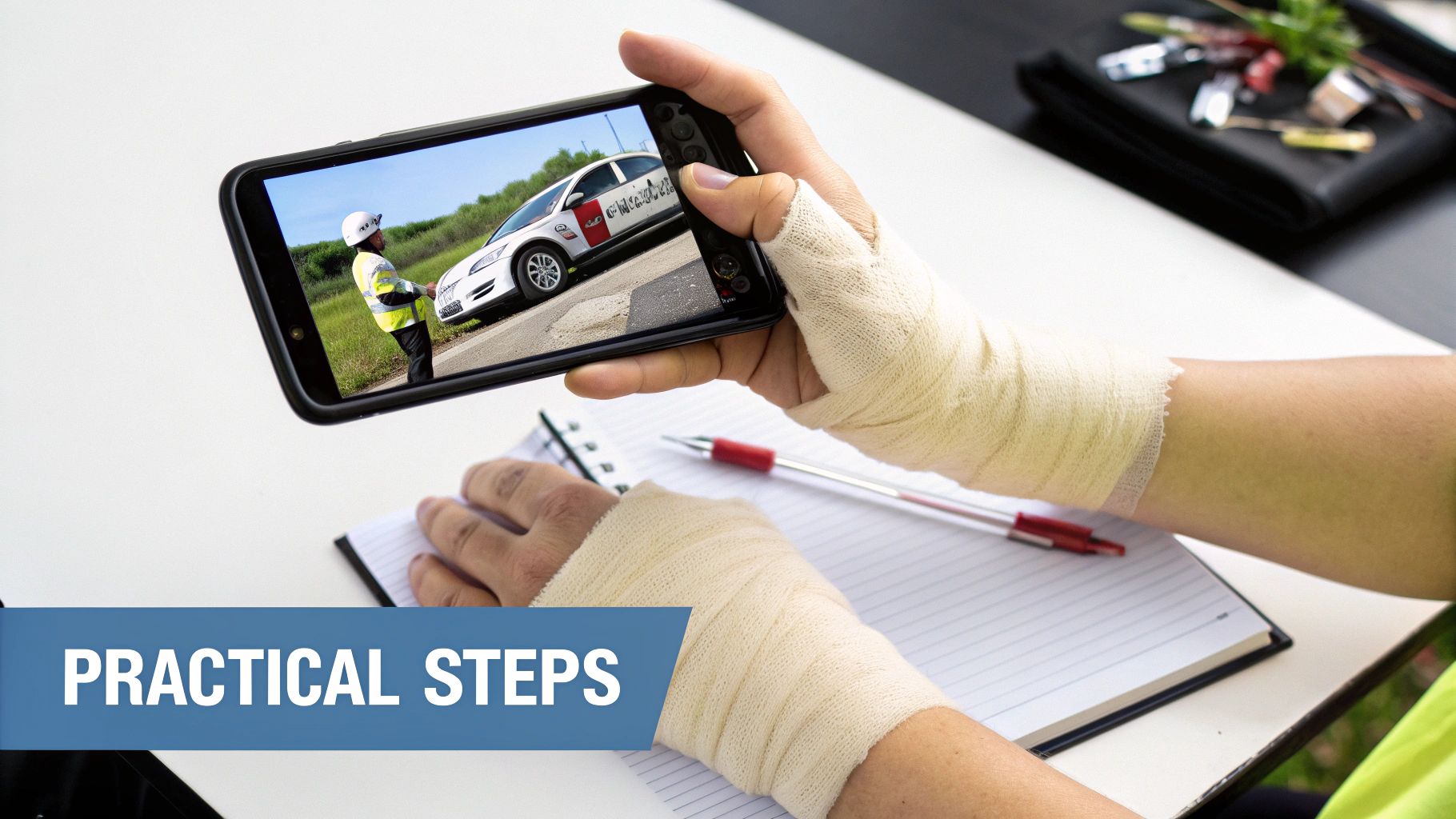
If you've been hurt in an incident where negligence feels obvious but is difficult to prove directly, understanding the concept of res ipsa loquitur is just the first step. The actions you take immediately after the injury are very important for protecting your legal rights and building a strong foundation for a potential claim.
Acting quickly and methodically can make a profound difference in the outcome. Your top priority should always be preserving any and all evidence. In the moments after an accident, details that seem minor can become very important down the road.
Document Everything Immediately
The scene of an injury can be cleaned up or altered in minutes, so capturing it exactly as it was is invaluable. This documentation creates a snapshot in time, preserving facts that memory alone can't reliably hold.
Here are the key actions to take:
- Take Photos and Videos: Use your smartphone to document everything. This includes the exact location, the object that caused the harm, visible property damage, and, of course, your injuries. Get multiple angles—close-ups to show detail and wider shots to provide context.
- Write It All Down: As soon as you are able, write down every detail you can recall. Note the date, time, weather conditions, and precisely what you were doing when the incident occurred. No detail is too small to include in your notes.
- Get Witness Information: If anyone saw what happened, ask for their name and phone number. A statement from an unbiased third party can be incredibly persuasive.
Seek Medical Attention and Speak with an Attorney
Your health is the absolute priority. Getting prompt medical care not only begins your recovery process but also creates an official record that links the accident to your injuries. This medical documentation is a cornerstone of any personal injury case.
Following an injury, taking the right actions is about protecting both your health and your legal options. Each step, from gathering evidence to consulting a professional, helps ensure you are in the best possible position to seek fair compensation.
Finally, one of the most important steps is to speak with an experienced personal injury attorney. A lawyer can evaluate the specific facts of your case, help you understand the details of personal injury claims, and determine if the principle of res ipsa loquitur is a viable path forward for your situation.
Frequently Asked Questions
Clients often have great questions about how res ipsa loquitur works in practice. Here are a few we hear all the time.
Does This Doctrine Guarantee a Win?
No, it doesn't. Think of it as a helpful tool that gets your foot in the door when you don't have direct proof.
The principle creates a strong inference of negligence, which shifts the burden of proof to the defendant. It's now their job to explain how they weren't negligent. They can still present evidence showing they acted with reasonable care, and a judge or jury will make the final call based on everything presented.
Can It Be Used in Any Injury Case?
Res ipsa loquitur is most effective in specific situations, usually where direct evidence is missing but the circumstances scream negligence. It’s a common feature in medical malpractice cases or premises liability claims involving things like falling objects.
It's less common in a typical car accident, where direct evidence like traffic camera footage, witness statements, and police reports are usually available. It’s also important to act fast, as Georgia has strict deadlines. To learn more about these time limits, you can read about the statute of limitations for personal injury in Georgia.
Ultimately, understanding what is res ipsa loquitur is the first step toward figuring out if it applies to your case.