When a loved one is taken from you because of another's negligence or intentional act, the grief can feel overwhelming. Georgia wrongful death law exists for this exact situation, offering a clear path for surviving family members to seek justice and financial stability. This is a civil claim, completely separate from any criminal charges, focused on compensating survivors for the tremendous void left in their lives. The goal is to provide real help and hold the responsible party accountable for their actions.
What Happens After a Tragic Loss in Georgia

After a family member's death, the legal system can seem like the last thing you want to handle. But a wrongful death claim serves an essential purpose: it holds the responsible party accountable and provides meaningful support for the family left behind. It’s a legal acknowledgment that the loss isn't just emotional but has a real, tangible financial impact.
A wrongful death can happen in many ways, but it always stems from one party’s failure to act with reasonable care, resulting in a fatality. In Georgia, we often see these cases arise from:
- Vehicle Accidents: Collisions caused by drunk, distracted, or dangerously reckless drivers.
- Medical Malpractice: Fatal mistakes made by doctors or hospitals, like a misdiagnosis or a surgical error.
- Unsafe Properties: Tragic incidents on a property where the owner knew about a hazard but did nothing to fix it.
- Defective Products: When a faulty product, used as intended, causes a fatal injury.
Understanding the Goal of a Wrongful Death Claim
It's helpful to know that a wrongful death action isn't about sending someone to jail—that's the job of a criminal case. A civil claim is about securing financial recovery for the survivors to cover both the concrete and the deeply personal losses they now face. Gaining a basic understanding of the initial legal intake process can help clarify how these cases begin.
The value of these claims can vary significantly. Wrongful death settlements in Georgia, especially those from car accidents, frequently fall between $500,000 and over $3.5 million. A case with clear fault involving a moderate-income earner might settle near the lower end, while those involving high-income earners or extreme negligence can easily surpass $2.5 million.
The core idea behind a wrongful death claim is to recognize the full value of the life that was lost. This goes beyond just calculating lost income; it also considers the personal joy, companionship, and experiences the deceased will miss, as viewed from their perspective.
Ultimately, Georgia law provides a way for families to seek justice and get back on their feet after a life-altering loss. Understanding the fundamentals of Georgia wrongful death law is the first step toward protecting your family’s future.
Identifying Who Is Eligible to File a Claim
When a family is reeling from a loss, one of the first questions under Georgia wrongful death law is, "Who actually has the right to take legal action?" The answer is very specific. Georgia law establishes a clear order of priority. This isn't just a legal formality—it's a system designed to ensure the claim is brought by those most directly devastated by the death.
Think of it as a legal family tree. Specific branches have the right to file a claim before others, and the law doesn't allow just any grieving relative to step forward. This hierarchy keeps the process focused on the closest surviving family members.
The Primary Right Holder: The Surviving Spouse
At the very top of this hierarchy is the surviving spouse. If the person who passed away was married, their husband or wife holds the primary and exclusive right to file the wrongful death claim. This right is absolute. No other family member can jump ahead in line.
However, the law also builds in protection for any minor children left behind. Even though the spouse files the claim, they are legally required to share any recovered compensation with the children. Georgia law mandates that the spouse must receive at least one-third of the total recovery, no matter how many children there are. This ensures both the spouse and children are financially provided for.
When Children and Parents Can File
So, what happens if there is no surviving spouse? In that case, the right to file passes directly to the deceased's children. They would then act together to bring the claim on the family’s behalf.
If the deceased was unmarried and had no children, the line of succession moves to the next level: the surviving parent or parents. They would then hold the right to pursue a wrongful death action for the loss of their child.
This infographic clearly lays out the hierarchy for who is eligible to file.
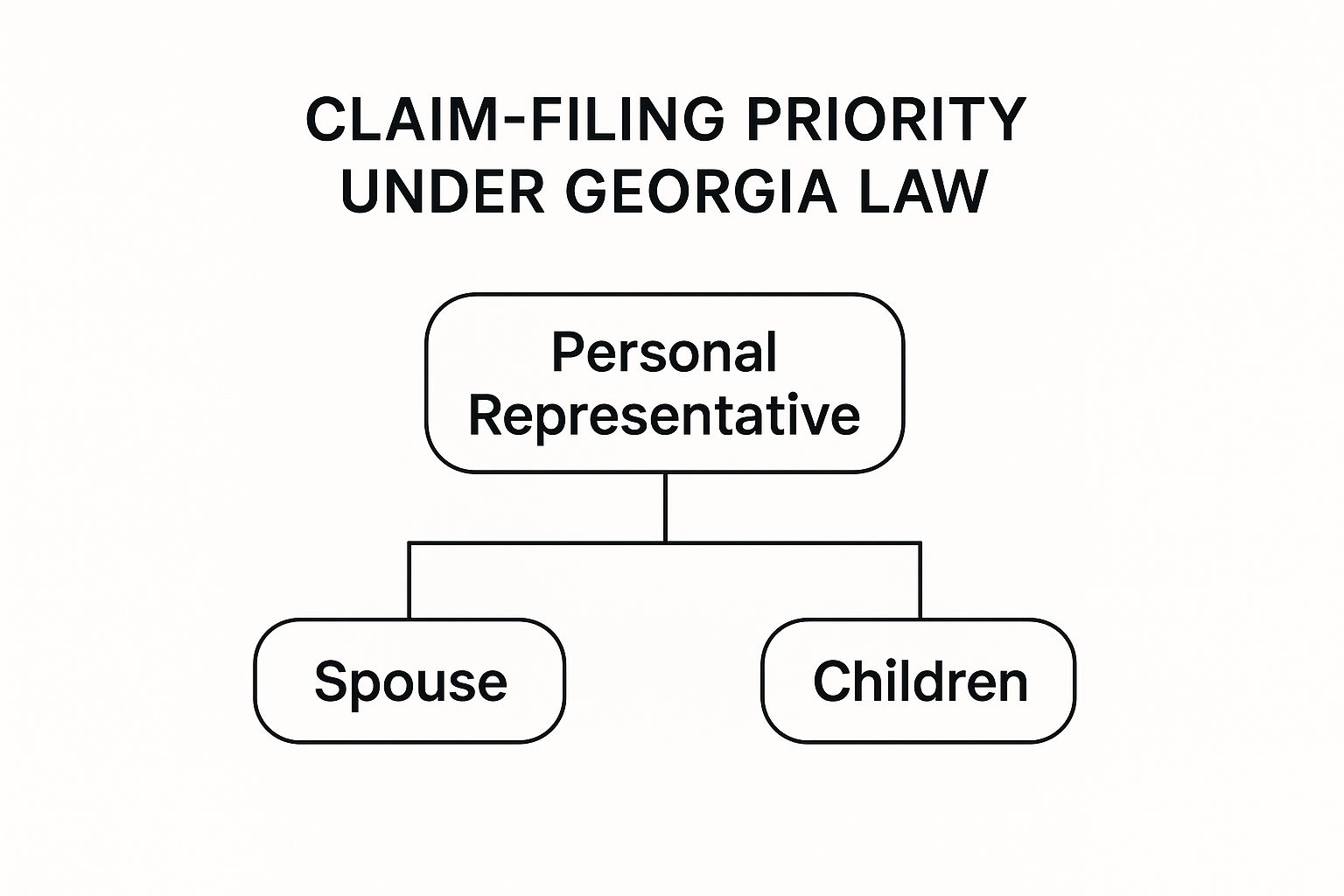
As you can see, the law is very specific: spouse first, then children, then parents. Only after these immediate family members are accounted for does the estate get involved.
The Role of the Estate's Personal Representative
In the tragic event that the deceased has no surviving spouse, children, or parents, the right to file the claim then falls to the personal representative of the deceased’s estate. This person, often called an executor or administrator, is appointed by the probate court to manage the estate's affairs.
It's important to know that the personal representative can also file a separate but related "estate claim" even when there are surviving family members. This type of claim is meant to recover different damages, such as medical bills incurred before death and funeral expenses, which we'll cover in more detail later.
Understanding this legal pecking order is a foundational piece of the puzzle. The rules are structured to make sure the process for filing a claim under Georgia wrongful death law is clear from the start. For a deeper dive into how these claims are managed, learning more about the role of a wrongful death lawyer can provide additional clarity.
The Two Claims Available in a Wrongful Death Action
When you're dealing with a wrongful death case in Georgia, it helps to understand that it’s not just one single claim. The law actually creates two distinct legal actions that run in parallel. Think of them as two sides of the same coin—each one represents a different, but equally important, part of the loss.
This two-part structure is designed to provide a more complete picture of the damages. One claim focuses on the loss suffered by the surviving family, while the other addresses the suffering and expenses the deceased person endured before they passed.
Claim 1: The Full Value of the Life of the Decedent
This is the main wrongful death claim, and it’s a concept unique to Georgia law. The goal here is to recover the “full value of the life of the decedent,” which is a legal term that means much more than just lost wages. This claim is filed by the eligible survivors—the spouse, children, or parents.
The "full value of life" is measured from the perspective of the person who died. It asks a powerful question: What did this person lose? The answer has two parts:
- Tangible Value: This is the economic side of things. It includes all the future income, benefits, and retirement funds the person would have earned if their life hadn't been cut short.
- Intangible Value: This is the non-economic component, and it's arguably the most profound. It represents the immeasurable value of life itself—the joy of being a parent, the companionship of a spouse, the pleasure from hobbies, and all the personal experiences that were stolen.
Georgia law recognizes that a life is more than a paycheck. It’s the sum of all the future moments, relationships, and joys that a person will now never get to experience.
Claim 2: The Estate Claim
The second cause of action is called the “estate claim.” This claim is brought by the personal representative or administrator of the deceased person’s estate. Its purpose is entirely different from the first claim.
While the wrongful death claim compensates the family for their future loss, the estate claim is there to recover losses the deceased person and their estate suffered directly. It’s about settling the financial and personal costs that stacked up before the death occurred.
An estate claim typically covers these specific damages:
- Final Medical Expenses: Any bills from the hospital, ambulance, or other treatments related to the fatal injury.
- Conscious Pain and Suffering: This compensates for any physical pain, fear, or emotional trauma the person went through between the moment of injury and their passing.
- Funeral and Burial Expenses: The costs required to lay the deceased to rest with dignity.
Understanding the difference between these two claims is a core part of handling personal injury claims in Georgia. Between 2013 and 2022, Georgia actually ranked fifth in the U.S. for the number of "nuclear verdicts"—jury awards that often top $10 million. The state's unique "full value of life" standard is a huge factor in why those outcomes are possible.
Ultimately, these two claims work together. The main wrongful death action compensates the family for the future they were robbed of, while the estate claim closes the books on the debts and suffering from the final moments of their loved one's life. Together, they aim to provide a full measure of justice under Georgia wrongful death law.
Calculating the Full Value of Life and Other Damages
When a family is grappling with a wrongful death claim in Georgia, one of the most important concepts they’ll hear is the "full value of the life of the decedent." This isn't just legal jargon; it's a unique principle in Georgia wrongful death law that sets our state apart. It recognizes that a life is infinitely more than a paycheck. It's the sum total of all the moments, relationships, and contributions that were stolen away.
The best way to get your head around this is to break it into two distinct parts: the tangible and the intangible.

The Tangible Value: Economic Losses
The tangible side of the calculation is the more straightforward, numbers-driven part. Here, we're adding up the measurable financial support the person would have provided their family had they lived a full life. It’s all about quantifying the economic hole their absence has created.
This includes things like:
- Lost Future Income: A projection of all the wages, salaries, and potential bonuses the person would have earned up until they would have naturally retired.
- Loss of Benefits: This covers the value of benefits the family depended on, like health insurance, retirement contributions (think 401(k) matching), and other job perks.
- Value of Services: This is a big one that's often overlooked. It accounts for all the unpaid but essential work the person did for the family—childcare, home maintenance, cooking, managing the bills. Now, the family might have to pay someone else to handle those tasks.
The Intangible Value: Loss of Life's Joys
This is where Georgia's law really shows its depth. The intangible, or non-economic, part of the claim looks at the value of life from the perspective of the person who died. It forces us to ask a deeply human question: What joys and experiences did this person lose out on?
Under Georgia law, the intangible value of a life is the immeasurable worth of the human experience itself. It's the loss of future laughter, the pride of watching children grow, the comfort of a lifelong partnership, and the simple pleasure of living.
This isn't about what the family lost; it's about what the deceased lost. A jury is asked to consider the richness of the life that was taken away, making this a profound and powerful element of any wrongful death case.
Damages Available Through the Estate Claim
Beyond the "full value of life" claim, a separate but related claim can be filed by the deceased’s estate. This is often called a survival action, and it covers the specific costs and suffering that took place between the fatal injury and the moment of death.
The estate claim helps recover damages for:
- Final Medical Bills: Ambulance rides, emergency room care, hospital stays, and any other treatments connected to the final injury.
- Funeral and Burial Costs: The necessary expenses to lay a loved one to rest with dignity.
- Conscious Pain and Suffering: This is compensation for any fear, pain, or emotional distress the person endured before they passed away.
To help clarify the two distinct types of claims, here’s a quick breakdown of what each one covers and who benefits.
Types of Recoverable Damages in a Georgia Wrongful Death Case
| Type of Claim | Damages Covered | Who Receives the Compensation |
|---|---|---|
| Wrongful Death Claim | The "full value of the life of the decedent," including tangible (economic) and intangible (non-economic) losses from the deceased's perspective. | Statutory beneficiaries, such as a surviving spouse, children, or parents. |
| Estate Claim | Financial losses incurred by the estate, including final medical bills, funeral costs, and the deceased's conscious pain and suffering before death. | The deceased's estate, which is then distributed to heirs according to a will or state law. |
Once you’ve put all these pieces together, the next step is formally presenting the claim to the insurance company. This is typically done by writing an effective insurance demand letter that clearly lays out the facts and the calculated damages.
Georgia juries have shown they take this responsibility seriously. We’ve seen major wrongful death verdicts across the state, including $25.7 million in Hall County and $25.5 million in Fulton County. More recently, another $28 million verdict was handed down in April 2024, showing a clear trend. These substantial awards prove that when presented properly, the full value of a life is something Georgia juries are prepared to recognize under Georgia wrongful death law.
Georgia's Wrongful Death Statute of Limitations
In any legal matter, timing is everything. For families considering a claim under Georgia wrongful death law, there’s a specific window to file, known as the statute of limitations. Think of it as a legal deadline. If you miss it, you could lose your right to seek justice forever.
The general rule in Georgia is pretty clear: a wrongful death lawsuit must be filed within two years of the person's date of death. It's important to note that this clock starts ticking on the day the loss occurred, not necessarily on the day of the incident that caused the fatal injury.
When the Clock Can Pause
While that two-year deadline is firm, Georgia law does account for specific situations that can make it impossible to move forward right away. In these instances, the statute of limitations can be “tolled”—a legal term that simply means paused.
Here are a couple of common reasons the clock might be tolled:
- Pending Criminal Case: If the death resulted from a criminal act, like a DUI fatality or a homicide, the two-year deadline for the civil wrongful death claim can be paused until the criminal case is resolved. This allows the criminal justice process to take its course first.
- An Unrepresented Estate: If the deceased’s estate doesn't have a personal representative appointed, the deadline can be paused for up to five years. This gives the probate court time to appoint someone to act on the estate’s behalf.
This screenshot from the Georgia Courts FAQ page offers a glimpse into the structured nature of legal proceedings in our state.
Official information like this just underscores that the legal system runs on hard and fast rules. It’s why understanding the specific deadlines that apply to your family’s situation is so important.
It's a common misconception that the two-year clock is flexible. While exceptions exist, they are very specific and don't apply to most cases. Assuming an extension applies without getting confirmation from an attorney can be a devastating mistake.
The Estate's Role in Extending Time
The involvement of the deceased person's estate can sometimes add another layer to the timeline. As mentioned, the statute can pause for up to five years if an estate isn’t probated and no representative is named. Once a representative is finally appointed, the clock starts running again.
This rule is particularly important when the deceased person has no surviving spouse, children, or parents. In that scenario, the estate’s representative is the one who files the wrongful death claim.
The statute of limitations is a strict, unforgiving rule. It’s one of the most important aspects of these cases because missing it can permanently bar a family from seeking accountability. While the rules for wrongful death differ slightly, you can learn more about the general deadlines in our state by reading about the statute of limitations for personal injury in GA.
Acting promptly is always the best way to preserve your family's rights under Georgia wrongful death law.
Common Misunderstandings About Wrongful Death

After a devastating loss, families are often bombarded with well-meaning but incorrect advice. The myths and misinformation swirling around Georgia wrongful death law can add a layer of confusion to an already unbearable time. Let's clear up a few common misunderstandings to provide a clearer path forward.
One of the most damaging myths is that you can’t file a claim if your loved one was retired, unemployed, or a stay-at-home parent. This is absolutely false in Georgia. The law rightly recognizes that a person's value is never defined by a paycheck.
The legal standard in Georgia is the “full value of the life.” This includes both the tangible (economic losses) and the intangible aspects of a life. A jury will consider the loss of companionship, guidance, and the personal joy of living—things that are immeasurable in dollars but are at the very heart of the claim.
Misconception 1: The Criminal Case Must Finish First
Many people believe a civil wrongful death claim has to wait until any related criminal proceedings are over. While the two cases are connected, you do not have to wait for a criminal conviction—or even for charges to be filed—to initiate a civil lawsuit.
The burden of proof is much lower in a civil case. In a criminal court, guilt must be proven “beyond a reasonable doubt.” A civil claim, however, only requires proof by a “preponderance of the evidence,” which simply means it was more likely than not that the defendant’s actions caused the death. To see how these claims are structured in practice, learning more from an experienced wrongful death lawyer is a helpful step.
Misconception 2: The Deceased Must Have a Perfect Record
Another harmful myth is the idea that the deceased must have been a "perfect" person for a claim to succeed. Defense attorneys may try to argue that the victim was partially at fault for their own death to reduce their client's liability. However, Georgia follows a legal principle called modified comparative negligence.
This standard means a family can still recover damages as long as the deceased was less than 50% responsible for the incident that caused their death. Here’s how it works:
- If a jury decides the deceased was 20% at fault, the total compensation award is simply reduced by 20%.
- If the deceased is found to be 50% or more at fault, the family is barred from recovering any damages.
It’s about fairness and proportion, not perfection.
Debunking these common myths is the first step toward understanding your rights. The truth is that Georgia wrongful death law is designed to provide a path to justice for survivors, regardless of their loved one's job or the details of a parallel criminal case.
Frequently Asked Questions
When a family is trying to find its footing after a devastating loss, questions are completely natural. Here are some straightforward answers to the common concerns we hear about Georgia wrongful death law, designed to bring a little clarity during an overwhelming time.
How Long Does a Wrongful Death Case Take to Resolve?
There’s no single timeline for a wrongful death case in Georgia; it really depends on the facts. If the evidence is straightforward and the insurance company is reasonable, a case might settle in several months.
However, situations needing deep investigation or that end up going to trial can easily take a year or more. Things like disputes over who was at fault or detailed calculations for future losses will almost always extend the timeline. Patience is key to making sure the final result is a just one.
Are Wrongful Death Settlements Taxable in Georgia?
This is an important question for any family trying to plan for the future. The short answer is that, generally, compensation for the "full value of the life" in a wrongful death claim is not considered taxable income by either the IRS or the state of Georgia.
But there’s a small detail here. If a part of the settlement is for the estate claim—covering things like the deceased’s lost wages or punitive damages (which are rare)—that portion could be taxed. It’s always best to talk with a financial advisor about your specific settlement. The IRS website also offers some general guidance on how settlements are treated.
What If the At-Fault Person Also Died in the Accident?
Tragically, it’s not unusual for the person responsible for an accident to also lose their life. If this happens, you can absolutely still file a wrongful death claim.
The process just looks a little different. Instead of suing the person directly, the claim is filed against their estate. The defendant in the case becomes the personal representative of that estate, and any settlement or award is typically paid by the deceased’s liability insurance, like an auto policy. While the legal mechanics change, your family’s right to seek justice under Georgia wrongful death law does not.
At Jamie Ballard Law, we know that no amount of money can ever replace your loved one. Our mission is to give you the support and legal guidance you need to secure your family's future and hold the responsible parties accountable. For a free, no-obligation consultation to discuss your case, please get in touch with us at https://jamieballardlaw.com.