When you're pursuing a personal injury claim here in Atlanta, the finish line often involves a document called a settlement release agreement. This isn't just another piece of paperwork; it's a binding contract that officially puts an end to your legal dispute. As an Atlanta Personal Injury attorney, I always explain to my clients that signing this document is the final step that closes their claim permanently. It's like the formal, on-paper handshake that finalizes everything.
Understanding Your Settlement Release Agreement

After an injury, the road to getting compensation can feel long. The settlement release agreement is the very last part of that journey. In simple terms, it’s a formal contract that brings your legal fight to a definite close.
By signing it, you (the "releasor") agree to give up your right to sue the at-fault party (the "releasee") for anything related to the incident. In return, the releasee pays you an agreed-upon amount of money, which is legally called the "consideration."
The main purpose of this document is to create finality. The at-fault party's insurance company gets the peace of mind that you can't come back and sue them again for the same injury. You, in turn, get your financial compensation without the stress, time, and high cost of a court trial.
Why This Document Matters So Much
Think of this agreement as building a permanent, legal wall between you and any future claims related to your injury. Once that wall is up, it's sealed. You can’t tear it down later if you discover a new medical issue or feel you should have gotten more money.
A settlement release agreement is a full and final resolution. It’s designed to end the matter completely, which is why understanding its terms before you sign is one of the most important things you can do.
Because of its binding nature, this agreement is a standard part of resolving nearly every personal injury claim in Atlanta and across Georgia. It’s the legal tool that ensures both sides can finally move on. The legal foundation for these contracts comes from state laws that define how binding agreements work. You can find more on this by reviewing Georgia's official state statutes that provide the legal basis for these kinds of agreements.
Key Parties and Their Roles in a Settlement Agreement
To give you a clearer picture, let's break down exactly who is involved. Every agreement clearly identifies the people or companies making the deal and what each is responsible for.
| Party | Also Known As | Primary Role |
|---|---|---|
| Releasor | Claimant, Injured Party | The person who was injured and is agreeing to give up their legal claim in exchange for compensation. |
| Releasee | Defendant, At-Fault Party, Insurer | The person, company, or insurance carrier paying the settlement to be released from future liability. |
Ultimately, the goal of a settlement release agreement is to make the terms of your resolution perfectly clear. It spells out the money you'll get, the legal rights you are giving up forever, and the promises both sides are making to officially close the book on your claim.
The Core Components of a Release Document
When you first get your hands on a settlement release agreement, it can feel like a dense wall of legalese. But it's not as confusing as it looks. The whole document is built from a few key sections, or "clauses." As an Atlanta personal injury attorney, I make it a point to walk my clients through each part so they know exactly what they’re signing.
Think of it like building a house. You need a solid foundation, sturdy walls, and a roof to make it complete. Each clause serves a specific function to make the agreement legally sound.
This image breaks down that basic structure, showing how the different pieces fit together.
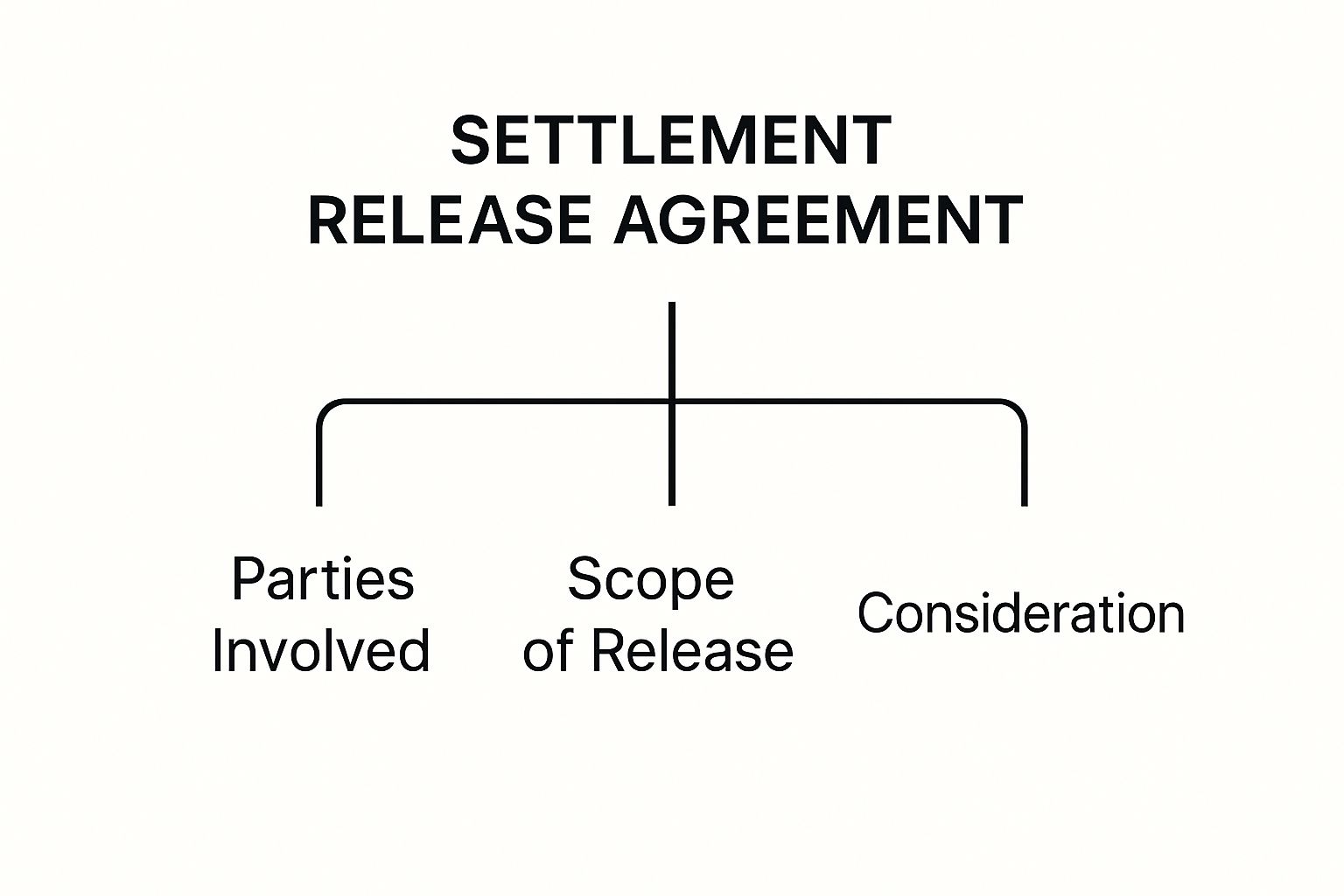
As you can see, every agreement starts with identifying who is involved, what rights are being given up, and what is being paid. Let’s dig into what each of these core components really means.
The Recitals or "Whereas" Clauses
Right at the top, you'll usually find a few paragraphs that start with the word "WHEREAS." This section is called the recitals, and it’s there to set the stage. It doesn't contain any legally binding promises but tells the background story of your claim.
The recitals will typically lay out the basic facts:
- Your name and the name of the at-fault party.
- When and where the incident (like a car wreck or slip and fall) happened.
- A neutral statement confirming you claimed injuries and damages.
- A line stating the at-fault party denies liability but wants to settle to avoid a lawsuit.
This part gives context to anyone reading the document, explaining why this agreement exists in the first place.
The Consideration Clause
Pay close attention here, because this is the heart of the deal. Consideration is the legal term for what you get in exchange for dropping your lawsuit. In almost every personal injury case, that means money.
The consideration clause will state the exact settlement amount in no uncertain terms (for example, "in consideration for the sum of fifty thousand dollars ($50,000.00)"). You must double-check that this number is the same one you agreed to during negotiations. It’s the core of the bargain you struck.
The Release of All Claims
This is where you make your biggest promise. The release of all claims clause is the section where you officially surrender your right to take any more legal action against the at-fault party for this incident. The language here is intentionally broad for a reason.
This clause is written to be airtight. It will state that you release the other party from all claims, demands, and actions, "whether known or unknown," that have come from or could ever come from the incident.
That "known and unknown" phrase is incredibly powerful. It means that if you discover a new, related injury a year from now, you can't go back and ask for more money. You are permanently closing the door on this legal matter. Releasing claims is a fundamental part of contract law, as you can see in resources like the Wikipedia page on legal releases).
The Confidentiality Clause
Many, though not all, settlement agreements include a confidentiality clause. You might also see it called a non-disclosure agreement, or NDA. This clause legally binds you to keep the settlement details—especially the dollar amount—private.
If your agreement has one, you can't discuss the terms with anyone other than a few specified people, like your spouse, attorney, or financial advisor. Breaking this clause is a serious breach of contract and could force you to pay the settlement money back.
Understanding these key sections is the first step toward feeling confident about what you’re signing. Each one has a job to do in finalizing your claim and making sure the settlement release agreement gives everyone a clean and permanent resolution.
Why Most Injury Cases End in a Settlement

Legal dramas on TV almost always build to a big courtroom showdown. In the real world of personal injury law, however, the vast majority of cases are resolved long before a judge or jury ever hears them. They end with a negotiated settlement, finalized with a settlement release agreement.
This might seem anticlimactic, but there are good, practical reasons why both injured people and insurance companies almost always prefer to settle. From my experience helping clients across Atlanta, settling isn't a sign of weakness—it's often the smartest move for everyone.
The Certainty of a Known Outcome
The single biggest reason cases settle is to avoid the massive risk of a trial. A jury is, by its very nature, unpredictable. No matter how strong your case seems, there's never a 100% guarantee of a win.
- An injured person risks a jury siding with the defense, walking away with nothing.
- An insurance company risks a "runaway" jury awarding a verdict far beyond what they could have settled the case for.
A settlement completely removes that uncertainty. You know the exact dollar amount you will receive, and the insurer knows its exact financial liability. That control is valuable.
A settlement provides a guaranteed result. It trades the possibility of a huge win or a total loss at trial for the certainty of a fair, agreed-upon amount of compensation right now.
This mutual desire to control risk is what really drives settlement talks forward. It pushes both sides to find a middle ground they can both accept.
The High Cost of Going to Trial
Another huge driver is the sheer expense of litigation. Taking an injury case all the way through a jury trial is an incredibly costly process.
These costs aren't trivial and can quickly add up:
- Expert Witness Fees: We often hire doctors, accident reconstructionists, or economists to explain issues to a jury. Their fees can run into tens of thousands of dollars.
- Deposition Costs: Every formal witness statement requires paying for court reporters, videographers, and transcripts, which gets expensive fast.
- Court Filing Fees: Every motion and document filed with the court has a price tag.
- Attorney Time: While we work on a contingency basis, the number of hours required to prepare for and conduct a trial is immense.
These litigation costs can eat into a final award. That means even a "win" at trial might leave you with less money in your pocket than a good settlement offer would have. For insurers, it’s a business decision—settling is almost always cheaper than funding their legal team for a lengthy courtroom battle.
The Global Trend Toward Settlement
This strong preference for settling isn't just a local Atlanta trend or even a U.S. phenomenon. It's a core feature of common law legal systems across the globe.
In fact, data shows that legal systems like ours, which require parties to disclose evidence early, have very high settlement rates. A recent study on how legal procedures influence settlement rates found that common law countries, including the U.S., often see settlement rates in tort cases (like personal injury) exceed 70%. This shows that using a settlement release agreement is a standard, efficient, and globally recognized way to resolve legal disputes.
Important Things to Check Before You Sign
Signing a settlement release agreement is the final, binding step in your personal injury claim. Once your name is on that paper, the case is over. You can't go back and ask for more money, no matter what happens.
As an Atlanta personal injury attorney, I've seen firsthand how important this final review is. This isn't a document you just skim. Before you even pick up a pen, you and your lawyer need to go over several key areas to make sure the agreement fully protects your financial future.
Double-Check Every Dollar and Cent
The first thing to verify is the gross settlement amount. It sounds basic, but you’d be surprised how often errors can sneak in. Confirm that the number written in the agreement—both as a numeral and spelled out in words—is the exact amount you agreed on.
This figure is the starting point for everything else. All attorney fees, case costs, and medical liens get paid from this gross amount. If that number is wrong, the entire financial breakdown will be off. Never just assume it’s correct. Always verify.
Understand Your Responsibility for Medical Liens
This is where a lot of people can get into trouble. If you used health insurance, Medicare, or Medicaid to pay for your treatment, those entities have a legal right to be reimbursed from your settlement. This is called a lien or a right of subrogation.
Your settlement check doesn't erase this debt. It is your responsibility, not the defendant's, to ensure these liens are paid. If you don't, the hospital or insurer can come after you for the money long after your case is closed.
Your attorney should have already identified and negotiated all outstanding liens. Before you sign, confirm that the agreement correctly outlines how these debts will be satisfied. In Georgia, agencies like the Georgia Department of Community Health have very specific rules for handling Medicaid liens, which you can learn more about on their official site. Getting this right prevents financial surprises down the road.
Review Any Restrictive Clauses
Most settlement agreements include clauses that restrict what you can do or say after the case is closed. The two most common are:
- Confidentiality: This clause legally prevents you from discussing the settlement amount or its terms with anyone.
- Non-disparagement: This stops you from saying or writing anything negative about the at-fault party or their insurance company. That includes social media posts.
These are standard, but you must understand what you’re agreeing to. Violating these terms can have heavy penalties, sometimes even forcing you to repay the entire settlement. Make sure you can live with these restrictions before you sign.
Confirm You Have Reached Maximum Medical Improvement
This is arguably the most important check of all. Have you reached Maximum Medical Improvement (MMI)? MMI is the point where your doctors confirm your condition has stabilized and isn't likely to improve further. It means you have a clear picture of any future medical care you might need.
Settling before you reach MMI is a massive risk. If you sign a release and later discover you need another surgery or long-term care, you're out of luck. That settlement release agreement permanently closes the door on any future claims against the other party for this incident.
How Settlement Agreements Are Used Globally

While your personal injury case feels deeply personal, the legal tool used to resolve it—the settlement release agreement—is a foundation of dispute resolution across the entire globe. Understanding that this document isn't just for car wrecks in Atlanta gives you a better perspective on the legal weight of the paper you are being asked to sign.
These agreements are so useful because they are so adaptable. They can resolve a simple slip-and-fall claim just as effectively as they can handle complex international disputes between massive organizations. Their purpose is always the same: to provide a final, binding end to a conflict without the cost and uncertainty of going to court.
A Tool for International Accountability
To see just how versatile these agreements are, look at how major global institutions use them. Organizations like the World Bank, which finances huge infrastructure projects worldwide, rely on settlement agreements to enforce rules and resolve conflicts. These aren't just for personal injuries; they are a key tool for maintaining integrity on a global scale.
For instance, when a company involved in a World Bank-funded project is accused of misconduct like fraud, a settlement agreement can resolve the issue. It provides a path for the company to accept responsibility and make amends, all while avoiding a messy and prolonged international legal battle.
This global use shows that a settlement is not about one side "giving in." It is a respected and efficient legal tool for achieving accountability and resolution, whether the dispute involves two people in Atlanta or a multinational corporation.
This reality underscores the power of a signed release. It’s a tool trusted by some of the world's most significant financial and governmental bodies to bring closure to very serious issues.
Settlements in Action on a Global Scale
The scale of this practice is enormous. Settlement agreements are frequently used in international development to address sanction violations. In fiscal year 2021 alone, the World Bank Group used these agreements to close 18 different cases involving companies and individuals across 13 countries, from Europe to the Middle East.
These settlements addressed serious allegations of misconduct in bank-financed projects, helping to safeguard billions of dollars in global development funds. By using a settlement, the organization can promote higher integrity standards without disrupting vital projects. You can find more details in a press release from the World Bank Group.
Upholding Rights Within Our Borders
Closer to home, these agreements are also used to enact major policy changes and protect civil rights here in the United States. A recent class-action settlement, for example, is set to change how U.S. Immigration and Customs Enforcement (ICE) handles detainers.
The agreement forces a neutral review process before a detainer can be issued in most states, protecting individuals' constitutional rights. This shows how a settlement release agreement can do far more than just pay damages—it can be a powerful instrument for reforming institutional practices and upholding fundamental legal protections on a massive scale.
Common Questions About Settlement Agreements
As an Atlanta personal injury attorney, I’ve found that even after a fair settlement amount is agreed upon, people still have important questions. Signing a settlement release agreement is the final step, and it's natural to want absolute certainty about what comes next. This is the moment to get clarity on all those final details.
To help, I’ve put together answers to some of the most common questions we hear from our clients in Atlanta. Our goal is to make sure you feel confident and fully informed as you close this chapter and move forward.
How long does it take to get my money after I sign the agreement?
This is, understandably, the first question on everyone's mind. The settlement agreement itself will specify a payment window. Most insurance companies are required to send payment within a set timeframe after they receive the signed settlement release agreement—typically somewhere between 14 and 30 days.
However, the process doesn't end when the check arrives at my office. Here’s a quick breakdown of what happens next:
- Depositing the Funds: The settlement check is deposited into a special, state-regulated lawyer's trust account, also known as an IOLTA account.
- Paying Liens and Expenses: We then use those funds to pay any outstanding medical bills, health insurance liens, or case-related expenses.
- Deducting Attorney's Fees: The agreed-upon contingency fee is deducted from the settlement total.
- Issuing Your Check: Once all obligations are met, we issue the final check to you for the remaining balance.
This entire process, from signing the release to having your money in hand, can take several weeks. I always make it a point to give my clients a clear, realistic timeline based on the specifics of their case.
Will I have to pay taxes on my personal injury settlement money?
This is a great question with a generally positive answer. According to the Internal Revenue Service (IRS), money you receive as compensation for physical injuries or sickness is not considered taxable income.
This tax-free status typically covers compensation for:
- Medical Expenses: Reimbursement for hospital bills, doctor visits, and physical therapy.
- Pain and Suffering: Money awarded for the physical pain and emotional distress directly resulting from your physical injuries.
However, it’s important to know that certain parts of a settlement can be taxed. For example, if a portion of your award is specifically for lost wages, that amount may be treated as taxable income. Additionally, punitive damages—which are intended to punish the defendant rather than compensate you—are almost always taxable.
Because every situation is unique, it's always a good idea to speak with a tax professional about your settlement. For more detailed information, the IRS provides a helpful guide, Publication 4345, called Settlements—Taxability.
What happens if I discover a new injury after I have already signed?
This is precisely why we are so careful about the timing of a settlement. A settlement release agreement is a full and final resolution of your claim. Once it is signed, it is over for good.
The document will contain very broad language releasing the other party from all claims, "known and unknown," related to the incident. That "unknown" part is legally powerful. It means if you sign the release and later find out you need another surgery or develop a chronic condition from the accident, you cannot go back and ask for more money. You have legally waived your right to pursue any future claims.
This is why we strongly advise clients to wait until they have reached Maximum Medical Improvement (MMI) before even considering a settlement offer. MMI is the point where your doctor confirms your medical condition has stabilized and is unlikely to improve or worsen. Settling only after you've reached MMI ensures you have a complete and accurate understanding of your total damages before you sign away your rights.
Finalizing your claim before you are medically stable is one of the biggest risks you can take. You get one chance to get this right, and a properly drafted settlement release agreement makes that resolution permanent.
At Jamie Ballard Law, we believe a successful outcome is about more than just a dollar amount; it's about providing the clarity and guidance you need to move forward with confidence. If you have been injured and have questions about the legal process, we are here to help. Contact us for a free, no-obligation case evaluation at https://jamieballardlaw.com.