After an accident, the damage isn't just about what you can tally on a calculator. Understanding pain and suffering settlements is key because they are designed to account for the true human cost of an injury—the physical agony, the emotional trauma, and the life disruptions that receipts and medical bills can never fully show. It's the legal system's way of acknowledging what was taken from your quality of life, and it's a vital part of your recovery.
Understanding What 'Pain and Suffering' Really Means
When lawyers and insurance adjusters talk about "pain and suffering," they aren't talking about a single, simple concept. It's a broad legal category that covers all the non-financial ways an injury can turn your world upside down.
Think of it as compensation for two different types of harm that go far beyond your economic losses.
Physical Pain and Suffering
This is the most straightforward component. It’s the actual, physical hurt you feel because of the accident. This includes:
- The immediate pain from the impact.
- The ongoing ache during recovery.
- Any future pain you're expected to endure, like chronic backaches, nerve damage, or arthritis that develops later.
Mental Pain and Suffering
This side of the coin covers the deep emotional and psychological toll. A serious accident can trigger significant mental anguish, including anxiety, depression, fear, sleepless nights, or even post-traumatic stress disorder (PTSD). It also compensates for the loss of enjoyment of life—not being able to play with your kids, pursue your hobbies, or simply engage in the activities that once brought you happiness.
To give you a clearer picture, here’s a breakdown of the specific harms that fall under this umbrella.
Types of Harm Covered by Pain and Suffering
| Type of Harm | Description | Example |
|---|---|---|
| Physical Pain | The direct physical discomfort from the injury, both immediate and long-term. | Chronic back pain after a rear-end collision. |
| Emotional Distress | The psychological impact, including anxiety, fear, depression, and PTSD. | Developing a fear of driving after a serious crash. |
| Loss of Enjoyment of Life | The inability to participate in hobbies, social events, or daily activities. | An avid runner who can no longer run due to a leg injury. |
| Disfigurement | Permanent scarring, amputation, or other changes to physical appearance. | Visible facial scars from broken glass in an accident. |
| Permanent Impairment | A lifelong physical limitation or disability caused by the injury. | Loss of full range of motion in a shoulder. |
| Loss of Consortium | The negative impact on a marital relationship, including loss of companionship. | An injury prevents a spouse from providing care and affection. |
Essentially, these damages are meant to provide a measure of justice for the quality of life that was taken from you, even if just for a while. For more definitions of common legal terms, our firm provides a helpful legal dictionary to clarify these ideas.
In the United States, nearly 400,000 personal injury claims are filed each year, with about 95% resolving through a pre-trial settlement. While payouts vary dramatically, non-economic damages like physical pain and emotional distress often make up a major portion of the final settlement, especially when injuries are severe.
Ultimately, a claim for pain and suffering tells the full story of your accident. It moves beyond the invoices and medical charts to paint a vivid picture of how this event has truly impacted your daily existence. This is a significant part of securing fair pain and suffering settlements.
How Insurance Companies Calculate Your Settlement
After an accident, the big question is always: how does an insurance company turn your pain, stress, and disruption into a specific dollar amount? It’s not a random guess. Adjusters use a couple of standard formulas to come up with a starting number for pain and suffering settlements, and they always begin with your hard financial losses.
Think of these formulas as their internal playbook. Knowing how they work gives you a helpful look into their process and shows you exactly why every single medical bill and therapy session is so important.
The Multiplier Method
The most common approach you'll see is the Multiplier Method. The idea is simple: the adjuster adds up your concrete economic damages—your medical bills and lost wages—and multiplies that total by a number.
That number, the multiplier, is everything. It usually falls somewhere between 1.5 and 5, and its value depends entirely on how severely the accident impacted your life.
- Low Multiplier (1.5x – 2x): This is for injuries that heal relatively quickly with minimal fuss, like minor whiplash or bruising. Your life was disrupted, but only for a short time.
- Mid-Range Multiplier (3x – 4x): This applies to more significant injuries—think a broken leg that needs surgery or a herniated disc requiring extensive physical therapy. The recovery is long, painful, and seriously interferes with your daily life.
- High Multiplier (5x or more): This is reserved for life-altering, permanent, or catastrophic injuries. We're talking about traumatic brain injuries, paralysis, or severe burns that leave you with permanent disfigurement and a fundamentally changed quality of life.
For example, let's say you had $10,000 in medical bills for a broken arm that required surgery. The adjuster might apply a multiplier of 3, valuing your pain and suffering at $30,000. Keep in mind, this is just one piece of the puzzle in most Atlanta personal injury claims.
This calculation is designed to put a number on both the physical and mental toll of an injury, as this image shows.
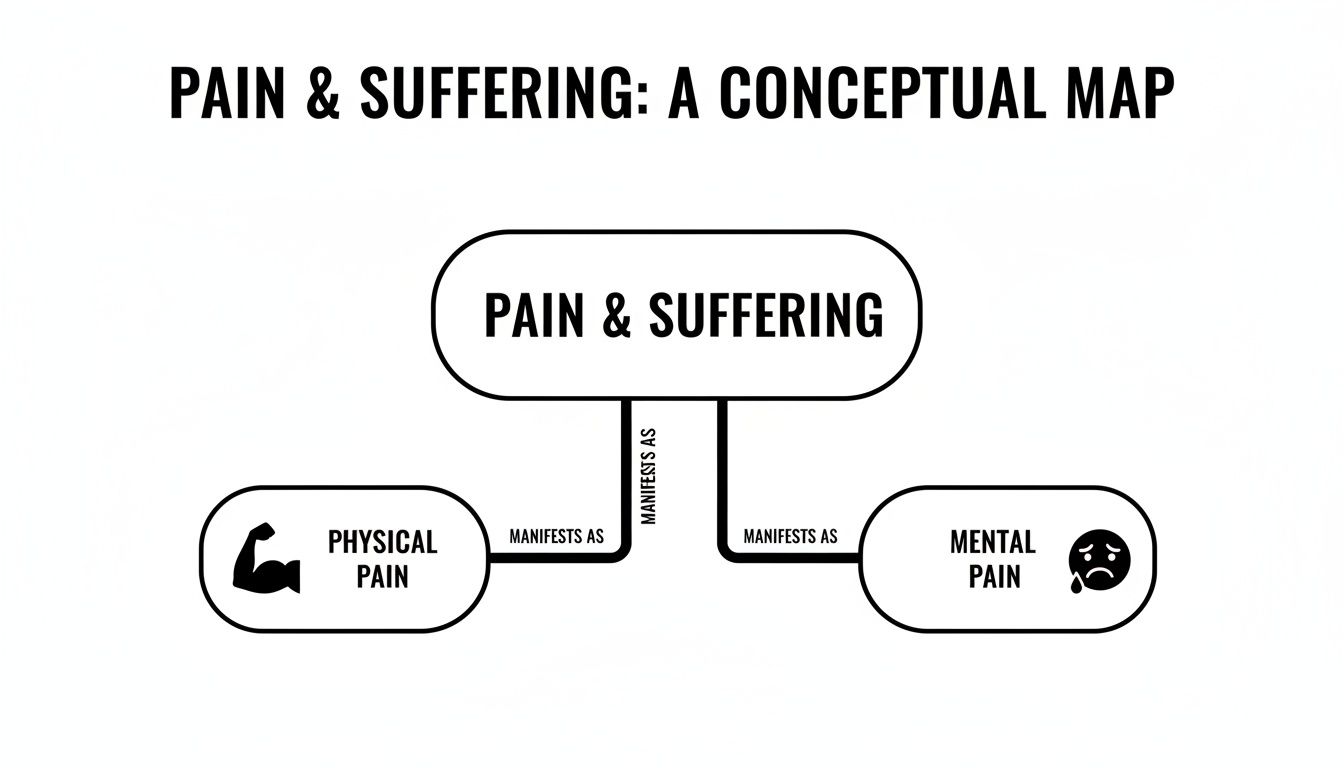
The goal is to compensate for both the physical injury itself and the emotional distress that comes with it.
The Per Diem Method
Another, less common formula is the Per Diem Method. "Per diem" is just Latin for "per day." With this method, the adjuster assigns a daily dollar value to your suffering.
That daily rate is then multiplied by the number of days you were in pain, starting from the accident date until you reach what doctors call maximum medical improvement (MMI). MMI is the point where your recovery has plateaued and you aren't expected to get any better.
The daily rate is often tied to what you earn in a day at your job. The reasoning is that having to endure significant pain is at least as hard as going to work.
So, if you earned $200 a day and your recovery took 150 days to reach MMI, the per diem calculation would be $30,000 ($200 x 150). This method is typically used for shorter-term injuries where the end of the recovery period is clear.
Both methods are just a starting point for negotiations. An adjuster will always argue for the lowest multiplier or the smallest daily rate. That’s why having detailed, undeniable proof of your injury's severity and its impact on your life is absolutely essential to getting a fair number for your pain and suffering settlements.
Key Factors That Influence Your Settlement Amount
When it comes to pain and suffering settlements, there's no magic number. Every case is different, and a handful of key factors can dramatically increase—or decrease—what an insurance company is willing to pay. Think of your claim's value not as a fixed price, but as something built piece by piece from the evidence in your case.
Knowing these factors is the first step to building a strong claim. An insurance adjuster will look at these specific elements to decide what your case is worth, much like a home appraiser considers square footage, location, and condition.
The Seriousness and Permanence of Your Injuries
This is the single most important factor. A simple fracture that heals completely in six weeks will always result in a lower settlement than an injury that causes lifelong pain or limitations.
The central question the adjuster is trying to answer is: "How much has this person's life been permanently altered?"
- Temporary Injuries: Things like whiplash, sprains, or minor broken bones are expected to heal fully. While they are still painful and disruptive, their impact has a clear end date, which caps their value.
- Long-Term or Permanent Injuries: An injury that demands multiple surgeries, leaves you with chronic pain, or causes permanent scarring or disability has a much higher value. This includes traumatic brain injuries (TBIs), spinal cord damage, or arthritis that develops in an injured joint.
A permanent limp or the loss of function in a limb fundamentally changes your ability to live your life. That justifies a significantly higher settlement.
The Quality of Your Medical Records
Your medical records are the foundation of your entire claim. They are the objective, documented proof of everything you've been through. Incomplete or inconsistent records are one of the fastest ways for an insurer to reduce the value of your claim.
To an adjuster, solid medical documentation shows an unbroken line connecting the accident to your current condition. This includes:
- Immediate Treatment: Getting medical attention right after the accident.
- Consistent Follow-Up: Attending every physical therapy session and specialist appointment.
- Detailed Doctor’s Notes: Records that explicitly link your pain and limitations back to the accident.
Gaps in treatment or failing to follow your doctor’s orders give the insurance company an opening. They’ll argue your injuries must not be as serious as you claim, weakening your negotiating position.
Key Takeaway: An insurance adjuster will scrutinize your medical history. Clear, consistent, and thorough documentation from healthcare professionals is your most powerful tool for proving the extent of your suffering.
How Clearly Liability Is Established
Who was at fault? The answer directly impacts your settlement. If the other party was 100% at fault—they ran a red light and T-boned you, for example—your position is much stronger.
But in Georgia, things can get tricky. Our state follows a rule called modified comparative fault. This law, found in the official state code under O.C.G.A. § 51-12-33, means your settlement can be reduced if you are found partially responsible for the accident.
For instance, if you were awarded $100,000 but found to be 20% at fault, your final award would be cut by 20%, leaving you with $80,000. If you are found to be 50% or more at fault, you are legally barred from recovering any damages at all.
The Tangible Impact on Your Daily Life
Finally, your settlement value is heavily influenced by how the injury has disrupted your day-to-day existence. This goes beyond medical reports and gets into the real, human consequences of the accident.
Ask yourself these questions:
- Can you no longer pick up your young children?
- Did you have to give up a hobby you loved, like running, gardening, or playing guitar?
- Does your injury stop you from doing household chores or joining in on family activities?
- Has your relationship with your spouse been negatively affected?
The more you can prove a significant "loss of enjoyment of life," the stronger your claim becomes. This is where personal journals and statements from friends and family can be incredibly persuasive. They help paint a full picture of your life before and after the accident, giving real weight to your claim for fair pain and suffering settlements.
How To Document Your Pain And Suffering
Getting a fair offer for pain and suffering settlements takes more than just submitting your medical bills. You need to paint a clear, compelling picture for the insurance adjuster of how this injury has fundamentally disrupted your daily life. The most effective way to do this is with strong, consistent documentation that turns abstract suffering into concrete evidence.

It all starts with your medical care. Follow your doctor's treatment plan to the letter. This means attending every appointment, completing every physical therapy session, and taking all prescribed medications. This behavior creates an official record demonstrating you are serious about your recovery and validates the extent of your injuries.
Start A Personal Injury Journal
Beyond medical records, a personal injury journal is your most powerful tool. It's your day-to-day account of life after the accident, capturing important details that medical charts will never show. An adjuster won't know you couldn't sleep through the night from back pain unless you write it down.
Your journal should track several key areas on a daily or weekly basis:
- Pain Levels: Rate your pain on a scale of 1 to 10. Note its location and describe its character (e.g., sharp, dull, throbbing).
- Emotional State: Document feelings of anxiety, frustration, depression, or fear. Did you have a panic attack driving past the accident scene? Record it.
- Life Activities Missed: List every single thing you could no longer do. This includes missing a child’s school event, being unable to do yard work, or skipping a social outing with friends.
- Daily Challenges: Did you need help getting dressed? Could you carry your own groceries? These details are vital to illustrating your loss of independence.
To streamline this process, tools like legal dictation software can help you efficiently transcribe your thoughts. When you're in pain, speaking your experiences is often easier than writing them down.
Collect Visual Evidence
A picture isn't just worth a thousand words—in an injury claim, it could be worth thousands of dollars. Photographs and videos provide undeniable proof of your physical injuries and their impact on your life.
Don't limit photos to the immediate aftermath. Document your injuries over time to show the healing process, or the lack thereof. This creates a compelling visual timeline for the insurer.
Visual Proof Checklist:
- Photos of visible injuries (bruises, cuts, swelling) taken immediately after the accident.
- Follow-up photos of your injuries a week later, a month later, and so on.
- Pictures of any medical equipment you must use, like casts, braces, or crutches.
- Short video clips showing your difficulty with simple tasks, like walking or climbing stairs.
This kind of visual proof helps an adjuster see you as a person, not just a claim number. It humanizes your experience in a way that words alone cannot.
Gather Statements From Witnesses
What you say about your suffering is important, but what others have observed can be even more persuasive. Statements from friends, family, or coworkers provide powerful, third-party validation for your claim.
These individuals can speak to the "before and after" reality of the accident. They can describe changes in your mood, your physical limitations, and your inability to participate in activities you once loved. This collaborative evidence reinforces the severity of your situation.
To help you organize your documentation, here is a practical checklist outlining the evidence you need to prove the full scope of your non-economic damages.
Evidence Checklist for Your Pain and Suffering Claim
| Evidence Type | Why It's Important | How to Get It |
|---|---|---|
| Medical Records | Officially documents injuries, treatments, and diagnoses. | Request copies from all providers (hospitals, doctors, physical therapists). |
| Personal Injury Journal | Provides a detailed, day-to-day account of your physical pain and emotional distress. | Keep a daily notebook, use a notes app, or record voice memos. |
| Photos & Videos | Creates a visual timeline of your injuries and recovery challenges. | Use your smartphone to take regular photos and short videos. |
| Witness Statements | Offers third-party validation of how the injury has impacted your life. | Ask friends, family, or colleagues to write down their observations. |
| Therapy/Counseling Notes | Proves mental and emotional anguish, such as anxiety, depression, or PTSD. | Request records from your therapist, counselor, or psychiatrist. |
| Proof of Missed Events | Shows loss of enjoyment of life with concrete examples. | Keep receipts, tickets, or emails for events you couldn't attend due to your injury. |
By methodically gathering this evidence, you build a strong foundation for your claim. For those just starting the process, understanding how to file a car accident claim in Atlanta provides a helpful roadmap. This disciplined approach is a sound way to secure one of the fair pain and suffering settlements you deserve.
Speaking with Insurance Adjusters and When to Get Help
After an accident, you can count on one thing: a phone call from the other party’s insurance adjuster. It’s important to remember their job isn't to help you—it's to protect their company's bottom line by paying out as little as possible on claims for pain and suffering settlements. They are trained negotiators, and anything you say can and will be used against you.

When an adjuster calls, less is always more. Provide only the basic facts of the accident, like the date, time, and location. You are under no obligation to provide a recorded statement, and it’s almost always a mistake to do so before speaking with an attorney. Simply decline politely.
Adjusters are masters at building a false sense of rapport. Be wary. Simple, automatic phrases like "I'm fine" or "I'm so sorry" can be twisted to argue your injuries aren't severe or that you admitted fault for the crash.
Common Adjuster Tactics to Watch For
Insurance companies have a playbook of tactics designed to devalue your claim. One of the most common is the quick, lowball offer. They might dangle a check in front of you within days of the accident, hoping you’ll take it before you understand the full extent of your injuries and future medical needs.
Be Aware: Accepting an early offer means signing a release. This document permanently forfeits your right to seek any further compensation for that accident, even if you later discover your injuries are far more serious than you realized.
Other common tactics include:
- Requesting a Recorded Statement: They use this to lock you into a story early on. Adjusters ask leading questions crafted to box you in and weaken your claim down the road.
- Delaying and Denying: Some adjusters will intentionally drag their feet, hoping financial pressure forces you to accept a low settlement out of sheer desperation.
- Misrepresenting Policy Limits: They might suggest the at-fault driver's policy is too small to cover your damages, discouraging you from pursuing what you’re rightfully owed.
To protect yourself in those first hours, it is smart to review what every client should know in the first 24 hours of their personal injury case.
When You Should Get Legal Help
While it’s possible to handle a minor fender-bender claim on your own, there are clear signals that it’s time to bring in a professional. Trying to take on a major insurance corporation by yourself puts you at a massive disadvantage.
You absolutely should get legal help when:
- Your Injuries are Serious: If you’ve suffered broken bones, a head injury, needed surgery, or require long-term physical therapy, the stakes are far too high to go it alone.
- Liability is Disputed: Is the insurance company trying to blame you for the accident? An attorney is essential to defend your rights under Georgia's comparative fault system.
- The Offer is Unfair: When an offer doesn’t even cover your medical bills—let alone lost wages and suffering—you need a professional advocate to fight for a just outcome.
- You Feel Overwhelmed: The claims process can be stressful. If you need to focus on healing, handing the fight to an expert is the right move.
An experienced Atlanta personal injury attorney will take over all communication with the insurer, compile the necessary evidence, and build a powerful case for the full compensation you deserve.
Many people hesitate to call a lawyer because they’re worried about the cost. But most personal injury firms work on a contingency fee basis. This means you pay absolutely nothing upfront. The attorney's fee is simply a percentage of the final settlement or verdict they win for you. If they don't win your case, you owe them nothing. This system ensures everyone can access high-quality legal help when they need it most.
Common Questions About Atlanta Injury Settlements
When you're trying to heal after an accident, the legal questions can feel just as overwhelming as the physical recovery. Here in Atlanta, we hear the same concerns from clients every day. Below are straightforward answers to the most common questions about pain and suffering settlements.
Is There a Cap on Pain and Suffering Damages in Georgia?
For most personal injury cases in Georgia, like car accidents, there is no cap on pain and suffering damages. The Georgia Supreme Court has been clear on this: they ruled that capping damages is unconstitutional. The court’s reasoning is that a jury, after hearing all the unique facts of a case, is in the best position to determine fair compensation—not politicians.
This means your claim’s value is based on the specific evidence of your case, not some arbitrary legal limit. However, there are a few exceptions. Claims against government entities (like a city or state agency) do have specific caps under what’s called sovereign immunity. An experienced attorney can tell you immediately if these special rules apply to your situation.
How Long Do I Have to File an Injury Claim in Georgia?
This is one of the most important deadlines in any injury case. In Georgia, the statute of limitations for most personal injury claims is two years from the date you were injured. This is an extremely strict deadline.
If you miss this two-year window, the courts will almost certainly bar you from seeking any compensation at all. While a few very rare exceptions exist—like for a minor, where the clock might be paused until they turn 18—you should never count on them. The safest move is to speak with an attorney long before the deadline to protect your rights. You can review Georgia's laws yourself on the Georgia General Assembly's website, but handling them alone is risky.
Important Takeaway: The two-year deadline is one of the most unforgiving rules in personal injury law. Don't wait until the last minute to explore your options.
Will My Case Definitely Go to Court?
It's highly unlikely. The reality is that the vast majority of personal injury cases—somewhere around 95%—are resolved through a settlement agreement long before they ever see the inside of a courtroom.
A settlement is simply a private agreement negotiated between your lawyer and the at-fault party's insurance company. For both sides, the goal is to reach a fair outcome without the time, expense, and stress of a trial. While filing a lawsuit is often a necessary strategic step to show the insurer you're serious, it rarely leads to a full-blown trial.
What if the Other Driver Has No Insurance?
This is a very real and common fear for anyone in an Atlanta car wreck. If the driver who hit you is uninsured or doesn't carry enough insurance to cover your losses, you can often turn to your own auto policy for help.
This is precisely what Uninsured/Underinsured Motorist (UM/UIM) coverage is for. Georgia law requires insurers to offer you this coverage, and it’s designed to be your safety net in this exact scenario. If you have UM/UIM on your policy, you can file a claim to recover damages for medical bills, lost income, and pain and suffering directly from your own insurance company, up to your policy limits. For an official overview, you can check with the Georgia Office of Insurance and Safety Fire Commissioner. It’s vital protection against irresponsible drivers.
If you're recovering from an injury in Atlanta and need someone to help you make sense of it all, Jamie Ballard Law is here for you. We can answer your questions and guide you through the next steps with a free, no-obligation case evaluation. Contact us today at https://jamieballardlaw.com.