The moments after a hit and run are chaotic and frightening. If you're wondering what happens after a hit and run, know that your first instinct might be panic, but taking calm, methodical steps is the single best way to protect both your physical safety and your right to compensation later on. Think of it as your immediate action plan in a disorienting situation. This guide will walk you through the immediate actions, legal fallout, and insurance process, helping you understand exactly what happens.
What Happens in a Hit and Run: An Immediate Overview
When another driver flees the scene, the burden of gathering information falls squarely on you. Your top priority is always your health and safety, followed closely by preserving every possible detail that could help law enforcement and your attorney track down the responsible party.
While a hit and run adds a layer of difficulty, many of the initial actions are similar to the general steps to take after any car accident. The main difference is the urgency—the evidence you collect at the scene might be all you have to go on.
Your First Steps at the Scene
Adrenaline can make it hard to think straight. Focus on this sequence to manage the situation effectively.
- Check for Injuries: First and foremost, assess yourself and any passengers. Injuries from car accidents, like whiplash or internal damage, aren't always immediately obvious. If there's any doubt, get medical attention.
- Move to a Safe Location: If your vehicle is drivable and in a dangerous position, like blocking traffic, move it to the shoulder or a nearby safe area. Immediately switch on your hazard lights to alert other drivers.
- Call 911 Immediately: This is a must. A formal police report is a foundational piece of evidence for any future insurance claim or legal action. Make sure to tell the dispatcher it was a hit and run.
This visual guide breaks down the most important actions to take right after a hit and run.
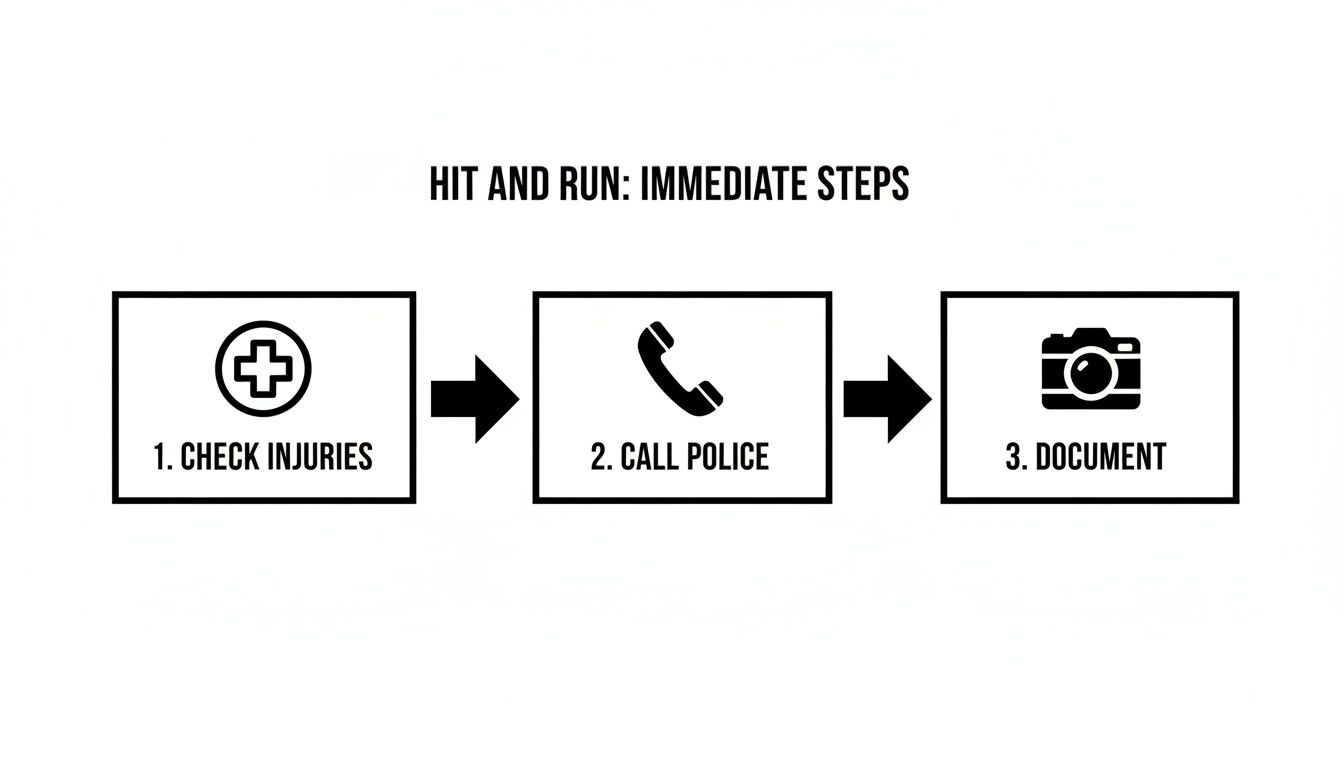
This process shows that a methodical response—starting with safety and moving to information gathering—is key.
The checklist below outlines the important actions to take at the scene of a hit and run in Georgia. Following these steps helps ensure your safety and preserves vital information for your case.
Immediate Steps After a Georgia Hit and Run
| Priority | Action to Take | Why It Matters |
|---|---|---|
| 1. Safety First | Assess injuries for yourself and passengers. Move to a safe location if possible. | Adrenaline can mask serious injuries. Moving your vehicle prevents further collisions. |
| 2. Official Report | Call 911 immediately to report the hit and run. | Creates an official police report, which is essential for insurance claims and legal action. |
| 3. Document Details | Write down or record everything you remember about the other vehicle and driver. | Details like a partial plate, car model, or unique damage are invaluable for the police investigation. |
| 4. Gather Evidence | Take photos of your vehicle's damage, the accident scene, and any visible injuries. | Photographic evidence is powerful proof of what happened and the extent of your losses. |
| 5. Find Witnesses | Ask anyone nearby if they saw what happened and get their contact information. | Independent witness testimony can corroborate your account and help identify the at-fault driver. |
By working through this checklist, you build the strongest possible foundation for your claim.
Document Everything You Can Remember
Once you are safe and have called the police, shift your focus to documentation. Since the other driver is gone, the evidence you can gather is your most powerful tool. Use your phone to take pictures, record a voice memo, or jot down notes while the details are still fresh.
Even a partial license plate number, the car's color, make, or a noticeable dent can be the key that helps police find the person who fled.
Never attempt to chase a driver who leaves the scene. It is extremely dangerous and not your responsibility. Your job is to stay safe and be the best witness you can be. These initial steps are the foundation for successfully handling what happens after a hit and run.
The Legal Consequences for a Fleeing Driver in Georgia
When a driver flees an accident scene in Georgia, they aren't just shirking responsibility—they're committing a serious crime. The question of what happens after a hit and run has a clear answer under state law, specifically Georgia Code O.C.G.A. § 40-6-270. This statute requires that any driver involved in a collision must stop, offer help, and exchange information. Choosing to flee triggers a cascade of legal consequences that can permanently alter a person's life.
These penalties are severe for a reason. From a legal standpoint, a "hit and run" isn't just a traffic violation; it's a serious offense because abandoning the scene can be the difference between life and death for an injured victim. With traffic fatalities remaining stubbornly high across the United States, lawmakers have consistently stiffened the penalties for fleeing drivers. The National Safety Council offers more data on these troubling trends.
Misdemeanor vs. Felony Hit and Run
In Georgia, the severity of the legal fallout hinges entirely on the outcome of the crash. The law draws a hard line between accidents causing only property damage and those resulting in injury or death.
- Property Damage Only (Misdemeanor): If the accident only damages a vehicle or other property—like a fence or a mailbox—leaving the scene is typically charged as a misdemeanor.
- Injury or Death (Felony): If the collision causes serious injury or kills someone, the charge escalates to a felony. This is a far more serious crime with much graver consequences.
This tiered system ensures the punishment fits the harm caused by the driver's choice to flee. Simply put, the greater the harm, the more severe the legal reckoning.
What Penalties Does a Fleeing Driver Face?
A conviction for leaving the scene of an accident carries significant penalties that go far beyond a simple ticket. They are designed to punish the offender and deter others from making the same reckless decision.
Under Georgia law, a convicted driver could be looking at:
- Substantial Fines: Fines can range from $300 to $1,000 for a misdemeanor charge, but they can be much higher for a felony conviction.
- Jail or Prison Time: A misdemeanor conviction can result in up to 12 months in jail. A felony is far more serious, carrying a potential prison sentence of one to five years.
- Mandatory License Suspension: A hit-and-run conviction leads to an automatic suspension of the driver's license, making it illegal for them to get behind the wheel.
The decision to flee an accident scene instantly transforms a traffic incident into a criminal matter. The penalties reflect the law's view that abandoning someone in need is an unacceptable act.
Impact on a Victim’s Personal Injury Claim
Beyond the criminal charges, a hit-and-run has a profound impact on a victim’s civil case. Once a fleeing driver is identified and charged, it dramatically strengthens the victim's personal injury claim.
The act of fleeing is often viewed as an admission of guilt or, at a minimum, as powerful evidence of reckless and irresponsible behavior. This can be a game-changer during negotiations with insurance companies or in a courtroom. It can also open the door for a claim seeking punitive damages—money awarded not to cover the victim's losses, but to punish the at-fault driver for their egregious conduct.
This is a key advantage for victims, providing a path to seek a level of justice that goes beyond just covering medical bills and lost paychecks. It’s also a reminder to act quickly, as the clock starts ticking on your right to file a claim. You can learn more about these important deadlines in our guide on the statute of limitations for personal injury in GA. Understanding these legal realities is the first step in knowing what happens after a hit and run.
How to Properly Report a Hit and Run in Atlanta
After a hit and run, what happens next depends entirely on creating an official record of the crash. Properly reporting the collision to the Atlanta Police Department isn't just a procedural step—it's the foundation for your insurance claim and any potential legal action.
Think of the police report as the first official chapter of your story. Getting the details right from the start is absolutely essential.
Your first call should always be to 911, even if you feel your injuries are minor. When the dispatcher answers, clearly state that you've been the victim of a hit and run. This immediately alerts them to the criminal nature of the incident and ensures the responding officer arrives ready to conduct the right kind of investigation.
Details to Provide to Law Enforcement
When the police arrive, they will ask you for a statement. Your goal is to be as clear and detailed as you can while the memory is fresh. Stick to the facts you are certain about.
Here is a quick checklist of information to give the officer:
- Location and Time: Pinpoint the exact location—street names, intersections, or nearby landmarks—and the approximate time the crash occurred.
- Description of Events: Explain exactly how the collision happened in your own words. Describe your direction of travel and what the other driver did.
- Fleeing Vehicle Details: Share every detail you can remember about the car that fled. This includes its color, make, model, and any unique features like a spoiler, bumper sticker, or visible damage. A partial license plate number is extremely helpful.
- Driver Description: If you got a look at the driver, provide any details you can recall, such as gender, approximate age, or what they were wearing.
- Witness Information: If anyone stopped to help, give their names and contact information to the officer. Witness statements provide powerful corroboration.
After giving your statement, always ask for the police report number before the officer leaves. This number is the key to accessing the official report later. You will need it for everything that follows, especially when you begin filing your insurance claim.
For a detailed walkthrough, our guide on how to file a car accident claim in Atlanta offers practical next steps.
Georgia’s Time Limits for Reporting
It's important to act fast. While there isn't a strict minute-by-minute legal deadline for calling 911, your own insurance policy almost certainly requires you to report the accident to the police "promptly."
This usually means within a specific, short timeframe (often 24-72 hours) to be eligible for Uninsured Motorist coverage.
Delaying your call to the police gives your insurance company a reason to be skeptical. They might question the validity of your claim or argue that waiting compromised their ability to investigate and find the at-fault driver.
Making that call immediately from the scene removes all doubt and officially documents the timeline. This simple action protects your rights and strengthens your position, ensuring you have the proof you need to move forward. The police report is the cornerstone of a successful claim after a hit and run.
Gathering Evidence When the Other Driver Disappears
When the at-fault driver flees, the crash scene instantly becomes your primary source of evidence. After a hit and run, what happens next—and your ability to get justice—often hinges on the information you can secure in those first important moments. You are in the best position to preserve key details that can help law enforcement identify the driver and strengthen your insurance claim.
Think of yourself as the first responder for your own case. Every small detail you can document is a potential puzzle piece that helps build a complete picture of what happened.
Creating a Visual Record of the Scene
Your smartphone is the single most important evidence-gathering tool at your disposal. Use it immediately, before anything is moved or the scene is cleared, to document everything from every possible angle.
Start with wide shots of the entire scene to establish context. Capture the intersection, nearby traffic signs, road markings, and the weather conditions. After that, move in to photograph specific, important details.
Your photo checklist should include:
- Damage to Your Vehicle: Get pictures of the damage from every angle—both close-up shots and from a distance. Make sure to capture any paint transferred from the other vehicle.
- Your Injuries: If you have any visible injuries like cuts, bruises, or scrapes, photograph them. These images can become important evidence later.
- Debris on the Road: Photograph any debris the fleeing car left behind. A broken taillight, a piece of a bumper, or even a side mirror can help identify the vehicle's make and model.
- Tire Marks: Skid marks on the pavement provide valuable data for accident reconstruction experts to analyze the speeds and movements of the vehicles involved.
This visual evidence tells a story that words alone cannot. It creates a clear, objective record of the immediate aftermath, which is essential for insurance adjusters and any legal proceedings. For more information on how this evidence supports the claims process, review our guide to personal injury claims.
Finding Witnesses and Modern Evidence Sources
While you're documenting the scene, look around for anyone who may have witnessed the collision. Witnesses are incredibly valuable, as their testimony provides an unbiased, third-party account of the events.
When approaching a potential witness, remain calm and polite. Simply ask if they saw the crash and what they remember.
Key Questions to Ask Witnesses:
- Can you describe the vehicle that left the scene? (Color, make, model?)
- Did you get a look at the driver?
- Were you able to see the license plate number, even a partial one?
- Which direction did the vehicle go after the impact?
Always get their full name and contact information. A formal statement from a witness to the police or your attorney could be the breakthrough needed to locate the driver who fled.
In today's world, video cameras are everywhere. Don't limit your search to eyewitnesses; modern technology often captures what people miss.
Expand your search beyond just people on the street. Look for nearby businesses like gas stations, banks, or convenience stores that might have security cameras pointed toward the road. Check residential homes for doorbell cameras that may have recorded the fleeing car as it drove away. Politely ask the property owner if they would be willing to review their footage and share anything relevant. This video evidence can be incredibly powerful, sometimes capturing a clear image of the car and its license plate. By being thorough, you significantly improve the odds of understanding what happens after a hit and run and holding the responsible party accountable.
Making Sense of Your Insurance After a Hit and Run
After the initial shock of a hit-and-run wears off, the biggest question on your mind is almost always financial: Who is going to pay for all of this? When the other driver vanishes, you can’t file a claim against their insurance. Instead, you have to turn to your own policy. What happens next depends entirely on the specific coverages you chose.
The good news is, your policy likely has provisions designed for exactly this kind of disaster. The key is knowing which parts of your policy apply and how to use them to cover your medical bills, lost wages, and vehicle repairs.
Your Primary Tool: Uninsured Motorist Coverage
In a hit-and-run scenario, your most important protection is Uninsured Motorist (UM) Coverage. For insurance purposes in Georgia, a driver who can’t be identified is treated as an uninsured motorist. Your UM coverage steps in to play the role of the at-fault driver's insurance—the coverage they should have had.
This part of your policy is designed to pay for your bodily injuries and the damages that come with them, including:
- Medical Expenses: This covers everything from the ambulance ride and emergency room visit to ongoing physical therapy and any future medical care you might need.
- Lost Wages: If your injuries keep you out of work, UM coverage can reimburse you for that lost income.
- Pain and Suffering: This is compensation for the physical pain and emotional trauma caused by the crash and your injuries.
In Georgia, UM coverage comes in two flavors, and the difference is significant.
- Standard (or Reduced) UM: This type pays the difference between the at-fault driver's liability limit and your UM limit. Since a hit-and-run driver has an insurance limit of $0, your Standard UM policy simply covers your damages up to your own policy limit.
- Add-On UM: This is almost always the better choice. Add-On coverage "stacks" on top of any other available insurance. While it functions similarly to Standard UM in a hit-and-run, it provides far greater protection if you're hit by a driver who has insurance, but not enough to cover your bills. For a deeper dive, the Georgia Office of Insurance and Safety Fire Commissioner has detailed guides on state coverage requirements.
Covering Vehicle Repairs and Medical Bills
While UM coverage is focused on your physical and financial recovery from injuries, other parts of your policy can address vehicle damage and immediate medical costs. These coverages often provide faster access to money while your main UM claim is processed.
Collision Coverage is what pays to repair your car, no matter who was at fault. If you have collision coverage, you can use it to get your vehicle fixed after a hit-and-run. You'll have to pay your deductible upfront, but if the at-fault driver is eventually found, your insurance company may be able to get that deductible back for you.
Medical Payments (MedPay) Coverage is another optional but incredibly useful coverage. It pays for your and your passengers' medical bills up to a set limit, again, regardless of fault. MedPay is perfect for covering health insurance deductibles and co-pays right away, giving you some quick financial breathing room.
Think of these coverages as a safety net. UM is for your personal recovery, Collision is for your car's recovery, and MedPay is for immediate financial first aid.
A Step-by-Step Guide to Filing Your Claim
Reporting the crash and filing a claim has to be done right to protect your ability to recover compensation. Just follow this simple process:
- Notify Your Insurer Promptly: As soon as you're safe, call your insurance agent or the company's claims hotline. Almost every policy requires "prompt" notification. Waiting too long could put your entire claim at risk.
- Provide the Police Report Number: When you call, have the police report number handy. Your insurer will need it to get a copy of the official report, which is the primary evidence validating a hit-and-run claim.
- Cooperate with the Adjuster: An insurance adjuster will be assigned to your case. Be honest and give them all the documentation you have—photos, witness contacts, and your medical records.
- Keep Meticulous Records: Start a file and keep everything related to the accident in it. This means every medical bill, pharmacy receipt, repair estimate, and a log of any days you missed from work.
Your insurance company has a legal duty to investigate your claim in good faith. By giving them clear, organized information, you help them do their job and keep the process moving. Managing the claims process is a huge part of what happens after a hit and run, but having the right coverage in place makes all the difference.
Why Pedestrians and Cyclists Are So at Risk
When we talk about a hit-and-run, the image that often comes to mind is one car hitting another. But on Atlanta’s busy streets, the most vulnerable people are those with absolutely no protection—pedestrians and cyclists. Without the steel frame of a car to absorb the blow, they are the ones who suffer the most catastrophic injuries.
The danger skyrockets when the at-fault driver flees. A victim left injured on the road can't call for help, and important minutes can pass before anyone finds them. This delay can turn a serious injury—like a traumatic brain injury, spinal cord damage, or internal bleeding—into a fatal one.
The Human Cost of Fleeing the Scene
Beyond the devastating physical harm, the emotional trauma of being hit and then abandoned is profound. Victims are left feeling discarded and helpless. It's a psychological wound that can ache long after the broken bones have started to mend, and the sense of injustice can be completely overwhelming.
Road crashes are a massive public safety problem worldwide, with pedestrians and cyclists making up more than half of all traffic fatalities. According to the World Health Organization, the human and economic costs rise sharply when a driver flees because victims wait longer for medical treatment and their families face far more complicated insurance battles.
Unique Dangers on Urban Streets
In a dense urban environment like Atlanta, pedestrians and cyclists face a unique set of risks that make them prime targets for hit-and-run drivers.
- Limited Visibility: Drivers often have a harder time spotting people on foot or on a bike, especially at night, in crowded intersections, or during bad weather.
- Lack of Physical Barriers: There is absolutely nothing between a cyclist or pedestrian and the crushing force of a multi-ton vehicle. They are completely exposed.
- Driver Distraction: A single moment of inattention from a driver—a quick glance at a phone—can have deadly consequences for someone crossing the street or riding in a bike lane.
These factors combine to create a perilous situation. For those who have been injured, the first step toward recovery is understanding their rights. Our guide, written from the perspective of an Atlanta pedestrian accident lawyer, provides more specific information about your legal options. Holding a fleeing driver accountable isn't just about justice for one person; it's about making our streets safer for everyone.
Common Questions About Georgia Hit and Run Accidents
After a hit and run, your mind is probably racing with questions. That's completely normal. The aftermath involves police procedures, strict insurance rules, and important legal deadlines.
Here are straightforward answers to the questions we hear most often from victims in Atlanta. My goal is to give you the clarity you need to handle what comes next.
What if My Parked Car Was Hit?
Even with no injuries, a driver leaving the scene is still a crime. Your first move should be to call the police and file an official report. You absolutely need this document for your insurance claim.
After that, it's time to gather evidence:
- Take photos of the damage and the surrounding area from several angles.
- Look for anyone who might have seen what happened. Witnesses are invaluable.
- Check if nearby businesses or homes have security or doorbell cameras that might have captured the incident.
Your claim will almost always fall under your policy's Collision or Uninsured Motorist Property Damage coverage.
How Long Do I Have to File a Claim?
Time is not on your side after a crash. Knowing the statute of limitations for personal injury is very important. In Georgia, you generally have two years from the date of the accident to file a personal injury lawsuit.
But don't let that number fool you. Your insurance policy has its own, much shorter deadlines for reporting the accident to make an Uninsured Motorist claim—often just a matter of days. Always report the crash to the police and your insurer immediately to protect your rights.
Waiting too long to notify your insurance company can give them a valid reason to deny your claim. Prompt reporting is one of the most important things you can do.
Can I Get Compensation if the Driver Is Never Found?
Yes, you can. This is precisely why Uninsured Motorist (UM) coverage exists. It’s designed to cover your medical bills, lost income, and other damages when the at-fault driver is unidentified.
As long as you can prove that an unknown driver's negligence caused your injuries, you can file a claim with your own insurance company. This is another reason why a formal police report is so vital. An attorney can help assemble the evidence needed to build a strong UM claim and ensure you get fair treatment from your insurer.
If you've been injured in a hit and run, you don't have to take on the insurance companies by yourself. At Jamie Ballard Law, we fight to get you the support and compensation you deserve. Contact us today for a free, no-obligation case evaluation. Visit us at https://jamieballardlaw.com.