If a dog has bitten you or a loved one in Georgia, it's important to understand how our state's laws work. Getting fair compensation isn't as simple as "a dog bites, the owner pays." The dog bite laws in Georgia require you to show the owner either knew their dog was dangerous or was careless in how they handled it, like letting it run loose in violation of a local leash law. Understanding these rules is the first step toward protecting your rights after an attack.
Georgia's Unique Approach to Dog Bite Cases
When you're dealing with the shock and pain of a dog attack, the legal side of things can feel overwhelming. Many people assume that if a dog bites someone, the owner is automatically on the hook. In Georgia, however, it’s not that straightforward.
Our state follows what’s often called a “modified one-bite rule.” This means a dog owner isn’t automatically liable the very first time their dog causes harm. Instead, the injured person must prove certain key facts to hold the owner responsible.
This approach puts the burden of proof squarely on the victim. Simply showing that a bite happened isn't enough to get compensation for your medical bills and other damages. You have to build a solid case that demonstrates the owner failed to prevent a foreseeable attack.
The Foundation of a Claim
To win a dog bite claim in Georgia, you typically need to establish one of two conditions. Think of them as two distinct paths to proving the owner is liable:
- Known Dangerous Behavior: You must show the dog had a history of aggressive or dangerous tendencies, and importantly, that the owner knew about it. This doesn't just mean a previous bite; it could include aggressive growling, lunging at people, or other menacing actions that put the owner on notice.
- Owner Negligence: You can also prove the owner was careless, often by showing they violated a local ordinance like a leash law. For instance, most cities and counties in Georgia have laws requiring dogs to be leashed when in public. You can usually find these local rules on your county government's website.
It’s important to know that even if an owner breaks a leash law, they aren't automatically liable. You still have to connect that specific violation directly to your injury. In other words, you have to prove that the owner’s failure to leash the dog is the reason the bite happened. This is a key distinction that our experienced Atlanta dog bite injury attorneys can help you understand.
To give you a clearer picture, here’s a breakdown of what you must prove to build a successful claim.
Key Elements of a Georgia Dog Bite Claim
| Element to Prove | What This Means for Your Case |
|---|---|
| Dangerous Propensity | You must present evidence that the dog was known to be dangerous (e.g., prior bites, aggressive lunging). |
| Owner's Knowledge | You must show the owner was aware of this dangerous behavior before your incident occurred. |
| Negligence | Alternatively, you can prove the owner carelessly let the dog roam free or violated a local leash law. |
| Causation | You must directly link the owner’s negligence or their dangerous dog to the injuries you sustained. |
| Lack of Provocation | You must establish that you did not provoke the dog into attacking you. |
Successfully proving these elements is the core of any dog bite case in Georgia. It requires gathering the right evidence—from witness statements to animal control records—to build a compelling argument.
Georgia's Law in Action: OCGA § 51-2-7
The primary law that governs these cases is Georgia Code § 51-2-7. This statute, available on legal information sites like Justia, lays out the specific conditions under which an owner or keeper of a "vicious or dangerous animal" can be held liable for the harm it causes.
The law requires proving the owner's knowledge of the dog’s dangerous nature or their negligence in allowing the dog to be "at liberty" (off-leash and out of control).
The statute also makes it clear that a person who "provokes" the injury cannot recover damages, adding another layer to these cases. Ultimately, understanding your rights and what it takes to build a case under the specific dog bite laws in Georgia is the first step toward getting the justice you deserve.
How to Prove a Dog Owner Is Liable
After a dog bite, proving the owner is legally responsible is the entire foundation of your case. Under Georgia's dog bite laws, liability isn't a given. You can't simply point to your injuries; you must build a case showing why the owner is accountable for what their dog did.
Think of it like building a legal bridge connecting the dog's actions to the owner's responsibility. In Georgia, you have two primary ways to construct that bridge.
The First Path: Proving a Vicious Propensity
The most direct route to establishing liability is to show the dog had a known "vicious propensity." This is a legal term, and it doesn't mean the dog is inherently bad. It simply means the dog had a documented tendency to act in a dangerous or aggressive way, and the owner knew it.
Many people mistakenly believe this requires a history of prior bites, but that's not always true. A dog's dangerous nature can be proven through other behaviors that should have put the owner on notice.
Evidence that helps establish a known dangerous nature includes:
- Previous Bites or Attacks: An official report filed with animal control or testimony from another victim is extremely compelling evidence.
- Aggressive Actions: Did neighbors see the dog constantly lunging at the fence, growling at people walking by, or snapping at kids? These behaviors establish a pattern of aggression.
- Owner's Warnings: If the owner ever said things like, "Watch out, he bites," or always had to lock the dog away when guests came over, it demonstrates they knew their dog posed a risk.
The essential element here is proving the owner knew or should have known about this aggressive behavior. Your entire argument rests on showing the owner was aware of the danger their dog presented but failed to take reasonable steps to prevent an attack.
The Second Path: Proving Owner Carelessness
What if the dog has never acted aggressively before? You can still build a case by proving the owner was careless—or negligent—and that this specific act of carelessness led directly to your injury. The most common example we see is a violation of a local leash law.
While Georgia does not have a statewide leash law, nearly every county and city, including Atlanta, has ordinances requiring dogs to be restrained in public areas. If an owner lets their dog run loose in a park or through the neighborhood and it attacks someone, that violation serves as powerful evidence of negligence.
Helpful Tip: Proving the dog was off-leash isn't enough on its own. You must directly connect that carelessness to the injury. The argument has to be that because the dog was not on a leash, it was able to run over and bite you.
To gather evidence and confirm these facts, legal professionals often use discovery tools. For example, they might issue a Sample Deposition Notice to formally question the owner or key witnesses under oath.
Evidence That Strengthens Your Case
Whether you are arguing vicious propensity or owner carelessness, your claim is only as solid as the evidence you have to back it up.
Here is the kind of evidence that can make or break your case:
- Witness Statements: Testimony from neighbors, mail carriers, or delivery drivers who saw the dog acting aggressively before or witnessed it roaming unrestrained can be invaluable.
- Animal Control Records: Official reports detailing prior complaints, bites, or warnings create a documented paper trail of the dog's behavior and the owner's awareness.
- Photos and Videos: Clear pictures of your injuries, the location of the attack, or even a photo of a broken fence a dog could escape through help tell the full story.
- Medical Records: Your official treatment records and medical bills document the severity of your injuries and the financial cost.
In some instances, a dog bite claim can overlap with issues of property safety. You can find out more about how an owner's duty to maintain a safe property is evaluated in our guide on Atlanta premises liability cases. A full understanding of all facets of the dog bite laws in Georgia is the key to building the strongest case possible.
The Two-Year Deadline for Filing Your Claim
When you're recovering from a dog bite, your immediate focus is—and should be—on healing. But it's important to know that Georgia law puts a strict time limit on your right to seek compensation. The dog bite laws in Georgia give you a firm two-year deadline to file a lawsuit.
This legal window is called the statute of limitations. For any personal injury case, including a dog bite, you have exactly two years from the date the attack happened to formally file a claim in court. If you miss that deadline, your right to recover any damages is gone, no matter how strong your case might have been.
Acting fast isn't just about meeting a legal requirement; it's about building the strongest case possible. Evidence has a shelf life. Medical records are created right away, photos of fresh wounds are most compelling, and witness memories are sharpest just after the incident. Waiting too long lets that valuable evidence degrade or disappear entirely.
Understanding the Clock
The two-year clock starts ticking the moment the dog attacks. Simple enough, right? But like many legal rules, there are a few important exceptions that can pause or "toll" that clock.
Here are a few key situations that can change the deadline:
- Injuries to a Minor: If a child under 18 is bitten, the two-year clock doesn't start until their 18th birthday. This means they generally have until they turn 20 to file their claim.
- Mental Incapacity: If the victim's injuries leave them mentally incapacitated, the statute of limitations may be paused until they recover their mental faculties.
- The Defendant Leaves Georgia: If the dog owner moves out of state after the incident, the clock might stop until they return.
These exceptions show just how important it is to understand the nuances of the statute of limitations for personal injury in GA.
This whole process—from the incident to investigation to filing the claim—has to happen well inside that two-year window.
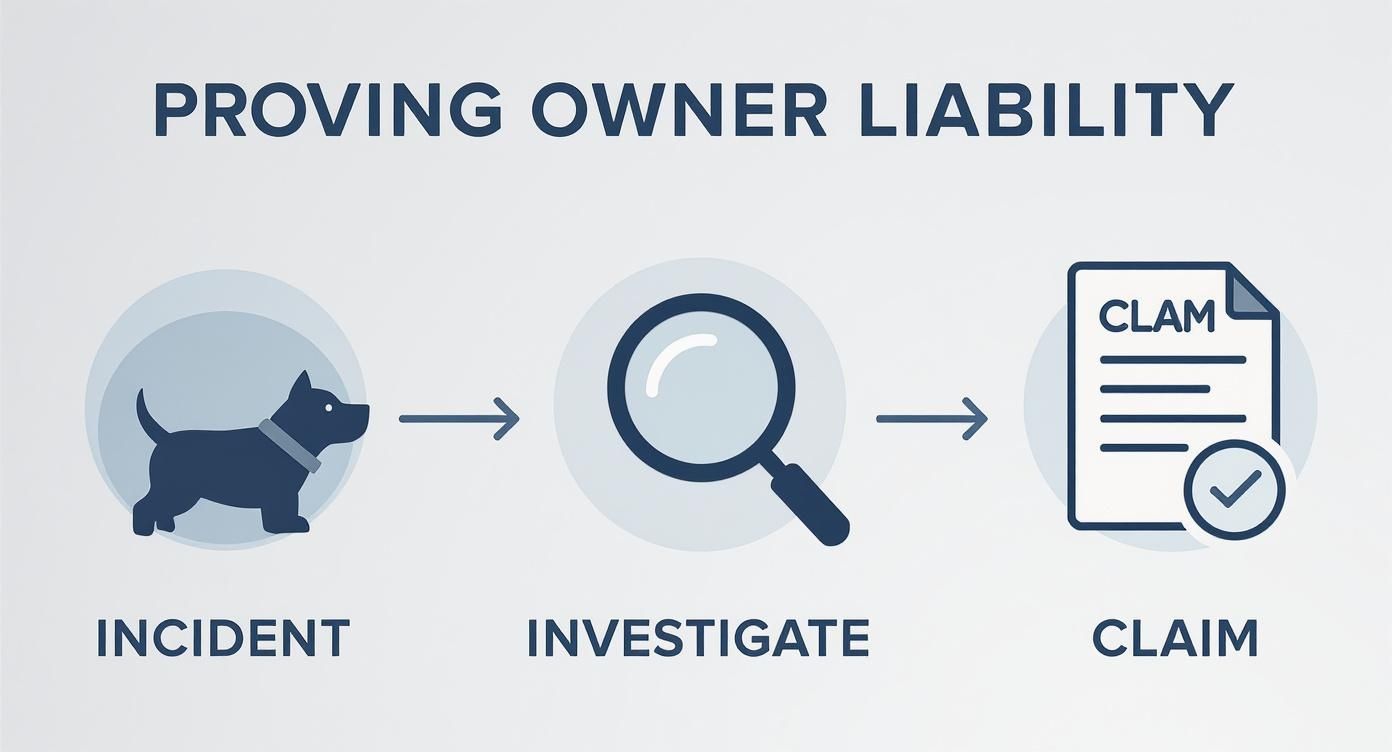
As you can see, gathering evidence and preparing a solid claim takes time. You can't afford to wait until the last minute.
The Legal Basis for the Deadline
This two-year period is not a suggestion; it's a hard rule codified in state law. O.C.G.A. § 9-3-33 sets this statute of limitations for all personal injury lawsuits in Georgia, and dog bite cases fall squarely under this statute.
Helpful Tip: Keep in mind that investigating a claim, gathering evidence, and negotiating with an insurance company all take time. Waiting until the last minute to act can jeopardize your ability to file a successful claim before the deadline expires.
Starting the process early gives your case the best chance of success. It allows for a thorough investigation into the dog’s past and the owner's conduct, which are the cornerstones of proving liability under the dog bite laws in Georgia.
Dog Bite Claim Timeline Checklist
Staying organized after an attack can feel overwhelming. This checklist breaks down the important actions you should take and when, ensuring you don't miss a beat while the clock is ticking on your two-year deadline.
| Timeframe | Recommended Action | Why It's Important |
|---|---|---|
| Immediately (First 24 Hours) | Seek medical attention. Report the bite to Animal Control. Photograph injuries. | Creates official records of the incident and injury severity, which are vital for your claim. |
| First Week | Identify the dog owner and any witnesses. Write down your account of the attack. | Gathers key evidence while memories are still fresh and reliable. |
| First Month | Notify the dog owner's insurance company (if known). Consult with a dog bite attorney. | Puts the insurer on notice and allows a legal expert to start preserving evidence and guiding you. |
| Within 6 Months | Continue all medical treatment. Keep detailed records of expenses and lost wages. | Builds a comprehensive file of your damages to ensure you're compensated for every loss. |
| Within 1 Year | Your attorney will conduct investigations, depose witnesses, and negotiate a settlement. | This phase requires significant time to build a strong case before considering a lawsuit. |
| Before 2 Years | If no settlement is reached, file a lawsuit in court. | This is the final, non-negotiable deadline set by O.C.G.A. § 9-3-33 to protect your right to sue. |
This timeline is a guide, but the message is clear: the sooner you act, the stronger your position will be. Don't let time run out on your right to justice.
Recovering Damages in a Georgia Dog Bite Case

When a dog bites, the initial injury is just the beginning. Suddenly, you're facing a mountain of medical bills, lost time from work, and the very real psychological trauma that follows such an attack. A key part of understanding dog bite laws in Georgia is knowing exactly what you can recover.
In legal terms, this compensation is called "damages," and it’s designed to make you whole again. In Georgia, these damages fall into two distinct buckets. The first is for the tangible, out-of-pocket costs you’ve paid because of the bite.
Economic Damages: The Financial Cost of a Bite
Economic damages cover the specific, calculable financial losses that stem directly from your injuries. Think of these as the concrete line items on an invoice—real-world expenses you would never have faced if the dog attack hadn't happened.
The goal is to reimburse you for every dollar you've had to spend or have lost.
These damages typically include:
- Medical Bills: This covers everything from the ambulance ride and emergency room visit to stitches, surgery, and prescriptions. It also extends to future medical needs, like physical therapy or procedures to minimize scarring.
- Lost Income: If your injuries kept you from working, you are entitled to compensation for the wages you lost. This isn't just salary; it includes hourly pay, commissions, and any other income you missed during your recovery.
- Future Lost Earning Capacity: If the injury is severe enough to cause a permanent disability that affects your ability to earn a living long-term, you may recover damages for this loss.
- Other Out-of-Pocket Expenses: This is a catch-all for related costs, such as transportation to doctor's appointments or necessary medical equipment you had to purchase.
Essentially, any direct financial hit you take because of the dog bite can be claimed as an economic damage. Keeping meticulous records of every single expense is necessary for proving these losses. You can learn more about the types of losses included in our general information on personal injury claims.
Non-Economic Damages: The Personal Toll of an Attack
While medical bills are easy to add up, the most profound harm from a dog bite often isn't financial. Non-economic damages are meant to compensate you for the intangible, personal suffering you endure. These losses don't have a neat price tag, but their impact on your quality of life is very real.
Helpful Tip: Because these damages are subjective, they are often the most heavily contested part of a dog bite claim. Insurance companies will work hard to downplay your suffering, which is why clearly documenting how the attack has affected your day-to-day life is so important.
Common types of non-economic damages include:
- Pain and Suffering: This is compensation for the physical pain, discomfort, and general misery your injuries have caused.
- Emotional Distress: A dog attack is a deeply traumatic event. This damage covers the mental anguish, anxiety, fear, and even Post-Traumatic Stress Disorder (PTSD) that can follow. You can find helpful resources on this topic from the National Institute of Mental Health.
- Permanent Scarring or Disfigurement: Visible scars, especially on the face, arms, or hands, can lead to significant emotional distress and social anxiety. The law recognizes this as a serious, compensable harm.
Proving these losses often requires more than just receipts. Personal journals detailing your daily struggles, statements from family and friends about changes in your personality, and reports from mental health professionals can all be powerful evidence. Understanding both economic and non-economic damages is fundamental to the dog bite laws in Georgia and essential to ensuring you receive fair compensation for everything you've been through.
When a Dog Attack Becomes a Criminal Matter
Most dog bite claims are civil matters, focused on making the victim whole again through financial compensation. But under Georgia dog bite laws, some attacks are so serious that they cross a line into criminal territory. When an owner's blatant disregard for safety leads to a severe attack, they can face a jail sentence, not just a lawsuit.
This transition from a civil claim to a criminal case is governed by Georgia's Responsible Dog Ownership Law. This statute lays out specific protocols for dogs that have been officially classified as "dangerous" or "vicious" due to prior incidents. An owner who knows their dog is a threat but fails to prevent another attack can face serious criminal charges.
Understanding Dangerous and Vicious Dog Classifications
A dog isn't just labeled "dangerous" on a whim; there's a formal process. An animal control officer or other authority can classify a dog as dangerous after an investigation reveals that the dog has:
- Caused a substantial puncture wound to a person without provocation.
- Acted so aggressively that a person reasonably feared imminent, serious injury.
- Killed a pet animal while off the owner's property.
The classification escalates to vicious when a dog inflicts a serious injury on a human. The law is very clear on this point. A "serious injury" means one requiring hospitalization or multiple stitches, causing a broken bone, or leading to significant health impairment. Owners of vicious dogs must adhere to extreme containment measures, including a locked enclosure and carrying a minimum of $50,000 in liability insurance.
When an Owner Faces Felony Charges
The stakes get incredibly high when the owner of a previously classified dangerous dog allows another, more serious attack to happen. The law is specifically designed to punish owners who were given a clear warning and ignored it.
A 2012 update to the law, known as HB 685, put real teeth into the penalties. If an owner has a prior conviction related to their dangerous dog and that same dog later causes a serious injury, the owner can be charged with a felony. The consequences are severe: one to ten years in prison and fines between $5,000 and $10,000. You can review the details of this legislation, formally known as the Responsible Dog Ownership Law (O.C.G.A. § 4-8-20), to see just how seriously the state takes this issue. In these cases, the dog is also required to be euthanized at the owner's expense.
Helpful Tip: This law sends an unmistakable message: if you own a dog with a known history of aggression, you have a heightened duty to protect the public. Failing to meet that duty isn't just a civil wrong—it's a potential criminal act with life-altering consequences.
This legal structure shows Georgia’s commitment to public safety. While the civil system aims to help victims recover, these criminal statutes exist to punish and deter the most reckless and irresponsible dog owners.
Answering Your Questions About Georgia Dog Bite Laws
After a dog attack, you’re left with a whirlwind of questions and uncertainty. Getting a handle on dog bite laws in Georgia is the first step toward regaining control. We've compiled the most common questions our clients ask to give you the clear, straightforward answers you need right now.
FAQ: Common Questions on Georgia Dog Bite Cases
What should I do right after a dog bite?
Your immediate priority is your health and safety. The first thing you must do is seek medical care. Even a bite that looks minor can lead to a serious infection.
Once a medical professional has seen you, take these important steps:
- Gather Information: Get the name and contact details of the dog’s owner. If there were any witnesses, ask for their information as well. Their account can be invaluable.
- Document Everything: Use your phone to take clear pictures of your injuries, the exact location where the bite happened, and the dog itself, but only if it’s safe.
- Make an Official Report: Contact your local animal control or police department to file a formal report. This creates an official, time-stamped record of the incident. For example, you can reach Fulton County Animal Services or DeKalb County Animal Services.
It's also a good idea to avoid giving any recorded statements to the dog owner’s insurance company until you fully understand your legal rights.
What if the dog had never bitten anyone before?
This is a common question and a major source of confusion in Georgia. Because Georgia law is not based on "strict liability," an owner might claim they had no idea their dog was dangerous. This is often called the 'one bite free' defense.
However, a previous bite isn't the only path to a successful claim. An owner can still be held responsible if you can prove they were negligent in some other way. This often means showing the owner violated a local leash law and that their carelessness directly led to your injury.
Can I file a claim if I was partially at fault?
Yes, in many situations, you absolutely can. Georgia operates under a legal principle known as modified comparative negligence. This rule, which you can read about on helpful sites like Wikipedia, allows you to recover damages as long as you are determined to be less than 50% responsible for the incident.
For example, if a court finds you were 20% at fault for what happened, your total compensation award is simply reduced by that 20%. But if you are found to be 50% or more at fault, you are barred from recovering any damages at all.
This is precisely why the specific details of every case are so important when dealing with dog bite laws in Georgia.
Understanding dog bite laws in Georgia is the foundation — but knowing what your dog bite case is worth is the next step. Settlement values vary based on injury severity, medical costs, and the owner's liability. At Jamie Ballard Law, we're here to help you get the support you need. For a free, no-obligation case evaluation, visit us at https://jamieballardlaw.com.