When you're dealing with a personal injury claim, the legal terms can be overwhelming. As an Atlanta personal injury attorney, I want to cut through the noise and answer a key question: what are exemplary damages?
Simply put, they are a special kind of financial award. They aren’t meant to cover your medical bills or lost wages. Instead, their purpose is to punish a defendant for truly awful behavior and make an example out of them to protect our community. Understanding this concept is a major step in knowing your rights.
What Are Exemplary Damages in Plain English?
After an injury, the first thing we look at are the direct costs you've incurred. These are called compensatory damages—they cover things like hospital stays, lost income, and the physical pain you've endured. The goal here is simple: to make you financially "whole" again.
Exemplary damages play by a completely different set of rules. They aren't about compensating you for your specific losses. They are a penalty, reserved for cases where a defendant’s conduct was not just careless, but shockingly reckless, malicious, or intentionally harmful.
Think of it like this: a driver who accidentally runs a red light and causes a fender bender will be responsible for the victim's car repairs and medical bills (compensatory damages). But a drunk driver speeding through a school zone who causes the same accident has shown a conscious disregard for human life. That egregious behavior might warrant exemplary damages to punish them and deter others.
The Core Difference: Compensation vs. Punishment
To truly understand your rights in a personal injury claim, you have to grasp the distinction between these two types of damages. I know legal terms can be confusing, which is why we’ve built an extensive legal dictionary to help you make sense of it all.
For now, this quick table breaks down the key differences between compensatory and exemplary damages.
Compensatory vs Exemplary Damages At a Glance
| Type of Damage | Main Purpose | Example |
|---|---|---|
| Compensatory | To reimburse the injured person for their actual losses. | Paying for a victim’s surgery, lost wages, and physical therapy after a slip and fall. |
| Exemplary | To punish the wrongdoer and deter similar future conduct. | Awarded when a company knowingly sells a defective product that causes severe injuries. |
The takeaway here is straightforward: one looks backward to fix the harm, while the other looks forward to prevent it from happening again.
In essence, compensatory damages are about restitution for the past. Exemplary damages are about retribution and prevention for the future.
This second category of damages is only on the table when a defendant’s actions cross the line from a simple mistake to outright indifference for others' safety. Because the standard is so high, determining whether your case might qualify for these special damages requires a deep dive into the specific facts of what happened.
The True Purpose Behind Awarding Exemplary Damages
While compensatory damages are designed to get you back to where you were financially before an injury, exemplary damages have a much bigger job. They aren't just about your individual case—they're about sending a message. To understand what are exemplary damages, you need to grasp their two core goals: punishment and deterrence.
These awards aren't for paying medical bills. They are a direct response to a defendant's conduct being so out of line that it shocks the conscience. The law reserves them for situations where someone acted with a willful, conscious, or even malicious disregard for the safety of others.
Punishment for Egregious Actions
The first goal is simple: punish the wrongdoer. This comes into play when just covering the victim's losses feels completely insufficient given how terribly the defendant behaved. The legal system recognizes that some actions are so awful they demand a penalty that goes far beyond making the victim whole again.
Consider a large corporation that finds a dangerous defect in its product. Instead of issuing a recall, it decides to hide the problem to save money. If that product later causes a catastrophic injury, simply paying the victim's medical expenses doesn't address the company's cold, calculated decision.
An exemplary damage award in a case like this acts as a direct financial penalty. It holds the company accountable for putting profits over people and sends a clear signal that its conduct was unacceptable.
Deterrence to Protect the Public
Punishment is just one side of the coin. The second, and arguably more important, purpose is deterrence. The idea is to make the financial penalty so significant that the defendant—and any other company or individual watching—thinks twice before ever engaging in similar harmful behavior again.
A multi-million-dollar verdict is more than just a number; it's a public declaration that this kind of conduct will not be tolerated in our society. This is why the bar for awarding these damages is so high everywhere. For instance, courts in other states often permit these damages only for the most outrageous conduct, demanding that a plaintiff show clear and convincing evidence of intentional misconduct or gross negligence, like in a severe DUI case. You can explore the public policy behind these high standards on educational platforms like Wikipedia.
Ultimately, by making an example of one bad actor, the legal system aims to lift the standard of care for everyone and improve public safety. When a company gets hit with a massive award, it forces them and their competitors to take a hard look at their safety protocols and internal policies. This forward-looking function is what truly defines the role of exemplary damages.
How Georgia Law Handles Exemplary Damages
Every state has its own playbook for personal injury claims. Here in Georgia, the rules for exemplary damages are laid out with precision in the Official Code of Georgia Annotated (O.C.G.A.) § 51-12-5.1. This statute defines the line between ordinary negligence and conduct that is far more blameworthy.
Think of it this way: a standard car wreck might happen from a moment of distraction. But exemplary damages are reserved for actions showing willful misconduct, malice, fraud, or a complete and conscious indifference to the consequences. The law targets behavior so reckless it demands more than just compensation—it demands punishment.
The High Standard of Proof in Georgia
In most personal injury cases, the burden of proof is a "preponderance of the evidence." You just have to show your version of events is more likely true than not—think of it as tipping the scales 51% in your favor.
For exemplary damages, Georgia requires a much higher standard: "clear and convincing evidence." This isn't just a slight tip of the scales; you must present evidence that leaves the jury with a firm belief that the defendant's conduct was truly outrageous. This higher bar shapes the entire legal strategy. It's also why understanding the nuances of Georgia's statute of limitations for personal injury claims is so important—building this type of case takes time, and deadlines are absolute.
This heightened standard applies to specific types of egregious behavior:
- Willful Misconduct: An intentional act performed with the knowledge that it would likely cause harm. A classic example is a bar knowingly over-serving a dangerously drunk patron who then causes a deadly DUI crash.
- Malice: Behavior driven by outright ill will or a direct intent to injure someone.
- Fraud: Deliberate deception for gain, like a manufacturer knowingly concealing a dangerous defect in a product sold to the public.
- Conscious Indifference: A defendant knows about a serious risk but chooses to do nothing, showing a shocking disregard for others' safety.
A landlord who receives multiple written warnings about a faulty handrail on a staircase but does nothing to fix it is a perfect example of conscious indifference. When that rail finally gives way and someone is badly hurt, the landlord’s failure to act goes far beyond simple negligence.
Georgia's Cap on Exemplary Damages
Georgia law also places a limit, or "cap," on these awards. In most personal injury cases, exemplary damages are capped at $250,000. This cap is intended to create a level of predictability for both plaintiffs and defendants.
However, there are major exceptions. The $250,000 cap is thrown out the window if the defendant acted with a specific intent to cause harm. The cap also disappears if the defendant's conduct was the result of being under the influence of alcohol or drugs.
In these severe situations, a jury is free to award an amount they believe is necessary to properly punish the defendant and send a clear message that such behavior will not be tolerated in our community. This system ensures that while there are general limits, the most dangerous offenders face the full financial consequences of their actions.
Punitive Damages vs. Exemplary Damages Explained

As you dig into the legal landscape of what are exemplary damages, you'll immediately see a related term: punitive damages. In Georgia, and for most practical purposes in our legal system, these two terms are functionally identical. They are used interchangeably.
Both describe a type of financial award intended to punish a defendant for egregious misconduct and to deter similar behavior from happening again. The distinction between them is more a matter of legal theory than courtroom practice here.
It's a bit like the difference between a "fine" and a "penalty." Both terms mean you owe money for breaking a rule, but each word carries a slightly different emphasis. The term punitive directly points to the goal of punishment, while exemplary underscores the intent to make an example of the defendant's conduct.
A Tale of Two Legal Theories
While Georgia law treats them as synonymous, some states draw a fine line between the two concepts. Understanding this distinction can offer a clearer picture of the legal reasoning behind these powerful awards.
Take Michigan, for instance. In that state, exemplary damages are not intended as punishment. Instead, Michigan law frames them as compensation for intangible harm—the humiliation, outrage, and indignity a victim suffers due to malicious or willful acts. This interpretation ties these damages directly to the victim’s emotional suffering, separating them from purely punitive measures.
Looking at how other states handle these issues provides valuable context for the various types of personal injury claims that may warrant such awards. It highlights the adaptability of legal doctrines across jurisdictions, even when the core objective of condemning outrageous behavior remains the same.
In Georgia, the law is unambiguous. Whether labeled punitive or exemplary, these damages serve one primary function: to send a strong public message. The goal is to punish and deter, not to provide additional compensation for emotional distress.
Ultimately, regardless of the name used, the purpose of these damages in Georgia is consistent. They are reserved for the most severe cases of misconduct, where a defendant's actions demonstrated a willful and wanton disregard for the safety of others—far beyond mere negligence. Answering what are exemplary damages means recognizing their important role in upholding public safety and enforcing accountability.
The Process for Awarding Exemplary Damages in Court
Winning an award for exemplary damages isn't a last-minute decision in a trial; it's a deliberate legal process that starts from day one. You can't just ask for them after the fact. The request must be included right in the initial complaint filed with the court, making it clear from the outset that we are pursuing a claim based on conduct that justifies these special damages.
Once that's established, Georgia law often splits the trial into two distinct stages. This is called a bifurcated trial, and it’s a way to keep things clean and fair for everyone involved by having the same jury focus on one set of issues at a time.
Stage One: The Verdict on Liability and Compensation
The first phase of the trial is all about the core facts of your personal injury case. The jury’s job here is straightforward. They hear the evidence and must answer two key questions:
- Is the defendant legally responsible for the injuries?
- If they are, what’s the right amount of money to compensate the victim for their medical bills, lost wages, and pain and suffering?
Notice that exemplary damages aren't even mentioned yet. The focus is purely on establishing fault and calculating the actual harm done. If the jury decides the defendant isn't liable, the case ends. But if they find the defendant is responsible, the courtroom moves into its second act.
Stage Two: The Hearing for Exemplary Damages
With liability confirmed, the trial enters its second stage. Now, the jury’s attention shifts completely to the defendant’s conduct. The court allows new evidence to be presented that is specifically aimed at answering whether the defendant's actions were bad enough to deserve punishment.
This is a key part of the overall lawsuit process, because information that was irrelevant before—like the defendant’s history or financial status—can now come into play.
Evidence considered in this stage often includes the defendant's financial standing, the severity of the harm caused, and whether the defendant attempted to conceal their wrongdoing. The goal is to give the jury a full picture of the defendant’s state of mind and the reprehensibility of their actions.
This chart breaks down how a potential award is calculated.
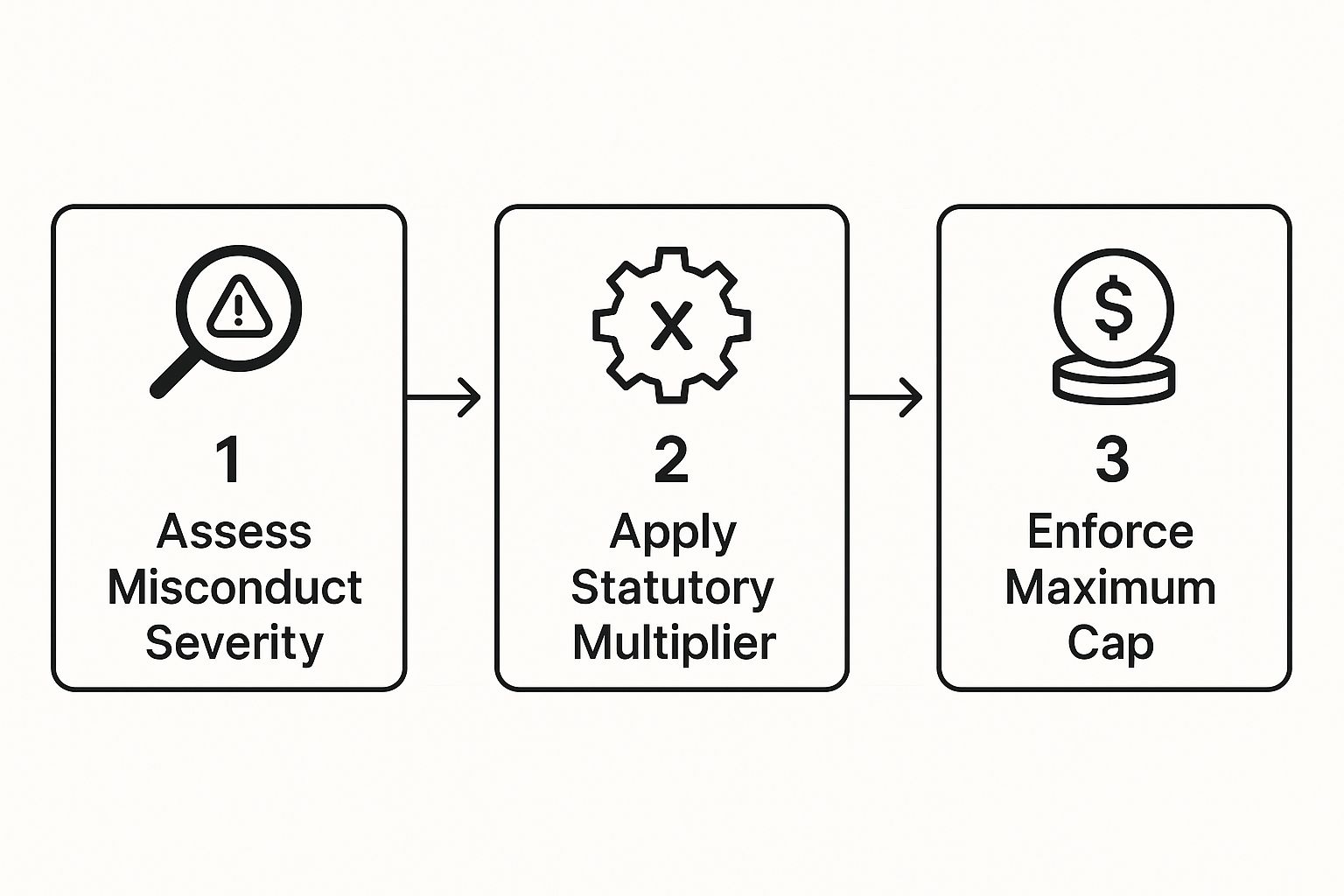
As you can see, the court has to first weigh the severity of the misconduct before thinking about numbers or legal caps. The jury sifts through this evidence to decide if the defendant’s behavior was so outrageous that it meets Georgia's "clear and convincing" standard. Only after making that determination can they decide on a financial figure that truly punishes the defendant and makes an example out of them, completing the process for awarding what are exemplary damages.
Real-World Scenarios Where Exemplary Damages Apply

Legal theory is one thing, but seeing how exemplary damages play out in the real world makes the concept crystal clear. These aren't awarded for a simple fender bender or an honest mistake. We're talking about conduct so far over the line that it demands a powerful response from the justice system.
Let's walk through a few scenarios that paint a picture of the kind of outrageous behavior that can trigger these awards. Each one moves beyond simple negligence and into the territory of willful misconduct or a conscious indifference to the safety of others.
Medical Malpractice
Imagine a surgeon with a known history of substance abuse—a history the hospital administration is fully aware of. Despite this, he performs a complex surgery while under the influence of alcohol, leaving the patient with a permanent, life-altering disability.
In this case, the surgeon's decision to operate while impaired is a shocking betrayal of his duty of care. But the hospital’s failure is just as bad. By knowingly letting a compromised doctor into the operating room, the institution itself showed a conscious indifference to patient safety.
Corporate Negligence
Think of a trucking company obsessed with cutting costs. To boost profits, management pressures drivers to fake their logbooks, pushing them to drive far beyond legal limits. They also systematically skip mandatory safety inspections on their trucks.
One day, an exhausted driver behind the wheel of a truck with failing brakes causes a massive pileup on an Atlanta interstate. This isn't just one person's mistake; it's a systemic failure. It’s the direct result of a corporate culture that deliberately chose to put profits ahead of people's lives. Reviewing various product liability case examples can also show how patterns of corporate misconduct lead to these kinds of awards.
This type of calculated risk-taking is precisely what exemplary damages aim to punish. The goal is to make the financial penalty so severe that the company, and others like it, will never make that dangerous calculation again.
Premises Liability
Consider an apartment complex owner who gets complaint after complaint from tenants about exposed, sparking electrical wires in a shared hallway. It's a clear fire hazard, but the owner ignores the warnings for months to avoid paying for the repairs.
Predictably, the faulty wiring eventually sparks a fire that severely injures a resident. The owner's failure to act, despite being fully aware of the imminent danger, elevates this case from simple negligence to a conscious disregard for tenant safety. It’s this conscious disregard that opens the door to a claim for exemplary damages.
Frequently Asked Questions About Exemplary Damages
When we talk about exemplary damages, a lot of the same questions come up. It's a part of the law that can feel a bit murky at first, so let's clear the air with some straightforward answers.
Can I Get Exemplary Damages for a Simple Car Accident?
Generally, no. A typical fender-bender caused by a moment of carelessness—like someone glancing at their phone—won't qualify. Exemplary damages are reserved for conduct that goes far beyond simple negligence. We're talking about actions that show a complete and shocking disregard for the safety of others.
Think of scenarios like these, which might rise to that level:
- A driver causing a wreck while having an extremely high blood alcohol level.
- Someone engaging in a high-speed street race on a public road.
- An intentional collision stemming from a road rage incident.
Is There a Cap on Exemplary Damages in Georgia?
Yes, for most personal injury cases, Georgia law puts a ceiling on exemplary damages at $250,000. You can find the specific legal language in the statute itself, O.C.G.A. § 51-12-5.1, on official government websites like the Georgia General Assembly.
But that cap isn't set in stone. There are some key exceptions where the limit gets thrown out the window. If the defendant acted with a specific intent to harm you, or if they were under the influence of drugs or alcohol, the $250,000 limit does not apply. In those cases, a jury has the freedom to award a higher amount based on the facts.
Who Actually Gets the Money from an Exemplary Damages Award?
This is where Georgia law gets really interesting. While the award is given to you, the injured plaintiff, you don't actually keep the entire amount.
The State of Georgia is entitled to 75% of any exemplary damages award that comes from a trial verdict. The plaintiff receives the remaining 25%, and legal fees and case expenses are paid out of that portion.
This rule really drives home the public purpose behind these damages. It’s a powerful statement that punishing extreme misconduct is a benefit to the entire community, not just the person who was directly harmed. Knowing these details is a big part of understanding what are exemplary damages and their role in our justice system.