When an accident happens, the first legal question is almost always the same: did someone’s carelessness cause the harm? That concept is called negligence, and it comes in several flavors. Understanding the different kinds of negligence is the first step in figuring out your rights after an injury. The law recognizes several types that apply in different situations, ranging from a simple mistake to a complete disregard for others' safety.
Understanding the Foundation of a Negligence Claim
Before diving into the specific types, it's helpful to grasp the one idea that ties them all together: the duty of care. This is a legal obligation we all have to act with reasonable caution to avoid hurting others. Think of it as the unwritten rulebook for society—whether you’re driving a car, mopping a store floor, or performing surgery.
When someone fails to meet that basic standard, they have "breached" their duty. That breach is the first domino to fall in building a personal injury case.
The Spectrum of Carelessness
The different kinds of negligence aren't random; they exist on a spectrum based on how far someone strayed from their duty of care. A key part of this is the standard of care, which is tied to establishing effective due diligence processes to prevent harm in the first place.
This hierarchy diagram shows how the behavior progresses from a simple failure to outright recklessness.
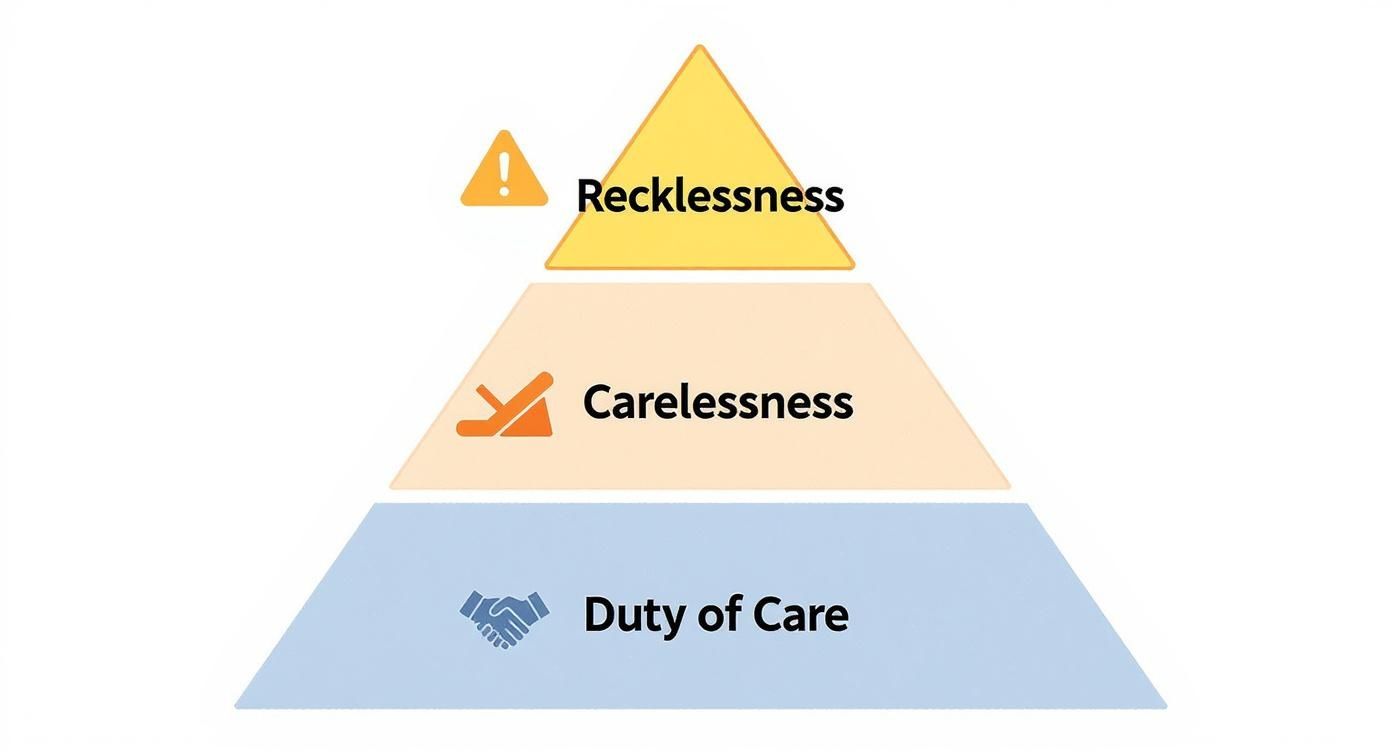
As the infographic makes clear, the more careless the act, the more severe the negligence.
In a personal injury claim, figuring out which type of negligence applies is a key step. It shapes the entire strategy, impacts the strength of the case, and can even affect the amount of compensation available. If you're new to these terms, our firm’s legal dictionary can provide more in-depth definitions.
We’ll break down the most common categories you're likely to encounter:
- Ordinary Negligence: This is the most common form. It’s a simple failure to act as a reasonably careful person would.
- Gross Negligence: A much more serious failure of care that shows a reckless disregard for the safety of others.
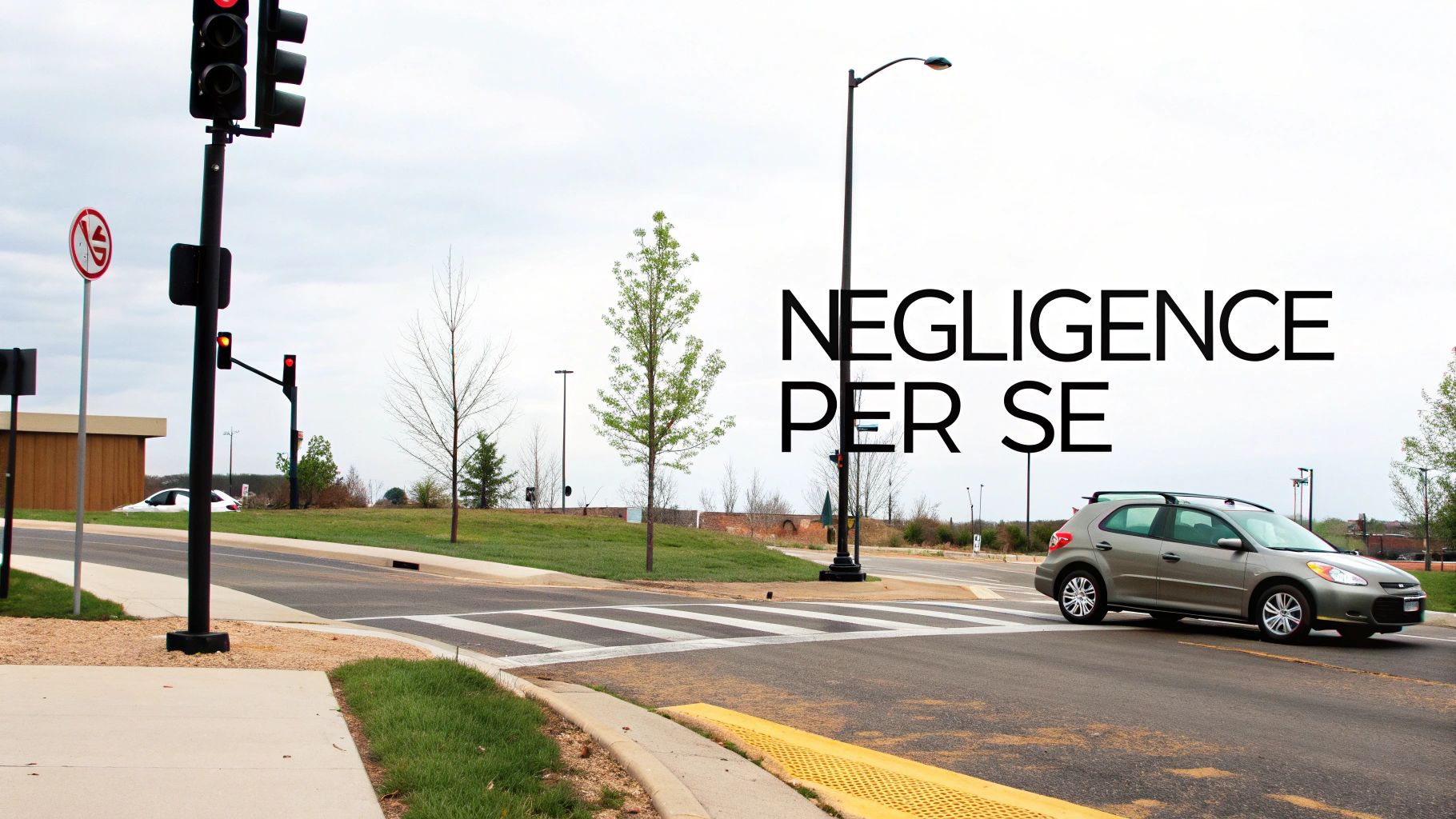
- Negligence Per Se: This applies when the careless act also happens to break a specific law or statute.
- Vicarious Liability: Holding one person or company responsible for the negligent actions of someone else (like an employee).
Each of these kinds of negligence has its own unique requirements for proving fault.
Quick Overview of Negligence Types
Here’s a simple table to help you keep the main types straight.
| Type of Negligence | Level of Carelessness | Common Example |
|---|---|---|
| Ordinary | Failure to act like a reasonably prudent person would. | A driver who briefly looks at their phone and rear-ends someone. |
| Gross | Conscious and voluntary disregard for the safety of others. | A surgeon amputating the wrong limb. |
| Negligence Per Se | An act that violates a safety law or statute. | A drunk driver causing a collision. |
| Vicarious | One party is held responsible for another's actions. | A company being held liable for a delivery driver's crash. |
This at-a-glance summary provides a solid starting point for understanding how a specific act of carelessness might be classified under the law.
Distinguishing Between Ordinary and Gross Negligence
Among the different kinds of negligence, two of the most common are ordinary negligence and gross negligence. The fundamental difference between them comes down to the defendant’s state of mind and just how careless their actions were.
Think of it as the gap between a simple, honest mistake and a shocking, conscious disregard for the safety of others.
What Does Ordinary Negligence Look Like?
Ordinary negligence is the most basic form of carelessness. It’s defined as the failure to act as a reasonably prudent person would under similar circumstances. There's no intent to cause harm here—it's simply a lapse in judgment or a failure to take reasonable precautions.
A classic example is a store owner who mops the floor but forgets to put out a "wet floor" sign.
Here are a few other clear examples:
- Distracted Driving: A driver glances down at their GPS for a second and causes a minor fender bender. They didn't intend to crash, but their inattention fell below the standard of care expected from a reasonably careful driver.
- Poor Property Maintenance: A landlord knows a handrail on a staircase is broken but fails to fix it for several weeks. A tenant then falls and gets hurt.
- Inadequate Supervision: A dog owner lets their pet off its leash in a public park that isn’t a designated off-leash area. The dog excitedly jumps on someone, knocking them over.
These situations all show a clear failure to meet a basic standard of care, which forms the foundation of most personal injury claims.
The Higher Bar of Gross Negligence
Gross negligence, on the other hand, is a major step up in severity. This involves a conscious and voluntary disregard of the need to use reasonable care, knowing it is highly likely to cause serious, foreseeable harm.
It’s not just a mistake; it’s reckless indifference to the well-being of others.
Courts view this type of conduct much more seriously. Proving this level of recklessness can sometimes open the door to punitive damages, which are designed to punish the wrongdoer, not just compensate the victim. This is especially true in cases involving professional standards, like those with a trusted medical provider. You can find more details on how these standards apply in our guide to understanding medical malpractice claims in Atlanta.
In legal terms, gross negligence is often described as behavior that "shocks the conscience." It's a departure from the standard of care so extreme that any reasonable person would immediately recognize the danger.
Imagine a surgeon amputating the wrong limb or a commercial truck driver speeding through an active school zone while texting. These aren't simple errors. They are extreme deviations from acceptable conduct that highlight the severe nature of different kinds of negligence.
How a Broken Law Can Prove Negligence Per Se

Sometimes, proving fault doesn't involve a big debate over what a "reasonable person" would have done. In certain cases, negligence is established the moment a safety law is broken. This powerful legal tool is known as negligence per se.
The term comes from Latin and means "negligence in itself." It's a legal shortcut. It says that the act of breaking a law designed to protect people is, on its face, a negligent act. When this applies, the violation itself stands as proof that the defendant breached their duty of care.
This can greatly simplify a personal injury claim. Instead of arguing about vague standards, the case pivots to two key questions: Did the defendant break a specific law, and did that violation directly cause the injuries?
The Elements of a Negligence Per Se Claim
To use this doctrine, the situation must fit a specific legal test. The court won't just accept any broken law as proof.
Typically, your attorney must show that:
- The defendant violated a specific law, statute, or local ordinance.
- The law was written to prevent the exact type of harm that occurred.
- The injured person is part of the group of people the law was designed to protect.
If you can prove these elements, the court can instruct the jury that the defendant’s actions were negligent as a matter of law.
A defendant violating a safety statute isn't automatically liable for all damages. You must still prove their violation was the direct and proximate cause of your injuries.
Real-World Examples in Georgia
This legal doctrine comes up all the time in personal injury cases, especially those involving car accidents. Think about it: the entire body of Georgia's traffic laws, found in the official Georgia Code, is a set of safety rules. Breaking any of them can trigger negligence per se.
Here are a few common examples you might see in Georgia:
- Running a Red Light: A driver blows through a red light and T-bones another car in an intersection. They violated a specific traffic law meant to prevent that exact type of collision.
- DUI Accidents: Someone gets behind the wheel after drinking and causes a crash. Violating Georgia’s DUI laws is clear evidence of their negligence.
- Building Code Violations: A landlord doesn't install smoke detectors in a rental unit as required by law. If a fire breaks out and a tenant is injured from smoke inhalation, that code violation establishes negligence per se.
In each scenario, we aren't debating whether the person was being "careless" in a general sense. Their failure to follow a specific safety statute provides direct proof of their negligence.
Understanding Vicarious Liability and Shared Responsibility
Sometimes, the person who caused your injury isn't the only one held responsible. This is where a legal principle called vicarious liability comes into play. It’s one of the important kinds of negligence to understand.
Simply put, vicarious liability means one party can be legally responsible for the negligent actions of another, all because of their specific relationship. It’s not about finding fault with an innocent bystander. Instead, the law acknowledges that relationships like employer-employee carry a duty to answer for harm caused by someone acting on your behalf.
The Most Common Scenario: Employer-Employee Responsibility
By far, the most common use of vicarious liability is in the workplace. The legal doctrine is known as respondeat superior—a Latin phrase that means "let the master answer."
Under this rule, an employer is on the hook for an employee's negligent acts, provided the employee was acting within the "scope of their employment."
Think of it this way: if a delivery driver speeds through a red light and hits you while on their route, the company that hired them can be held liable for your injuries. The driver was doing their job, so the company that benefits from that work must also carry the risk of their mistakes.
To see how establishing fault fits into the wider legal process, you can learn more about the personal injury lawsuit process and what to expect.
Other Relationships and Shared Responsibility
Vicarious liability isn't limited to the workplace. The principle of shared responsibility pops up in several other contexts where one person has a duty of care or control over another.
- Parent-Child: Georgia law allows parents to be held responsible for certain malicious acts committed by their minor children, though these situations are specific and often have financial caps.
- Vehicle Owner-Driver: Under the "family purpose doctrine," if a vehicle owner provides a car for general family use, they can be found liable when a family member causes an accident through negligence.
- Business Partnerships: In a partnership, each partner is generally liable for negligent acts committed by another partner while conducting business.
The core idea behind vicarious liability is that the responsible party was in a position to control the actions of the negligent person or benefited from their activities, making it fair to hold them accountable.
This legal concept is important for injury victims. It ensures there's a practical path to getting compensation, especially when the person who directly caused the harm lacks the resources to cover the full extent of the damages.
How States Handle Shared Fault with Comparative Negligence

It’s rare for an accident to be 100% one person's fault. Often, the injured person might have contributed to the incident in a small way. This brings up an important question in any personal injury case: what happens when both parties share some of the blame? This is where the concept of shared fault comes in, and most states, including Georgia, use a system called comparative negligence to figure it out.
This modern approach is a far cry from the old, harsh rule known as contributory negligence. Under that doctrine, if you were found to be even 1% at fault for your own injuries, you were completely barred from recovering a single dime. It was an all-or-nothing system that led to unfair results, where a mostly innocent victim got nothing from a defendant who was 99% to blame.
Thankfully, only a handful of states still cling to this outdated rule. The vast majority saw the injustice and moved to a more balanced system.
Pure vs. Modified Comparative Negligence
The comparative fault system directs a jury to assign a percentage of fault to everyone involved. From there, states apply the rule in one of two main ways: "pure" or "modified."
- Pure Comparative Negligence: In these states, an injured person can recover damages regardless of how much fault is placed on them. If you were 90% responsible for a crash, you could technically still sue the other driver to recover the 10% of damages they caused.
- Modified Comparative Negligence: This is the more common system and the one we use here in Georgia. It sets a threshold on fault. If your share of the blame crosses that line, you can no longer recover damages.
Most states that use a "modified" rule set a 50% or 51% bar. This means your eligibility for compensation depends on being less at fault than the other party.
Georgia’s 50% Modified Comparative Fault Rule
Georgia operates under a modified comparative fault system with a strict 50% bar. Legally, this means you can recover damages only if you are found to be 49% or less at fault for the accident. If a jury decides your share of the blame is 50% or more, you are barred from recovering anything.
Here’s a practical example of how this plays out:
Imagine you're in a car wreck and your total damages amount to $100,000. The jury finds the other driver was 80% at fault for running a red light, but you were 20% at fault for speeding. Under Georgia's rule, your $100,000 award is reduced by your share of fault (20%, or $20,000). You would receive a final award of $80,000.
This system makes proving the other party’s degree of fault a vital part of your case. Even outside of traffic accidents, shared fault is a factor. The World Health Organization estimates that roughly 1 in every 10 patients is harmed while receiving medical care, often due to various kinds of negligence. You can learn more about these global safety issues on the WHO's patient safety page.
Common Questions About the Kinds of Negligence
To help tie all this together, let’s run through some common questions we hear from clients about the different kinds of negligence. Think of this as a quick Q&A to clear up these important legal concepts.
What Is the Difference Between Negligence and an Intentional Act?
The core difference is all about intent—or the lack of it. Negligence is fundamentally about carelessness. It's when someone fails to act with reasonable care, and that failure unintentionally hurts someone else. The person did not mean for the injury to happen.
An intentional act, like assault, is the opposite. It happens when someone deliberately acts to cause harm. Because these acts involve purposeful wrongdoing, the legal system treats them much more severely. They can lead to criminal charges on top of a civil lawsuit.
Is Medical Malpractice a Form of Negligence?
Yes, absolutely. Medical malpractice is a very specific type of negligence. It happens when a healthcare professional—a doctor, surgeon, or nurse—provides care that falls below the accepted standard of care in their field, directly causing injury to a patient.
The "standard of care" is the level of skill and caution that a reasonably competent professional in that same specialty would have used in a similar situation. Proving a breach of this standard almost always requires testimony from a medical expert who can establish what should have happened and explain how the defendant failed to meet that mark.
How Long Do I Have to File a Negligence Claim in Georgia?
In Georgia, the clock is ticking. The legal deadline for filing most personal injury claims is called the statute of limitations. For the majority of negligence cases, you have two years from the date of the injury to file a lawsuit. If you miss that deadline, your right to seek compensation is likely gone forever.
This deadline is one of the most unforgiving rules in personal injury law. No matter how strong your case is, waiting too long can permanently bar you from getting the justice you deserve.
There are a few rare exceptions, like cases involving minors or claims against government entities. To make sure you don’t miss your window to act, you can learn more about the statute of limitations for personal injury in GA and see how it applies to your specific circumstances.
Can I Still Have a Case if No One Was Physically Hurt?
Generally, a personal injury claim requires proof of actual damages, which almost always means a physical injury. If only your property was damaged—for example, your car in a fender bender—that would be a property damage claim, not a personal injury case.
While claims for purely emotional distress without physical harm do exist, they are very difficult to prove in Georgia. Success depends heavily on the specific facts and state law. Understanding what qualifies as a compensable injury is a necessary first step in determining if you have a valid claim for any of the kinds of negligence.