If you've just been told you need to give a deposition, it's natural to feel a bit on edge. So, what happens at a deposition? It's really just a formal Q&A session that takes place outside the courtroom. Instead of a scary interrogation, think of it as a structured conversation where attorneys gather facts for a legal case. My goal here is to give you helpful, straightforward information about this common legal step. Understanding the process is the best way to feel prepared and confident when you share your story.
Your Role in the Discovery Process
Once a personal injury lawsuit gets filed here in Atlanta, both sides move into a phase called discovery. This is the part of the legal process where each party gets to find out what the other side knows. A deposition is a key piece of that puzzle. It's an oral examination, given under oath, where attorneys can question witnesses before a case ever goes to trial. You can find more information about this at the Cornell Law School Legal Information Institute.
The main goal is to let the opposing attorney hear the facts directly from you. It's their chance to understand your side of the story and see how you come across as a witness. Since this is such a standard part of most civil cases, it's a good idea to know what to expect.
Who's Who in the Deposition Room
Walking into the room for your deposition, you’ll find a few key people. Knowing who they are and what they do can take a lot of the mystery out of the process.
Let's break down who you'll meet and what their job is.
| Participant | Their Role and Responsibility |
|---|---|
| The Deponent | This is you. Your job is to answer questions truthfully and clearly under oath. |
| Your Attorney | Your lawyer is your advocate. They are there to prepare you, protect your rights, and object to improper questions. |
| The Opposing Attorney | This is the lawyer representing the other party. They will be asking you the questions to gather information for their case. |
| The Court Reporter | A neutral professional who administers the oath and creates a verbatim transcript of everything said during the deposition. |
Understanding these roles helps clarify that a deposition is a structured, official proceeding governed by rules, not just an informal chat.
Below is a screenshot from Georgia's official government website, which offers resources on state laws and legal issues that guide procedures like depositions.
This resource confirms that all legal proceedings, depositions included, follow established state rules. Knowing this should give you confidence that the process is designed to be fair and orderly.
Your testimony becomes a permanent record. Everything you say is transcribed and can be used later during settlement negotiations or in court. This is why clear, honest answers are so important.
The information gathered helps both sides evaluate the strengths and weaknesses of their cases. A strong, consistent testimony can significantly influence the direction of your claim. Understanding what happens at a deposition is the first step toward confidently sharing your story.
How to Prepare for Your Deposition

Feeling prepared is the single best way to build confidence before you testify. While simply understanding what happens at a deposition is a great first step, the proactive work you put in beforehand can make a world of difference. Your attorney is your guide, but your own preparation is a powerful tool.
The goal isn't to memorize a script. It's to get comfortable with the facts so you can state them clearly. Your honesty is your greatest asset.
Review Key Documents
Before the deposition, it’s smart to refresh your memory by looking over important documents tied to your case. Your attorney will point you to the most important ones.
These usually include:
- The Police Accident Report: Get reacquainted with the details recorded right after the accident.
- Medical Records and Bills: Review the timeline of your treatment, the doctors you saw, and the costs involved.
- Your Answers to Interrogatories: These are written questions you’ve already answered under oath. It is important that your spoken testimony aligns with these previous statements.
The focus here is on familiarity, not memorization. You don’t need to have every date or dollar amount committed to memory. The idea is to have the general sequence of events straight in your mind.
The Power of Honesty
The most important rule in a deposition is simple: tell the truth. You are under oath, and your credibility is everything. The opposing lawyer isn't just listening to what you say; they are sizing you up, trying to figure out how a jury might perceive you.
Stick to what you know for sure. If you don't know the answer to a question, the correct response is, "I don't know." If you can't recall a specific detail, it is perfectly fine—and honest—to say, "I don't remember."
Never, ever guess or speculate. An incorrect guess can destroy your credibility far more than admitting you don’t recall a minor detail. This direct, honest approach protects both you and the integrity of your case.
Practice with Your Attorney
Your lawyer will schedule a prep session with you before the deposition. This is your chance to ask any lingering questions and get comfortable with the whole process. We almost always run through a mock Q&A, asking the kinds of questions you can expect to hear from the other side.
This practice run helps you:
- Organize your thoughts and practice giving clear, concise answers.
- Learn to listen carefully to the exact question being asked, not what you think is being asked.
- Understand how to handle confusing, compound, or tricky questions.
This preparation ensures you walk into the deposition feeling ready and composed. Being well-prepared is the best way to handle what happens at a deposition and provide clear, effective testimony that strengthens your case.
A Play-by-Play of Deposition Day
Walking into a deposition can feel intimidating, but much of that anxiety comes from the unknown. Once you understand the sequence of events, it becomes a much more manageable, structured process. Let's break down what the day will actually look like, from the moment you arrive to the very end.
You'll typically meet at the opposing counsel's office or a neutral location, where you'll be shown to a conference room. The only people in the room will be you, your attorney, the other side's attorney, and a court reporter. The first official action is being sworn in. The court reporter will ask you to raise your right hand and swear an oath to tell the truth, the whole truth, and nothing but the truth—the same oath you would take in a courtroom.
The Flow of Questioning
With the oath administered, the questioning starts. The lawyer for the other side will ask almost all the questions. Your lawyer's job here is mostly to listen, ensure you're comfortable, and object if a question is improper or unfair.
The questioning almost always follows a predictable path:
- Background Information: They'll start with the basics—your name, address, job history, and education. This warms everyone up and gives them a baseline understanding of who you are.
- Pre-Accident Health: Next, they will inquire about your health and any medical conditions you had before the accident. Their goal is to establish a clear "before" picture to compare with your condition "after."
- The Incident Itself: This is the heart of the deposition. You will be asked to describe, in your own words and in detail, exactly how the accident occurred.
- Post-Accident Damages: Finally, the focus shifts to the consequences. You'll answer questions about your injuries, the medical treatment you've received, any lost income, and how the incident has affected your day-to-day life.
The photo below gives you a good idea of the setup. It’s a formal setting, but it’s really just a structured conversation where your testimony is recorded.
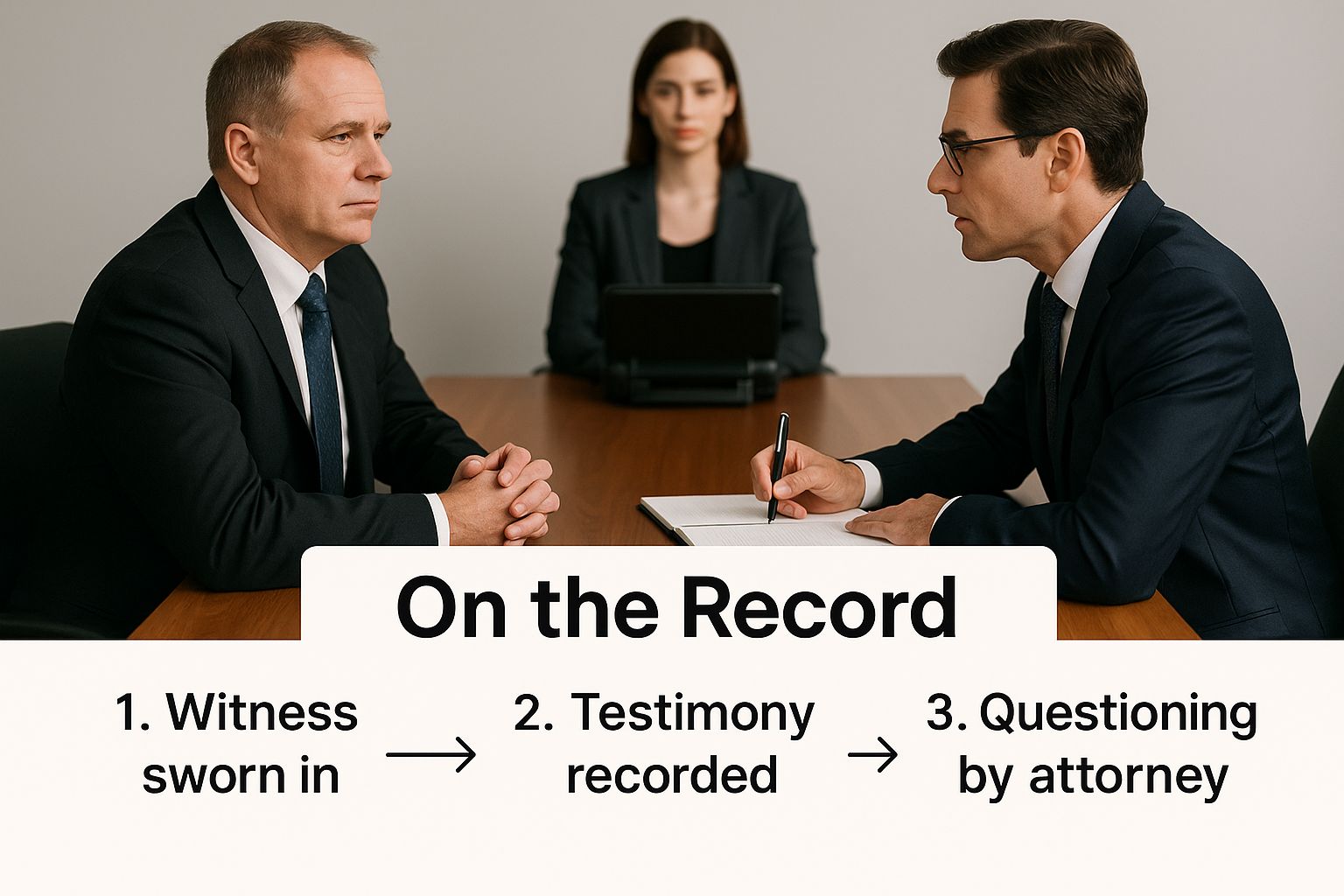
Deposition Day Timeline What to Expect
To give you an even clearer picture, here is a simple timeline of how the day usually unfolds.
| Phase | What Happens During This Phase |
|---|---|
| Arrival & Setup | You, your lawyer, the opposing lawyer, and a court reporter gather in a conference room. |
| Swearing In | The court reporter administers the oath to tell the truth. Your testimony is now "on the record." |
| Questioning Begins | The opposing lawyer starts with background questions before moving to the accident and your injuries. |
| Breaks | You can request breaks as needed to rest, consult with your attorney, or just clear your head. |
| Concluding Questions | The lawyer will signal they are finishing up, often with a phrase like, "I just have a few more questions." |
| "Off the Record" | Once questioning is complete, the court reporter announces you are "off the record." The deposition is over. |
Seeing the process laid out like this helps demystify it. Each phase has a clear purpose, and there are no surprises.
Pacing Yourself and Using Technology
Remember, a deposition is a marathon, not a sprint. You have the right to ask for a break. If you feel tired, confused, or just need a minute, simply tell your attorney you need to pause. It is far better to take a five-minute break to refocus than to power through and give an unclear or inaccurate answer.
Technology is also changing the landscape, with tools making the process more accessible and efficient. You can find more details in this industry analysis of deposition technology. However, the core of the deposition—truthful testimony—remains the same.
By understanding this play-by-play, you can walk into your deposition feeling prepared and confident about what happens at a deposition.
Answering Common Deposition Questions
While no two depositions are identical, the questions you'll face often follow a very predictable script. Getting a handle on what happens at a deposition means learning these patterns so you can give clear, truthful answers without feeling ambushed. The point isn't to memorize answers, but to understand what the other side’s lawyer is trying to accomplish.
Think of it as the opposing attorney piecing together a puzzle. The questions are designed to gather specific pieces of information about you, the incident, and how it has affected your life.
Questions About Your Background
The deposition will almost always kick off with basic questions about you. This is a warm-up of sorts, allowing the attorney to get some simple facts on the record while also observing your demeanor and how you communicate.
You can expect them to ask about:
- Your full legal name and current address.
- Your education, starting from high school.
- Your complete employment history.
- Your marital status and basic family details.
These questions seem simple, but they’re laying the foundation for your credibility. Your attorney will likely advise you to keep these answers brief and stick strictly to the facts.
Questions About Your Health and the Incident
This is the real heart of the deposition. The opposing lawyer needs to establish a baseline of your physical condition before the incident. Why? So they can later argue about which of your injuries were actually caused by the event in question.
- Your Prior Medical History: Get ready for a deep dive into your past. They'll ask about old injuries, surgeries, chronic conditions, and even routine doctor visits. Absolute honesty here is non-negotiable.
- The Incident Itself: You will be asked to walk them through the accident step-by-step. It’s important that you only describe what you personally saw, heard, and did. Never guess what someone else was thinking or doing.
Key Advice: Listen to the entire question before you even think about answering. Once you've answered the specific question that was asked, stop talking. It's a natural human tendency to want to fill the silence or over-explain, but volunteering extra information can accidentally open up new lines of questioning you don't want to deal with.
Personal injury claims fall under the umbrella of civil cases. The image above, from the U.S. Courts, underscores that these types of cases involve disputes between people or organizations. They are governed by very specific rules of procedure, including the rules that apply to depositions. You can get a better sense of this legal arrangement by reviewing the Federal Rules of Civil Procedure.
Questions About Your Life After the Incident
Finally, the attorney will shift focus to the aftermath. This is your opportunity to explain the real-world consequences of the incident and your injuries.
They will almost certainly ask about:
- Medical Treatment: Every single doctor, physical therapist, chiropractor, or specialist you have seen since the incident.
- Lost Income: Any time you missed from work and, more broadly, how the injury has impacted your ability to earn a living.
- Daily Life: How your injuries have interfered with your ability to perform daily activities, from hobbies and exercise to household chores.
By anticipating these three core areas, you can walk into your deposition mentally prepared. Understanding what happens at a deposition is really about knowing this predictable playbook.
Why Your Attorney Makes Objections

As you're testifying, you will almost certainly hear your attorney say, "Objection." It can feel a bit dramatic, maybe even disruptive, but it’s a standard—and very important—part of the procedure. An objection is simply your lawyer’s way of acting as a shield to protect you from improper or unfair questions.
Think of it like a referee calling a foul in a basketball game. The ref isn't trying to stop the game; they are simply making sure everyone plays by the rules. In the same way, your attorney isn’t trying to hide the truth. They are enforcing the established rules of civil procedure to keep the questioning fair and focused on what matters.
Understanding Common Objections
While there are many legal grounds for an objection, a few common ones come up all the time in personal injury depositions. If you know what they mean ahead of time, it can help you stay calm and composed when you hear them.
Here are a few you are likely to hear:
- Objection, Form: This is the most frequent objection you'll encounter. It’s a catch-all that means the question itself is flawed. It might be confusing, vague, compound (asking two questions at once), or argumentative.
- Objection, Asked and Answered: This one is exactly what it sounds like. The other lawyer is asking a question you have already answered. Your attorney objects to stop them from trying to trap you into giving a slightly different response.
- Objection, Calls for Speculation: This happens when the opposing lawyer asks you to guess what someone else was thinking, feeling, or seeing. You can only testify about what you know for a fact, not what you think someone else knows.
What to Do When You Hear "Objection": Your job is simple but important. The moment you hear your attorney object, you must stop talking immediately. Don't try to finish your sentence or answer the question. Listen for your attorney's instruction on what to do next.
Most of the time, especially with "form" objections, your attorney will follow up by saying something like, "Objection to the form. You can answer if you understand." This puts the control back in your hands, reminding you to only answer if you are absolutely clear on what is being asked.
This whole process is governed by strict guidelines, like those found in the Federal Rules of Civil Procedure, to ensure fairness. Understanding your lawyer’s protective role during what happens at a deposition is key to feeling confident and in control.
So, What Happens After the Deposition Is Over?
When the final question is asked and the court reporter announces, "we're off the record," you'll probably feel a huge wave of relief. You’ve just cleared a major hurdle in your personal injury case. But it's also natural to wonder, what now? Understanding what comes next is key to seeing how your testimony will shape the rest of your claim.
First things first, the court reporter gets to work. They take the complete recording from the deposition and begin the painstaking process of creating a verbatim written transcript. This isn't an overnight job—it can take a few weeks to get the finished document. Once it's done, that transcript becomes the official, word-for-word record of everything that was said.
Reviewing and Signing the Transcript
You and your attorney will receive a copy of this transcript. It’s your job to read through it, line by line, to check for any errors. Court reporters are incredibly skilled, but mistakes can still happen—a misspelled name, a jumbled date, or a misheard word. This is your chance to make sure everything is accurate.
After your review, you’ll be asked to sign the transcript, formally certifying that it’s true and correct to the best of your memory. This is called reading and signing. Once signed, this document is locked in as a powerful piece of evidence.
Your signed deposition transcript solidifies your testimony. It's a tool both sides will use to build their arguments, negotiate a settlement, and if your case goes to trial, it can even be read directly to the jury.
How Your Testimony Moves the Case Forward
With your testimony officially on the record, both your lawyer and the opposing attorney will use it to re-evaluate the case. A deposition where you come across as strong, consistent, and credible can dramatically improve your position. In many instances, it’s the final push that gets the other side to start serious settlement negotiations.
It's also important to know that the rules can get more involved if international parties are involved. For example, global deposition rules vary widely.
Ultimately, what happens in that conference room doesn't stay there. Your words create ripples that guide the next phase of your case and move it one step closer to a final resolution. Understanding this full picture of what happens at a deposition can help you see its importance in your case.
Frequently Asked Questions About Depositions
Here are some quick answers to a few common questions we often get from our Atlanta clients. Having answers to these practical details can make a big difference in feeling prepared.
- How long will this take?
Most personal injury depositions last a few hours. For cases with more factors, it could take a full day. You have a right to take breaks whenever you need to. - Should I bring notes?
No. I always advise against bringing any notes or documents with you. Anything you bring into the room can be demanded by the other lawyer and become an exhibit in the case. It is much better to rely on your preparation with your attorney. - What should I wear?
Dress like you are going to court. Business casual is a safe bet. You want to look clean, put-together, and respectful. Your appearance communicates that you are taking the proceeding seriously. - Will I be on camera?
It’s possible. The opposing side has the right to videotape the deposition. If they do, they must provide advance notice, so you will know beforehand if a videographer will be there. - What if I don't know the answer?
The best answer is the most honest one. If you do not know the answer to a question, simply say, "I don't know." If you can't remember a specific detail, say, "I don't recall." Never guess or make something up. Your credibility is your most important asset.