When you set foot on someone else’s property in Atlanta—be it an apartment complex, a shopping mall, or even a parking garage—you have a right to expect a reasonable degree of safety. Negligent security lawsuits are a legal pathway to hold property owners accountable when they fail to provide that basic protection, leading to a visitor being harmed by a criminal act. This guide is here to offer helpful information on these types of cases.
These cases aren't about assigning blame for the crime itself. They're about holding the property owner responsible for creating an environment where that crime could easily happen.
The Core of a Negligent Security Claim
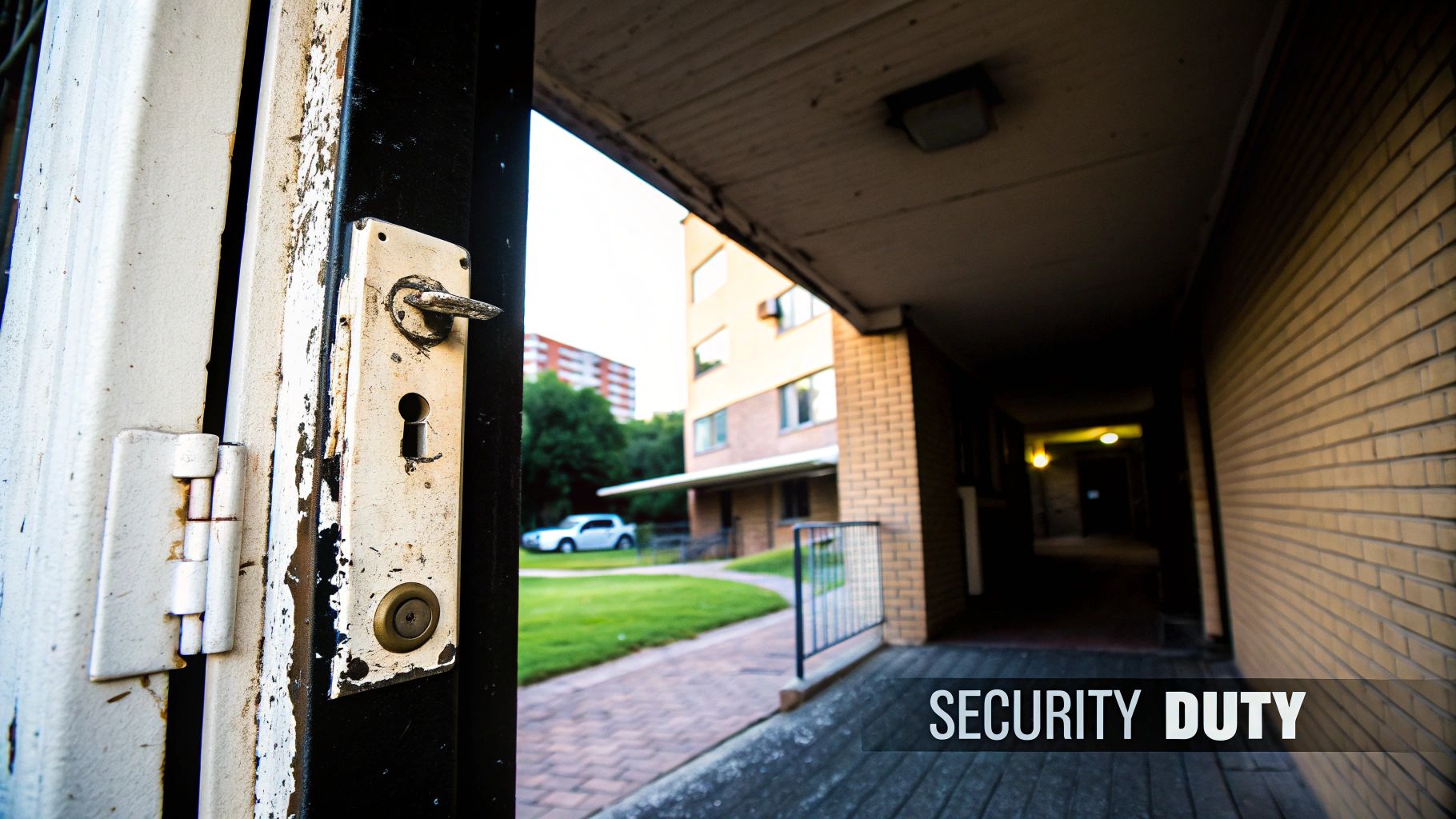
Think of a property owner like the captain of a ship. That captain has a duty to make sure the vessel is safe for everyone on board. If they know there's a hole in the hull and do nothing about it, they're responsible when a passenger gets hurt because of their inaction. Negligent security works the same way on land.
Under Georgia's premises liability laws, property owners have a legal duty to protect people from predictable criminal threats. When they fail to meet this obligation and someone is attacked, injured, or killed, it’s not just a random act of violence. It's often a direct result of the owner's carelessness.
The Role of Foreseeability
The single most important concept in these cases is foreseeability. The key question is always: did the property owner know, or should they have reasonably known, that a crime like this was likely to occur on their property?
For instance, if an apartment building’s parking garage has seen multiple assaults and break-ins, another attack becomes foreseeable. A history of crime on or near the property puts the owner on notice. They can no longer claim ignorance.
Once a danger is foreseeable, the owner has a heightened responsibility to act. They are expected to implement security measures that match the level of risk, like fixing broken locks, adding bright lighting, or hiring security. When they don't, especially with a known crime problem, that failure is what constitutes negligence. You can find more information about this legal duty of care on the Justia legal resource website.
To build a strong case, you must prove a few key things. This table breaks down the legal building blocks of a claim.
Core Elements of a Negligent Security Claim
| Legal Element | What It Means for Your Case |
|---|---|
| Duty of Care | The property owner had a legal responsibility to keep visitors reasonably safe from harm. |
| Breach of Duty | The owner failed to meet that responsibility by not providing adequate security measures. |
| Foreseeability | The criminal act was a predictable risk, given the property's history or location. |
| Causation | The owner's failure to provide security directly led to or enabled your injury. |
| Damages | You suffered actual harm (physical, emotional, or financial) because of the incident. |
Establishing these five elements is the foundation of a successful claim. It connects the owner's inaction directly to the harm you suffered.
At its heart, a negligent security claim is not about blaming the victim. It’s about accountability. It recognizes that property owners have a responsibility to create a reasonably safe environment, and when they don't, they can be held responsible for the harm that follows.
Common Examples of Security Failures
A property owner’s failure to provide adequate security can take many forms. Here are some of the most common red flags we see in these cases:
- Poor or broken lighting in parking lots, stairwells, or hallways that give attackers a place to hide.
- Broken or missing security gates and locks that allow anyone to walk right onto the property.
- Lack of surveillance cameras in high-risk areas like lobbies, entrances, or parking garages.
- Inadequate security personnel, like having no guards for a large apartment complex or hiring poorly trained staff.
Ultimately, these cases give victims a way to demand justice. If a property owner’s failure to implement basic, reasonable security measures resulted in your injury, exploring negligent security lawsuits is about holding them accountable for their inaction and getting the resources you need to recover.
Where Do Negligent Security Incidents Happen Most Often?
While a crime can technically happen anywhere, experience shows us that certain types of properties are far more likely to be the scene of a preventable attack. These aren't just random acts of violence; they are often the tragic result of a property owner ignoring predictable dangers. When you understand where negligent security lawsuits most commonly arise, you can better recognize environments where owners have a heightened duty to keep people safe.
Think about it from a criminal's perspective. They look for opportunities in places with poor lighting, high foot traffic, or isolated corners. A property owner who knows these risks exist on their premises—and fails to take reasonable steps to fix them—can be held accountable.
This is the Fulton County Courthouse in downtown Atlanta. It's where many inadequate security claims are filed, argued, and ultimately decided. Seeing the courthouse is a powerful reminder that these cases aren't just complaints; they are formal legal actions to hold property owners responsible for devastating security failures.
Common Hotspots for Security Failures
Certain properties show up again and again in these cases because they come with unique security challenges. When a business or property manager fails to address those challenges, the risk of assault, robbery, or worse skyrockets for their customers, residents, and visitors.
Here are some of the most common venues we see in these lawsuits:
- Apartment & Condominium Complexes: Broken security gates, dark stairwells, and unmonitored common areas like laundry rooms or gyms can turn a home into a hunting ground for criminals.
- Parking Lots & Garages: We've all felt that unease in a poorly lit parking garage. These vast, often deserted spaces at malls, office parks, and apartment buildings are frequent sites for attacks precisely because of the lack of surveillance and security patrols.
- Bars & Nightclubs: When management fails to provide enough security to handle aggressive patrons, check for weapons, or manage crowds, the results can be catastrophic fights and assaults.
- Hotels & Motels: Guests are vulnerable. Broken room locks, unsecured entrances that anyone can walk through, and unmonitored hallways put them in serious danger.
- Hospitals & Nursing Homes: These facilities have a fundamental duty to protect vulnerable patients. Tragically, assaults can come from other patients, visitors, or even staff members when security protocols fail.
The Statistics Behind the Locations
The data from past cases gives us a clear picture of where these incidents happen most. For instance, assault and battery cases make up roughly 42% of all negligent security claims. When you dig into that number, bars and nightclubs are the most common defendants, with apartment complexes and restaurants not far behind.
For the most horrific cases involving sexual assault, apartment complexes are again a primary location. However, hospitals and nursing homes also appear far too often as venues where these attacks happen. You can learn more by exploring findings on negligent security case trends.
The common thread connecting all these locations is foreseeable risk. A long history of 911 calls to a nightclub or a string of break-in reports at an apartment complex legally puts the owner on notice. Their failure to respond with adequate security is the very foundation of most negligent security lawsuits.
How to Prove a Property Owner Was Negligent
Winning negligent security lawsuits isn't as simple as showing you were hurt on someone else’s property. Legally, we have to prove the property owner failed in their duty to protect you from a crime they should have reasonably seen coming. It’s all about connecting their carelessness directly to the harm you suffered.
Think of it like this: a homeowner knows their backyard has a large, hidden sinkhole. If they host a barbecue and don't warn their guests, they are responsible when someone inevitably falls in and gets hurt. The owner knew the danger existed but did nothing. That's the heart of negligence.
Proving this in court means building a solid case, piece by piece, with compelling evidence. The objective is to show a jury that the criminal act wasn't just a random, unavoidable tragedy, but a preventable one.
The Role of Foreseeability
The absolute key to any negligent security case is foreseeability. We must demonstrate that the property owner either knew, or should have known, that criminal activity was a genuine risk on their premises. This isn't about blaming them for the crime itself; it's about holding them accountable for ignoring clear warning signs that put people like you in danger.
Evidence is how we tell that story. We gather documentation, records, and testimony to paint a clear picture of the property's troubled history and the owner's failure to respond.
Here’s a breakdown of the core legal elements we need to prove.
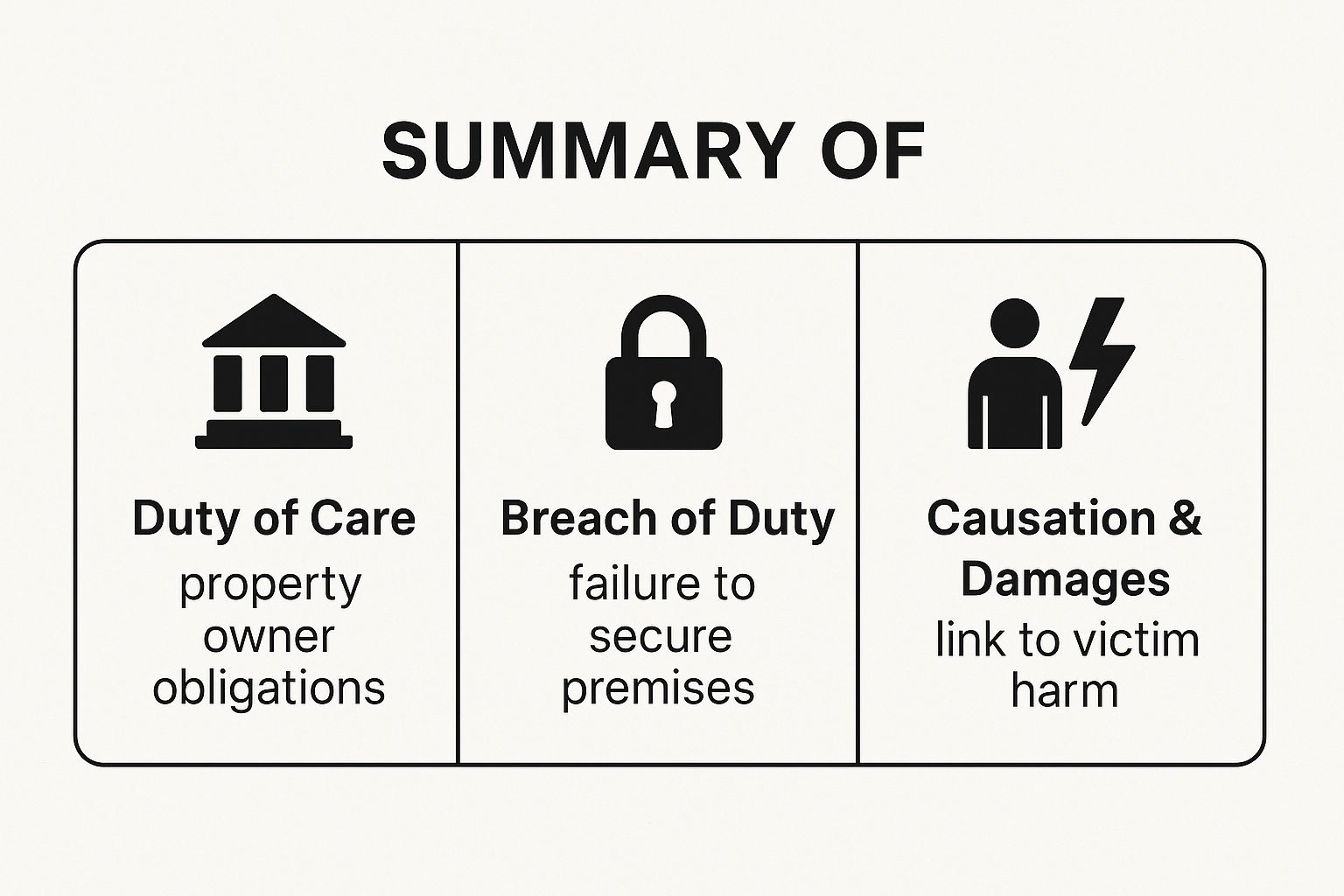
As you can see, the owner's legal duty, their breach of that duty, and the direct link to your injuries all have to connect for a claim to succeed.
Key Evidence in a Negligent Security Case
To build a persuasive case, we rely on specific types of proof. The evidence table below summarizes the most common types we use to establish a property owner’s liability.
| Evidence Used in Negligent Security Cases | |
|---|---|
| Type of Evidence | Why It's Important |
| Prior Police Reports & 911 Calls | Establishes a documented history of crime, proving the owner was on notice of the risks. |
| Witness Statements | Confirms long-standing security failures, such as broken gates or poor lighting, from people who saw it firsthand. |
| Maintenance & Inspection Logs | Reveals if security equipment (cameras, locks) was known to be broken and left unrepaired. |
| Expert Witness Testimony | Provides an objective standard for what "reasonable security" looks like and shows how the owner failed to meet it. |
Each piece of evidence contributes to a larger narrative of neglect. By carefully assembling this proof, we can show that the property owner’s failure to provide adequate security was a direct cause of what happened to you.
It's not about finding one "smoking gun." It's about the combined weight of all the evidence demonstrating a clear pattern of disregard for safety. The more proof we have that the owner knew about a risk and did nothing, the stronger your case becomes. For a deeper dive into security standards and legal expectations, resources like Wikipedia's page on security can provide additional context.
This methodical approach is essential for any successful negligent security lawsuits.
The Impact of Security Guard Failures
Sometimes, the very security measures put in place to keep you safe are the reason you get hurt. When people think about negligent security lawsuits, they often picture broken locks or dark parking lots. But a property owner's responsibility also includes the actions—or inaction—of the security guards they hire.
When security personnel don't do their job, the consequences can be catastrophic. This isn't just a matter of a guard looking the other way. It covers a whole range of failures that can directly lead to someone being assaulted or injured on the property.
In Atlanta, property owners can be held legally responsible for the security guards they employ, regardless of whether they are direct employees or third-party contractors. That’s because the owner has a fundamental duty to make sure any security they provide is competent and properly trained to handle the job.
Common Security Personnel Failures
A guard’s negligence isn't always as obvious as a physical attack, but it can create incredibly dangerous situations in places like shopping centers, apartment complexes, and concert venues.
Here are some of the most common ways security personnel fail in their duties:
- Failure to Intervene: A guard sees a heated argument escalating or a clear assault in progress but does nothing to stop it or call for police backup.
- Improper Training: The guard was never taught how to properly respond to emergencies, handle unruly individuals, or spot suspicious behavior before it turns violent.
- Using Excessive Force: A guard overreacts and physically harms a visitor, turning a minor disruption into a serious assault and battery case.
- Abandoning Their Post: The guard isn’t where they’re supposed to be, leaving a high-risk area like a front lobby or parking garage completely unmonitored and vulnerable.
The scope of negligent security lawsuits has broadened as awareness grows around the duty of care property owners and their security providers owe to the public. Security guard negligence is a major factor, with cases arising in bars, schools, hospitals, and malls. When guards use excessive force or simply neglect their duties, victims may have claims for assault, battery, or other violations of their rights. You can explore additional details about the frequency of these cases by learning more about security guard negligence.
At the end of the day, if a security guard's failure leads to your injury, the responsibility often traces right back to the property owner who hired them. Proving the guard’s actions were negligent is an important component of many successful negligent security lawsuits.
What to Do Immediately After an Incident
Feeling disoriented and overwhelmed after being attacked or injured is a completely normal reaction. The minutes and hours following a traumatic event on someone else's property are chaotic, but the actions you take can fundamentally impact both your physical recovery and your ability to pursue negligent security lawsuits. Your first priority, always, is your own safety.

Think of this guide as a clear-headed checklist for a time when clear thinking is understandably difficult. Each step is designed to build a strong record of what happened—an invaluable foundation if you decide to take legal action down the road.
Your Immediate Action Plan
Once you are in a safe place, there are a few important steps to take as soon as possible. These actions help document the incident and preserve the evidence necessary for a potential claim.
-
Seek Medical Attention Immediately: Your health is paramount. Call 911 or get to the nearest emergency room, even if you think your injuries are minor. Serious conditions like concussions or internal bleeding often don't show obvious symptoms right away. A medical evaluation creates an official record of your injuries, tying them directly to the time and location of the incident.
-
Report the Incident to the Authorities: Call the police to file an official report. A police report is one of the most powerful pieces of evidence you can have. Provide the officer with as much detail as you can about the attack and the property's condition (e.g., poor lighting, broken locks). To find your local precinct, you can use the Atlanta Police Department's online resources.
-
Notify the Property Owner or Manager: Inform the property owner, manager, or landlord about what happened. It's best to do this in writing—an email or text message works perfectly—to create a timestamped record. This action formally puts them on notice that a dangerous condition on their property led to an injury.
Gathering and Preserving Evidence
What you collect in the hours and days after the incident can make or break a case. Evidence can disappear quickly, so it's vital to document everything while your memory is fresh and the scene is still intact.
- Take Photos and Videos: Use your smartphone to document everything. Take pictures of your injuries, the exact location where the incident occurred, and any contributing factors like broken gates, dim lighting, overgrown bushes, or non-working security cameras.
- Identify Witnesses: If anyone else saw what happened, get their name and contact information. A witness statement can provide powerful, independent confirmation of your account and the unsafe conditions of the property.
- Write Everything Down: As soon as you are able, write down every single detail you can recall. Describe the lighting, the sequence of events, what was said, and who was present. Memories fade over time, so this written account becomes an essential tool for future negligent security lawsuits.
What Compensation Can Be Recovered
While no amount of money can ever erase the trauma of an attack, filing a negligent security lawsuit is about holding the right people accountable and securing the financial stability you need to heal. When a property owner’s negligence leads to your harm, Georgia law gives you the right to demand compensation—legally called damages—for every loss you’ve suffered. This isn’t a lottery win; it's about making you whole again.
The compensation you can pursue is broken down into two main categories.
Economic Damages: The Tangible Costs
These are the most clear-cut losses because they come with a paper trail. Think of economic damages as a direct reimbursement for every dollar the attack has cost you, both right now and for the rest of your life.
This category includes:
- Medical Expenses: Every single cost tied to your physical and mental recovery. This starts with the ambulance and emergency room visit but extends to surgeries, physical therapy, counseling for PTSD, and necessary prescriptions.
- Lost Wages and Earning Capacity: This covers the paychecks you missed because you were unable to work. If your injuries are permanent and you can no longer do your old job or earn the same living, you can also be compensated for this devastating loss of future earning potential.
Non-Economic Damages: The Intangible Harm
These damages are much harder to put a number on, but they are just as real and often more profound. This compensation is for the immense personal suffering that doesn't come with a bill.
Under Georgia law, specifically O.C.G.A. § 51-1-6, a person who is wronged has a right to sue for the damages they have endured. This statute provides the legal foundation for victims to demand compensation for the deep, non-physical wounds caused by an attack.
These damages are meant to address the personal impact of the trauma, including:
- Pain and Suffering: This compensates for the physical pain and chronic discomfort you’ve lived with and may face for years to come.
- Emotional Distress: This covers the invisible scars—the mental anguish, terror, anxiety, and conditions like PTSD that are a direct result of the violent act.
- Loss of Enjoyment of Life: You deserve compensation when the incident robs you of your ability to enjoy your life, from simple daily activities and hobbies to your relationships with loved ones.
Securing fair compensation for both tangible and intangible losses is the central purpose of filing negligent security lawsuits.
Frequently Asked Questions About Negligent Security in Atlanta
After being hurt because a property wasn't kept safe, people naturally have a lot of questions. Here are some of the most common ones we hear from victims in Atlanta, with straightforward answers to help you understand your options.
How Much Time Do I Have to File a Claim in Georgia?
In Georgia, the clock is ticking from the moment the incident occurs. The statute of limitations for most personal injury cases, including negligent security, is generally two years from the date you were harmed.
If you miss this two-year deadline, the law will almost certainly bar you from ever seeking compensation. That’s why it is so important to speak with an attorney and get the process started long before the window closes.
Can I Sue If I Was Trespassing?
This is a tricky area of the law. As a general rule, property owners in Georgia don't owe the same duty of care to protect trespassers from harm as they do to invited guests.
However, there are important exceptions. If a property owner's actions were willful or wanton, meaning they showed a reckless disregard for someone's safety, they could still be held liable. The specifics are laid out in the official Georgia Code, and a lawyer can determine if your situation qualifies.
What If the Attacker Was Never Caught?
You can absolutely still file a negligent security claim, even if the person who assaulted you is never found or arrested.
It's a common misconception, but your lawsuit isn't against the criminal. It's filed against the property owner whose failure to provide reasonable security—like working locks, adequate lighting, or security patrols—created the dangerous environment that allowed the attack to happen in the first place.
The focus is entirely on the property owner's negligence, not the identity of the attacker.
Is a Lawsuit My Only Option to Get Compensation?
Not at all. In fact, many negligent security cases are resolved through a negotiated settlement with the property owner’s insurance company, without ever stepping foot in a courtroom. A fair settlement can get you the resources you need much faster.
However, filing a negligent security lawsuit is an essential tool. If the insurance company refuses to make a fair offer or tries to deny a valid claim, filing a lawsuit shows them you are serious and forces them to take your case seriously. It gives you the leverage needed to fight for the full compensation you deserve.