As an Atlanta personal injury attorney, I’ve seen firsthand the financial devastation that follows a car crash, especially when insurance coverage isn't what people thought it was. When you ask, what does full coverage mean on auto insurance, the first thing to understand is that 'full coverage' isn't an official policy you can actually buy. It’s just a common phrase—a shorthand, really—for a bundle of different insurance types that work together to give you broad protection. Think of it as a solid financial safety net for when things go wrong on the road.
Unpacking the Idea of Full Coverage
Think of "full coverage" like a well-stocked first-aid kit. A single bandage might be fine for a small cut, but you need more tools to handle a serious injury. "Full coverage" is the kit, designed to handle a wide range of problems you might face on the road.
Because it’s not a standardized term, what one person considers full protection might differ from what an insurance agent or another driver thinks. To cut through the confusion, you need to understand the core components that typically make up this bundle. If you ever get stuck on specific insurance terms, our firm's legal dictionary offers some straightforward definitions.
The infographic below breaks down the three main pillars that form the foundation of most "full coverage" packages.
This visual shows how Liability, Collision, and Comprehensive coverages combine to create a safety net, each one protecting you from a different kind of risk.
Why State Minimums Are Often Not Enough
A lot of drivers assume that just meeting the state's legal insurance requirements is enough. This can be a risky assumption. These minimums are designed to provide a very basic level of protection for other people you might injure, and they can leave you financially exposed.
For example, Georgia’s minimum liability requirements are just $25,000 per person and $50,000 per accident for bodily injury. In any serious collision, medical bills, lost wages, and other damages can skyrocket past those amounts in a hurry. When that happens, you could be held personally responsible for paying the rest.
This is exactly why building a robust policy is so important. Relying only on the legally required minimum insurance often leaves families financially vulnerable after a serious crash. To truly protect yourself, you need to understand what does full coverage mean on auto insurance in a practical sense—it means building a policy that actually covers your assets and risks, not just scraping by with the bare minimum.
Breaking Down the Three Pillars of Coverage

To really grasp what "full coverage" means, you have to break it down into its core components. Think of it as a three-part shield, with each part designed to protect you from a specific type of financial disaster. Together, they create a robust policy that goes far beyond the state minimums.
Liability Coverage: Protecting Others
The first and most fundamental piece is Liability Coverage. This is the part of your policy that pays for the other person's damages and injuries when you are at fault for an accident. It’s not for your car or your medical bills; it’s for theirs.
In Georgia, liability coverage is split into two distinct categories:
- Bodily Injury Liability: This covers the medical expenses, lost wages, and pain and suffering for anyone you injure in a crash.
- Property Damage Liability: This pays to repair or replace the other driver’s vehicle or any other property you damage, like a storefront or a guardrail.
While Georgia law only requires you to carry minimum limits of 25/50/25 ($25,000 per person, $50,000 per accident for bodily injury, and $25,000 for property damage), these amounts are dangerously low in today's world. A single serious accident can easily blow past these limits, leaving you personally on the hook for the rest. We see this happen all the time in the personal injury claims we handle.
Collision and Comprehensive: Protecting Your Own Vehicle
The next two shields are all about protecting your own car. These are the coverages that a lender will almost always require if you have a loan or a lease on your vehicle, and for good reason.
The second shield is Collision Coverage. This is exactly what it sounds like—it pays to repair or replace your vehicle if it's damaged in a collision with another car or an object. Think hitting a telephone pole or backing into a retaining wall. It kicks in regardless of who was at fault.
The final shield is Comprehensive Coverage. This protects your car from just about everything else. It covers a huge range of unexpected events that are completely out of your control, such as:
- Theft
- Vandalism
- Fire
- Hail
- Hitting a deer
Comprehensive coverage is also what typically handles the cost of a professional windshield replacement after a rock cracks your glass on the highway.
Let’s quickly review how these three essential parts of a full coverage policy work together.
Full Coverage Components at a Glance
| Coverage Type | What It Covers | Example Scenario |
|---|---|---|
| Liability | Damages and injuries you cause to other people and their property. | You run a red light and hit another car, injuring the driver. Your liability coverage pays for their medical bills and car repairs. |
| Collision | Damage to your own car from a collision with another vehicle or an object. | You lose control on an icy road and slide into a guardrail. Collision coverage pays to fix your car's front end. |
| Comprehensive | Damage to your own car from non-collision events like theft, weather, or animal strikes. | A hailstorm dents your car's roof and hood while it's parked outside. Comprehensive coverage pays for the repairs. |
When you put these three pillars together—Liability, Collision, and Comprehensive—you get what people commonly refer to as a "full coverage" auto policy. Each one plays a key role in safeguarding your financial well-being after an accident.
Protecting Yourself From Uninsured Drivers
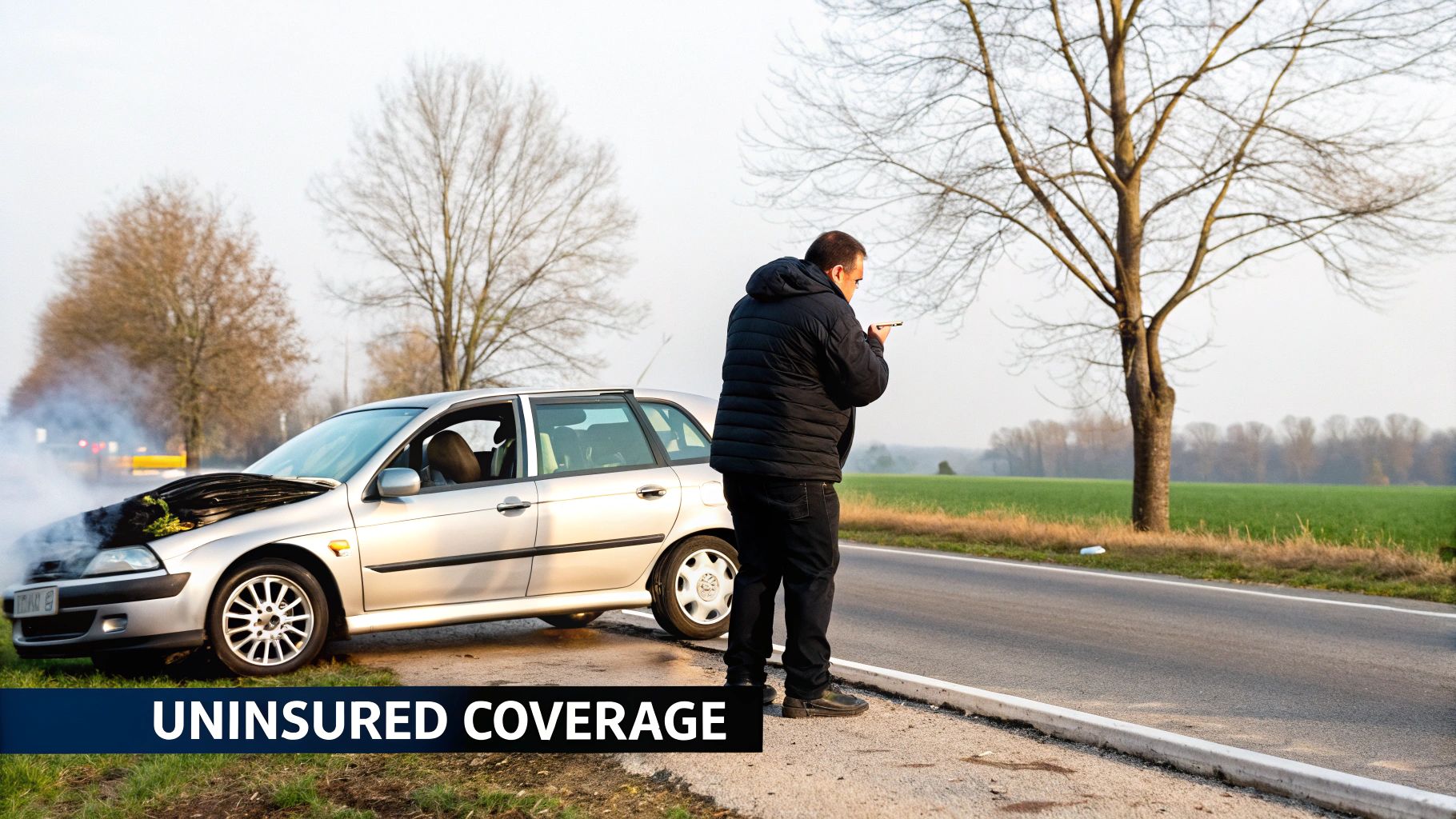
As an attorney, I often find that one of the most important parts of an auto policy is also the most frequently overlooked. What happens if the driver who hits you has no insurance at all? Or what if they have a bare-bones policy that can’t possibly cover your medical bills?
This is precisely where Uninsured/Underinsured Motorist (UM/UIM) coverage becomes your financial safeguard. It’s an essential piece of the puzzle when you’re trying to understand what does full coverage mean on auto insurance.
This coverage is designed to protect you and your passengers. It steps in to pay for your medical expenses and other damages when the at-fault driver is either uninsured (has no coverage) or underinsured (has a policy with limits too low to cover the harm they caused).
A Real-World UIM Scenario
Let's walk through a common situation. You're in a wreck that wasn't your fault, and your medical bills quickly add up to $75,000. The other driver carries Georgia's minimum liability coverage, which is only $25,000.
Without UIM coverage on your own policy, you’d only get that $25,000 from the other driver's insurance. You would be personally on the hook for the remaining $50,000, a situation that can lead to devastating financial hardship.
Now, imagine you had a $100,000 UIM policy. It would bridge that $50,000 gap, covering your remaining bills and protecting your finances. These claims have specific procedures, so it’s wise to understand how to file a car accident claim in Atlanta.
What Does It Mean to "Stack" Coverage in Georgia?
Georgia law includes a powerful option that lets you "stack" UM/UIM coverage, effectively multiplying your available benefits. Here’s a basic breakdown of how it works:
- Stacking Policies: If you insure multiple vehicles on separate policies, you can often combine the UM/UIM limits from each one.
- Example: Say you have two cars, each with $50,000 in UIM coverage. By stacking them, you could have a total of $100,000 in benefits available after being hit by an underinsured driver.
It is absolutely essential to review your policy and confirm your UM/UIM limits. For official state guidelines, you can always consult the Georgia Office of Insurance and Safety Fire Commissioner. Truly understanding what full coverage means on auto insurance starts with ensuring this important protection is firmly in place.
How to Decide If You Need Full Coverage
Figuring out if you need full coverage is a personal financial call, not a one-size-fits-all answer. As an attorney, I can’t give you direct financial advice. What I can do is walk you through the key factors to consider so you can have a much more informed discussion with your insurance agent.
The first question is the easiest. Do you have a loan or a lease on your car? If you do, the decision is already made for you. Your lender will almost certainly require you to carry both collision and comprehensive to protect their investment until the car is paid off.
The Value vs. Cost Calculation
For cars that are owned outright, the decision boils down to a simple cost-benefit analysis. You have to weigh the actual cash value of your vehicle against what you’re paying every year for the insurance premiums. This is the main step in determining if the added protection is a sound investment or a waste of money.
If your car’s value is modest—say, around $3,000—and you have a $1,000 deductible, any insurance payout for a total loss wouldn't be very large. This is exactly why so many people drop collision and comprehensive coverage as their cars get older. You can find more data on auto insurance trends from the Insurance Information Institute.
A common rule of thumb is to consider dropping full coverage when the annual premium for collision and comprehensive is more than 10% of your car's current market value.
A Checklist for Your Decision
To help you think through your own situation, here is a simple checklist of questions to ask yourself:
- What is my car worth? Use an online tool like Kelley Blue Book to get a realistic estimate of its actual cash value (ACV). Don’t just guess.
- Can I afford to replace my car? If your vehicle was totaled tomorrow, could you comfortably cover the cost of a replacement out-of-pocket without serious financial strain?
- What is my daily driving risk? Do you have a long commute through heavy Atlanta traffic, or do you work from home and rarely drive? A higher risk of an accident might justify more coverage.
Answering these questions honestly will give you a much clearer picture of your needs and help you decide if full coverage is the right choice for your financial security.
Understanding Your Insurance Premiums

When you add collision and comprehensive coverage to your policy, you’ll see your premium go up. That's no surprise—it’s the direct result of the insurance company taking on more financial risk to protect your vehicle. But have you ever wondered how they land on that specific number?
An insurance premium isn't just pulled out of thin air. It’s a carefully calculated price based on a whole profile of your personal risk factors.
Key Factors That Influence Your Rate
Insurers in Georgia, and everywhere else for that matter, look at several key pieces of information to figure out how likely you are to file a claim. Each factor helps them build a complete picture of your risk level as a driver.
Here are the most common things they’ll review:
- Your Driving History: A clean record with no accidents or tickets will always get you a better rate than a history of violations. It’s that simple.
- Your Location: Where you park your car matters. Insuring a vehicle in a dense urban area like Atlanta, with higher rates of theft and accidents, is typically going to cost more than in a quiet rural town.
- The Car You Drive: The make, model, age, and safety features of your vehicle all play a part. A high-performance sports car, for instance, costs a lot more to insure than a sensible family sedan.
- Your Age and Experience: Statistics, like those found on the National Safety Council's website, consistently show that younger, less experienced drivers are involved in more accidents, which unfortunately leads to higher insurance costs.
- Your Chosen Deductible: This one is a big deal and directly in your control. A deductible is the amount of money you agree to pay out-of-pocket for a claim before your insurance coverage kicks in.
Think of it this way: choosing a higher deductible, like $1,000, is you telling the insurer that you'll handle the smaller dings and dents yourself. This lowers their risk, and in return, they’ll often give you a lower monthly premium. On the flip side, a lower deductible means they pay more, so your premium will be higher.
While it's always tempting to go for the lowest possible premium, being underinsured after a serious wreck is a far more expensive mistake to make. Truly understanding what full coverage means on auto insurance is all about finding that sweet spot between affordable premiums and rock-solid protection.
Common Questions About Full Coverage Insurance
I hear a lot of the same questions about auto insurance, so I’ve put together some straightforward answers to help you get a clearer picture. Answering these questions is key to understanding what "full coverage" really means for your unique situation.
Does Full Coverage Pay My Medical Bills If I Cause an Accident?
Generally, no. A standard “full coverage” policy—built with liability, collision, and comprehensive—is designed to cover the other party’s injuries and damages if you’re at fault. It doesn't pay for your own medical costs.
To cover your own medical bills, regardless of who caused the accident, you need a separate, optional coverage called Medical Payments (MedPay). I always suggest discussing MedPay with your agent. It’s a low-cost addition that offers significant value and peace of mind when you need it most.
Is Full Coverage Legally Required in Georgia?
No, the State of Georgia only legally requires you to carry minimum liability insurance. The current state-mandated minimums are:
- $25,000 per person for bodily injury
- $50,000 per accident for bodily injury
- $25,000 per accident for property damage
However, if you finance or lease your vehicle, your lender will almost certainly require you to carry both collision and comprehensive coverage. This is to protect their financial stake in the car until the loan is paid off.
When Can I Drop Full Coverage on an Older Car?
You can drop collision and comprehensive coverage anytime, as long as you own the car outright and have no loan on it. A good rule of thumb is to consider dropping it when the annual cost of the coverage is more than 10% of your car's actual cash value.
For example, if your car is worth $4,000 and adding collision and comprehensive costs you $500 per year, it may be time to weigh the savings against the risk. You’d have to decide if you’re comfortable paying for all repairs—or a full replacement—out of your own pocket. Keep in mind that the statute of limitations for personal injury in GA is a separate issue from any property damage claims you might have.
While "full coverage" handles the big-ticket items like vehicle damage and liability, it doesn’t cover everything. It's worth remembering that specialized policies, like those discussed in this guide on Car Key Insurance Explained, can protect you from niche scenarios many drivers forget about.