After a car wreck here in Atlanta, trying to figure out what really happened can feel overwhelming. Witness memories fade, and stories often change. So, what are black boxes in cars? Think of them as a small, secure device in your vehicle that acts like an impartial witness, capturing objective data in the seconds right before and during a crash. It records details like your speed, if you hit the brakes, and whether your seatbelt was on.
Your Guide to Understanding Vehicle Black Boxes
When you're recovering from a collision, the other driver’s story might not match the physical evidence. This is where an Event Data Recorder (EDR)—the official name for a black box—becomes so important.
An EDR is not recording your conversations or tracking your every move like a GPS. Its only job is to log specific, technical data when a crash happens. This technology gives us a snapshot of the vehicle's dynamics, and for anyone dealing with the aftermath of an accident, that data can be the key to proving what truly occurred.
How Common Are Black Boxes?
You might be surprised to learn these devices aren't just for airplanes anymore. They've become nearly standard equipment in modern cars and trucks. For years, the National Highway Traffic Safety Administration (NHTSA) has used EDR data to study crashes and make vehicles safer for all of us.
Because of federal rules, they are now a fixture in almost every new vehicle sold in the United States. This means there's a very high chance that the cars involved in your recent accident have one of these devices, holding onto incredibly valuable evidence that can help establish who was at fault.
For example, in one real-world case, an EDR from a Lexus proved the driver had their foot on the brake until just 3.45 seconds before impact, then suddenly hit the accelerator to 44% throttle. The data showed the engine revved from 800 RPM to a screaming 2,700 RPM in only two seconds, leading directly to the collision. This is the kind of precise, undeniable data that clarifies a case.
Why This Data Matters For You
The information stored on an EDR provides a clear, unbiased account of a crash that can either support or completely contradict what a driver claims happened. Accident reconstruction experts use this data to piece together the sequence of events with amazing accuracy.
These devices log the key details that are fundamental to understanding the mechanics of a crash, including:
- Vehicle speed in the seconds before impact.
- Whether the brakes were applied.
- The position of the accelerator pedal.
- Seatbelt usage for the driver and front passenger.
To help you understand these technical details, we've put together a helpful legal dictionary on our website. And while EDRs are fantastic tools for understanding what went wrong after an accident, remember that proactive vehicle care is your first line of defense. Following essential car maintenance tips is a great way to stay safe on the road in the first place. This guide will continue to explain exactly what are black boxes in cars and how they help your case.
How a Black Box Works During a Collision
Many people believe a car's black box is always recording everything, like a dashcam that never turns off. That’s not quite how it works. An Event Data Recorder (EDR) is always monitoring your vehicle's systems, but it only saves data when a specific "trigger event" happens.
Think of it like a security camera that only saves the clip when it senses motion. The EDR is constantly on the lookout for the signs of a crash—a sudden, forceful change in speed or the airbags deploying. These abrupt physical jolts are what signal the device to save a snapshot of exactly what was going on.
When one of these trigger events takes place, the EDR locks in a very short window of time. It doesn't just capture the moment of impact; it saves important data from the few seconds before the collision, during the event itself, and for a moment right after.
What Triggers the Recording Process
The system is smart enough to know the difference between a minor bump in a parking lot and a serious wreck on an Atlanta highway. The main triggers are events that indicate a significant collision.
- Sudden Deceleration or Acceleration: The most common trigger is a jarring, non-driving change in velocity. Hitting another car, a guardrail, or even a deep pothole at high speed can be enough to activate it.
- Airbag Deployment: This is a definite trigger. If the impact is severe enough to deploy the frontal or side airbags, the EDR will automatically record and save the data. It's a non-negotiable trigger.
- "Near-Deployment" Events: Sometimes, a crash can be just below the level needed to set off the airbags. Even in these cases, the jolt can still be enough to trigger the EDR to save the event data.
This selective recording ensures that only relevant, crash-related information is stored. The device focuses entirely on incidents that are likely to involve injuries or major property damage. For a deeper dive into evidence used in accident claims, we offer many helpful articles in our free resources section.
How Much Data is Actually Saved
The amount of data captured is surprisingly short, but it's packed with useful information. Following regulations from the National Highway Traffic Safety Administration (NHTSA), most EDRs record a very specific, limited timeframe.
The device typically captures data for about 5 to 10 seconds before the crash and a few seconds during and after. This short window provides a complete, second-by-second story of what the vehicle was doing right before the collision.
This brief recording window is intentional. It gives investigators a focused look at the cause and effect of the crash without getting into long-term driver privacy issues.
Where is the Black Box Located
To make sure the data survives even a major crash, the EDR is placed in one of the most protected parts of the vehicle. It's almost always built directly into the Airbag Control Module (ACM).
The ACM is usually found in a secure, central location within the car’s frame, often under the center console or one of the front seats. This placement shields it from the crushing forces of an impact, preserving the vital data inside. The data itself is written to non-volatile memory, which means it stays put even if the car's battery is destroyed or disconnected. This tough design makes the black box a highly reliable witness to the facts of a crash and a key piece of evidence in understanding what are black boxes in cars.
What the Data from a Car's EDR Actually Reveals
The data inside a car’s black box tells the story of a collision with incredible, unbiased detail. It’s far more than just a simple speed reading. When we work with accident reconstruction experts here in Atlanta, we use this data to build a second-by-second timeline of what really happened on the road.
Understanding these specific data points is the key to proving how another driver’s actions caused your injuries. Each piece of information is like a chapter in the story of the crash—and when you put them all together, you get a powerful, clear picture that cuts right through conflicting witness statements.
Key Metrics and What They Show
Data from an Event Data Recorder (EDR) is objective evidence. It isn’t based on someone's memory or perception; it's pure, raw sensor input. Here’s a breakdown of the most valuable data points and how they establish the facts in a personal injury claim.
-
Vehicle Speed: This is probably the most well-known metric. It confirms or flat-out disproves claims about speeding, which is often the central factor in determining fault. For instance, if a driver swears they were going the speed limit, but the EDR shows they were traveling 20 mph over just one second before impact, that becomes undeniable proof of negligence.
-
Brake Application: The EDR logs whether the brakes were applied and, just as importantly, when. This can completely debunk a common excuse after a rear-end collision. If someone hits you from behind and claims you "slammed on your brakes for no reason," the data might show they never touched their own brake pedal at all, proving they were distracted and failed to react in time.
-
Throttle Position: This metric reveals if the accelerator was being pressed and how hard. In a disputed intersection accident, throttle data can show if a driver tried to speed up to "beat the light" instead of slowing for the yellow, demonstrating clear reckless behavior.
-
Steering Wheel Angle: This information helps experts reconstruct a vehicle's exact path leading up to the crash. It can show if a driver attempted an evasive maneuver or if they made a sudden, dangerous turn that caused the collision. A steering angle of zero degrees right up to the impact suggests the driver never even saw the hazard coming.
The objective, technical data from an EDR provides a stark contrast to the information typically found in a police report, which can be influenced by witness memory, officer interpretation, and statements made under stress at the scene.
EDR Data Versus a Police Report
| Evidence Source | Type of Information | Potential for Error | Impact on a Claim |
|---|---|---|---|
| EDR ("Black Box") | Objective, sensor-based data (speed, braking, throttle). | Low. Based on machine readings. | Provides hard, scientific evidence to prove or disprove fault. |
| Police Report | Subjective information (witness statements, driver accounts, officer's diagram). | High. Subject to human memory, bias, and interpretation. | A helpful starting point, but often contains inaccuracies that can be challenged. |
While a police report is an important document, the EDR data often provides the definitive evidence needed to establish liability and secure a fair settlement.
Painting the Full Picture of the Accident
Beyond those core metrics, the EDR captures other vital details that fill in the gaps of an accident investigation. The technology behind these devices is becoming more and more integral to road safety and forensic analysis.
The global market for these automotive black boxes shows just how important they've become. It was valued at $2.5 billion in 2025 and is projected to hit an incredible $8.1 billion by 2033. This growth is fueled by government mandates, including NHTSA rules in North America, which have pushed adoption rates to over 90% in new passenger cars.
This widespread use means more objective data is available than ever before to prove what really happened. Other key data points often include:
- Seatbelt Status: This confirms if the driver and front passenger were wearing their seatbelts. While not directly related to who caused the crash, it can be relevant to the severity of injuries claimed in a lawsuit.
- Airbag Deployment: The data logs the precise timing of airbag deployment, which helps pinpoint the primary moment of impact and its force.
Modern EDRs are also starting to interface with more advanced vehicle systems, like Advanced Driver-Assistance Systems (ADAS). This means they may record data from features like automatic emergency braking or lane-keep assist. If you're looking for professional services related to these advanced systems, consider a provider offering ADAS Calibration to ensure they function correctly. This kind of objective information is foundational to understanding what are black boxes in cars and the powerful role they can play in your case.
How to Access and Preserve EDR Data After an Accident
After a serious car accident, the clock starts ticking. Some of the most valuable evidence—the data on the other vehicle’s black box—is incredibly fragile. If that car is driven just a few more times, important crash data could be overwritten. Worse, the vehicle could be sent to a salvage yard or repaired, and that objective record will be lost forever.
Immediate action is the only way to safeguard this evidence. You can’t just ask the other driver to hand it over; accessing and preserving EDR data is a formal legal process. It requires swift, decisive steps to ensure the information isn’t destroyed, whether by accident or on purpose.
The First Step: Preservation Through a Spoliation Letter
The most important tool for protecting this data is a spoliation letter. This is a formal legal notice, sent by an attorney, demanding that the vehicle's owner preserve it—and all the data it holds—in its exact post-accident condition.
This letter puts the vehicle owner and their insurance company on official notice that they have a legal duty to prevent the evidence from being altered, destroyed, or tampered with. It legally stops them from:
- Repairing the vehicle: Even minor bodywork could interfere with the EDR system.
- Driving the vehicle: This could trigger the EDR to overwrite the crash data with new information.
- Selling or junking the vehicle: Doing so would make the data completely inaccessible.
Sending a spoliation letter is one of the very first moves your attorney should make. Think of it as the legal equivalent of putting yellow police tape around a crime scene, making sure a key piece of evidence remains untouched until experts can analyze it.
Who Can Actually Download the Data
Getting the data off a black box is not a do-it-yourself job. It requires specialized hardware, proprietary software, and a trained technician to perform the download correctly. The data is stored deep within the airbag control module, and you need the right tools to connect to it and retrieve the information without corrupting it.
Typically, only a few groups have the necessary equipment and expertise:
- Law Enforcement: A police agency’s serious crash investigation unit will often have the tools to download EDR data, especially in collisions involving fatalities or severe injuries.
- Insurance Companies: Most insurers employ their own investigators or contract with third-party experts to retrieve EDR data to help determine fault.
- Legal Teams and Forensic Experts: Personal injury law firms work closely with independent accident reconstruction experts who specialize in EDR data retrieval and analysis.
This flowchart shows the kind of story the EDR data tells—from the vehicle's speed and braking to the precise moment of impact.
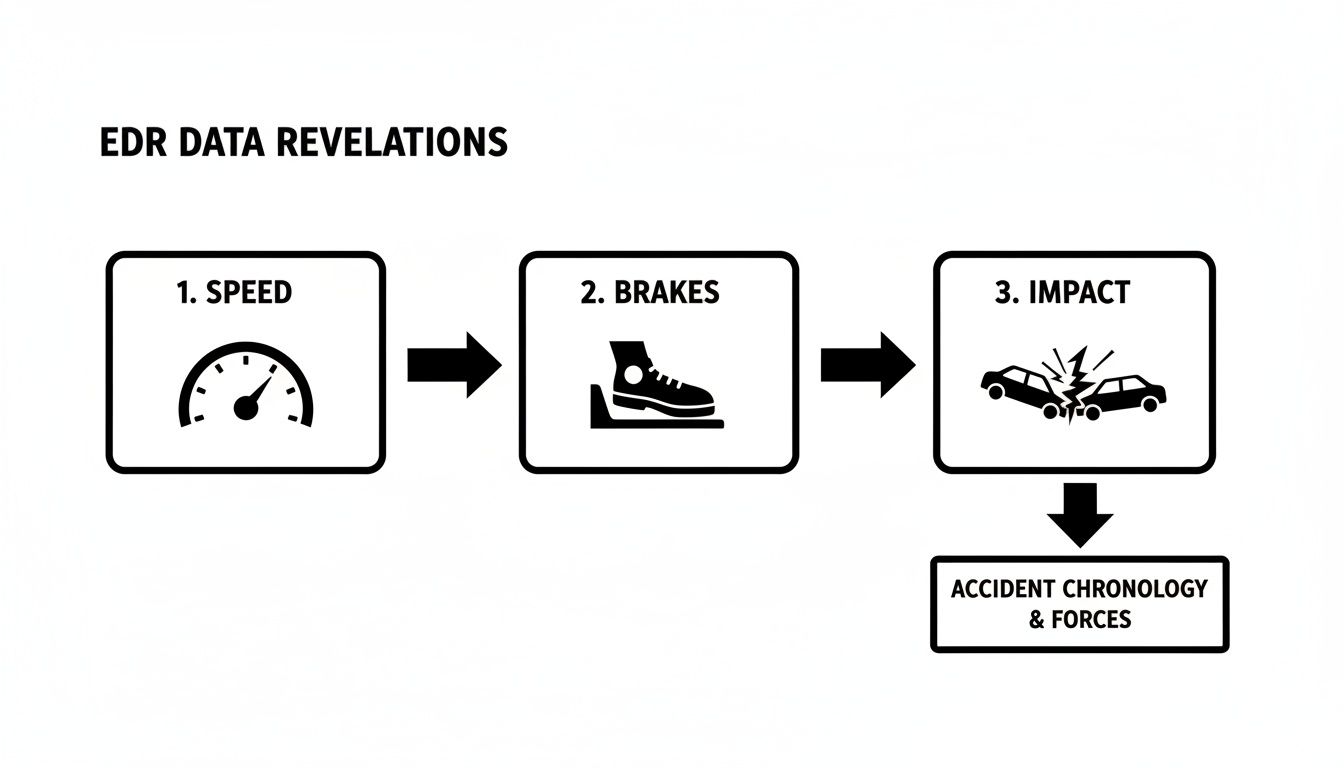
By visualizing this flow, it’s easy to see how a black box creates an objective, second-by-second timeline of a collision.
Georgia Laws on EDR Data Ownership and Access
In Georgia, the law is clear: the data on a vehicle's EDR belongs to the owner of the vehicle. This means the other driver's insurance company can't just access it without permission or a court order. This ownership right is an important protection, but it also shows why you need legal help to obtain the data from the at-fault party's car.
An experienced Atlanta attorney can quickly file the necessary legal notices, including the spoliation letter. If needed, we can petition a court to compel the other party to allow access for a data download. This formal process ensures that everything is handled correctly and that the retrieved data will be admissible as evidence in your case. If you're unsure where to begin, our guide on how to file a car accident claim in Atlanta offers additional context.
Protecting this evidence is a time-sensitive and absolutely essential part of building a strong injury claim. It provides the unbiased facts needed to prove exactly what happened.
Using EDR Evidence to Strengthen Your Injury Case
Having the raw EDR data is a significant step, but its true value is in how it’s used to build a clear and persuasive injury case. Here in Atlanta, we see countless "he said, she said" arguments where the at-fault driver’s story simply doesn't align with reality. Black box data cuts through the noise and replaces subjective claims with hard facts.
This isn't about winning a simple argument. It’s about connecting objective, verifiable evidence directly to your legal right to fair compensation for medical bills, lost wages, and pain and suffering. The data changes from a technical report to a powerful tool that proves negligence and helps secure the resources you need for your recovery.
Proving Fault in Common Atlanta Accidents
Let's look at how this works in a few common accident scenarios on Atlanta's roads. In these situations, black box data can single-handedly dismantle the other driver's defense.
-
Disputed Red-Light Collisions: You're hit by a driver who ran a red light but insists their light was green. Witness memories can be unreliable or conflicting. The EDR data from the at-fault car can show its speed and throttle position. If the data reveals the driver accelerated into the intersection instead of slowing, it strongly suggests they were trying to "beat the light" and directly contradicts their claim.
-
Rear-End Crashes and Distraction: A driver rear-ends you on I-285 and alleges you "stopped suddenly for no reason." Their vehicle’s EDR might show their speed was constant and the brakes were never applied in the five seconds before impact. This is powerful evidence of distracted driving, proving they weren't paying attention to normal traffic flow.
-
Sudden Lane Change Accidents: Another driver merges into your lane on Peachtree Street, causing a sideswipe, but claims you swerved into them. Their EDR could show a sharp steering wheel input just moments before the collision. This, combined with their sustained speed, demonstrates an aggressive and unsafe lane change.
This objective, second-by-second data provides an indisputable timeline of events. It’s not a memory or an opinion; it's what the car was physically doing, recorded by its own sensors.
Countering False Narratives from the Other Driver
One of the most valuable uses of EDR data is its ability to disprove false claims. Insurance companies often look for any reason to deny or reduce a claim, and they will seize upon any statement from their driver that shifts blame onto you.
The black box acts as an unbiased fact-checker. If a driver claims they were only going 25 mph in a school zone, but their EDR logs their speed at 45 mph one second before impact, their credibility is destroyed. This not only proves they were speeding but also establishes them as an unreliable source of information about the accident as a whole.
Linking Negligence to Your Recovery
Ultimately, the goal of gathering this evidence is to build a strong case showing the other driver's negligence directly caused your injuries. When we present EDR data to an insurance adjuster or a jury, we connect the dots in a clear, logical sequence.
For instance, we can show:
- The EDR proves the other driver was speeding.
- Accident reconstruction experts confirm this excessive speed led to a much more forceful impact.
- Your medical records document injuries consistent with a high-force collision.
This direct line from a negligent act to tangible harm makes it extremely difficult for the defense to argue against your right to compensation. We explain how this evidence supports all aspects of your recovery in our overview of Atlanta personal injury claims. By using this technology, we ensure the focus remains on the facts of the case, illustrating the true extent of the at-fault driver’s carelessness.
Common Questions About Car Black Boxes
As an Atlanta personal injury attorney, I field questions every day from clients trying to make sense of the evidence in their case. When the topic of EDRs comes up, there’s a mix of curiosity and a few common myths. Getting clear answers helps people feel more in control of the situation.
Here are the questions I hear most often about what are black boxes in cars.
Does My Car Have a Black Box?
The answer is almost certainly yes. Federal regulations that went into effect in 2013 made Event Data Recorders standard on nearly all new passenger vehicles sold in the U.S. Today, the National Highway Traffic Safety Administration (NHTSA) confirms that well over 96% of new cars have an EDR installed at the factory.
So, if your car was made in the last decade, it has one. The easiest way to confirm this is to check your owner's manual—there's usually a section on data recording systems. If you can't find it, a quick online search for your car's make, model, and year, along with the term "EDR," will give you a definitive answer.
Can the EDR Data Be Wrong or Inaccurate?
The data from a black box is generally considered highly reliable. It comes straight from your car's own internal sensors, which are calibrated for precision. These systems are built to be tough and provide a factual, unbiased record of what the vehicle was doing.
But no technology is flawless. While rare, there are limitations. For instance, a pre-existing sensor problem or major, non-standard vehicle modifications—like huge, oversized tires—could potentially skew the data's context. This is exactly why you need a trained expert to analyze the raw information.
An experienced accident reconstructionist knows how to interpret the numbers correctly, account for any variables, and present the findings as clear, credible evidence. Their analysis makes sure the EDR's story is told accurately and powerfully.
Who Owns the Data on My Car's Black Box?
This is an important legal question. In Georgia, the law is clear: the data on the EDR belongs to the vehicle owner. You can find more information about this in the state's official code, specifically O.C.G.A. § 40-9-102.
This means the other driver’s insurance company can't just demand access to it. They need your explicit permission or a court order to download the data from your vehicle. After a serious collision, a court will almost always grant such a request when it's made through the proper legal channels.
This ownership principle is also why sending a preservation letter so quickly is a top priority. It puts the other party on legal notice, obligating them to protect their vehicle—and the valuable data inside—until it can be professionally and legally downloaded.
Will My Insurance Company Use My Black Box Data Against Me?
Your own insurance company will likely want to access the EDR data to help their investigation, and your policy may even require you to cooperate. The data's impact depends entirely on what it reveals. If it proves you weren't at fault, it becomes your strongest piece of evidence.
On the other hand, if the data suggests you were partially or fully responsible, they could use it to deny your claim or reduce its value. It's a tricky situation that requires a careful approach.
You should always speak with an attorney before giving any insurer—even your own—permission to download the black box data. We can walk you through the implications and ensure your rights are protected. The goal is simple: make sure the data is used to tell the whole truth of what happened.
Since federal rules for light-duty vehicles were updated in 2014, EDRs in over 96% of new cars now record up to eight seconds of pre-crash data, including throttle position, brake status, and vehicle speed. This data often becomes the deciding factor in personal injury cases. For truck accidents or bicycle collisions here in Atlanta, this technology helps level the playing field against large commercial insurers. An attorney can obtain EDR downloads through a subpoena to maximize compensation for pain and suffering. Even as fatality rates have fallen, black boxes play a key role in ensuring accountability on our roads. You can read more about these traffic safety trends from the NHTSA. Understanding the full scope of what are black boxes in cars empowers you to take the right steps after an accident.
If you've been injured in an accident and need help securing the evidence to prove your case, Jamie Ballard Law is here for you. We understand the importance of acting quickly to preserve black box data and can guide you through every step. Contact us today for a free, no-obligation case evaluation at https://jamieballardlaw.com.