If you've been in a car wreck in Atlanta, one of the most pressing questions you'll have is, "how long after an auto accident can you sue?" The answer is found in Georgia's statute of limitations. For most personal injury claims, you have exactly two years from the date of the accident to file a lawsuit. This is not just a guideline—it's a hard legal deadline. Knowing this timeframe is the first step toward protecting your rights.
The Clock is Ticking on Your Georgia Car Accident Claim
Missing that two-year window almost always means a court will throw out your case, no matter how clear the other driver’s fault was. Think of it as a countdown timer that starts the second the crash happens. Once it hits zero, your legal right to seek compensation for your injuries is gone for good.
This deadline exists for a practical reason: to keep the legal process fair. As time passes, evidence gets lost, memories fade, and witnesses move away. A firm timeline forces everyone to act while the facts are still fresh and reliable.

Different Deadlines for Different Types of Claims
It’s important to understand that a single car accident can create several different types of legal claims, and each one can have its own deadline. Getting these dates straight is essential to protecting your rights.
Here’s a quick overview of the most common timelines you need to know in Georgia.
Georgia Car Accident Statute of Limitations Deadlines
A summary of the legal deadlines to file a lawsuit for different types of claims following a car accident in Georgia.
| Type of Claim | Statute of Limitations |
|---|---|
| Personal Injury | Two years from the date of the accident. This covers your medical bills, lost income, and pain and suffering. |
| Property Damage | Four years from the date of the accident. This applies to the cost of repairing or replacing your vehicle. |
| Wrongful Death | Two years from the date of death. Note this may be a different date than the accident itself. |
As you can see, keeping these dates straight is a key part of the process. The deadline for your physical injuries is much shorter than the one for your vehicle damage.
While Georgia's rules are very specific, it's worth knowing that every state sets its own statute of limitations, and they vary significantly. Some states give you just one year, while others might allow up to six, depending on the claim. You can find more information about these deadlines on sites like Wikipedia.
To get a complete picture of how these timelines work, you can learn more by reading our detailed guide on the statute of limitations for personal injury in GA. Knowing your deadline is the first and most important step toward securing the compensation you deserve.
Understanding Exceptions to the Two-Year Rule
While Georgia's two-year deadline for filing a lawsuit is firm, it's not absolute. The law recognizes that some situations make it unfair or impossible for a victim to file a claim within that standard window. These exceptions are designed to protect the rights of those who need more time through no fault of their own.
One of the most common exceptions involves injuries to a minor. If a child under 18 is hurt in a car accident, the two-year clock is legally paused. This pause is called tolling.
The clock doesn’t start ticking until the child's 18th birthday. From that point, they have until their 20th birthday to file a lawsuit, ensuring a young person isn't penalized for being unable to act for themselves when the injury happened.

When an Injury Is Not Obvious
Sometimes, the full extent of an injury isn't clear right after a crash. You might walk away feeling sore but generally okay, only to discover weeks or months later that you have a serious back injury, like a herniated disc that requires surgery. This is where an exception known as the “discovery rule” can sometimes apply.
In very specific cases, the two-year countdown might begin on the date the injury was discovered—or reasonably should have been discovered—rather than the date of the accident. Proving this isn't easy and requires strong medical evidence that links the delayed diagnosis directly back to the crash.
Important Takeaway: Simply feeling pain later is not enough to trigger the discovery rule. It usually applies when a hidden medical condition, directly caused by the accident, is formally diagnosed by a doctor much later.
Other Scenarios That Pause the Clock
Several other situations can pause, or toll, the statute of limitations in Georgia. While less common, they are just as important for protecting an injured person's rights.
- The At-Fault Driver Leaves Georgia: If the person who caused the accident moves out of state before you file a lawsuit, the clock stops. It will only restart if and when they move back to Georgia.
- Mental Incapacity: If the accident leaves a victim mentally incompetent and unable to manage their own affairs, the two-year deadline is paused until their competency is restored.
- Pending Criminal Charges: If the at-fault driver is facing criminal charges related to the accident, like a DUI, the civil lawsuit deadline may be tolled until the criminal case is resolved. According to the Official Code of Georgia Annotated § 9-3-99, this pause can last for up to six years.
These exceptions add layers to understanding how long after an auto accident you can sue. Because the specific facts of your case determine if an exception applies, getting legal clarity is essential. You can gain a deeper understanding by exploring the foundations of personal injury claims and how they are structured.
What Happens If You Miss the Filing Deadline?
Missing the statute of limitations isn't like forgetting a credit card payment where you can just pay a late fee and catch up. The consequences are far more serious—and they're permanent. Once this legal deadline passes, your right to seek compensation in court is extinguished. For good.
This means that no matter how obvious the other driver's fault was, or how severe your injuries are, a judge is legally required to dismiss your case. In legal terms, your claim becomes "statute-barred."
Think of it like a winning lottery ticket that has an expiration date. If you show up to claim your prize a day late, it doesn't matter that you have the winning numbers. The opportunity is gone, and the rules are absolute.
The Impact on Insurance Negotiations
That statute of limitations deadline is the single biggest piece of leverage you have when dealing with an insurance company. The possibility of a lawsuit is what motivates an insurer to negotiate a fair settlement for your medical bills, lost income, and pain.
When the deadline to file a lawsuit expires, that leverage disappears completely.
An insurance company has zero legal or financial incentive to offer you a fair settlement—or any settlement at all—once your claim is statute-barred. They know you can no longer force them to pay by taking them to court, so they can deny your claim with no risk.
This is exactly why some insurance adjusters will intentionally drag out negotiations. They know that if they can delay you long enough for the deadline to pass, their company is off the hook. It's a calculated strategy that highlights just how important timely action is.
For anyone asking how long after an auto accident you can sue, the finality of this deadline is the most important lesson. Once that clock hits zero, your ability to recover what you're owed is effectively over. You can find more information on the official procedures for filing claims on the State Bar of Georgia's website.
Watching Other Important Timelines After an Accident
While the two-year statute of limitations is the final, hard deadline for filing a lawsuit, it’s not the only one you need to worry about. Far from it.
Think of it as the last exit on the highway. Several other important exits for handling insurance matters and government claims appear much, much sooner. If you miss one, you can close off important paths to getting the compensation you deserve.
Right after an accident, your immediate dealings are with insurance companies, and they play by their own rulebook. Your own insurance policy almost certainly has a clause requiring you to report the accident "promptly" or within a "reasonable time."
This isn't just a suggestion—it's a contractual obligation. Failing to notify your insurer in a timely manner could give them the legal grounds to deny your claim, leaving you to foot the bill for everything.
Special Deadlines for Claims Against the Government
The rules change completely when a government entity is at fault. Let’s say you were hit by a MARTA bus, a City of Atlanta garbage truck, or any state-owned vehicle. You can't just file a lawsuit against them. You first have to provide a formal notice of your claim, known as an ante litem notice.
This notice has a much shorter fuse than the standard statute of limitations.
- Claims Against a City: For any claim against a municipality in Georgia, you typically have just six months from the date of the injury to send this formal notice.
- Claims Against the State: For claims against the State of Georgia or one of its counties, that window extends to twelve months.
This isn't optional; it's a mandatory first step. If you miss this much shorter deadline, you lose your right to sue the government entity, no matter what the two-year statute of limitations says. The legal requirements for this notice are incredibly specific, as laid out in the Official Code of Georgia Annotated § 36-33-5.
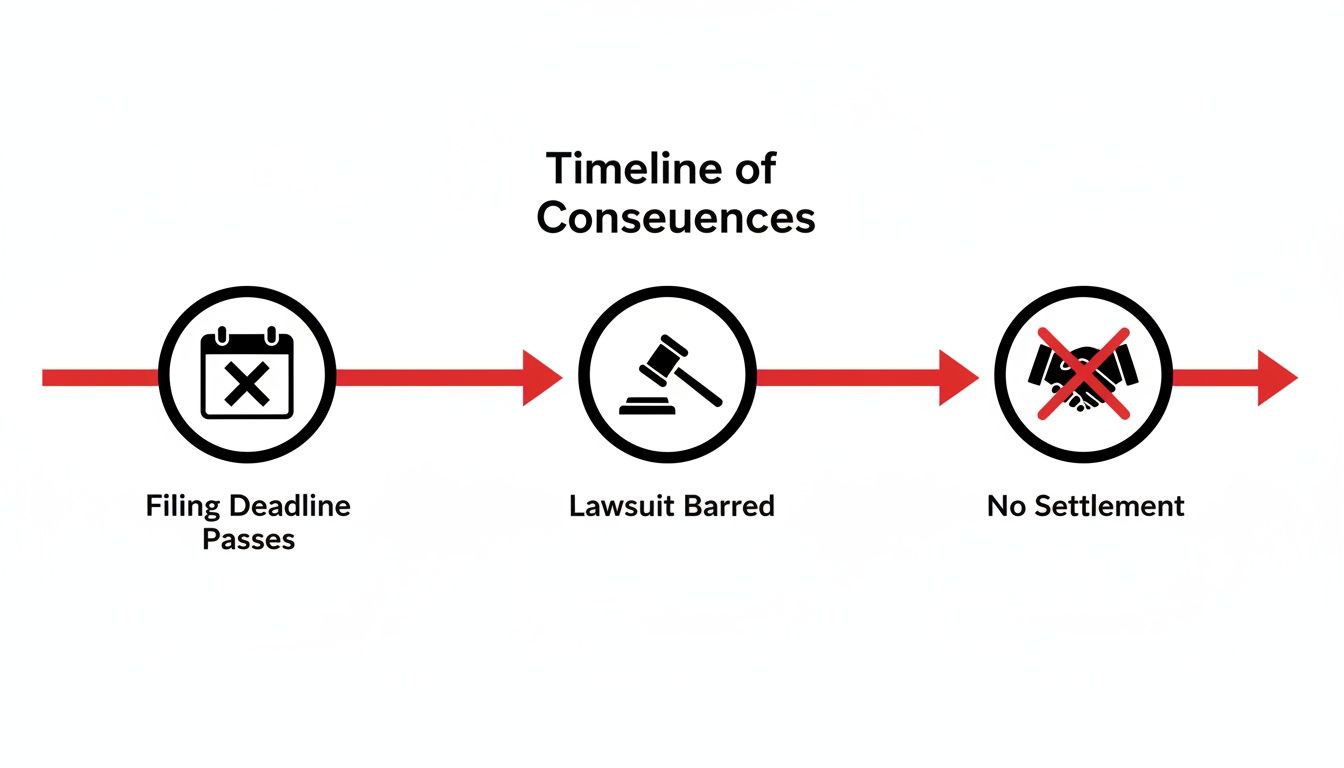
As you can see, the consequences are severe. Once that deadline passes, your ability to file a lawsuit is permanently gone. When that happens, any incentive for an insurer to offer a fair settlement vanishes along with it.
These earlier deadlines are hurdles you must clear. Clearing them is essential to keep all your legal options open and underscores why knowing how long after an auto accident you can sue involves far more than just one date on the calendar.
Practical Steps to Protect Your Claim Immediately After a Crash
While the legal deadlines might seem a long way off, the truth is your case is won or lost in the hours and days right after the crash. Thinking about how long after an auto accident you can sue is smart, but protecting your rights starts the moment it happens. Your first priority is always health and safety.
Once you’re out of harm’s way and have called for help, your next job is to become a documentarian. If you’re able, use your phone to take photos and videos of everything from every angle. Get shots of the vehicle damage, the road conditions, nearby traffic signals, and any visible injuries. This evidence you gather at the scene can be the bedrock of your entire claim.

Gather Key Information and Seek Medical Care
After you’ve captured the scene, shift your focus to gathering the essential information for your claim. This means exchanging contact and insurance details with the other driver and, just as importantly, getting the names and phone numbers of anyone who witnessed the accident. Don't forget to get a copy of the official police report as soon as it’s available.
Next, and this is non-negotiable: get a medical evaluation right away. Do this even if you feel fine. The adrenaline rush after a crash is powerful and can easily mask serious injuries like concussions or whiplash. A prompt medical visit not only safeguards your health but also creates an official record that directly connects your injuries to the accident.
Key Takeaway: If you wait to see a doctor, the insurance company will almost certainly argue that your injuries weren't caused by the crash or aren't as bad as you claim. It’s a classic defense tactic.
Finally, be very careful what you say. Never admit fault, and don’t give a recorded statement to the other driver’s insurance adjuster without speaking to an attorney first. You can learn more about the initial steps by reading up on how to file a car accident claim in Atlanta.
Why Acting Early Matters for Settlement
While the statute of limitations marks the final cutoff for filing a lawsuit, the practical timeline for your case is much shorter. The overwhelming majority of personal injury claims never see the inside of a courtroom. In fact, studies show that roughly 90–96% of personal injury claims settle before trial, with just a tiny fraction going to a jury verdict.
This means your real goal is to build such a strong case that the insurance company has no choice but to offer a fair settlement. Prompt medical care, immediate notice to insurers, and preserving all your evidence—these are the actions that give you leverage in negotiations. It’s also important to understand the roadblocks you might face; you can learn more about why your insurance company might refuse to pay a claim and what you can do about it.
Ultimately, these early steps directly influence the strength and value of your claim, making them just as important as knowing how long after an auto accident you can sue.
Frequently Asked Questions About Georgia Car Accident Deadlines
After a car wreck in Georgia, it's natural to have a lot of specific questions about your own situation. I've put together some direct answers to the questions my clients ask most often. While this is solid general guidance, remember that every case has its own unique twists and turns.
Getting a handle on these points will help you understand the process and know exactly how long after an auto accident you can sue.
Is the Deadline Different for Just Car Damage?
Yes, it is, and this is an important distinction. For claims that only involve property damage—like getting your car fixed—Georgia law gives you a longer runway. You generally have four years from the date of the wreck to file a lawsuit for vehicle damage.
The two-year deadline you hear about is specifically for personal injury claims. That covers your medical bills, lost wages, and pain and suffering. It's helpful to think of it as two separate clocks ticking for these two different types of damages.
What If I Did Not Realize I Was Hurt Right Away?
This is a really common scenario, and it's where something called the "discovery rule" can sometimes come into play. With certain injuries, the pain or symptoms don't show up immediately. In those specific situations, the statute of limitations clock might start on the date you discovered the injury, or reasonably should have discovered it.
Be warned, though: applying this rule isn't a slam dunk. It requires strong medical evidence that clearly shows the injury had a delayed onset and connects it directly back to the crash. You'll definitely want to speak with an attorney to figure out if this exception could apply to your case.
Key Reminder: Successfully using the discovery rule is tough. You can't just point to general aches that came up later. It demands a clear, professional diagnosis that directly links a late-appearing condition back to the original accident.
Protecting your claim means more than just gathering paperwork; you have to know what it all means. Getting a baseline on understanding document analysis can give you an edge when looking at police reports and medical records.
Do Settlement Talks with an Insurer Pause the Deadline?
No, they absolutely do not. This is probably the single most dangerous misunderstanding people have. Talking with an insurance adjuster or negotiating a settlement does not stop that two-year clock from ticking down.
Insurance companies know this. Sometimes, they will drag out negotiations, giving you a false sense of security. If you miss your filing deadline, they no longer have any legal reason to pay your claim, and they know it. The only way to officially stop the clock and preserve your right to sue is to file a lawsuit in court before that deadline expires.
What Is the Timeline for a Wrongful Death Claim?
For a wrongful death lawsuit in Georgia, the statute of limitations is typically two years from the date of the person's death, which might be a different date than the accident itself. This type of claim allows surviving family members to seek compensation for the immense loss they have suffered.
These claims are legally different from "survival actions," which are filed to address the pain and suffering the deceased person endured before they passed away. The legal definitions for these terms are very specific, and you can look up more of them in our firm's legal dictionary to get more clarity. Given the detailed nature of these cases, it's important to consult an attorney who has experience handling wrongful death claims.
At Jamie Ballard Law, I believe every injured person deserves clear answers and a strong advocate in their corner. If you're feeling overwhelmed by legal deadlines and insurance company runaround after an accident, you don't have to handle it alone. I'm here to manage the legal fight so you can focus on healing. For a free, no-obligation evaluation of your case, contact us today. https://jamieballardlaw.com