After a car crash, one of the first questions people ask is, "how much are car accident settlements worth?" While every situation is unique, settlements can range from a few thousand dollars for minor incidents to well over $500,000 for life-altering injuries. The final amount hinges entirely on the specific facts of your case, especially the severity of your injuries and the total economic losses you've suffered. Understanding what goes into calculating these figures is the first step toward securing fair compensation for your personal injury claim.
What Is a Typical Car Accident Settlement in Atlanta?
Trying to pin down a "typical" settlement value can feel like chasing a moving target. The best we can do is look at averages to get a general idea, but remember—these numbers are just a starting point. Your case has its own story, and that story will determine the final outcome.
Think of building your settlement like building a house. The foundation is made up of your tangible, documented losses—medical bills, repair invoices, and lost paychecks. Only after that foundation is solid can we add the layers that reflect the full personal impact, like your pain and suffering.
Understanding the Settlement Ranges
Generally, settlement amounts are grouped by injury severity. A minor fender-bender that leaves you with a few bruises is going to have a very different value than a collision that results in broken bones, surgery, and months of physical therapy.
This chart gives a simple visual of how averages tend to break down.
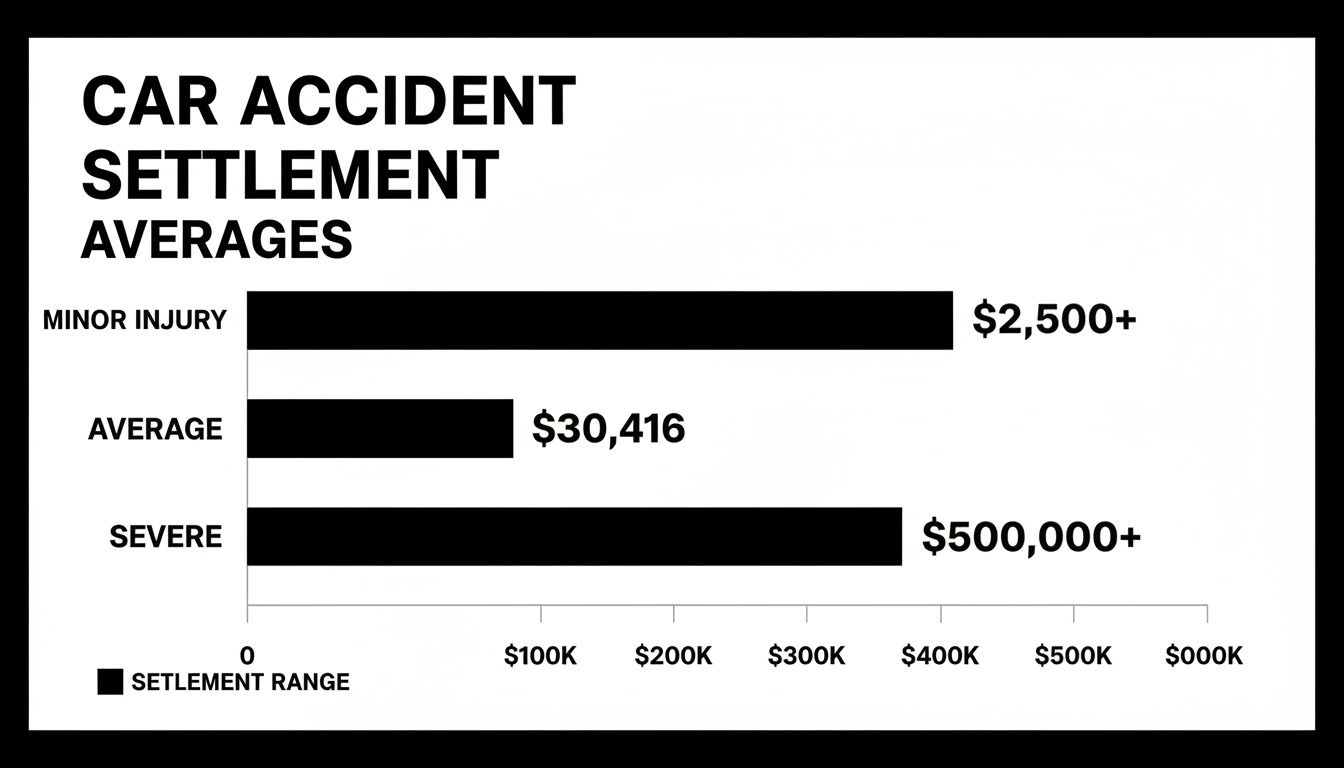
As you can see, the value of a claim climbs dramatically with the seriousness of the injury, jumping from thousands into the hundreds of thousands.
To give you a clearer picture, here are some typical settlement ranges based on national data for different injury levels.
Typical Settlement Ranges by Injury Severity
This table provides estimated settlement ranges for common car accident injuries, from minor to severe, to give you a general idea of potential compensation.
| Injury Type | Typical Settlement Range (National Averages) | Factors Included |
|---|---|---|
| Minor Injuries (e.g., whiplash, sprains, bruises) | $2,500 – $25,000 | Limited medical bills, minimal lost wages, short-term pain & suffering. |
| Moderate Injuries (e.g., herniated discs, fractures) | $30,000 – $500,000 | Surgery, physical therapy, significant lost wages, moderate pain & suffering. |
| Severe Injuries (e.g., TBI, spinal cord damage) | $500,000+ | Long-term care, permanent disability, extensive lost earning capacity, severe pain & suffering. |
These figures show how quickly the value can escalate when an injury requires more than just a few doctor's visits.
Nationally, the average settlement for an injury claim is around $30,416, but that number can be misleading. It lumps together very small claims with multi-million dollar verdicts, skewing the result. A more useful approach is to look at the ranges. For instance, soft tissue injuries like whiplash often settle between $2,500 and $25,000. In contrast, moderate injuries like herniated discs or broken bones can push a settlement well into the $30,000 to $500,000 range. You can discover more insights about these settlement averages to see how they are calculated.
In our experience here in Atlanta, we often see cases that align with these national trends. The key is always meticulous documentation. Every single bill, receipt, and note from your doctor provides the leverage needed to negotiate a fair amount that truly covers your recovery.
Ultimately, the goal is to make you whole again by securing compensation for everything you've lost. Knowing how much car accident settlements are on average is a helpful baseline, but your specific case details will always tell the full story.
Key Factors That Determine Your Settlement Amount

There’s no magic calculator that spits out a settlement number. Instead, the final value of your claim is built piece by piece from several important factors. Think of it like assembling the evidence for a case—each piece adds strength and clarity to the final picture of what you’re truly owed.
The most concrete pieces are your economic damages. These are the tangible, out-of-pocket costs with a clear dollar figure attached. Meticulously documenting these expenses is one of the most powerful things you can do to build a strong claim.
The Foundation: Economic Damages
Economic damages represent the direct financial losses you’ve suffered due to the accident. They are the easiest part of a claim to prove because they come with receipts, pay stubs, and invoices.
Here’s a breakdown of what that includes:
- Total Medical Expenses: This isn’t just the emergency room visit. It covers every single related cost: the ambulance ride, hospital stay, surgeries, prescriptions, physical therapy, and any ongoing chiropractic care.
- Lost Wages and Income: If your injuries forced you to miss work, you are entitled to compensation for that lost income. This covers your regular salary plus any commissions, bonuses, or overtime you would have earned.
- Future Medical Costs: A serious injury often requires long-term care. Your settlement must account for anticipated needs, like future surgeries, ongoing medication, or extended rehabilitative therapy.
- Property Damage: This is primarily the cost to repair or replace your vehicle. It also includes personal items damaged in the crash, such as a laptop, cell phone, or car seat.
Let's say your medical bills come to $15,000 and missing six weeks of work cost you $6,000 in lost income. Your economic damages start at a baseline of $21,000. This number becomes the solid foundation for all settlement negotiations.
Valuing Your Pain and Suffering
Beyond the stack of bills, a settlement must also address the human toll of the crash. We call these non-economic damages, but you probably know the term "pain and suffering." This category is designed to compensate you for the physical pain, emotional distress, and loss of enjoyment of life you’ve endured.
There’s no receipt for anxiety or a price tag on chronic pain. Calculating this value is more subjective and often involves assessing the severity of your injuries, the duration of your recovery, and the long-term impact on your daily life.
An injury that leaves a permanent scar or causes a lifelong disability will carry a much higher pain and suffering value than a sprain that heals in a few weeks. The goal is to assign a monetary value to the very real, but non-financial, ways the accident has diminished your quality of life. Keeping a daily journal to document your pain levels and challenges can serve as powerful evidence.
The Role of Fault and Insurance Limits
Finally, two major external factors can dramatically alter your settlement amount: liability and insurance policy limits. In Georgia, who was at fault is very important. If you are found partially responsible for the accident, your final award can be reduced based on your percentage of fault.
Additionally, every insurance policy has a limit. You can learn more about Georgia's minimum requirements from the Georgia Office of Insurance and Safety Fire Commissioner. This limit is the maximum amount the insurance company will pay out, no matter how high your damages are. If your total losses exceed the at-fault driver's policy limit, collecting the full amount you deserve becomes significantly more involved. Together, all these elements determine how much car accident settlements are truly worth.
How Pain and Suffering Is Calculated in Georgia
While adding up medical bills and lost wages is pretty straightforward, "pain and suffering" is often the largest and most confusing piece of a car accident settlement. It's the part that's supposed to compensate you for the real human cost of the crash—the physical pain, the emotional distress, and the way it turned your life upside down.
So how do you actually put a number on something so personal?
In Georgia, there isn't a single, rigid formula set in stone. Instead, attorneys and insurance adjusters typically use a couple of common-sense methods to get to a fair number. Understanding these approaches is important to figuring out how much car accident settlements are really worth.
The Multiplier Method
The most common approach you'll see is the Multiplier Method. Think of it like this: you have your concrete, provable economic damages—the total of your medical bills and lost wages. That number becomes the base.
Then, that base number is multiplied by a factor, usually somewhere between 1.5 and 5, depending on how severe your injuries and their impact were.
- A low multiplier (1.5 to 2) might apply to more minor injuries, like whiplash that heals up in a few weeks with physical therapy.
- A high multiplier (4 to 5) is reserved for catastrophic, life-altering injuries that cause permanent disability, chronic pain, or severe emotional trauma.
For example, if you racked up $10,000 in medical bills and your case justifies a multiplier of 3 because of a difficult, painful recovery, your pain and suffering value would be calculated at $30,000. This calculation becomes a key part of the total settlement negotiation. You can see how this fits into the bigger picture in our guide on the different types of personal injury claims in Georgia.
The Per Diem Method
Another tool in the toolbox is the Per Diem Method. "Per diem" is just Latin for "by the day." This approach assigns a daily dollar amount for your suffering, then multiplies it by the number of days you were in pain or actively recovering.
The basic argument here is that a day of suffering is worth at least what you would have earned during a day of work. So, if you earn $200 per day and you were in significant pain for 100 days, the per diem calculation would put your pain and suffering at $20,000.
This method works best for injuries that have a clear and definable recovery timeline. It’s less effective for chronic or permanent injuries where the suffering doesn't just stop on a specific date.
Pain and Suffering Calculation Methods
To make it simple, both methods are just starting points. They give us a logical place to begin negotiations, but they aren't the final word. Here’s a quick breakdown of how they compare.
| Calculation Method | How It Works | Best For |
|---|---|---|
| Multiplier Method | Total economic damages (medical bills + lost wages) are multiplied by a factor of 1.5-5 based on injury severity. | Cases with a wide range of severities, from minor to catastrophic. It's the most commonly used method. |
| Per Diem Method | A daily rate (often based on your daily wage) is assigned and multiplied by the number of days you were recovering. | Injuries with a clear and finite recovery period, making it easy to count the number of days affected. |
Ultimately, whether we use the Multiplier or Per Diem method, our job is to build a compelling story backed by hard evidence. We use your medical records, photos of your injuries, and even personal journals to argue for a value that truly reflects what you've been through.
Strong advocacy is what pushes a settlement value from a simple calculation to a number that accounts for the very real, human side of your injuries. This is what truly determines how much are car accident settlements in the end.
How Georgia’s At-Fault Laws Affect Your Claim
When we talk about car accident settlement values, it’s not just a matter of adding up your medical bills and lost paychecks. Here in Georgia, the amount you actually receive is directly tied to who was responsible for the crash. Our state follows a legal principle called “modified comparative negligence,” which sounds involved, but the core idea is pretty straightforward.
This rule simply means your final settlement amount can be reduced by your percentage of fault. Think of it like a pie. If a jury awards you $100,000 but decides you were 20% responsible for the collision, your slice of the pie gets smaller. You would ultimately walk away with $80,000—the total award minus your 20% share of the blame.
Understanding Your Percentage of Fault
So, who decides this percentage? An insurance adjuster or, if your case goes to court, a jury will review all the evidence to assign a percentage of responsibility to each driver.
Here’s a real-world example of how this plays out:
- Let's say you were driving five miles per hour over the speed limit.
- Another driver blows through a red light and T-bones your car.
- While the other driver is clearly the main cause of the wreck, your slight speeding could be seen as a minor contributing factor.
In a situation like this, an adjuster or jury might assign you 10% of the fault. That means whatever final compensation figure you’re awarded gets reduced by 10%. This is exactly why it’s so important to gather solid evidence proving the other driver was the one at fault as you go through the lawsuit process.
The 50% Bar in Georgia
Now, here’s the most important part of this rule in Georgia. Our state has a firm cutoff, often called the 50% bar, which is spelled out in the Official Code of Georgia Annotated (O.C.G.A.) § 51-12-33.
The rule is simple and unforgiving: If you are found to be 50% or more responsible for the accident, you are legally blocked from recovering any money at all. Your settlement value instantly drops to zero.
This makes proving fault the single most important battle in any Atlanta personal injury claim. Even with catastrophic injuries and mountains of medical debt, being assigned half or more of the blame means you get nothing.
Here’s a look at the actual statute that sets these rules.
This section of the law is precisely what requires a court to reduce a plaintiff's damages in proportion to their percentage of fault—as long as that fault is less than 50%.
Because of this all-or-nothing rule, insurance companies will work hard to shift as much blame as they can onto you to either slash their payout or deny your claim entirely. This is where having a skilled attorney in your corner becomes essential. Our job is to collect and present the evidence—police reports, witness statements, traffic camera footage—to build an undeniable case that the other party was overwhelmingly at fault. Understanding this Georgia law is a major piece of the puzzle when answering the question, how much are car accident settlements?
Essential Documents to Maximize Your Settlement

A strong car accident claim isn't built on arguments alone. It's built on a foundation of solid evidence. The more organized and thorough your documentation is, the clearer the picture becomes for an insurance adjuster or jury. Think of yourself as the storyteller of your own recovery; every document is a chapter in that story.
This isn’t just about collecting a pile of paperwork. Each piece of evidence serves a specific purpose, from proving the other driver’s fault to justifying the full value of your medical care and personal suffering. Your ability to provide clear, organized records directly strengthens your negotiating position.
Your Essential Evidence Checklist
Building a compelling case starts the moment the accident happens. Here’s a practical checklist of the documents you should start collecting immediately after a crash. Keeping everything in a dedicated folder will make the process much smoother down the road.
- Official Police Report: This is often the single most important document at the start. It provides an objective summary of the collision, identifies witnesses, and often includes the officer's initial assessment of who was at fault.
- Complete Medical Records: This means everything. From the initial emergency room visit and ambulance bills to follow-up appointments with specialists, physical therapy logs, and even prescription receipts. Every record helps validate the severity of your injuries.
- Proof of Lost Wages: Ask your employer for a letter on company letterhead that details your job title, pay rate, and the exact dates you were forced to miss work because of your injuries. Pay stubs from before and after the accident also help demonstrate the financial impact.
- Photos and Videos: Visual evidence from the scene is incredibly powerful. Pictures of vehicle damage, your injuries, skid marks, and traffic signs can help reconstruct exactly what happened and why.
Beyond the initial medical reports, evidence like X-ray results is invaluable for proving the extent of certain injuries. Knowing where to find urgent care with X-ray facilities quickly after an accident ensures you get a timely diagnosis and proper documentation.
The Power of a Personal Journal
While bills and official reports document your financial losses, a personal journal brings your human story to life. It's one of the most effective tools for demonstrating the extent of your pain and suffering, which is a major component of any settlement.
Your journal should be a simple, daily log of how you feel. Note your pain level on a scale of 1 to 10, list activities you can no longer do, and describe the emotional toll the accident is taking on you and your family. This firsthand account provides a powerful narrative that a stack of medical bills simply cannot convey.
This personal record helps translate your daily struggles into a compelling argument for fair compensation, showing the real-world impact that goes far beyond just the numbers. For more helpful legal information, you can explore the resources for your personal injury claim on our firm's website.
Ultimately, a well-documented file is the best tool you have to show exactly how much are car accident settlements worth in your specific case.
Why an Experienced Attorney Can Make a Difference
When an insurance adjuster calls with an offer just days after your accident, it’s natural to wonder if you really need an attorney. The adjuster might sound friendly, even helpful, and the initial offer may seem reasonable. But their job isn’t to help you—it’s to protect their company’s profits by minimizing what they pay.
An experienced personal injury attorney levels the playing field. We understand the tactics adjusters use because we counter them every day. Our role extends far beyond filing paperwork; we build a strategic, evidence-based case that compels the insurance company to negotiate in good faith.
Uncovering All Sources of Compensation
One of our most important functions is to investigate every possible avenue for compensation. This often means looking beyond the at-fault driver's policy to find coverage you may not even know exists.
We identify and pursue all available sources, including:
- Uninsured/Underinsured Motorist (UM/UIM) Coverage: This is a vital part of your own auto policy that provides a safety net if the at-fault driver has little or no insurance.
- Medical Payments (MedPay) Coverage: Also part of your policy, MedPay helps cover medical bills immediately, regardless of who was at fault.
- Third-Party Liability: In some accidents, parties other than the driver share responsibility. This could be an employer, a vehicle manufacturer, or a government entity responsible for unsafe road conditions.
Without a thorough investigation, it's easy to leave significant compensation on the table.
Aligning Our Interests with Yours
We handle all personal injury cases on a contingency fee basis. This means you pay absolutely nothing upfront. We cover all the costs of building your case, from gathering police reports and medical records to hiring expert witnesses when necessary.
We only get paid if we win a settlement or verdict for you. Our fee is a percentage of the total recovery, so our goal is perfectly aligned with yours: to maximize the amount of money you receive.
This structure removes the financial risk from your shoulders, ensuring you have access to high-quality legal representation when it matters most. A professional on your side ensures your rights are protected throughout the entire process, which is a major factor in determining how much are car accident settlements. An experienced attorney also invests in proven business practices; understanding their approach, including reviewing effective lead generation strategies for lawyers, can highlight their commitment to serving clients effectively.
Common Questions About Car Accident Settlements
When you're dealing with the aftermath of a car wreck, you’re bound to have questions. It’s a confusing time, and getting clear, straightforward answers is the first step toward feeling in control again. Here are some of the most common concerns we hear from our clients in Atlanta.
Common Questions Answered
We've put together this table to give you quick, direct answers to the questions that come up most often after a collision.
| Question | Answer |
|---|---|
| What is a good settlement offer? | A good offer is one that covers all your losses—past, present, and future. It must account for your medical bills, lost income, and the real-world impact of your pain and suffering. |
| How long do I have to file a claim? | In Georgia, you typically have just two years from the date of the accident to file a lawsuit. This is a hard deadline known as the statute of limitations. |
| What if I was partially at fault? | You can still recover damages as long as you are less than 50% at fault. Your settlement will be reduced by your percentage of fault. |
| Is my settlement taxable? | Generally, no. Compensation for personal physical injuries, medical costs, and lost wages is typically not considered taxable income by the IRS. Punitive damages are an exception. |
Think of this table as a starting point. Now, let's dig into the details behind these answers.
What Makes a Settlement Offer "Good"?
A "good" settlement offer isn't just a number that sounds high. It’s a figure that truly makes you whole again by covering every single loss you've suffered. This includes your immediate medical bills and the time you missed from work, but it goes much deeper.
A fair settlement must also account for any future medical treatments you might need and, very importantly, the value of your physical pain and emotional distress. The first offer from an insurance company is almost always a lowball attempt to close your case quickly and cheaply. A genuinely good offer reflects the total impact the accident has had on your life.
Is There a Deadline to File a Car Accident Claim in Georgia?
Yes, and it's a very important one. In Georgia, the law gives you a limited window to take legal action, known as the statute of limitations. For most personal injury claims from a car accident, you have two years from the date you were injured to file a lawsuit.
If you miss this deadline, you will almost certainly lose your right to seek compensation forever. It’s a strict rule, which is why it's so important to act quickly. To get the specifics, you can learn more about Georgia's statute of limitations for personal injury cases.
Can I Still Get a Settlement if I Was Partially at Fault?
Absolutely. Georgia operates under a modified comparative negligence rule, which is more forgiving than the laws in some other states. This legal doctrine means you can still recover damages as long as a jury or judge finds you to be less than 50% responsible for the crash.
Here’s how it works in practice: your final settlement is simply reduced by your percentage of fault. For example, if your case is valued at $50,000 but you were found 10% at fault, your award would be reduced by 10% ($5,000), and you would receive $45,000. If you are found to be 50% or more at fault, however, you are barred from recovering anything.
Do I Have to Pay Taxes on My Car Accident Settlement?
For most people, the answer is no. The Internal Revenue Service (IRS) does not classify compensation for personal physical injuries or sickness as taxable income. This is great news because it means the portions of your settlement for medical expenses, lost wages, and pain and suffering are generally tax-free.
The one major exception is punitive damages. If your settlement includes an amount specifically meant to punish the other driver for extreme negligence, that portion may be taxable. You can always find the official guidelines on the IRS website regarding settlements.
At Jamie Ballard Law, we believe in providing clear answers and dedicated support when you need it most. If you've been injured in an accident, contact us for a free, no-obligation case evaluation to understand your rights and options. https://jamieballardlaw.com