After a car wreck, the police report is often the most important document for your insurance claim and any future legal action. Learning how to read a police accident report is a key step in protecting your rights. The first page contains the basic facts an insurance adjuster will look at first—the who, what, where, and when of the collision.
My name is Jamie Ballard, and as an Atlanta personal injury attorney, I’ve seen firsthand how a single error on this document can disrupt a claim. A wrong street name, an incorrect time, or a misidentified party can cause serious delays in getting the compensation you deserve. This guide will walk you through exactly what to look for on your Georgia Uniform Motor Vehicle Accident Report, starting with the basics.
Your First Look at the Georgia Accident Report
Before you can review the report, you need to get a copy. You can typically get your report from the responding law enforcement agency or through an online portal like BuyCrash.com, which is commonly used in Georgia.
Once you have it, focus on page one. This section sets the stage for your entire claim by establishing the basic context: date, time, location, and contributing conditions like weather. These aren’t just minor details; they are fundamental for how insurers and lawyers assess liability.
Verifying the Core Details
The top of the report is where you’ll find the basic, undisputed facts. Think of this as the foundation. If the foundation is cracked, the whole claim can become unstable.
Here’s a breakdown of the key fields you’ll find on the first page of a Georgia accident report and why they are so important.
Key Information on Page One of Your Georgia Accident Report
This table highlights the vital information on the first page of your report. Meticulously verify each field against your own recollection and any evidence you gathered at the scene.
| Field Name | What It Means | Why It’s Important |
|---|---|---|
| Date and Time of Crash | The official record of when the accident occurred. | An incorrect time can create conflicts with witness statements or your own account of events, potentially damaging your credibility. |
| Location of Crash | The exact location, including county, city, street, and nearest cross-street or mile marker. | This is vital for accident reconstruction. An error here could make it difficult to use evidence like traffic camera footage or witness testimony. |
| Number of Units | The total number of vehicles, pedestrians, or fixed objects involved in the collision. | Ensures all parties are accounted for. If a car that fled the scene isn’t noted, it complicates an uninsured motorist claim. |
| First Harmful Event | The first event in the crash sequence that resulted in injury or damage (e.g., “collision with motor vehicle”). | This helps establish the primary cause of the accident and is a key factor in determining fault. |
| Weather and Light Conditions | The officer’s notes on conditions like rain, fog, daylight, or darkness. | These factors can influence the assessment of negligence. For example, rainy conditions might suggest a driver should have reduced their speed. |
Cross-referencing these details is your first line of defense against administrative errors that can harm your case.

Treating this initial review with the same rigor as a professional legal document review is important. Small mistakes can have big consequences down the line.
Pro Tip: Take a clear picture of the entire report with your smartphone as soon as you get it. This creates an immediate digital backup and lets you zoom in to read small text and decipher codes without straining your eyes.
Ensuring these basic facts are 100% accurate is the first step in protecting your rights. For more guides and helpful tools, please explore the other materials available in our firm’s online resources.
Decoding the Codes and Contributing Factors
When you first get your hands on a Georgia accident report, it can feel like you’re trying to read a foreign language. But learning to decipher the officer’s codes is one of the most important parts of understanding the report. These aren’t just random numbers; they’re a shorthand that tells the story of the crash from the officer’s perspective.
Insurance adjusters often jump straight to these codes to make a quick, initial decision about who was at fault.
These codes for contributing factors and driver actions are typically located in the sections detailing each driver’s information. On a standard Georgia report, look for boxes labeled “Driver Contributing Factors” or “Vehicle Maneuvers.” A number placed in one of those boxes next to a driver’s name is the officer’s way of assigning initial blame.

Common Contributing Factor Codes in Georgia
While the full code list is extensive, a few pop up constantly in Atlanta-area accidents. Recognizing them gives you an immediate read on how law enforcement viewed the collision.
- Failure to Yield Right of Way: This is a big one, especially at intersections and during left turns. It means the officer concluded a driver failed to wait their turn when legally required.
- Following Too Closely: The classic code for a rear-end collision. This indicates the driver in back didn’t leave a safe stopping distance.
- Exceeding the Speed Limit / Driving Too Fast for Conditions: These are two sides of the same coin. The officer is noting that a driver’s speed was a primary factor, whether they were over the legal limit or simply going too fast for rain, traffic, or other hazards.
- Improper Lane Change: This code is used when a driver drifts, swerves, or merges into another lane unsafely, causing a sideswipe or forcing another driver into a defensive, and often unsuccessful, maneuver.
These are just a few examples. If you see an unfamiliar code, it’s important to find out what it means. Many terms in these reports have specific legal definitions. You can find many of them in our firm’s legal dictionary for common personal injury terms.
A Real-World Example: An Incorrect Code
I once handled a case where my client was T-boned at an intersection. The police report came back and coded my client for “Failure to Obey Traffic Control Device,” which essentially meant she ran a red light. She was adamant her light was green, but that single code nearly tanked her entire claim before it even started.
We immediately requested intersection camera footage. The video proved her light was green and the other driver’s was red. The officer had simply spoken to the wrong witness first and made a quick, but incorrect, assumption. We got the report amended, which completely turned the case around and led to a successful outcome for her.
This highlights a key point: an officer’s opinion, captured in these codes, is not the final word. It is an initial assessment based on the evidence available at that moment, and it can be challenged.
Understanding Injury Severity Codes
Besides fault codes, you’ll also see codes for injury severity. In Georgia, these are often single letters:
- (N) No Apparent Injury
- (C) Possible Injury (complaint of pain, but no visible signs)
- (B) Non-Incapacitating Injury (visible injury, like a cut or bruise)
- (A) Incapacitating Injury (severe injury preventing normal activities)
- (K) Fatal Injury
These codes matter. An insurance adjuster uses them for an initial valuation of your claim. If an officer marks “(C) Possible Injury,” the adjuster might assume it’s a minor claim, even if you later develop debilitating back pain. Remember, an officer is not a medical professional. Their on-scene assessment can be very different from a doctor’s diagnosis after a full evaluation.
Data from the Georgia State Patrol in 2023 showed ‘failure to yield’ as the top factor in 22% of over 150,000 reported accidents. This detail, often coded right next to the at-fault driver’s information, directly influences how insurance companies determine liability from the outset.
Knowing how to read these factors on the police report gives you the power to understand the official narrative of your wreck—and, more importantly, to spot potential errors that need to be addressed early.
Analyzing the Officer’s Narrative and Diagram
While the codes and checkboxes provide the raw data, the officer’s narrative and diagram are where their opinion takes shape. This is the section where the responding officer constructs a story of the crash, and it’s often the first thing an insurance adjuster reads. Learning how to read a police accident report’s narrative and diagram is fundamental to understanding the official version of events.
This part of the report is persuasive because it combines the officer’s professional observations with driver statements and physical evidence. It’s their attempt to create a cohesive summary of a chaotic event.

Reading Between the Lines of the Narrative
The narrative is the officer’s chronological summary of the investigation, starting from their arrival at the scene. Pay close attention to the specific language used, as it often signals an opinion on fault.
Phrases like “Vehicle 1 failed to yield right of way” or “Vehicle 2 made an improper lane change” are direct indicators of how the officer assessed liability. The narrative might also contain direct quotes from you, the other driver, or witnesses, which can carry significant weight.
Professional Insight: I always cross-reference the narrative with the contributing factor codes. If the code box says “Following Too Closely” and the narrative notes, “Driver 2 stated they looked down at their phone and did not see Driver 1 stop,” it creates an airtight case for fault that is very difficult for an insurance company to dispute.
Dissecting the Crash Diagram
The crash diagram is a bird’s-eye sketch of the accident, meant to visually represent the narrative. It uses simple symbols to map out the scene.
- Vehicle Positions: Cars are typically shown as labeled rectangles (“V1,” “V2”) at their final resting points.
- Direction of Travel: Arrows show the path each vehicle was on just before the collision.
- Point of Impact: An “X” or starburst symbol marks the initial point of contact.
- Landmarks: The drawing should include key reference points like lane lines, traffic signals, stop signs, or crosswalks.
This diagram can be an incredibly useful tool for visualizing how the crash unfolded. Unfortunately, it’s also a common source of significant errors.
Common Errors in Narratives and Diagrams
Remember, the officer arrived after the crash happened. They are reconstructing a past event, often under pressure and with limited information. From my experience handling cases across Atlanta, these are the mistakes I see most often:
- Incorrect Vehicle Positions: The diagram may place vehicles in the wrong lanes or show their final positions inaccurately.
- Misinterpreted Statements: In a hectic post-crash environment, your statement can easily be simplified or misquoted in the officer’s narrative.
- Flawed Roadway Depictions: An officer unfamiliar with a specific location might incorrectly draw the lanes or traffic patterns, a frequent issue at busy Atlanta intersections.
- Illegible Handwriting: The narrative is often handwritten and can be difficult to decipher. You may need specific tools to recognize handwritten text to make sense of it.
Inaccuracies in the narrative and diagram can completely change the outlook of an insurance claim. A misdrawn lane or an incorrect point of impact can be the difference between a fair settlement and a denied claim.
Never assume the officer’s diagram is a perfect, to-scale rendering. If the drawing conflicts with your memory of the event—or better yet, with photos you took at the scene—it’s a major red flag. A flawed diagram can and should be challenged with stronger evidence. Mastering how to read a police accident report means being a critical reviewer, not just a passive reader.
Identifying Driver, Vehicle, and Insurance Information
After a collision, the official police report is the primary document for obtaining the contact and insurance details essential to your claim. Knowing precisely where to find this information is the first step in holding the at-fault party accountable.
The report organizes information by “unit,” where each unit represents a driver and their vehicle. While these sections are intended to be factual records, I’ve seen my share of reports with transposed license plate numbers or misspelled insurance carriers. You have to verify everything.
Locating Driver and Vehicle Details
On a standard Georgia Uniform Motor Vehicle Accident Report, look for the sections labeled Unit 1, Unit 2, and so on. Each section should contain specific boxes for the other driver’s details.
You must confirm the accuracy of the other driver’s:
- Full Name
- Current Address
- Phone Number
Likewise, the report will list the vehicle specifics. Cross-reference this with any photos you took at the scene.
- Vehicle Make and Model (e.g., Honda, Accord)
- Vehicle Year
- License Plate Number (State and Tag #)
- Vehicle Identification Number (VIN)
A mismatched license plate or an incorrect VIN can create significant delays for your insurance company. The VIN is a car’s unique fingerprint and can be cross-referenced for accuracy using the National Highway Traffic Safety Administration’s (NHTSA) website.
A Quick Tip from Experience: The moment you get the report, check the license plate number against your own photos from the scene. A single incorrect digit is one of the most frequent errors I encounter, and it can send an insurer on a completely fruitless search.
Pinpointing the Insurance Information
This is arguably the most important data in the report. The form has designated fields for the other driver’s insurance company name and their policy number. This information is the key to initiating a claim against their liability coverage.
Sometimes, an officer may write “Pending” or leave the insurance section blank if the driver failed to provide proof at the scene. While this doesn’t automatically mean the driver is uninsured, it does signal that an extra step will be needed to track down their carrier.
Your Data-Gathering Checklist
Think of yourself as an investigator collecting evidence for your case. Having this information organized and ready will significantly speed up the claims process for your attorney or insurer.
Information Checklist:
- Other Driver’s Full Name, Address, and Phone Number.
- Other Driver’s License Number and State.
- Vehicle Make, Model, Year, and Color.
- Vehicle License Plate Number and VIN.
- Insurance Company Name.
- Insurance Policy Number.
- Name and Contact Information for Any Passengers or Witnesses Listed.
Carefully collecting and verifying these details is one of the first and most important actions you can take after a wreck. It ensures the administrative process starts correctly and avoids unnecessary errors down the line.
Common Errors in Police Reports and What to Do About Them
Police accident reports are foundational documents in any personal injury claim. Yet, they often contain errors. An officer arriving at a chaotic crash scene must quickly synthesize information, and mistakes—from minor typos to major misinterpretations of fault—are more frequent than you might think.
An inaccurate report is not just a clerical issue. Insurance adjusters rely heavily on this document to determine liability. A single error can jeopardize your ability to get fair compensation.
Factual Errors vs. Interpretive Errors
Mistakes on a police report fall into two main categories, each requiring a different approach to correct.
- Factual Errors: These are objective mistakes that can be verified with documentation. Think a misspelled name, an incorrect license plate number, a wrong date of birth, or a transposed digit in an insurance policy number.
- Interpretive Errors: These are subjective and far more damaging. This happens when the officer incorrectly assigns fault, misinterprets a witness statement in the narrative, or creates a flawed diagram of the collision.
The information is usually organized into specific sections, which helps pinpoint where an error might have occurred.
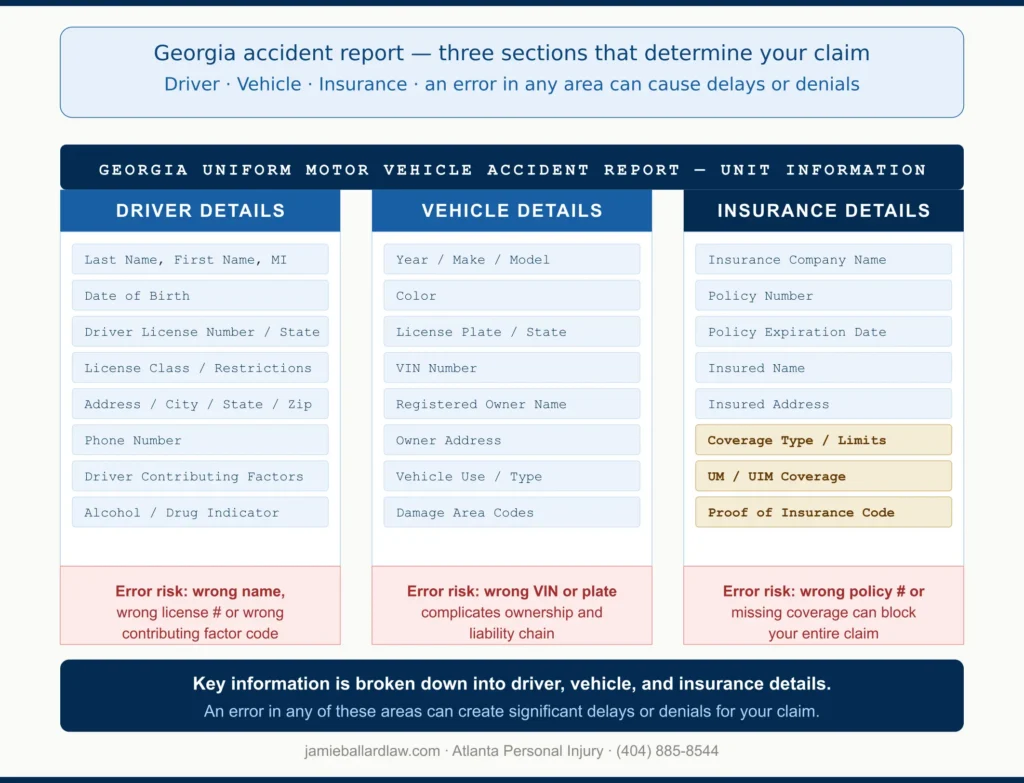
As the chart shows, key information is broken down into driver, vehicle, and insurance details. An error in any of these areas can create significant delays or denials for your claim.
Identifying and Correcting Common Report Errors
Finding a mistake is the first step. The next is knowing what to do about it. The table below outlines some of the most common errors we see and the immediate action you should take.
| Type of Error | Example | What You Can Do |
|---|---|---|
| Incorrect Personal Details | Your name is misspelled, or your date of birth is wrong. | Gather your driver’s license or birth certificate and contact the police department’s records division to request an amendment. |
| Wrong Vehicle Information | The report lists the wrong license plate, make, or model. | Use a copy of your vehicle registration to prove the correct information and submit it with your amendment request. |
| Flawed Crash Diagram | The diagram shows the point of impact on the wrong side of your car. | Provide clear photos you took at the scene showing the actual damage. Photos are powerful, objective evidence. |
| Misquoted Statement | The officer’s narrative incorrectly summarizes what you said. | This is an interpretive error. You need strong proof, such as a recording you made (if legal) or a conflicting statement from an unbiased witness. |
| Incorrect “Contributing Factor” | You were wrongly cited for a contributing factor like “following too closely.” | Challenge this with dash-cam footage, witness testimony, or photos of the final resting positions of the vehicles. |
This list isn’t exhaustive, but it covers the issues that can most directly impact your insurance claim. Always review your report meticulously as soon as you get it.
The Formal Process for Amending a Report in Georgia
You cannot simply write on the report to fix it. Correcting an official police document requires a formal process.
You must act quickly. All legal matters are time-sensitive, and the longer you wait, the less likely a department is to amend a report. These deadlines are strict, much like the statute of limitations for personal injury claims in Georgia, which sets a firm two-year window for filing a lawsuit.
To start the process, you will need to contact the law enforcement agency that filed the report, whether it was the Georgia State Patrol, Atlanta Police, or a local sheriff’s office.
My Practical Advice: Police departments are generally willing to fix clear factual errors but are very reluctant to change an officer’s stated opinion (an interpretive error). You must present them with undeniable proof.
Here are the practical steps to take:
- Gather Undeniable Proof: This is the most important step. You cannot simply state the report is wrong; you must prove it. For factual mistakes, a copy of a driver’s license or vehicle registration is usually sufficient.
- Compile Evidence for Interpretive Errors: To challenge an officer’s judgment call, you need stronger evidence. This could include clear photographs from the scene, video from a dash-cam or security camera, or a formal statement from a credible witness who saw the crash.
- Submit a Formal Written Request: Contact the records division of the responsible police department and ask for their specific procedure for requesting an amendment. Draft a professional letter that clearly identifies the error, explains why it is incorrect, and attaches copies (never originals) of your supporting evidence.
If the department agrees that an error was made, the officer can file an addendum or a supplemental report. This new document becomes part of the official record and ensures the insurance companies have the correct facts when evaluating your claim.
Frequently Asked Questions About Atlanta Accident Reports
Even after a detailed breakdown of your accident report, questions always come up. I’ve seen this with hundreds of clients over the years. The process of learning how to read a police accident report is one thing; knowing what it means for your case is another.
Here are the most common questions I get from my Atlanta-area clients, along with the straightforward answers you need. My goal is to demystify this document so you can move forward with confidence.
How Long Does It Take to Get My Report?
This is almost always the first question I’m asked. You can’t really begin the insurance claim process without it.
In the Atlanta metro area, it typically takes 3-5 business days for an accident report to be processed and made available. The timeline can fluctuate depending on the specific police department and its current caseload.
You have a couple of options for getting a copy:
- Online: Most Georgia law enforcement agencies use BuyCrash.com as their official portal.
- Directly: You can also request the report from the responding agency, like the Atlanta Police Department or the Georgia State Patrol.
My advice is to start checking online about three days after the crash. The sooner you have the report, the sooner we can start building your claim.
Can a Police Report Be Used as Evidence in Court?
This is a key point and a common misconception. While your accident report is the cornerstone of your insurance claim, its function in a courtroom is much more limited.
Under Georgia law, the police report itself is generally considered hearsay. That means that in a civil trial, you can’t just hand the report to the jury as proof of what happened or who was at fault. More information on legal terms like this can be found on sites like the one from Cornell Law School.
What This Means in Practice: The insurance adjuster will treat the report as the definitive story of the crash and make their initial fault decision based almost entirely on it. If your case proceeds to trial, however, the officer who wrote the report can be called to testify in person about their investigation and what they observed at the scene.
So, while the document itself isn’t direct evidence, the officer’s live testimony—which is based on the report—is incredibly influential. This is just one more reason why ensuring the report is accurate from the start is so important.
What if the Other Driver’s Insurance Isn’t Listed?
Seeing the insurance section of the report left blank can cause a moment of panic. It’s a frustrating discovery, but it’s not a dead end.
First, don’t assume the other driver is uninsured. It’s common for a driver to not have their insurance card handy at the scene, or sometimes an officer simply misses a field when completing the report.
If you find this information is missing, here are your next steps:
- Let Your Insurer Investigate: Contact your own insurance company immediately. Give them all the information you have from the report—the other driver’s name, address, license plate number, and VIN. Insurers have access to databases that can often locate the at-fault driver’s policy.
- Consult a Personal Injury Attorney: My firm has access to even more robust investigative tools than the average person. We can run specialized searches to uncover insurance coverage that might otherwise be hidden.
If it turns out the driver was, in fact, uninsured, you’ll need to turn to your own Uninsured Motorist (UM) coverage. We cover this exact scenario in our guide on how to file a car accident claim in Atlanta, which provides a clear roadmap.
Even when the path forward seems unclear, there are almost always options for pursuing the compensation you deserve. This guide on how to read a police accident report is the first step in taking control.