When a catastrophic injury strikes, the damage doesn't stop with the person who was hurt. The fallout ripples through their closest relationships, often hitting their marriage the hardest. A loss of consortium claim in Georgia is a legal action designed to address this very specific, personal harm and the damage done to the marital bond itself. I’m here to walk you through what this means. This type of claim is filed by the uninjured spouse to seek justice for the profound, yet intangible, losses they suffer when someone else's negligence upends their partnership and family life.
What a Loss of Consortium Claim Truly Represents
Think of your marriage as a team. When one partner is severely injured because of someone else’s carelessness, the entire dynamic is thrown into chaos. A loss of consortium claim isn’t about the injured spouse's medical bills or missed paychecks; their own personal injury case covers those economic damages.
Instead, this is a separate and distinct claim that focuses entirely on the uninjured spouse's losses. It's a legal acknowledgment that a significant part of their life has been taken from them. The law recognizes that a healthy marriage provides immense value that goes far beyond money—value that is destroyed when a spouse can no longer offer the same level of love, companionship, and support.
The Foundation of the Claim
At its core, a loss of consortium claim is about putting a value on the specific, non-economic elements of a marriage. These are the things that make a partnership strong and fulfilling, the things most of us take for granted until they’re gone.
To help clarify what's being compensated, here’s a breakdown of the core components of a loss of consortium claim.
Key Elements of a Loss of Consortium Claim
-
Society & Companionship: This represents the loss of shared activities, hobbies, and the simple comfort of having your partner present and engaged in daily life.
-
Affection & Intimacy: This element deals with how the injury affects the physical and emotional closeness a couple shares, from simple gestures of affection to sexual relations.
-
Services: This covers the loss of practical support, such as managing household chores, childcare, or family finances.
This list shows that the claim is about the whole of the marital relationship. It's not just one thing, but the combination of many small and large interactions that have been damaged.
Essentially, the claim answers a fundamental question: How has the injury to one spouse unfairly and negatively impacted the marital relationship, and what is the value of that harm?
A Historical Perspective on Marital Rights
The idea of compensating for this kind of harm has changed dramatically over time. For many years, American courts only allowed husbands to file these claims. Wives were denied the right to recover for the loss of consortium when their husbands were negligently injured.
That started to change with the landmark 1950 case of Hitaffer v. Argonne Co., which began recognizing a wife’s right to be compensated for the loss of her husband's companionship. This shift reflected a more modern view of marriage as a true partnership. You can explore the historical context of these legal changes to better understand their application today.
Understanding the "Derivative" Nature
It's critical to understand that a loss of consortium claim is "derivative." This means it is directly linked to the injured spouse's main personal injury case. If the injured spouse cannot prove the other party was at fault and their case fails, the loss of consortium claim automatically fails, too.
Think of it like a branch on a tree. The branch (the consortium claim) cannot survive if the trunk (the personal injury claim) is cut down. This dependency is why a strong, well-documented personal injury case is the essential foundation for any successful loss of consortium action.
Who Is Eligible to File for Loss of Consortium?

When a catastrophic injury strikes, it doesn't just harm the victim—it sends shockwaves through their marriage. Understanding who can seek compensation for this profound disruption is the first critical step. In Georgia, filing a loss of consortium claim is not an option for every family member. It is reserved exclusively for the legal spouse of the person who was injured.
Put simply, you and your partner must have been legally married at the time of the negligent act. This is a strict, foundational requirement in our state.
The Bright Line of Legal Marriage
Georgia law draws a clear and unmistakable line at legal marriage. The entire concept of "consortium" is built on the unique rights, responsibilities, and companionship that are legally part of a marital union. While a severe injury undoubtedly impacts children, parents, or unmarried partners, this specific claim is designed only to protect the legal bond of marriage.
To be eligible to file, you must meet two core criteria:
-
You must have been legally married to the injured person when the accident occurred.
-
Your spouse must have suffered a severe, debilitating, or catastrophic injury due to another party’s negligence.
The injury has to be significant enough to truly deprive you of the benefits of your marriage. A minor injury that heals quickly just won't support a substantial claim.
One key takeaway is this: the claim’s success hinges on the legal status of your relationship at the time of the injury. A couple who gets married after an accident cannot file for loss of consortium, because the marital relationship didn't exist when the harm was done.
Georgia’s Stance vs. Evolving Trends
It’s important to see where Georgia law stands compared to other states. The legal landscape around family relationships is always shifting, and some jurisdictions are starting to expand who can file these types of claims.
Historically, loss of consortium was tied almost exclusively to marriage. Courts held that the bundle of rights known as ‘consortium’ simply couldn't exist outside of it. However, as social norms have changed, a handful of states now recognize the relational harm felt by unmarried partners in long-term, committed relationships. You can read more about this evolving legal perspective to understand how the law is adapting elsewhere.
Despite these trends, Georgia holds firm to the traditional, more restrictive rule. Only a legal spouse can file. This includes same-sex spouses, provided the marriage is legally recognized. However, it explicitly excludes:
-
Unmarried domestic partners
-
Fiancés
-
Children of the injured person
-
Parents of the injured person
While these individuals certainly experience their own profound losses, they cannot file a loss of consortium claim in Georgia and must seek other legal avenues for compensation. Grasping this distinction is fundamental before pursuing a claim for harm to your marital relationship.
How Do You Prove Damage to Your Marriage?

Proving a loss of consortium claim requires demonstrating harm that isn't visible on an x-ray or in a medical chart. The core task is to show how the injury fundamentally altered the marital relationship. This means painting a clear "before and after" picture for an insurer or jury.
The evidence must translate a deeply personal loss into a format the legal system can assess. It requires showing, with candor and respect, how the accident stripped away the companionship, affection, support, and intimacy that defined the marriage. This process can feel invasive, but it's essential to prove the full extent of the damages.
Building Your Case with a Before-and-After Narrative
The most effective claims for the loss of spousal companionship are built on contrast. Your attorney’s goal is to illustrate the strong, supportive partnership that existed before the injury versus the new reality you now face. This narrative is constructed from different types of evidence that, together, create a compelling picture.
Key evidence sources typically include:
-
Your Personal Testimony: A detailed account of how the relationship has changed is foundational.
-
Witness Statements: Friends, family, or colleagues who can speak to the strength of your marriage before the accident provide the right context.
-
Photos and Videos: Visual evidence of a shared life—hobbies, vacations, family events—that are no longer possible can be very powerful.
-
Journals or Communications: Personal writings, emails, or texts may illustrate the emotional toll and day-to-day frustrations caused by the injury.
-
Expert Testimony: In certain cases, a therapist or counselor can offer a professional opinion on the psychological impact of the injury on your marriage.
Gathering Compelling Evidence
Effectively proving your claim means presenting authentic and consistent evidence. The defense will scrutinize the marriage, so all evidence must be credible.
Your testimony is where you articulate specific changes. For instance, you might explain that you and your spouse used to take nightly walks to connect, but their physical limitations have ended that routine. Or perhaps your spouse handled all household maintenance, but now you bear that burden in addition to caregiving duties.
Be prepared: a loss of consortium claim puts your marriage under a microscope. While this is a difficult and personal process, it is the only way to demonstrate the value of what was lost.
Witness testimony is invaluable for support. A close friend might describe how you were once a vibrant social couple but now rarely go out. A family member could testify that your spouse, once an active parent who coached sports, can now only watch from the sidelines.
Visuals add undeniable impact. A photo album from annual camping trips or a video from a family holiday effectively demonstrates a shared, active life that the injury has taken away. Contrasting these "before" images with the present reality is highly persuasive.
Finally, while not always necessary, testimony from a mental health professional can add significant weight. A professional can explain the psychological strain, new anxieties, or depression that has impacted the partnership, validating the claim for loss of consortium.
What Damages Can You Recover in a Loss of Consortium Claim?
When a catastrophic injury upends your life, no amount of money can truly restore what was taken from your marriage. A loss of consortium claim acknowledges this painful reality. The compensation isn't meant to "replace" your spouse's companionship; instead, it provides a financial award to recognize the profound, intangible damage inflicted on your relationship.
These are known as non-economic damages. Unlike a medical bill or a pay stub, there is no receipt for the loss of a shared life or the absence of emotional support. The legal system must assign a monetary value to this very real, but deeply personal, suffering.
The Types of Harm Compensated
A successful claim compensates you for the loss of the core elements that define a marriage. While every relationship is different, the damages awarded typically fall into several distinct categories.
These categories help a judge, jury, or insurance adjuster understand the full scope of how the injury has fractured your life together. They include:
-
Loss of Society and Companionship: This covers the inability to share hobbies, social outings, and the simple comfort of having your partner present and engaged.
-
Loss of Affection and Moral Support: This addresses the emotional void created when a spouse can no longer offer the comfort, encouragement, and guidance they once did.
-
Loss of Services: This accounts for the practical contributions your spouse made, from managing household repairs and finances to taking care of children.
-
Loss of Sexual Intimacy: This recognizes the direct impact of the injury on the physical and intimate part of your marriage.
In short, a loss of consortium award is an attempt to quantify the value of a healthy, functioning marital relationship that was destroyed by someone else's negligence.
How Is a Claim's Value Determined?
Since these losses are subjective, several key factors influence the potential value of a claim for loss of spousal support. The court and insurance companies will look at the totality of your marriage, both before and after the accident.
Some of the most critical factors considered are:
-
The Severity and Permanence of the Injury: A permanent, life-altering injury like paralysis will almost always result in a higher valuation than a temporary one.
-
The Couple's Life Expectancy: The age and health of both you and your spouse are used to project how many years the loss will be suffered.
-
The Quality of the Marital Relationship: Evidence showing a stable, loving, and supportive marriage before the incident is absolutely necessary.
The financial awards can be substantial, reflecting how seriously the law takes this type of harm. For example, in one high-profile case, a jury awarded $4 million for past and future loss of consortium to a wife whose husband’s injuries radically changed their shared life. You can discover more about how courts value these claims to see how these awards underscore the gravity of destroying a marital bond.
Ultimately, a strong claim requires telling a personal story. You must demonstrate not just that your spouse was physically hurt, but that the very fabric of your life together was torn apart. A successful loss of consortium claim can provide the financial resources needed to help you and your family face this difficult new reality.
The Legal Process and Deadlines in Georgia
Understanding the path forward is imporant when you're considering a loss of consortium claim. The legal process can seem intimidating, but it follows a clear sequence. The most important concept to get a handle on is that your claim is legally classified as "derivative," a term that has huge implications for your case.
What this means is that your right to recover damages is directly tied to your injured spouse's personal injury case. Think of it as two boats tethered together—if one sinks, the other goes down with it. If your spouse's claim is unsuccessful for any reason, whether from a lack of evidence or a missed deadline, the loss of consortium claim cannot succeed on its own.
The Critical Statute of Limitations
In Georgia, the clock is always ticking. The law sets a strict deadline for filing a lawsuit, known as the statute of limitations. For most personal injury cases, including loss of consortium, you have just two years from the date the injury happened to file your claim.
Miss this deadline, and the consequences are severe. If you fail to file within that two-year window, the court will almost certainly block you from ever seeking compensation, no matter how strong your case is. This rule is unforgiving, which is why acting quickly is so important.
Under Georgia Code § 9-3-33, the two-year statute of limitations applies to "injuries to the person." Because a loss of consortium claim stems directly from a spouse's physical injury, it falls under this same critical deadline.
This time limit highlights why you need to seek legal advice soon after an accident. It gives you and your attorney time to properly investigate, gather the evidence needed to support both the primary injury and the consortium claim, and make sure all legal paperwork is filed correctly and on time.
The Role of Negotiation and Settlement
The vast majority of personal injury and loss of consortium claims are resolved outside of court through negotiations with insurance companies. Your claim is typically presented right alongside your spouse's as part of a total settlement demand package.
The at-fault party's insurance adjuster will evaluate both claims together. They will analyze:
-
The strength of the primary personal injury case.
-
The severity and permanence of your spouse's injuries.
-
The quality and depth of the evidence proving your marital loss.
The following graphic outlines the basic steps for starting the claim process.
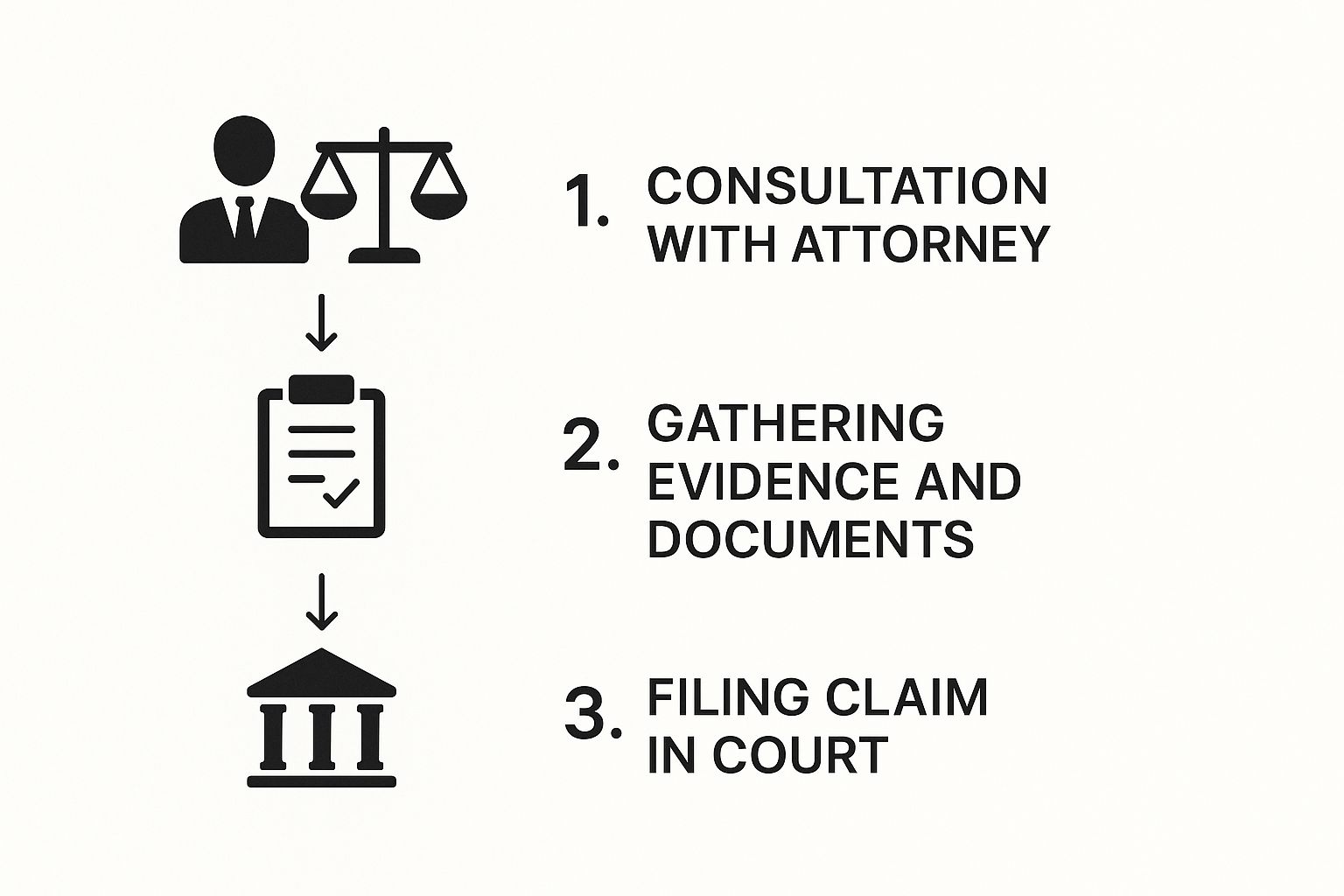
This visual shows the journey begins with getting professional advice, moves to building a strong foundation of proof, and culminates in the formal filing of the claim if a settlement can't be reached.
Negotiations can be a long back-and-forth process. The insurer will likely try to downplay the impact on your marriage to reduce what they have to pay. This is where having compelling, well-organized evidence of your loss becomes absolutely invaluable.
What to Expect if Your Case Goes to Trial
If you can't reach a fair settlement, the next step is filing a lawsuit and potentially taking the case to trial. At trial, both you and your spouse would need to testify. You would face questions not only from your attorney but also a cross-examination by the defense lawyer.
This can be an emotionally draining experience, as you'll have to speak openly about the most personal aspects of your marriage. The defense attorney will be looking for any inconsistencies or weaknesses in your story. Sometimes, however, presenting your case to a jury of your peers is the only way to get a just outcome for the immense damage done to your relationship.
Frequently Asked Questions About Loss of Consortium Claims
When a serious injury strikes, the legal questions can feel overwhelming, especially around a concept like loss of consortium. To bring clarity, here are answers to the most common questions we receive from clients in Atlanta. Each response is designed to be straightforward and practical, reinforcing the core concepts of this guide.
Informed clients are empowered clients. Let's dig into the details.
Can I File for Loss of Consortium if My Spouse’s Injury Was Temporary?
Yes, a temporary injury can still support a claim, but the duration of the injury is a critical factor in determining the case's value. A claim for spousal companionship is directly linked to how long and how severely your marriage was disrupted.
If your spouse recovered fully in a few months, your claim is limited to the losses suffered during that specific period. For instance, if you took on all household duties, provided round-the-clock care, and lost your partner's companionship for three months, your claim would be valued accordingly.
Contrast this with a catastrophic injury—like paralysis or a severe traumatic brain injury—where the loss is permanent. Those claims result in far higher damages because the harm is lifelong. For any claim, temporary or permanent, the key is meticulously documenting how your marital relationship was negatively affected.
What Happens if My Spouse Was Partially at Fault for the Accident?
This is an important point. Georgia follows a modified comparative negligence rule, outlined in O.C.G.A. § 51-12-33. Since your loss of consortium claim is legally derived from your spouse's personal injury case, their percentage of fault directly reduces your recovery.
Here’s how it works in practice:
-
A jury awards you $100,000 for your loss of consortium.
-
The jury finds your spouse was 20% at fault for the accident.
-
Your award is reduced by that 20% ($20,000), leaving you with $80,000.
Most importantly, if your spouse is found 50% or more at fault, they are barred from recovering any damages in Georgia. As a result, your loss of consortium claim becomes worthless. This all-or-nothing rule at the 50% threshold makes a professional and thorough accident investigation non-negotiable.
It is vital to understand that the success of your claim is legally tethered to your spouse's. Their assigned fault becomes your assigned fault in the eyes of the law.
Will I Have to Share Personal Details About My Marriage?
Yes, and you should be prepared for this. Filing a loss of consortium claim puts the quality and nature of your marriage directly at issue. To prove what you've lost, you must show what your marriage was like before the injury compared to what it became after.
This requires sharing personal information, including details about:
-
Your emotional support for one another.
-
Shared hobbies, activities, and your life together.
-
The division of household responsibilities.
-
The nature and frequency of your physical intimacy.
The defense attorney is entitled to investigate these areas, which can feel intrusive. They may ask very personal questions in a deposition. While uncomfortable, this is a necessary step to demonstrate the true, profound extent of your damages.
Is the Money from a Loss of Consortium Award Taxable?
This is a common and important question. In general, the Internal Revenue Service (IRS) does not tax compensation received for personal physical injuries. Because a loss of consortium claim stems directly from a spouse's physical injury, the award is typically non-taxable.
However, tax law can be complicated. If a settlement is structured to include interest, that portion may be taxable. It is always best to consult a qualified tax professional to review the specific implications of your settlement or award. For official guidance, you can review helpful government resources like IRS Publication 4345, Settlements—Taxability.
Answering these questions can help demystify the process, but no two cases are identical. The strength of your claim will always depend on the specific facts of the accident and the documented impact on your marriage. I hope this guide helps you understand your rights after a devastating injury impacts your family and you're forced to consider a loss of consortium claim.
At Jamie Ballard Law, we understand that the damage from a serious accident goes far beyond physical injuries. If your marriage has been impacted by someone else's negligence, you don't have to face this difficult time alone. Contact us today for a free, no-obligation consultation to discuss your case and learn how we can help. Visit us at https://jamieballardlaw.com to get started.