After a wreck in Atlanta, the first question on everyone's mind is, "What is my case actually worth?" You’ve probably seen an online auto accident settlement calculator that promises a fast, simple answer. As an Atlanta personal injury attorney, I can tell you these tools can offer a basic starting point, giving you a preliminary estimate based on a standard industry formula. They are a helpful first step in understanding the components of your claim, but they don't tell the whole story.
How a Settlement Calculator Actually Works
Think of a settlement calculator less like a crystal ball and more like a simple adding machine. It’s designed to give you a ballpark figure by running a quick, two-step calculation. It's a decent first step to get a general sense of what a claim might look like on paper.
The whole process is built on a basic formula that has become standard for initial insurance evaluations. Understanding this foundation is helpful to see both its uses and its major limitations.
The Core Formula
At its heart, the calculator uses a straightforward equation to come up with its estimate. This formula involves two key components that represent the different kinds of losses you've suffered.
- Step 1: Add Up Your Economic Damages: The calculator first totals all your tangible, out-of-pocket costs. These are the expenses with clear dollar amounts, like medical bills, lost wages from missed work, and vehicle repair costs.
- Step 2: Apply a Pain and Suffering Multiplier: Next, the tool applies a "multiplier"—usually a number between 1.5 and 5—to that total. This is an attempt to assign a monetary value to your non-economic damages, like physical pain, emotional distress, and the overall disruption to your life.
The result is then added back to your initial economic damages to generate the final settlement estimate. For example, with $10,000 in medical bills and a multiplier of 2, the non-economic portion would be estimated at $20,000, giving you a total ballpark figure of $30,000. If you're new to some of these terms, our firm's legal dictionary can provide clear definitions.
Understanding the Numbers in Context
It helps to see how these estimates stack up against real-world outcomes. The average car accident settlement involving injuries can vary widely based on the specifics of the case. More severe accidents can easily result in settlements from $50,000 to well over $1 million. You can find more information about typical claim values from sources like the Insurance Information Institute.
While a calculator provides a valuable starting point, it only scratches the surface. It can't account for the unique details of your recovery, the credibility of witnesses, or how a jury in Fulton County might perceive your story.
Ultimately, an online tool is just that—a tool. While it can give you a rough estimate, you need a deeper dive into how a case's value is truly determined for a complete picture. You can explore methods for understanding your case's overall worth to learn more. The number it provides is a good starting point for a conversation, but it is certainly not the final word on what you are truly owed.
Understanding the Numbers You Enter

An auto accident settlement calculator is only as smart as the information you give it. To get a remotely useful estimate, you have to understand what each number represents and where it comes from.
Think of your claim as having two distinct buckets of losses: economic damages and non-economic damages. The first covers the clear, calculable costs, while the second attempts to compensate for the human impact of the crash.
Gathering accurate documentation for both is the foundation of a strong claim. Every bill, receipt, and pay stub tells a part of your story—and proves your losses.
Economic vs. Non-Economic Damages at a Glance
This table breaks down the two main types of compensation you can claim after an auto accident. Understanding the difference is important for valuing your case correctly.
| Damage Type | What It Covers | Example |
|---|---|---|
| Economic | Tangible, out-of-pocket financial losses with a clear dollar value. | Ambulance bill, lost salary, vehicle repair costs. |
| Non-Economic | Intangible, personal losses related to the physical and emotional toll. | Chronic pain, anxiety, inability to enjoy hobbies. |
Simply put, economic damages are about what you paid, while non-economic damages are about what you went through.
Economic Damages: The Tangible Costs
These are the straightforward, black-and-white expenses that have a direct dollar value. They are the easiest part of your claim to track because you can prove them with paperwork.
- Medical Bills (Past and Future): This is the cornerstone of your claim value. It includes everything from the initial ambulance ride and ER visit to surgeries, physical therapy, and prescriptions. It must also account for any future medical care your doctor anticipates you’ll need.
- Lost Wages: This covers the income you lost from being unable to work while you recovered. You’ll need pay stubs or other proof of income to calculate this precisely. If you have benefits like short term disability insurance, that can also factor into the overall financial picture.
- Property Damage: This is the cost to repair or replace your vehicle. It also includes any personal property damaged in the accident, like a laptop, phone, or child’s car seat.
Non-Economic Damages: The Human Impact
This is where things get more personal. This category is much harder to put a price tag on because it represents the non-financial ways the accident has upended your life. It's also where a simple calculator almost always falls short.
These damages attempt to compensate you for the real-life consequences of your injuries.
The core idea behind non-economic damages is to acknowledge the physical pain and emotional suffering you have endured. A settlement calculator uses a multiplier to guess this value, but it can never truly grasp the day-to-day reality of your experience.
This includes things like:
- Pain and Suffering: The physical pain, discomfort, and general misery caused by your injuries.
- Emotional Distress: The anxiety, fear, depression, or even PTSD that can follow a traumatic event like a car wreck.
- Loss of Enjoyment of Life: This accounts for how the injury has stopped you from enjoying your hobbies, activities, and daily routines.
These components are central to all personal injury claims and are what truly define the full scope of your losses. The more accurately you can document your tangible costs, the stronger the foundation you’ll have for arguing the value of the intangible ones.
The Pain and Suffering Multiplier Explained

This is the most confusing part of any auto accident settlement calculator. The "multiplier" is a number that seems to come out of nowhere, but it’s the method adjusters use to put a dollar value on the human side of your accident—your pain, your stress, and all the ways your life was turned upside down.
Think of it this way: your medical bills and lost wages are the concrete foundation of your claim. They’re provable, hard numbers. The multiplier builds the rest of the structure on top of that foundation, representing all the intangible losses that don’t come with a neat invoice.
What Is the Multiplier Range?
This number usually falls between 1.5 and 5. It’s applied directly to your total economic damages (medical bills plus lost wages) to estimate what’s known as "pain and suffering" or non-economic damages.
The specific number isn't random. It’s chosen based on the severity and long-term impact of your injuries, reflecting how significantly the accident has altered your life.
- A low multiplier (e.g., 1.5 to 2): This is common for minor accidents where the injuries are temporary. Think of a whiplash case that resolves in a few weeks with some physical therapy. The disruption is real but thankfully short-lived.
- A high multiplier (e.g., 4 or 5): This is reserved for serious injuries that cause permanent damage, require surgery, or result in a long-term disability. The impact here is profound and life-changing.
For instance, an accident that leaves someone with a permanent limp or chronic nerve damage demands a much higher multiplier than a sprain that heals completely. If you're dealing with a condition like this, it’s important to understand how these lasting effects are valued. We handle many cases involving chronic pain syndrome in Atlanta and know how to argue for their true worth.
Why an Online Calculator Falls Short
This is where an online tool’s limitations become painfully obvious. A calculator can’t grasp the human context behind your numbers. It doesn't know you missed your daughter's graduation because you were in the hospital, or that you can no longer pick up your grandchild.
Your story isn't average.
The multiplier isn’t just about the injury itself; it’s about the story of your recovery. It considers the length of your treatment, the intensity of your pain, and the total disruption to your daily routine. An online form can't possibly capture that narrative.
A real-world evaluation looks at factors a calculator completely misses, including:
- The visibility of scarring or disfigurement.
- The emotional trauma and psychological fallout, such as anxiety or PTSD.
- The strain the injury has placed on your personal and family relationships.
Ultimately, the multiplier is an attempt to quantify the unquantifiable. While an auto accident settlement calculator uses it to generate a ballpark figure, a true and fair assessment requires a deep understanding of your personal story and the full impact the accident has had on your life.
A Step-by-Step Sample Settlement Calculation
The theory is one thing, but let's put some real numbers to it. To see how an auto accident settlement calculator actually works, we'll walk through a hypothetical Atlanta car accident. This will show you exactly how the pieces fit together and, more importantly, how much the final amount can vary.
The Scenario: An I-285 Rear-End Collision
Picture this: you're driving home on I-285 when another car slams into you from behind. It's not a catastrophic wreck, but it's bad enough to give you a nasty whiplash injury. You have to go to the ER, and you're forced to miss a full week of work while you recover.
Right away, your provable costs—what we call economic damages—start piling up. These are the hard numbers that serve as the foundation for your entire claim.
Step 1: Adding Up the Economic Damages
First, we have to tally up every documented expense you incurred because of the wreck. These aren't guesses; they're figures backed by bills and receipts.
For our I-285 scenario, let's say your tangible costs look like this:
- Emergency Room Visit and X-rays: $2,500
- Follow-up Orthopedic Doctor Visit: $500
- Physical Therapy (8 sessions): $1,200
- Prescription Medications: $150
- Lost Wages (one week of work): $1,000
- Rental Car While Yours is Repaired: $300
Total Economic Damages: $5,650
This $5,650 is our concrete starting point. It represents the direct financial hit you took from an accident that wasn't your fault.
Step 2: Applying the Pain and Suffering Multiplier
Now comes the subjective part. We take that $5,650 and apply the multiplier to account for your pain and suffering. An insurance adjuster will look at the facts of your case—the severity of your injury, how long your recovery took, and how much it disrupted your life—to assign this number.
Let's see how two different multipliers create two very different results:
-
Low-End Scenario (Multiplier of 2.0): If the adjuster argues your injuries were minor and you recovered quickly, they'll push for a low multiplier.
- $5,650 (Economic Damages) x 2.0 (Multiplier) = $11,300 (Non-Economic Damages)
-
High-End Scenario (Multiplier of 4.0): But if you can prove the whiplash caused lingering pain, significant distress, and a recovery that dragged on, a higher multiplier is completely justified.
- $5,650 (Economic Damages) x 4.0 (Multiplier) = $22,600 (Non-Economic Damages)
This is where the fight really happens. The infographic below shows just how this simple formula works.
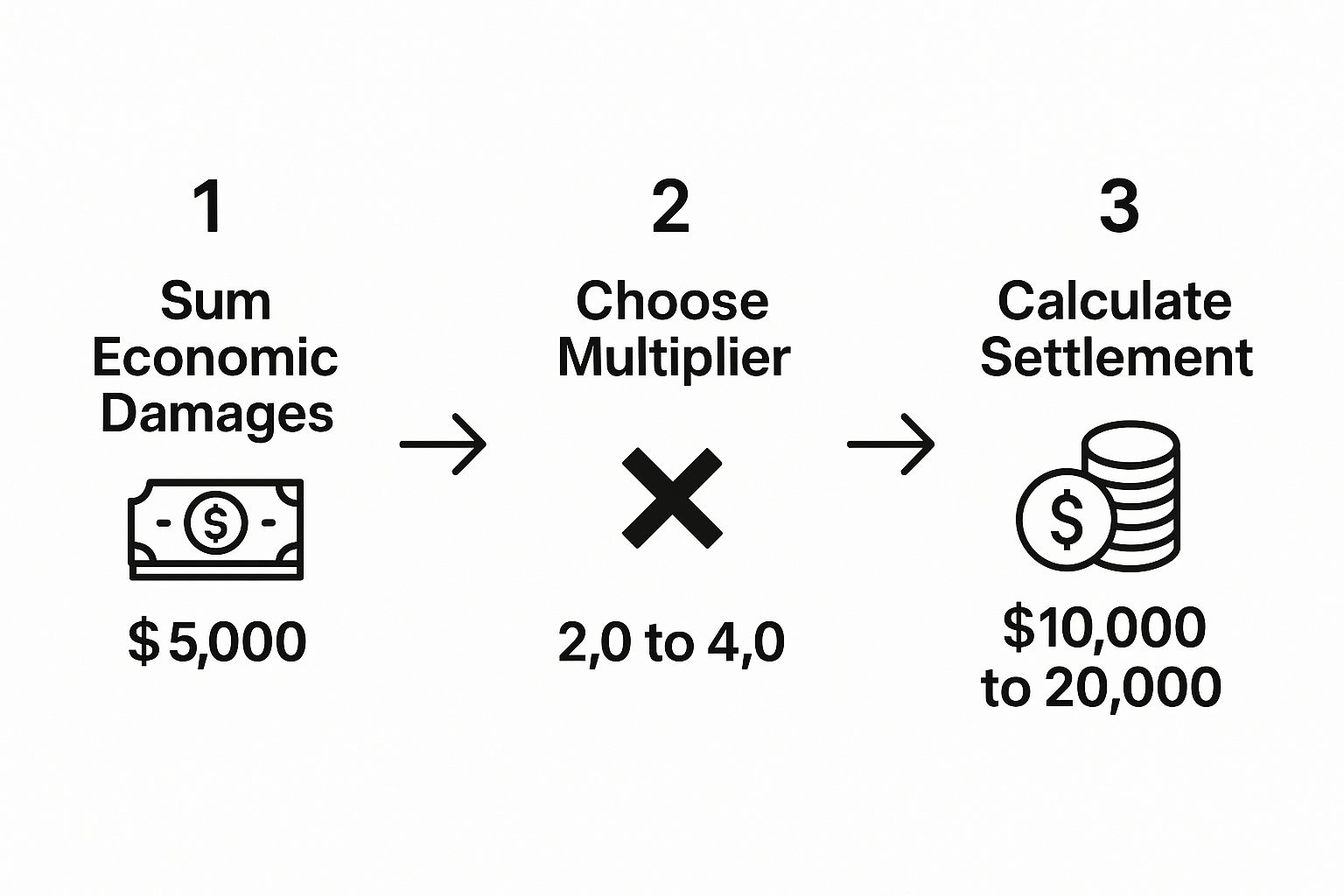
As you can see, the same initial costs produce wildly different figures depending on that one important number: the multiplier.
Step 3: Calculating the Final Settlement Range
To get our final settlement estimate, we just add the non-economic damages back to our original economic damages.
- Low-End Estimate: $5,650 (Economic) + $11,300 (Non-Economic) = $16,950
- High-End Estimate: $5,650 (Economic) + $22,600 (Non-Economic) = $28,250
For the exact same accident, the potential settlement range is over $11,000 apart. That entire gap comes down to how effectively the story of your pain and suffering is told.
This table breaks down how the multiplier drives the final value.
Sample Settlement Calculation Outcomes
Here’s a side-by-side look at how a low versus a high multiplier impacts the final settlement estimate, starting from the same base costs.
| Calculation Step | Multiplier 2.0 Scenario | Multiplier 4.0 Scenario |
|---|---|---|
| Economic Damages | $5,650 | $5,650 |
| Multiplier Applied | x 2.0 | x 4.0 |
| Non-Economic Damages | $11,300 | $22,600 |
| Total Settlement Estimate | $16,950 | $28,250 |
This is why having strong medical evidence and a compelling narrative is so important. An auto accident settlement calculator gives you the numbers, but it can’t argue on your behalf to secure the higher multiplier you deserve.
What a Calculator Simply Cannot Measure
An online auto accident settlement calculator processes numbers, but it remains blind to the human story behind them. Your collision was not merely a series of bills and expenses; it was a traumatic event with impacts that a simple online form cannot possibly comprehend.
These tools are designed to tally concrete costs but fall short when attempting to quantify the profound human elements that heavily influence a real settlement’s value. The true weight of a case is found in the details a calculator can't ask about.
The Intangible Factors That Shape Your Claim
Your case is a unique story, not a mathematical formula. An online tool cannot capture the fear you felt during the wreck, the strain your recovery placed on your family, or how your injuries have stolen your ability to enjoy your favorite hobbies.
Several powerful, non-numerical factors significantly impact what your settlement is actually worth:
- Emotional Trauma: The anxiety, stress, or even PTSD that can linger long after physical injuries begin to heal.
- Loss of Enjoyment of Life: How the accident has impacted your ability to live as you did before—whether that’s playing with your children, gardening, or going for a run.
- Your Credibility: How believable you are is a major factor. A jury or insurance adjuster will assess how clearly and consistently you present your account of events.
- Witness Testimony: Independent witness statements can either strongly corroborate or weaken your version of events.
The valuation of a car accident settlement involves many variables, from injury severity to insurance coverage. For devastating injuries like traumatic brain damage, settlements can be much higher due to the necessity of lifelong medical care. Discover more insights about average settlement amounts and see how these elements come into play.
How Georgia Law Changes Everything
A calculator also fails to account for state-specific laws that can completely alter the outcome of your case. Here in Georgia, we operate under a "modified comparative fault" rule.
Under Georgia law (O.C.G.A. § 51-12-33), you can still recover damages even if you were partially at fault for the accident, provided you were less than 50% responsible. However, your final award will be reduced by your percentage of fault.
This statute is a game-changer. If you are found 20% at fault for the crash, your total settlement is reduced by 20%. If you are found 50% or more at fault, you are barred from recovering anything. An auto accident settlement calculator cannot assess legal blame or apply this vital standard, which is why its estimate can be profoundly misleading.
Next Steps After Using a Calculator
So, you’ve plugged in the numbers and have an estimate from an online auto accident settlement calculator. Think of that figure as a useful starting point—a ballpark idea. But it’s just the beginning of the conversation, not the final word. The logical next step is to move from a rough estimate to concrete action.
This is where you shift from a theoretical value to building a claim with real-world proof. The number from the calculator is a hypothesis; your documentation is the evidence that will prove it.
Gather and Preserve Your Documentation
Before anything else, your first priority is to get organized. You need to collect and protect every single piece of paper and digital file related to your accident. Insurance adjusters won't take your word for it—they demand concrete proof for every loss you claim.
You're essentially building a case, and every document strengthens your position and backs up the numbers you used in the calculator.
- Medical Records: This isn’t just the final bill. It’s every invoice, diagnosis report, treatment plan, and prescription receipt from every single provider—doctors, hospitals, physical therapists, and specialists.
- Police Report: Get an official copy of the accident report. It contains the officer’s initial assessment of fault and other details about the crash. In Georgia, you can often request this online through services like BuyCrash.com.
- Proof of Lost Income: You'll need more than just saying you missed work. Gather recent pay stubs and ask your employer for a letter detailing your regular pay rate and the specific dates you were unable to work.
- Photographs and Videos: Organize every photo you have of the accident scene, the damage to your vehicle, and your injuries. Timestamps are incredibly helpful here.
- Witness Information: Make sure you have a secure list of any witnesses' names and contact information. Their statements can be invaluable.
Get a Professional Evaluation of Your Claim
An online calculator is a great tool, but it simply can’t replace human experience. The next logical step is to have your case reviewed by a professional who understands the specific legal landscape here in Atlanta. This isn't just about a sales pitch; it's about getting an accurate, realistic assessment.
A consultation allows an attorney to analyze the nuanced factors that a calculator inevitably misses. It helps you form a real strategy for dealing with insurance adjusters, whose primary goal is to minimize their company's payout.
An experienced lawyer can evaluate the unique story behind your numbers. They will assess the strength of your evidence, apply Georgia-specific laws to your situation, and give you a far more realistic valuation than any automated tool ever could. This process turns the uncertainty of an online estimate into a confident plan of action.
Speaking with an attorney helps you understand what your claim is truly worth and how to pursue it effectively. If you're ready to discuss the specifics of your situation and get a clear, personalized assessment, you can schedule a free consultation with our team. A professional evaluation provides a far more accurate picture than any auto accident settlement calculator can offer.