If you've suffered harm because of a doctor's mistake, your first thought is probably, "Do I need a lawyer for medical malpractice?" It’s a valid question. From my experience as an Atlanta personal injury attorney, medical malpractice happens when a healthcare provider’s careless action—or inaction—causes a patient real harm. This is a very important distinction: it's not just about a bad outcome. It’s about a clear failure to provide the expected standard of care, and finding the right lawyer for medical malpractice is a key step.
What Is Medical Malpractice and When Should You Seek Help?
Placing your health in a doctor's hands requires immense trust. When that trust is broken and you end up injured, it's easy to feel lost, angry, and unsure of what to do next. The first step toward finding clarity is understanding exactly what qualifies as medical malpractice here in Georgia.
At its core, medical malpractice isn't just about a treatment that didn't work out as hoped. It's about a specific kind of professional failure. Think of it like this: an experienced pilot has a pre-flight checklist that every other competent pilot follows. If your pilot decides to skip a step—like checking the fuel levels—and it leads to a preventable accident, that's not just bad luck. It's a failure to follow the accepted standard.
In the same way, if a doctor or hospital deviates from the established medical standards that other skilled professionals in their field would follow, and you are hurt because of it, that’s likely malpractice.
The Four Pillars of a Malpractice Claim
For a malpractice claim to be successful, four essential elements must be proven. Imagine you're building a stool with four legs—if even one leg is missing, the whole thing collapses. The same goes for these cases.
- A Doctor-Patient Relationship Existed (Duty): This is usually the easiest part to prove. It simply establishes that the medical professional had a legal responsibility to provide you with care.
- The Care Fell Below the Accepted Standard (Breach): This is the "mistake." You have to show that the doctor, nurse, or hospital acted negligently and did something a reasonably skilled professional wouldn't have done in the same situation.
- The Mistake Directly Caused Your Injury (Causation): There has to be a direct, provable link between the provider's negligence and the harm you suffered. An unfortunate outcome isn't enough; the negligence must be the clear reason for the injury.
- You Suffered Significant Harm (Damages): The injury must have led to actual losses. This could include things like extra medical bills, lost income from being unable to work, or significant pain and suffering.
Quick Guide to Identifying Potential Malpractice
Sometimes it's hard to know if what happened to you fits the legal definition. This quick guide breaks down the four pillars into plain English to help you see if you might have a case.
| Element | What It Means in Plain English | A Simple Example |
|---|---|---|
| Duty | The doctor agreed to treat you. | You went to the emergency room and were seen by a physician. |
| Breach | The doctor messed up in a way other competent doctors wouldn't have. | A surgeon leaves a surgical sponge inside a patient. |
| Causation | The doctor's mistake is the direct reason you were harmed. | The forgotten sponge causes a severe internal infection. |
| Damages | You suffered real, measurable losses because of the harm. | You need another surgery to remove the sponge and miss two months of work. |
If you can check off all four of these boxes, it's a strong sign that you should speak with an attorney.
Knowing When to Act Is Important
Because these cases require solid proof, you need to act quickly if you suspect negligence. The deadlines for filing a claim are strict, and building a strong case takes time. You can learn more about the timelines for personal injury cases in Georgia in our detailed guide here: https://jamieballardlaw.com/statute-of-limitations-for-personal-injury-ga/.
Consulting a specialist is an important step. A seasoned malpractice attorney has the resources to investigate your claim properly, hire medical experts to review your records, and determine if all four pillars of your case are standing strong. This isn't just about filing paperwork; it's about building an undeniable foundation for your claim. Finding the right lawyer for medical malpractice ensures you have an advocate who knows how to prove your case and fight for the justice you deserve.
What a Medical Malpractice Lawyer Does for Your Case
Hiring a lawyer for medical malpractice is about much more than just filing paperwork. Your attorney acts as your investigator, strategist, and advocate, managing every detail of the case so you can focus on your recovery. The first thing they do is launch an exhaustive investigation into exactly what happened to you.
This goes far beyond simply requesting your medical charts. It involves digging deep to uncover hospital staffing records, internal safety protocols, and even private communications between medical staff. Your lawyer pieces together the full, unvarnished story of your care.
Building the Foundation of Your Claim
A credible malpractice claim must be validated by other medical professionals. Your attorney will tap into a trusted network of medical experts—doctors, surgeons, and nurses in the relevant field—to conduct a rigorous review of your case. These experts offer a professional opinion on whether the care you received fell below the accepted medical standard.
This independent validation is non-negotiable. Without an expert willing to testify that negligence occurred, a case can't move forward. This step confirms the merit of your claim before you invest significant time and energy into legal action.
Your lawyer also serves as a necessary shield. They will immediately take over all communications with hospital administrators, their legal teams, and insurance adjusters looking to minimize their payout.
This protective role is one of the most immediate benefits of hiring an attorney. It stops the pressure, prevents you from being manipulated into a lowball settlement, and ensures your rights are defended at every turn. You no longer have to face them alone.
Calculating Full Damages and Preparing for a Fight
Once the investigation is complete and the claim is validated, the work of building your case begins. Your attorney will meticulously document the full extent of your harm and calculate your total damages. This is far more involved than just adding up your medical bills.
The calculation is a comprehensive assessment of all your losses, including:
- Future Medical Needs: Projecting the costs of ongoing treatments, future surgeries, rehabilitation, and any long-term care you may require.
- Lost Earning Capacity: Documenting not just the wages you've already lost, but also the income you will be unable to earn in the future because of your injury.
- Pain and Suffering: Quantifying the immense personal toll of the injury, including physical pain, emotional trauma, and the loss of enjoyment of life. You can explore how different kinds of personal injury claims are structured in our helpful guide.
From there, your lawyer prepares for every scenario, whether it's negotiating a fair settlement or taking your case to trial. Beyond the legal work, a medical malpractice lawyer must also use effective law firm marketing strategies to connect with clients who desperately need their help.
All this work is typically done on a contingency fee basis. This means you pay absolutely nothing unless and until your lawyer wins your case. This arrangement shows the confidence a skilled Atlanta lawyer for medical malpractice has in your fight for justice.
The Four Elements of a Successful Malpractice Claim
Winning a medical malpractice case isn't as simple as showing a doctor made a mistake. To build a successful claim, a skilled lawyer for medical malpractice has to prove four specific elements. Think of it like building a table—if any of the four legs are missing, the whole thing comes crashing down.
Let's be clear: these cases are tough. Statistics show that only about 30% to 40% of medical malpractice lawsuits end with a favorable result for the patient. This isn't meant to discourage you; it's to highlight why winning requires deep legal expertise and a rock-solid case built on clear evidence. You can find more insights about these challenging statistics online.
Understanding these four pillars will help you have a much more productive conversation with an attorney.
Element 1: Duty of Care
First, we have to establish a duty of care. This is usually the easiest part. It just means proving a formal doctor-patient relationship existed.
The moment a doctor, hospital, or clinic agrees to treat you, they take on a professional duty to provide competent care that meets accepted medical standards. Proving this relationship is straightforward—we use medical records, appointment confirmations, billing statements, and intake forms.
Element 2: Breach of Duty
Second, we must prove a breach of duty. This is the heart of the claim and often the most contentious part. Here, we demonstrate that the healthcare provider was negligent, meaning their care fell below the standard that a reasonably skilled professional in their field would have provided in the same situation.
This isn't about the doctor's intentions. It's an objective evaluation of their actions. To prove a breach, your attorney will rely on evidence like:
- Expert Medical Testimony: We bring in other qualified doctors to review your case. They provide a professional opinion on whether the care you received was substandard. Their testimony is non-negotiable.
- Hospital Policies and Procedures: Sometimes, the provider violated their own employer's safety rules. This is powerful evidence of a breach.
- Medical Literature: We can use established medical journals and guidelines to show the provider’s actions went against accepted best practices.
Element 3: Causation
The third leg of the table is causation. This is the link connecting the doctor’s negligence directly to your injury. It’s not enough to show they made a mistake; we have to prove that their specific mistake is what harmed you.
Imagine a radiologist misreads an MRI and misses a tumor. Causation is established by showing that the delay in diagnosis allowed the cancer to grow and spread, leading to a much worse prognosis. We build this connection with expert testimony that rules out other possible causes and proves that "but for" the doctor's error, you wouldn't have been injured.
This is where a lawyer's real work begins—connecting the dots from the mistake to the harm it caused.
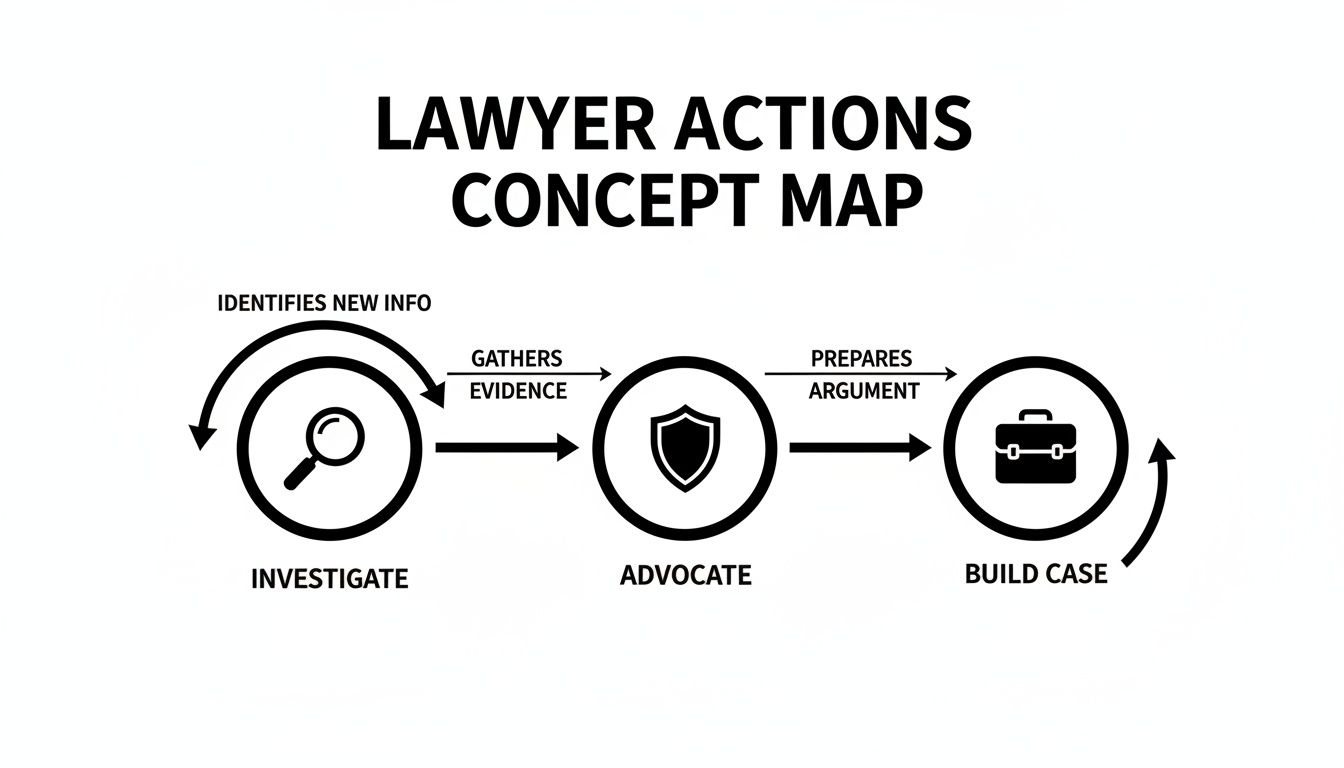
As you can see, an attorney’s role is to investigate the facts, build a logical case, and advocate fiercely on your behalf.
Element 4: Damages
Finally, there must be damages. This means you suffered real, measurable harm because of the injury. If a doctor was negligent but you weren't harmed, there is no case. Damages are the quantifiable losses—both economic and non-economic—that you've endured.
Proving damages is about painting a complete picture of how the injury has impacted your entire life—financially, physically, and emotionally. It quantifies the real-world consequences of the medical error.
We document these losses with hard evidence: medical bills, pay stubs showing lost income, and reports from experts who can calculate the cost of your future medical needs.
When you speak with a lawyer for medical malpractice, having a basic grasp of these four elements will help you understand exactly what we need to prove to win your case.
Common Examples of Medical Malpractice in Atlanta
Trying to figure out if you have a valid claim can feel overwhelming. It often helps to see how medical negligence actually plays out in real-world scenarios. These errors aren't always the dramatic events you see on TV; sometimes, they're quiet mistakes with devastating, life-altering consequences. Here in Atlanta, we see certain patterns of negligence more than others.
Recognizing these common examples can help you put a name to what you or a loved one has experienced. This isn't about diagnosing your own case, of course, but about understanding the different forms medical negligence can take. Below are some of the most prevalent types of malpractice we handle, each with a brief story to show how these errors impact real families.

A landmark study from Johns Hopkins Medicine found that medical errors are a leading cause of death in the United States. That's a sobering fact, and it underscores just how profound and devastating these preventable mistakes can be for patients and their families.
Misdiagnosis or Delayed Diagnosis
One of the most common and damaging errors is the failure to correctly identify a patient's condition in a timely manner. When a treatable illness is missed, that delay can completely eliminate the chance for an effective intervention. Time is a luxury patients don't have.
- Example: An Atlanta father of two visits his doctor with a persistent cough and chest pain. The doctor writes it off as a bad case of bronchitis without ordering a simple chest X-ray. Eight months later, another doctor correctly diagnoses him with Stage IV lung cancer, which is now untreatable. The initial failure to investigate his symptoms allowed the cancer to spread, tragically changing his future.
Surgical Errors
Mistakes in the operating room are what most people picture when they hear the term "malpractice." These errors are almost always preventable and often stem from poor communication, staff fatigue, or a breakdown in the hospital's own safety protocols.
- Example: A patient undergoes knee replacement surgery at an Atlanta hospital. Weeks later, she's in excruciating pain and develops a severe infection. Imaging reveals a surgical sponge was left inside her knee during the procedure. Now she needs a second, high-risk surgery to remove it and treat the life-threatening infection.
These are not just unfortunate accidents; they are often the result of systemic failures. When basic safety checks are ignored, patients are the ones who pay the price with their health and well-being.
Birth Injuries
Mistakes made during labor and delivery can cause permanent, devastating harm to a newborn. These injuries often result from a doctor or nurse's failure to monitor the baby's condition and respond appropriately to clear signs of distress.
- Example: During a difficult delivery, the medical team fails to recognize signs of fetal distress on the monitor. Instead of ordering an emergency C-section, they press on with a prolonged vaginal delivery, depriving the baby of oxygen. As a result, the child is born with cerebral palsy—a lifelong condition that will require millions of dollars in medical care. You can find more specific information on our site about Atlanta birth injury claims.
The financial toll of these mistakes is becoming more apparent. Juries are awarding more substantial damages as they recognize the true cost of these errors. For instance, the average of the top 50 U.S. verdicts recently hit $56 million. Right here in Georgia, a jury upheld a record $40 million verdict against a physician for gross negligence.
If any of these situations sound painfully familiar, speaking with an experienced lawyer for medical malpractice can help you understand your rights and figure out your next steps.
Key Questions to Ask Before Hiring a Malpractice Lawyer
Choosing the right legal partner is one of the most important decisions you will make. To find the best lawyer for medical malpractice for your unique situation, you need to ask direct, insightful questions during your initial consultations.
This isn't about being confrontational; it's about being an informed consumer. Think of it like getting a second opinion from a medical specialist—you want to feel confident in their expertise, comfortable with their communication, and clear on the plan forward. A good lawyer will welcome your questions.
Questions About Experience and Success
Not all personal injury attorneys have the specific background to handle these types of cases. Medical malpractice law has its own rules, requires a network of credible medical experts, and demands a deep understanding of healthcare standards of care.
Here are some key questions to ask to gauge an attorney's relevant experience:
- How many medical malpractice cases similar to mine has your firm handled?
- What is your track record with these cases in Atlanta-area courts?
- Who will be my primary point of contact throughout the case?
Local knowledge is a significant advantage. An attorney familiar with local judges, court procedures, and defense firms can better anticipate challenges and build a stronger strategy from day one. It's also important to know who you'll be speaking with—the lead attorney or a paralegal—to set clear communication expectations.
As you evaluate potential firms, it's also worth noting how attorneys make themselves known in a competitive field, often relying on effective SEO for law firms to connect with people who need their help.
Understanding the Financial Arrangement
For most people, the cost of hiring a lawyer is a major concern. Fortunately, reputable malpractice attorneys work on a contingency fee basis, which removes the financial barrier for victims seeking justice.
A contingency fee agreement means you pay no upfront fees. The attorney's payment is a percentage of the financial recovery they secure for you. If they don't win your case, you owe them no attorney fees. This system aligns the lawyer's interests directly with yours—they only get paid if you do.
To ensure you have full transparency, ask the following:
- What is your contingency fee percentage?
- Does that percentage change if the case goes to trial?
- How are case expenses (like expert witness fees) handled? Are they deducted from the settlement before or after the attorney's percentage is calculated?
To help you stay organized during your search, use this checklist to compare your options and make a confident decision.
Attorney Evaluation Checklist
Use this checklist during your free consultations to compare potential attorneys and make an informed decision.
| Question to Ask | Why This Question Matters | What a Good Answer Sounds Like |
|---|---|---|
| How many medical malpractice cases like mine have you personally handled? | Gauges direct, hands-on experience, not just the firm's overall numbers. | "I've personally managed over 20 cases involving surgical errors, and our firm has handled more than 50 in the last decade." |
| What is your track record in Atlanta courts? | Local knowledge is a huge asset. It indicates familiarity with local judges, rules, and opposing counsel. | "We've had great success in Fulton and DeKalb counties. We know the judges and how they typically rule on motions in these types of cases." |
| Can you provide references from past clients or other attorneys? | Shows confidence in their reputation and the quality of their client relationships. | "Absolutely. While client confidentiality is important, we can connect you with past clients who have agreed to speak about their experience with our firm." |
| What is your contingency fee and how are costs handled? | Ensures financial transparency and avoids surprises down the road. | "Our fee is a standard 33.3%, which increases to 40% if we go to trial. Case costs are advanced by us and reimbursed from the settlement after our fee is calculated." |
| Who will be my main point of contact? | Sets expectations for communication and tells you if you'll be working with the lead attorney or passed to a junior associate. | "You'll be working directly with me. My paralegal, Sarah, will assist with scheduling and document collection, but I will be your primary contact for all strategic decisions." |
Making an informed choice gives you peace of mind. To get a better sense of our team's approach, you can learn more about our firm's background and values. Choosing the right lawyer for medical malpractice is about finding a skilled advocate you can trust completely on this journey.
Frequently Asked Questions About Atlanta Malpractice Claims
When you're reeling from a medical injury, the last thing you need is a confusing legal process. It’s completely normal to have questions about deadlines, costs, and whether you even have a case. We've compiled a few of the most important questions we hear from people in Atlanta to give you the clarity you need.
Our goal is to give you direct answers to your most pressing concerns, helping you feel confident about what to do next for yourself and your family.
How Long Do I Have to File a Medical Malpractice Lawsuit in Georgia?
This is one of the most time-sensitive questions, and the answer is strict. In Georgia, you generally have two years from the date the injury happened or was reasonably discovered to file a lawsuit. This deadline is known as the statute of limitations.
However, there’s another layer to this. Georgia also has a statute of repose, which sets an absolute deadline. No claim can be filed more than five years after the negligent medical act occurred, regardless of when the injury was found. This can create extremely tough situations, especially when the harm isn't immediately obvious.
There are a few narrow exceptions, like when a foreign object is left inside a patient’s body. Because these time limits are so rigid and unforgiving, it’s an important reason to speak with an attorney as soon as you even suspect medical negligence. You can find the official text of these laws in the Code of Georgia.
What Kind of Compensation Can I Receive in a Malpractice Case?
Compensation, legally called “damages,” is meant to cover the full scope of your losses—financial, physical, and emotional. The goal is to make you as whole as possible after the harm you’ve endured.
In Georgia, damages typically fall into a few key categories:
- Economic Damages: These are for every measurable financial loss. Think past and future medical bills, lost wages from being unable to work, and any damage to your future earning capacity.
- Non-Economic Damages: This covers the profound, non-financial impact on your life. It includes compensation for physical pain and suffering, emotional distress, mental anguish, and the loss of your ability to enjoy life.
- Punitive Damages: These are rare. They are only awarded in cases where the healthcare provider’s conduct was especially reckless or showed a conscious indifference to your safety. Their purpose isn’t to compensate you, but to punish the at-fault party and deter similar behavior.
An experienced attorney will meticulously analyze every facet of your life that was affected to calculate the true value of your claim, ensuring no loss is ignored.
How Much Does It Cost to Hire a Lawyer for Medical Malpractice?
This is a major source of anxiety for many people, but the system is designed to provide access to justice for everyone. Reputable medical malpractice firms, including ours, handle these cases on a contingency fee basis.
A contingency fee means you pay absolutely no upfront costs or hourly fees. The law firm advances all the money required to build and litigate your case, from filing fees and expert witness retainers to deposition costs.
The attorney’s fee is a percentage of the financial recovery they win for you, either from a settlement or a court verdict. If there is no recovery, you owe no attorney fees. It’s that simple. This model ensures your ability to hire top legal talent doesn’t depend on your bank account.
What if I Signed a Consent Form Before My Procedure?
This is a common misconception that stops many people from seeking help. Signing a consent form does not give a doctor permission to be negligent.
When you sign that form, you are acknowledging the known, inherent risks of a procedure when performed correctly. You are agreeing to the possibility of a complication that can occur even when the medical team does everything right.
You are not agreeing to be harmed by a preventable medical error. If your injury happened because a doctor or hospital failed to meet the required standard of care—by operating on the wrong site, misreading a test result, or failing to monitor your vitals—the consent form does not shield them from accountability. A skilled lawyer for medical malpractice can analyze the facts and explain precisely why this is the case.
If you have more questions or believe you were a victim of medical negligence, the team at Jamie Ballard Law is ready to help. We offer a free, no-obligation case evaluation to listen to your story and explain your legal options. Contact us today at https://jamieballardlaw.com to get the straightforward answers you deserve.