When you're dealing with a legal issue in Atlanta, one of the first things you need to understand is the difference between a defendant vs plaintiff. It's really quite simple: the plaintiff is the person who brings a lawsuit, and the defendant is the person being sued. Understanding these roles is the first step in making sense of the legal process.
In personal injury cases, the plaintiff is the individual who was injured and is now seeking financial help for their losses. The defendant is the party who is being accused of causing that injury. Knowing the distinction between a defendant vs plaintiff is foundational to any case.
Defining the Core Legal Roles

To really get a handle on how a personal injury case works here in Atlanta, you have to be clear on who plays what part. These aren't just labels—they define each side's duties, goals, and legal standing from the very start.
Think about a car wreck on Peachtree Street. The driver who was hit and injured would be the plaintiff. They're the one taking legal action to get money for medical bills and other damages. The driver accused of causing the crash? That's the defendant, and they have to respond to the claims made against them.
Plaintiff vs Defendant At a Glance
Here’s a simple table to quickly break down the different roles and responsibilities for the plaintiff and the defendant.
| Attribute | Plaintiff | Defendant |
|---|---|---|
| Initiating Action | Files the lawsuit (complaint) against the defendant. | Responds to the lawsuit with a formal "Answer". |
| Primary Goal | To prove the defendant is liable and recover damages. | To disprove the plaintiff's claims or present a defense. |
| Burden of Proof | Has the initial responsibility to prove their case. | Does not have to prove anything initially; must defend. |
| Position in Court | The party making the accusation or claim. | The party being accused or defending against the claim. |
This dynamic is incredibly common. The American legal system sees over 40 million lawsuits filed every single year, according to sources like the National Center for State Courts.
The outcomes really depend on the specifics of the case. For example, plaintiffs in car accident cases win about 60% of the time at trial. But in medical malpractice cases, defendants come out ahead in 74% of trials. It shows just how much the details matter.
If you want to dig deeper into these terms and others, our firm put together a comprehensive legal dictionary with clear definitions. Knowing the language of the law is a huge part of feeling in control of your own case. It helps you understand what's happening at every stage, from the first filing to the final verdict.
The Plaintiff's Journey: Kicking Off a Claim

When we talk about defendant vs plaintiff, the plaintiff is always the one who gets the ball rolling. This journey doesn’t start in a courtroom. It starts at the scene of the injury—maybe a bad multi-car pile-up on Atlanta's I-285. The injured person, now a potential plaintiff, has to make the tough decision to pursue a legal claim.
Before filing anything, a plaintiff must have standing. This is a legal term that simply means you have the right to sue because you were directly harmed. If you were the one injured in that I-285 crash, you have standing. A concerned friend who heard about it later? They don’t.
Carrying the Burden of Proof
Once a lawsuit is filed, the plaintiff carries a significant responsibility in a civil case: the burden of proof. It’s up to the injured party to present enough evidence to convince a judge or jury that their version of events is true. The defendant doesn’t have to prove their innocence; the plaintiff must prove the defendant is liable for their injuries.
In a personal injury case, the legal standard is called a preponderance of the evidence. This is a much lower bar than the "beyond a reasonable doubt" standard you hear about in criminal trials.
A preponderance of the evidence means it is more likely than not (a greater than 50% chance) that the defendant’s negligence caused the plaintiff’s injuries. Think of it like tipping the scales of justice, even if only slightly, in your favor.
Building the Foundation of a Claim
So how does a plaintiff meet this burden? Let's go back to that wreck on I-285. Building a strong case from the very beginning is important. It involves a few key steps:
- Gathering initial evidence: This means taking photos and videos of the accident scene, the damage to all vehicles, and any visible injuries. You also need to get the names and contact information of every witness you can find.
- Documenting all injuries: Get medical attention right away. Every doctor's visit, diagnosis, prescription, and medical bill becomes a vital piece of evidence connecting the accident to the harm you suffered.
- Consulting an attorney: An experienced Atlanta personal injury lawyer can look at the evidence, explain your rights, and map out the best strategy for holding the at-fault party accountable.
After gathering this information, the formal legal process starts with filing a Complaint. This document, filed with the court, officially kicks off the lawsuit. It lays out who the plaintiff is suing (the defendant), explains the facts of the incident, and details the damages you’re seeking. Understanding how to properly start a case is a key first step. You can learn more about what it takes to file a car accident claim in Atlanta. This action officially establishes the roles of defendant vs plaintiff.
The Defendant's Role Responding to a Claim
The dynamic between defendant vs plaintiff officially begins the moment a lawsuit is served. A sheriff's deputy or a professional process server will hand you a set of legal documents—the Summons and Complaint. This is a meaningful moment, and the worst thing you can possibly do is ignore it. Ignoring a lawsuit won't make it disappear; it will almost certainly lead to a default judgment against you, meaning you automatically lose the case.
As the defendant, your role is fundamentally reactive. While the plaintiff takes the offensive position, working to prove their claims, your job is to build a defense against those allegations. That process starts with a formal document called an Answer.
Filing a Formal Answer
The Answer is your first formal opportunity to respond to the plaintiff's accusations. It's a structured, point-by-point reply where you must admit, deny, or state that you lack the information to respond to each specific claim in the Complaint. This isn't just a simple form—it's a valuable strategic document.
This is also the stage where you introduce affirmative defenses. These are legal arguments that, even if the plaintiff's claims are true, provide a reason why you shouldn't be held liable. In Georgia personal injury cases, a very common and effective affirmative defense is comparative negligence. You can read the official state code on this at O.C.G.A. § 51-12-33.
Under Georgia’s modified comparative negligence rule, a plaintiff’s compensation can be reduced by their percentage of fault. If the plaintiff is found to be 50% or more at fault for the accident, they are barred from recovering any damages at all. This is a powerful defensive tool.
Navigating the Discovery Process
Once your Answer is filed, the case enters the discovery phase. This is the evidence-gathering stage, and as the defendant, you'll be an active participant. Your goal here is to scrutinize the plaintiff's evidence while simultaneously building your own defense.
From the defendant's perspective, key discovery activities include:
- Responding to Interrogatories: These are written questions from the plaintiff that you are required to answer under oath.
- Producing Documents: You will need to provide any documents the plaintiff requests, which could include anything from insurance policies and vehicle maintenance records to relevant emails or text messages.
- Giving a Deposition: You will almost certainly be required to give sworn testimony outside of court. The plaintiff's attorney will question you about the incident, and your lawyer will be there to prepare you and protect your rights.
Discovery is all about testing the strength of the plaintiff’s case and uncovering evidence that supports your side of the story. Understanding the step-by-step nature of this process is essential. You can learn more about the complete personal injury lawsuit process in Georgia to see how all these phases fit together. A defendant's strategic responses at every step are fundamental to shaping the outcome of the dispute.
How Legal Roles Differ in Civil and Criminal Cases
To really grasp the difference between a defendant vs plaintiff, you have to know which court you're in. The legal system splits into two major branches—civil and criminal—and each one handles harm in a completely different way. Whether you are the plaintiff or the defendant depends entirely on which side of that divide your case falls.
In a civil case, like the personal injury claims we manage here in Atlanta, the fight is between two private parties. The plaintiff is the person or company that has suffered some kind of loss, like a physical injury or damaged property. They are suing the defendant for monetary compensation, with the goal of being made "whole" again, at least from a financial standpoint.
Criminal Cases: The Government Steps In
Criminal cases operate on another level entirely. Here, the defendant isn't just accused of harming an individual; they're accused of committing a crime against society itself. Because of this, the government—through a prosecutor—acts as the plaintiff, filing charges on behalf of the people. You can find more information about how this works on the Department of Justice website.
The actual victim is a significant witness, but they are not the one driving the case.
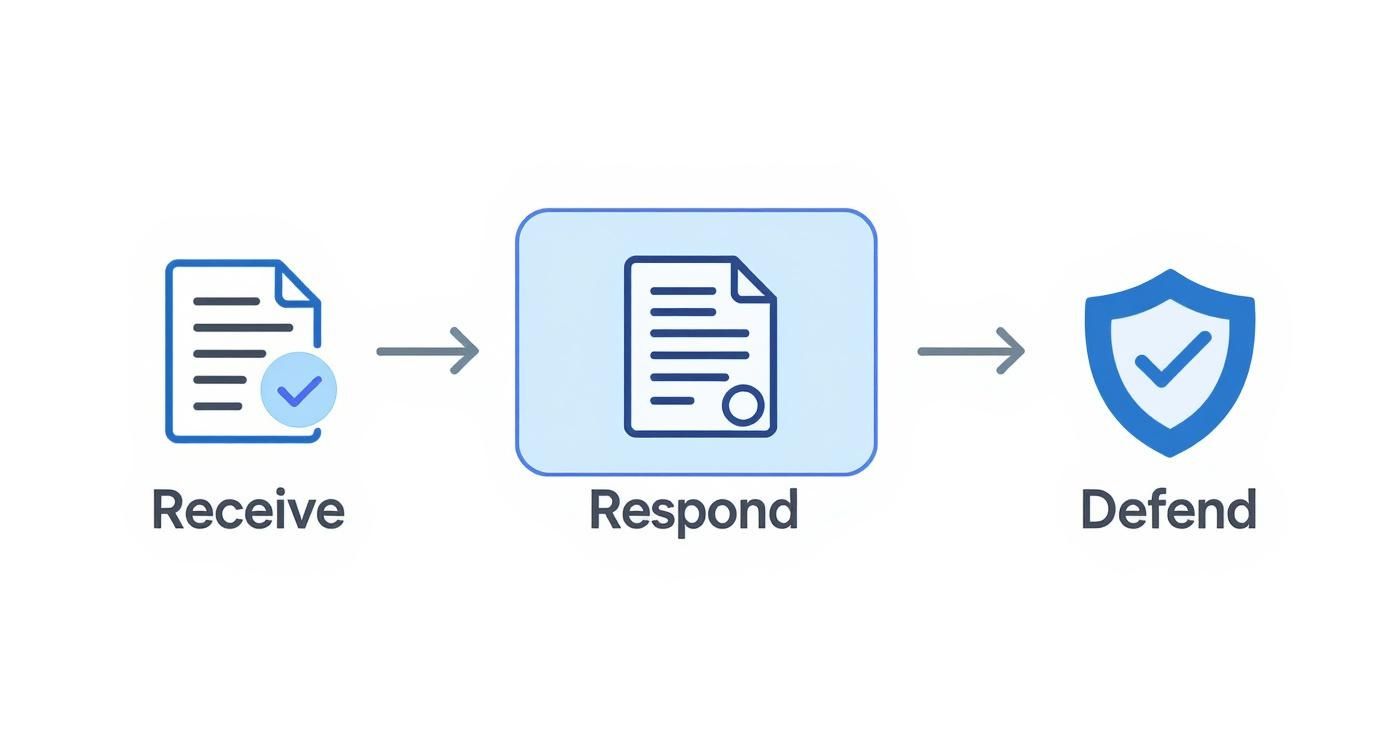
This workflow shows the defendant's position perfectly. Their role is almost entirely reactive, with every move being a response to an action taken by the plaintiff.
The stakes are also much higher. A civil defendant may have to pay money, but a criminal defendant faces penalties that can include fines, probation, and even prison time. In the United Kingdom, for instance, the number of defendants prosecuted in criminal court dropped by 15% between 2011 and 2024. For more serious crimes, the drop was an even sharper 38%, signaling a major shift in prosecutorial focus. You can review the data in this in-depth look at criminal justice trends.
To make these distinctions clearer, here’s a direct comparison of the two systems.
Civil vs Criminal Court: A Comparison of Roles and Standards
| Aspect | Civil Case (e.g., Personal Injury) | Criminal Case |
|---|---|---|
| Who is the Plaintiff? | The injured individual or entity (e.g., a car accident victim) | The government (state or federal prosecutor) |
| What is the Goal? | To recover financial compensation ("damages") for a loss | To punish the offender for a crime against society |
| Burden of Proof | "Preponderance of the evidence" (more likely than not) | "Beyond a reasonable doubt" (highest legal standard) |
| Typical Outcome | Defendant pays damages or is found not liable | Defendant is found guilty or not guilty (acquitted) |
| Potential Penalties | Financial compensation, court orders (injunctions) | Fines, probation, community service, imprisonment |
This table highlights the fundamental differences in purpose, standards, and consequences between the two court systems.
Different Burdens of Proof
The most meaningful difference might be the burden of proof—the amount of evidence needed for one side to win.
In civil court, the plaintiff must prove their case by a "preponderance of the evidence." This standard just means it's more likely than not (think a 50.1% chance) that the defendant is responsible for the harm.
Criminal court is a much tougher arena for the prosecution. The government must prove the defendant’s guilt "beyond a reasonable doubt." This is the highest standard in American law for a reason: someone's freedom is on the line.
This is exactly why a defendant can be acquitted in a criminal trial but still be found liable for the very same act in a civil lawsuit. The dispute between a defendant vs plaintiff is judged by two completely different yardsticks.
Understanding the Financial Side of a Lawsuit
Beyond the legal arguments, the financial realities of a lawsuit heavily influence the dynamic between a defendant vs plaintiff. Every case brings with it significant economic pressures that can shape strategy from day one, and for an injured person in Atlanta, these factors are impossible to ignore.
A plaintiff in a personal injury case usually gets legal help through a contingency fee agreement. This arrangement means you only pay attorney fees if you win your case. Still, plaintiffs are often responsible for litigation costs like court filing fees or fees for expert witness testimony, which can add up over time.
The Defendant's Financial Exposure
A defendant’s financial picture looks quite different. The costs are immediate, starting with the need to hire an attorney who typically bills by the hour. Those expenses start ticking the moment a lawsuit is served and don’t stop until the case is resolved.
The biggest financial risk for a defendant, of course, is a large judgment against them if the plaintiff prevails. This is where insurance plays a key role. In most personal injury claims, like a car wreck, the defendant's insurance carrier steps in to provide a legal defense and cover any settlement or judgment, but only up to the policy's limits.
The economic weight of lawsuits in the U.S. is immense. The American tort system, which handles personal injury disputes, costs the economy roughly $529 billion a year as of 2022. That breaks down to an average burden of over $4,200 per U.S. household annually.
How Costs Influence Legal Strategy
Financial pressure affects decisions on both sides of the aisle. An injured plaintiff might feel compelled to accept a lower settlement offer to avoid the mounting costs and long delays of a full-blown trial. This is especially true given that Georgia law imposes strict deadlines. You can learn more about the statute of limitations for personal injury in GA and see just why timing is so important.
On the other side, a defendant and their insurance company constantly weigh the ongoing cost of legal defense against the risk of a much larger jury verdict. This cost-benefit analysis is what drives settlement negotiations, pushing both parties toward a middle ground to avoid the expense and uncertainty of trial. In the end, the financial story of a lawsuit is just as compelling as the legal one, shaping every move in the dispute between a defendant vs plaintiff.
First Steps to Take After an Injury in Atlanta

The moments after an accident in Atlanta are often confusing and overwhelming. Yet, the actions you take immediately are important for both your physical recovery and protecting your legal rights.
How you handle these first few hours can lay the foundation for a successful personal injury claim, especially if you find yourself in the legal system where the roles of defendant vs plaintiff become your new reality.
Your absolute first priority is your health. Seek immediate medical attention, even if you think your injuries are minor. Adrenaline can mask serious conditions like concussions or internal damage that only a doctor can diagnose. A professional medical evaluation creates an official record that directly links your injuries to the accident.
Document Everything You Can
Once you've addressed your immediate medical needs, shift your focus to gathering evidence. This information is the bedrock of any future claim you might file.
- Take Photos and Videos: Use your phone to document the entire scene. Capture damage to all vehicles or property, any visible injuries you have, and the surrounding environment—things like traffic lights, stop signs, or slick floors.
- Get Witness Information: If anyone saw what happened, get their name and phone number. An impartial account from a third party can be incredibly powerful.
- Keep Detailed Records: Start a dedicated folder for everything related to the incident. This includes the police accident report, medical bills, and receipts for out-of-pocket expenses. We also strongly advise keeping a simple journal to track your symptoms and how the injuries are affecting your daily life.
Understand Your Legal Options
Knowing your legal standing under Georgia law is one of the most important first steps you can take. The legal process has many parts, and it’s easy to make a mistake that could jeopardize your case. For many people, this means learning about finding personal injury attorneys who can guide them.
Consulting with an experienced personal injury lawyer helps bring clarity to an otherwise chaotic situation. An attorney can review the evidence you’ve collected, explain the distinct roles of the defendant vs plaintiff, and give you a straightforward assessment of whether you have a viable case. This initial guidance empowers you to make informed decisions when it matters most.
Common Questions About Legal Roles
When you're dealing with the legal system, just figuring out the basic terms like defendant vs plaintiff can feel like a lot. Here are some straightforward answers to the questions we hear most often from people trying to get their bearings after an injury in Atlanta.
Can a Person Be Both a Plaintiff and a Defendant?
Yes, and it happens more often than you might think. This is done through a legal move called a counterclaim.
Here's how it works: if someone (the plaintiff) sues you (the defendant), you have the right to sue them back within that same lawsuit. When you do that, the original plaintiff also becomes a "counter-defendant," and you, the original defendant, are now a "counter-plaintiff." For more on this, you can check out information on civil procedure rules, such as those explained by the Legal Information Institute at Cornell Law School.
Who Decides Who is the Plaintiff and Who is the Defendant?
The roles are set from the very beginning. The person who starts the lawsuit by filing an official complaint with the court is the plaintiff.
Whoever they file that complaint against is automatically the defendant. It all comes down to who makes the first move.
Does the Defendant Have to Prove They Are Innocent?
No, not in a civil lawsuit. The legal responsibility, what we call the burden of proof, falls squarely on the plaintiff.
The plaintiff's job is to present enough evidence to convince a judge or jury that their claim is valid. The defendant’s main role is to poke holes in that evidence and build their own defense—not to prove their innocence from scratch.
It's useful to remember that in a personal injury case, the plaintiff only has to show it's "more likely than not" that the defendant was at fault. This standard is much lower than the "beyond a reasonable doubt" required to convict someone in a criminal trial.
For legal professionals interested in the business side, understanding effective lead generation strategies for lawyers offers a look into how potential plaintiffs find and connect with the right attorneys in the first place.
Can a Case Be Settled Before a Trial?
Absolutely. In fact, the overwhelming majority of personal injury cases settle out of court. Trials are expensive, time-consuming, and unpredictable for everyone involved.
Both the plaintiff and the defendant (usually through their lawyers and insurance companies) can negotiate a settlement at any point. Reaching an agreement avoids the risk and cost of letting a jury decide.
Knowing the difference between a defendant vs plaintiff is the first step toward protecting yourself after you've been hurt.
If you've been injured and aren't sure what to do next, our team at Jamie Ballard Law is here to help you understand your legal options with a free case evaluation. We're available 24/7 to provide the guidance you need. https://jamieballardlaw.com