When a property owner's carelessness leads to your injury, a premise liability settlement is a formal agreement that provides compensation for your medical bills, lost wages, and pain and suffering, all without the need for a full trial. From my experience as an Atlanta Personal Injury attorney, I know how important it is to understand this process. This guide is here to provide helpful, straightforward information about how premise liability settlements work right here in Georgia.
What a Premise Liability Settlement Really Means for You
When you're hurt on someone else’s property, the law offers a path to hold the owner accountable for their negligence. The entire foundation of your claim is built on a legal concept called duty of care. This is simply the property owner’s legal obligation to keep their premises reasonably safe for others.
But here in Georgia, that responsibility isn't a one-size-fits-all rule. The level of care an owner owes you depends entirely on why you were on their property in the first place. Understanding this key distinction is the first and most important step in building a strong case.
Your Status on the Property Matters
Georgia law sorts visitors into three distinct categories. Each group is owed a different level of protection by the property owner, which directly shapes your ability to recover damages in a settlement.
This table gives a clear breakdown of how the law sees it.
Georgia Visitor Status and Property Owner Responsibilities
| Visitor Status | Definition | Property Owner's Duty of Care |
|---|---|---|
| Invitee | Someone on the property for the owner's benefit (e.g., a customer in a store). | The highest duty. Must inspect for hidden dangers and fix them or warn you. |
| Licensee | A social guest with permission to be on the property (e.g., a friend at a BBQ). | A lesser duty. Must warn of known dangers but no duty to inspect for unknown hazards. |
| Trespasser | Someone on the property without permission. | The lowest duty. The owner cannot willfully or wantonly injure them. |
Let's look at what this means in the real world:
-
Invitees: You're considered an invitee when you're on a property for the owner's commercial benefit. Think of shoppers in a mall, diners in a restaurant, or clients visiting an office. Owners owe invitees the highest duty of care. They have an active responsibility to inspect their property for hazards, fix them, or clearly warn you about them.
-
Licensees: A licensee is a social guest—a friend you invite over for dinner or a family member visiting your home. Here, the owner’s duty is to warn you of any dangers they already know about. They are not, however, required to go looking for hidden problems they aren't aware of.
-
Trespassers: A trespasser enters a property without any permission. In most cases, property owners owe no duty to keep a trespasser safe, with one major exception: they cannot intentionally injure them.
These legal terms might seem a bit academic, but they are the bedrock of your case. If you want simple definitions for these or other legal concepts, our legal dictionary provides clear, straightforward explanations.
Here's a simple way to think about it: A grocery store must regularly check for spills (for an invitee), but a homeowner doesn't have to constantly search their backyard for hidden risks before a friend comes over (for a licensee).
This difference is precisely why a slip and fall case in a Publix is handled differently than an injury at a friend's cookout. The law simply expects more from a business that invites the public onto its property to make money. Proving the property owner failed to meet their specific duty of care is the key to every successful premise liability settlement.
The Four Elements of a Successful Claim
Just because you got hurt on someone else's property doesn't automatically qualify you for a settlement. To obtain premise liability settlements, you and your attorney have to prove four distinct elements.
Think of it like building a case with four essential pillars. If even one is weak, the entire claim can fall apart. These legal elements—Duty, Breach, Causation, and Damages—are the foundation we use to prove the property owner is legally responsible for your injuries.
Element 1: Duty of Care
First, we have to establish that the property owner owed you a legal duty of care. This is a formal way of saying they had a responsibility to keep you reasonably safe.
As we covered earlier, Georgia law defines that duty based on your status as an invitee, licensee, or trespasser. In most slip and fall cases, you're an invitee—a customer in a store, for instance. A Kroger in Atlanta has a clear duty to shoppers to look for spills, fix broken shelves, and put out warning signs. This duty is the legal starting point.
Element 2: Breach of Duty
Next, we prove the owner breached that duty. This is the "negligence" part. A breach happens when the owner knew about a hazard—or should have known about it—and failed to take reasonable steps to fix it or warn people.
Common examples of a breach include:
- Not cleaning up a spill for an unreasonable amount of time.
- Failing to repair a loose handrail on a staircase.
- Ignoring a patch of ice forming on a walkway without salting it.
- Keeping a parking garage so poorly lit that tripping hazards are hidden.
Proving a breach often comes down to evidence. We look for security footage, maintenance records, and witness testimony to show the hazard was there long enough for a responsible owner to have found and addressed it.
Element 3: Causation
The third pillar is causation. This is where we draw a direct line from the owner's breach to your injury. It’s not enough to show a hazard existed and you were hurt. You must prove the specific hazard caused the injury.
We use what's called the "but for" test: "but for" the owner's negligence, the injury would not have happened.
For instance, if you slipped on an unmarked puddle of oil in a Jiffy Lube (the breach), we must show that specific fall is what caused your broken wrist. Medical records created immediately after the incident are so important here. Insurance adjusters love to argue an injury was pre-existing, so connecting the incident directly to the harm is non-negotiable.
Element 4: Damages
Finally, you must show you suffered actual damages. These are real, measurable losses resulting from the injury. Without damages, there’s legally nothing to compensate you for.
Damages are the quantifiable costs of your injury, both economic and non-economic. They are the reason you are seeking a settlement in the first place.
These losses are tallied up and include things like:
- Medical Bills: The ambulance ride, ER visit, surgery, physical therapy, and prescriptions.
- Lost Wages: All the income you couldn't earn while you were out of work recovering.
- Future Lost Income: If the injury is severe enough to impact your long-term ability to work.
- Pain and Suffering: Compensation for the physical pain and emotional trauma you've been forced to endure.
To secure a fair settlement, all four of these elements must be proven with clear, compelling evidence.
How Your Settlement Amount Is Calculated
One of the first questions I hear from clients is, "What is my claim actually worth?" When it comes to premise liability settlements, there's no magic formula or online calculator that spits out an answer. The true value of your case is built, piece by piece, by analyzing the key factors that tell the full story of your losses.
Think of it like building a house. You don't just guess the final price. You have to add up the cost of the foundation, the framing, the plumbing, and every other detail. In the same way, your settlement is the sum of all your damages—both the ones with clear price tags and those that are much harder to put a number on.
The Foundation: Economic Damages
The most straightforward part of any claim starts with your economic damages. These are the tangible, out-of-pocket financial losses you’ve suffered because of the injury.
We start by gathering every single bill, receipt, and pay stub related to the incident. These documents form the concrete financial base of your claim and are essential for proving exactly what this injury has cost you.
Common economic damages include:
- Medical Treatment Costs: This covers everything from the ambulance ride and ER visit to surgeries, hospital stays, prescriptions, and physical therapy.
- Future Medical Needs: If your injury requires long-term care—like future surgeries, ongoing pain management, or assistive devices—we work with medical experts to project those costs over your lifetime.
- Lost Wages: This is the income you lost while you were unable to work. We document this with pay stubs and employment records to show what you should have earned.
- Loss of Earning Capacity: If your injury is permanent and stops you from returning to your old job or working at the same level, this compensates you for the future income you'll no longer be able to make.
- Property Damage: Sometimes a premises liability incident also involves property damage. For instance, if a dangerously maintained tree falls on your property, specialized expertise like that used in tree appraisals might be necessary to calculate the true value of the loss.
Valuing Your Pain and Suffering
Beyond the stack of bills, a major part of your settlement is for non-economic damages, most often called pain and suffering. This is compensation for the human cost of your injury—the physical pain, the emotional distress, and the sheer disruption to your life.
Calculating this is more of an art than a science. There’s no invoice for anxiety or a receipt for sleepless nights. Insurance adjusters often use a "multiplier" method. They take the total of your medical bills and multiply it by a number, typically between 1.5 and 5, based on the severity of your injuries.
For example, a minor sprain that heals quickly might get a 1.5x multiplier. But a severe injury requiring multiple surgeries and causing permanent limitations could easily justify a 4x or 5x multiplier.
Other Major Factors That Shape Your Settlement
The final settlement amount doesn't just come down to your damages. Several other elements can significantly raise or lower the value of your claim.
Strength of Evidence
How clearly can you prove the property owner was negligent? Strong evidence—like security footage of a spill that was ignored, maintenance logs showing a known hazard wasn't fixed, or multiple witness statements—gives you massive leverage in negotiations. Weak or disputed evidence will almost always result in a lower settlement offer.
Insurance Policy Limits
A property owner's liability is nearly always paid by their insurance policy. A homeowner might have a $300,000 policy, while a large commercial property like a mall could have a policy worth millions. That policy limit often acts as a practical cap on what you can recover in a settlement.
Your Own Degree of Fault
Under Georgia's modified comparative negligence rule, your settlement can be reduced if you are found partially at fault for your injury. If you are found to be 49% or less at fault, your final award is reduced by that percentage. But if a jury decides you were 50% or more responsible, you are barred from recovering any damages at all. This rule is detailed in the Official Code of Georgia Annotated (O.C.G.A.) § 51-12-33.
Understanding all these moving parts is key to setting realistic expectations about the potential value of your premises liability settlement.
Typical Settlement Ranges for Injury Claims
If you've been hurt on someone else's property, one of the first questions you'll have is, "What is my case worth?" It's a fair question, and while no lawyer can give you a precise number upfront, we can look at common ranges to set realistic expectations.
Think of it this way: a sprained ankle from a slip and fall that heals in a few weeks is worlds apart from a permanent disability caused by a collapsing staircase. The final figure in a premise liability settlement hinges entirely on the unique facts of your case.
The type of property where the injury happened also makes a huge difference. An accident at a friend's house is handled very differently from one at a big-box store like Target or Home Depot, mostly due to different legal standards and, importantly, much larger insurance policies.
How the Property Type Influences the Settlement
Commercial properties—malls, grocery stores, hotels—are legally held to a high standard of care. They invite the public onto their premises to make a profit, so they have a strong obligation to keep things safe. To cover that risk, they carry substantial insurance policies that can pay out significant claims.
Residential properties, like a private home or an apartment building, also have a duty to keep visitors safe, but their insurance coverage is typically much lower.
The numbers reflect this difference. Across the U.S., premises liability settlements show a wide spectrum:
- Residential Property Claims: Often settle in the $25,000 to $200,000 range.
- Commercial Property Claims: With stricter safety rules in play, settlements frequently land between $100,000 and $1.5 million.
- Government Property Claims: These cases can be more involved, but can sometimes exceed $2 million due to specific laws governing municipal liability.
Real-World Settlement Examples
Seeing how these factors work in practice helps connect the dots. These anonymized scenarios are based on real situations and show how different elements shape the outcome.
-
Minor Injury Case: A guest at a friend’s house trips on a bunched-up rug, sprains their wrist, and has to miss a week of work. The medical bills are around $5,000 and lost wages are $1,000. Here, a fair settlement might fall in the $15,000 to $25,000 range to cover those economic losses plus some compensation for their pain and inconvenience.
-
Moderate Injury Case: A shopper in a grocery store slips on a puddle from a leaking freezer that was ignored for over an hour. There was no "wet floor" sign. The fall causes a herniated disc that requires painful injections and months of physical therapy. With medical bills hitting $45,000 and a clear case of negligence, the settlement could be between $100,000 and $250,000.
-
Severe Injury Case: A tenant in an apartment complex falls down a dangerously unlit staircase with a broken railing, suffering a traumatic brain injury (TBI). The injury permanently affects their ability to work and live independently. Because the injury is life-altering and the landlord's negligence is obvious, a settlement could easily reach $1 million or more to account for a lifetime of medical care and lost earning capacity.
The pattern is clear: the more devastating the injury and the more obvious the property owner's fault, the higher the settlement value. You can also see what this journey is like for real people by reading some of our personal injury testimonials.
The Path from Your Injury to a Settlement Check
It helps to know what’s coming. Understanding the steps involved in a premises liability claim can make the whole process feel less overwhelming. The journey from the moment you're hurt to receiving compensation follows a clear, structured path.
This roadmap will show you what to expect at each stage and clarify your options along the way. It all kicks off the instant an injury occurs. Your first priorities are always your health and safety—seek immediate medical attention and report the incident to the property manager or owner. After that, the formal claims process begins.
This visual breaks down the typical flow from injury to the successful resolution of your claim.
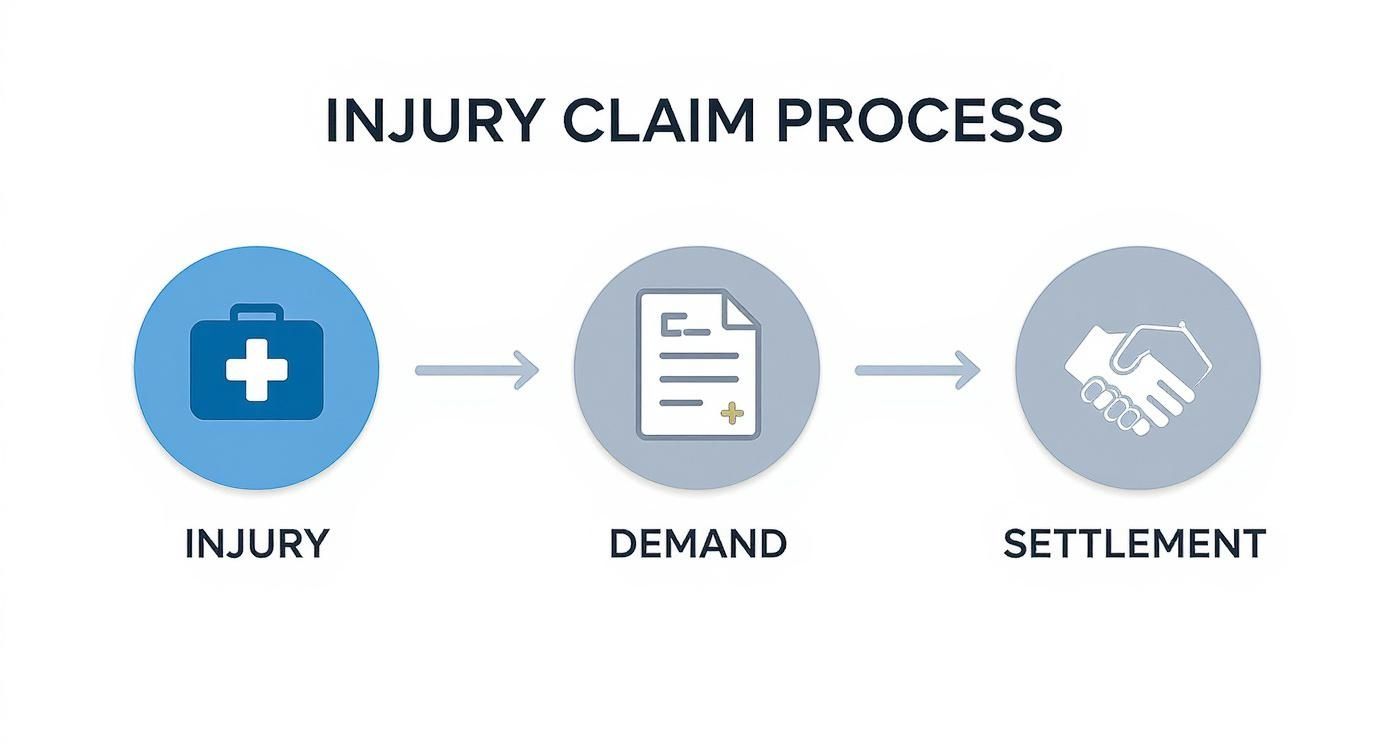
As you can see, each step builds on the last. It starts with the injury, moves to a formal demand for compensation, and aims for a final settlement. This progression is the standard for nearly every personal injury claim.
The Initial Steps After Your Injury
Once you’ve received medical care and reported the accident, the next move is to formally notify the property owner’s insurance company that you intend to file a claim. This is the official starting gun. The insurance company assigns an adjuster to your case, whose job is to investigate everything from their perspective.
During this investigation phase, it's all about gathering evidence. Key pieces include:
- Photographs and Videos: Pictures of the hazardous condition that caused your fall and photos of your injuries are incredibly powerful.
- Witness Statements: The contact information and account from anyone who saw the accident can back up your version of events.
- Incident Reports: Get a copy of the official report you filed with the property owner or manager.
- Medical Records: Keep a complete file of every doctor visit, treatment, and bill related to the injury.
This evidence is the backbone of your claim. It proves how the accident happened and documents the full extent of your damages.
Building Your Case and Making a Demand
After you have a clear picture of your total damages—including all medical bills and lost wages—it’s time to prepare a demand letter. This is a formal, detailed document sent to the insurance adjuster that lays out your entire case. It explains the legal basis for the claim, describes your injuries, and presents a full accounting of both your economic and non-economic damages.
The demand letter ends with a specific dollar amount you are seeking to settle the claim. This figure is the opening bid for negotiations.
The demand letter is your opening move. It tells the insurance company you are serious and presents a well-supported argument for why they owe you for your losses.
The insurance adjuster will review your demand and respond, almost always with a much lower counteroffer. Don't be alarmed; this is completely normal. It just marks the beginning of the back-and-forth negotiation process. The goal is to land on a fair number that adequately compensates you.
Negotiation and When to File a Lawsuit
Negotiations can take weeks, sometimes months. Your attorney will handle every phone call and email, presenting arguments and evidence to push back against the adjuster’s attempts to downplay your injuries or shift the blame.
It’s important to know that the vast majority of these cases resolve without ever stepping into a courtroom. Premises liability cases make up about 17% of all personal injury claims, and statistics show that approximately 96% of them settle out of court. Negotiation is the preferred path. That said, the defense has a 61% success rate for the small fraction of cases that go to trial. You can explore more liability insurance statistics to see these trends.
If the insurance company digs in its heels and refuses to make a reasonable offer, filing a lawsuit becomes a necessary strategic tool. Taking this step often motivates the insurer to get serious, as it signals you're prepared to take the case to a jury. Many premise liability settlements are reached even after a lawsuit is filed, but long before a trial date is ever set.
How an Attorney Strengthens Your Claim
Trying to take on a massive insurance company by yourself after an injury is an uphill battle. Their adjusters are skilled negotiators whose primary job is to protect their company's profits, which means minimizing what they pay you. This is where an experienced attorney completely changes the dynamic, fortifying your claim and fighting for fair premise liability settlements.
Think of your lawyer as your dedicated advocate. They take over the entire legal process so you can focus on healing. Right away, they launch a comprehensive investigation into the accident, working fast to secure crucial evidence before it vanishes. This often includes tracking down security camera footage, demanding maintenance and cleaning logs, and interviewing anyone who witnessed the incident.
Building a Case Backed by Experts
A huge part of an attorney's job is to calculate the true value of your claim, which is much more than just adding up your current medical bills. A serious injury can have financial consequences that last a lifetime.
To build a complete and undeniable picture of your losses, your lawyer will often bring in a team of trusted professionals:
- Medical Experts: To testify about how severe your injuries are and what future medical care, like surgeries or physical therapy, you will need.
- Vocational Experts: To determine how your injuries will affect your ability to work and earn a living, calculating your lost earning potential over your entire career.
- Financial Experts: To project the long-term costs of future care and other economic damages, making sure your settlement is enough to cover your needs for the rest of your life.
To effectively strengthen a claim, an attorney must master the ability to process and synthesize vast amounts of information, including thoroughly summarizing complex legal documents and research effectively.
Your Shield and Your Sword in Negotiations
Most importantly, your attorney takes over all communication with the insurance company. They handle the relentless phone calls and information requests, shielding you from the high-pressure tactics adjusters often use to push you into accepting a lowball offer.
Your lawyer will assemble a powerful demand package, loaded with hard evidence and expert analysis, and then negotiate aggressively on your behalf. This is more important than ever. Premises liability claims exist in a legal climate where jury awards are on the rise, sometimes leading to what the industry calls "nuclear verdicts." For instance, the average nuclear verdict in general liability cases—which includes premises liability—has recently climbed to a staggering $89 million. This trend has made insurance companies dig in their heels and defend claims even more fiercely.
An attorney isn't just a legal representative; they are your personal advocate who levels the playing field against powerful insurance corporations, ensuring your story is heard and your losses are fully valued.
Hiring a seasoned lawyer sends a clear signal: you are serious about receiving full and fair compensation. For a closer look at how an Atlanta premises liability lawyer can help with cases right here in Georgia, we have more detailed information available. Ultimately, professional representation is about making sure you get a just result.
Common Questions About Georgia Injury Claims
After a serious injury, your mind is probably racing with questions. It's completely normal. Below are some clear, direct answers to the most common concerns we hear from clients trying to understand premise liability settlements in Georgia.
How Long Do I Have to File an Injury Claim in Georgia?
This is one of the most important rules in any personal injury case. In Georgia, the statute of limitations for most claims is two years from the date the injury occurred.
Let me be clear: this is a hard deadline. If you miss that two-year window, the court will almost certainly throw out your case. You lose your right to seek compensation forever, no matter how strong your claim is. This is why acting quickly is so important.
For a more detailed breakdown, you can learn more about Georgia's statute of limitations for personal injury and the specific exceptions that might apply.
What if I Was Partially at Fault for My Accident?
This question comes up all the time. The good news is that Georgia law accounts for this situation with a rule called "modified comparative negligence." The law, officially known as O.C.G.A. § 51-12-33, allows you to recover damages as long as you are found to be less than 50% responsible for what happened.
Your final compensation is simply reduced by whatever percentage of fault is assigned to you.
Here’s a simple example: Imagine your total damages are calculated at $100,000, but a jury decides you were 20% at fault—maybe you were looking down at your phone when you slipped. Your recovery would be cut by 20%, leaving you with $80,000. But if you are found 50% or more responsible, you can’t recover a dime.
Do Most Injury Claims Go to Court?
No, not at all. In fact, the opposite is true. Well over 90% of all personal injury cases, premises liability claims included, are settled out of court.
The settlement happens through skilled negotiations between your attorney and the property owner’s insurance company. Filing a lawsuit is often a necessary strategic move to show the other side you’re serious and to gain access to key evidence through the "discovery" process. Many cases settle even after a lawsuit is filed, but long before anyone ever steps foot in a courtroom for a trial. This saves everyone the stress, time, and expense of a full-blown court battle while still achieving fair premise liability settlements.
At Jamie Ballard Law, our job is to provide the clear answers and dedicated legal support you need to move forward. If you’ve been injured and have more questions, don’t hesitate to reach out for a free, no-obligation case evaluation. You can learn how we can help by visiting us at https://jamieballardlaw.com.