You've just been in a wreck. The stress is overwhelming. Then comes the gut punch: the other driver has no insurance, or not enough to cover your injuries. This scenario is exactly why understanding uninsured motorist coverage in GA is so important.
It's a safety net you buy for yourself—one designed to step in and cover your losses when the person who caused the crash can't pay for the harm they've done. This is your personal protection plan.
What Is Uninsured Motorist Coverage?
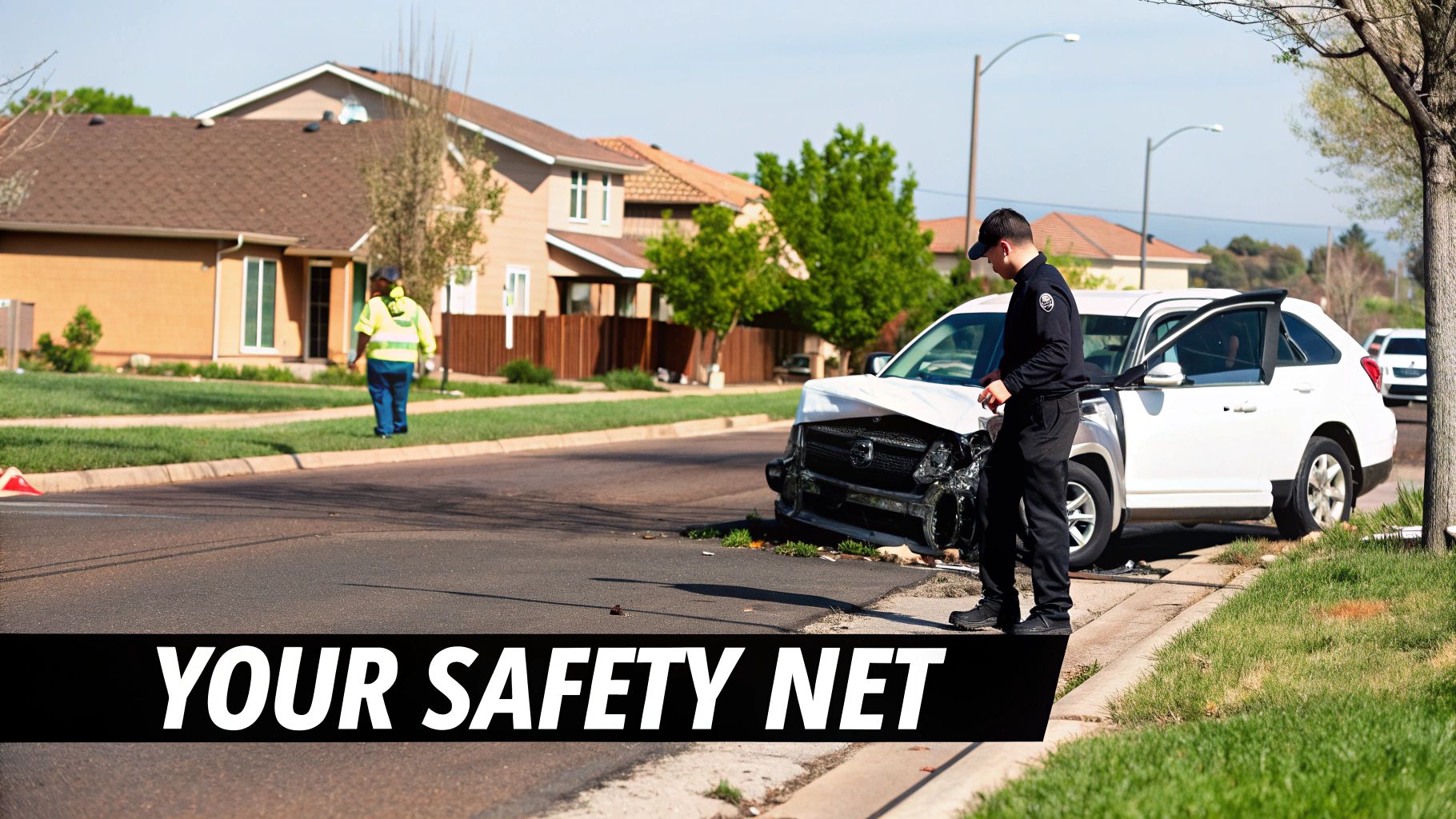
Think of Uninsured Motorist (UM) coverage as your personal financial shield. When you're hit by a driver with no liability insurance, insufficient coverage, or someone who flees the scene (a hit-and-run), this is the part of your own policy that protects you.
It’s not there to fix the other guy's car. It’s there to take care of you and your passengers. This coverage pays for the same damages you would have claimed from the at-fault driver's insurance if they had it, making it your primary defense against a financial disaster.
What It Covers
The protection UM coverage offers is broad, designed to make you whole again after an accident that wasn't your fault. Here’s a quick look at what it typically pays for:
- Medical Bills: Covers everything from the ambulance ride and ER visit to ongoing physical therapy, surgeries, and follow-up appointments.
- Lost Income: If your injuries keep you out of work, UM can reimburse you for the wages you lose while you recover.
- Pain and Suffering: This compensates you for the physical pain and emotional trauma caused by the collision, recognizing the impact on your quality of life.
Insurance policies are filled with specific terms. For a deeper dive into the language of insurance, our firm's legal dictionary is a great resource.
Two Main Types in Georgia
In Georgia, you'll generally be presented with two distinct UM options. Your choice here has a massive impact on how much money you can actually recover after an accident.
The two types are known as 'Add-On' and 'Reduced-By' (sometimes called non-stacking). While the names sound technical, the difference is simple: one gives you far more potential protection than the other.
'Add-On' coverage is almost always the better choice. It lets you stack your UM policy limit on top of whatever the at-fault driver's liability insurance pays. 'Reduced-By' coverage, on the other hand, is offset by any payment from the at-fault driver’s policy.
Making the right choice is fundamental. Having the right uninsured motorist coverage in GA means you’re prepared long before you ever need it.
Why Georgia Drivers Cannot Afford to Skip UM Coverage
It’s tempting to assume every driver on the road is as responsible as you are, but that’s a risky gamble here in Georgia. Adding uninsured motorist coverage in GA isn’t just an extra line item on your policy—it’s a necessary shield protecting you and your family from financial disaster.
Think about this scenario: You’re driving on I-75 when another driver causes a serious wreck. You quickly find out they have no insurance at all, or worse, only the bare minimum required by the state. In Georgia, that’s just $25,000 per person for bodily injury.
A single visit to the ER can eat up that amount in a heartbeat, let alone any follow-up surgeries or physical therapy. Once their tiny policy is exhausted, you’re stuck covering the rest of your medical bills and lost income out of your own pocket. This is precisely where your UM coverage kicks in to bridge that dangerous gap.
The Real Numbers on Georgia Roads
The number of uninsured drivers on our roads is higher than most people think. This isn't some distant possibility; it's a real and present danger every time you pull out of your driveway. Without the right protection, you are completely exposed.
This infographic breaks down the startling reality of how many uninsured drivers are out there, the accidents they cause, and how Georgia stacks up.

The data is clear: tens of thousands of crashes in Georgia involve uninsured drivers every single year. It’s not a matter of if you’ll encounter one, but when.
The Florida Factor and Other Risks
Georgia’s role as a major travel hub creates unique problems. While roughly 12% of Georgia’s own drivers are uninsured, our interstates are flooded with traffic from neighboring states—including Florida, which has the unfortunate distinction of having the nation’s highest rate of uninsured drivers at nearly 27%, according to the Insurance Research Council.
This "Florida Factor" means the actual risk on highways like I-75 and I-95 is far greater than Georgia's statistics alone suggest.
Securing robust UM coverage is the only reliable way to protect your financial well-being from the actions of an irresponsible driver. It’s a shield you purchase for yourself when you cannot count on others.
This coverage isn't just for when you're driving your own car. It typically follows you, protecting you as a passenger in someone else's vehicle or even as a pedestrian if you’re hit by an uninsured driver. If you'd like to dig deeper, you can explore general auto insurance topics and get more car-related insights.
Ultimately, your ability to recover after a crash shouldn't hinge on the other driver's insurance choices. By securing the right uninsured motorist coverage in GA, you take back control, guaranteeing you have a path to recovery no matter who caused the accident.
Choosing Between Add-On and Reduced-By Coverage

When you buy car insurance in Georgia, your agent will ask you to make a choice about your uninsured motorist (UM) coverage. It might seem like a small detail buried in the paperwork, but your answer has massive financial implications if you’re ever in a wreck.
You’ll have to select either "Add-On" or "Reduced-By" UM coverage. These two options sound similar, but they operate in completely different ways. One acts as a true safety net, while the other can leave you with far less money than you think you’re paying for.
How Add-On Coverage Works
Think of "Add-On" coverage as stacking your protection. It allows you to add the full amount of your UM coverage right on top of whatever the at-fault driver’s insurance pays out. This is the gold standard and the option we always recommend.
Let's walk through a quick example:
- You’re in a serious crash, and your total damages (medical bills, lost wages, etc.) come to $100,000.
- The driver who hit you only has Georgia’s minimum liability coverage of $25,000.
- Fortunately, you have $100,000 in "Add-On" UM coverage.
With this policy, you would first collect the $25,000 from the at-fault driver's insurance. Then, you can turn to your own insurance company and claim up to $75,000 from your UM policy to cover the rest. You get a total of $100,000 and are made whole.
Understanding Reduced-By Coverage
"Reduced-By" coverage is a different story, and the name says it all. Your available UM coverage is reduced by whatever the at-fault driver's insurance pays. It’s a non-stacking policy, meaning you can't just add one policy on top of the other.
Under a "Reduced-By" policy, your UM coverage only pays the difference between your policy limit and the at-fault driver’s liability limit. This can sometimes mean you get nothing at all from your own UM policy.
Let’s use the same accident scenario, but this time with a "Reduced-By" policy.
- Your damages are still $100,000.
- The at-fault driver's policy pays out its $25,000 limit.
- You have $100,000 in "Reduced-By" UM coverage.
To figure out your potential UM payout, your insurer subtracts the at-fault driver's payment ($25,000) from your UM limit ($100,000). The most you can now get from your own policy is $75,000.
Now, consider a truly dangerous scenario. What if you only had $25,000 in "Reduced-By" coverage? After the other driver's $25,000 payment, your available UM coverage would be reduced to $0. You’d get nothing from the policy you’ve been paying for, even if your damages were much higher.
How Add-On vs. Reduced-By UM Coverage Compares
The difference becomes crystal clear when you see the numbers side-by-side. Let’s stick with our example where your total damages are $100,000 and the at-fault driver has a $25,000 policy.
| Scenario Detail | Payout With 'Add-On' Coverage | Payout With 'Reduced-By' Coverage |
|---|---|---|
| Your UM Policy Limit | $100,000 | $100,000 |
| Payment from At-Fault Driver | $25,000 | $25,000 |
| Max Payment from Your UM Policy | $75,000 (stacks on top) | $75,000 (pays the difference) |
| Your Total Potential Recovery | $100,000 | $100,000 |
| What if your UM Limit was only $25k? | Your UM pays $25,000 | Your UM pays $0 |
As the table shows, the real danger of "Reduced-By" coverage appears when your UM limits are close to the at-fault driver's limits. It can render your own coverage worthless.
Why The Choice Matters
Under Georgia law, Add-On coverage is the default. You must actively reject it in writing to get the lesser "Reduced-By" option. While a "Reduced-By" policy might save you a few dollars on your premium, the financial risk is enormous.
That tiny bit of savings isn't worth it when a serious accident can leave you with tens of thousands of dollars in uncovered medical bills. You can find more details on state requirements at the Georgia Office of Commissioner of Insurance and Safety Fire.
Choosing "Add-On" is the single best step you can take to build strong uninsured motorist coverage in GA and protect your family's financial future.
What Uninsured Motorist Coverage Actually Pays For
After a wreck, the bills start arriving with shocking speed. When the at-fault driver has no insurance, panic can easily set in. This is the exact moment your own policy's uninsured motorist coverage in GA is supposed to step in and act as the financial backstop you need. A lot of people think it just covers hospital bills, but its reach is far broader than that.
Essentially, your UM coverage is designed to pay for the same damages you could have legally recovered from the at-fault driver if they’d had proper insurance. It's built to help you get back on your feet financially after a crash you didn't cause. This means it goes well beyond the immediate medical costs to cover the full spectrum of losses you’ve suffered.
Covering Your Medical Expenses
This is the most obvious and immediate need. Your UM coverage can reimburse you for a wide range of medical costs stemming from the accident. This protection is designed to be thorough, ensuring your physical recovery isn't derailed by financial worries.
- Emergency Services: This covers the initial ambulance ride from the scene and the emergency room visit.
- Hospital Stays: If your injuries are serious enough to require admission, UM can cover the costs of your stay, including surgeries or other procedures.
- Ongoing Treatment: Recovery is often a long road. Coverage can extend to follow-up doctor's appointments, physical therapy, rehabilitation, and even necessary prescription medications.
Reimbursing Your Lost Wages
A serious injury almost always means time away from work. While you’re focused on healing, your regular income disappears, but the household bills don't. Uninsured motorist coverage directly addresses this financial squeeze.
It can pay for the income you lose while you are unable to perform your job. This isn't just your base salary; it can also cover lost overtime opportunities or commissions you would have otherwise earned. This part of the coverage is key to keeping your family financially stable during a difficult recovery.
The goal of UM coverage is to prevent an irresponsible driver's actions from causing a financial crisis for your family. It replaces the protection that the at-fault driver failed to carry.
Compensation for Pain and Suffering
Not all harm is visible or easily calculated on a receipt. A car accident causes real physical pain, emotional distress, and a major disruption to your life. Georgia law recognizes these non-economic damages, and your UM policy is there to cover them.
This compensation is for the human cost of the collision—the physical pain of your injuries, the mental anguish, and the loss of enjoyment of life. Understanding the full scope of what you can claim is a major part of the personal injury claims process in Georgia.
Handling Vehicle Repairs with UMPD
Finally, your policy might include Uninsured Motorist Property Damage (UMPD). This is specifically for fixing or replacing your vehicle if you don't have collision coverage. If the at-fault driver has no insurance to pay for your car's repairs, UMPD can step in.
When your policy pays out for vehicle damage, discussions about the types of parts used—specifically original equipment manufacturer (OEM) versus aftermarket—can come up. For a more detailed look, you might find this information on OEM vs. Aftermarket Parts for auto repairs to be a useful resource.
From medical care to lost income and vehicle repairs, a strong policy for uninsured motorist coverage in GA provides the complete protection you deserve.
Steps for Filing a UM Claim in Georgia

Knowing you have uninsured motorist coverage in GA is one thing. Knowing how to actually use it when you're hurt is something else entirely. After the shock of a crash with an uninsured driver or a hit-and-run, the steps you take right away can make or break your ability to get compensated.
Following a clear plan can bring some much-needed order to a chaotic and stressful situation. The process starts the moment the accident happens. While your safety is always priority one, properly documenting the incident from the get-go lays the foundation for a successful UM claim.
Immediate Actions at the Scene
The first moments after a wreck are disorienting, but a few key actions are absolutely essential. These steps preserve the evidence and create the official record you'll need for your claim.
- Call 911 Immediately. This is non-negotiable. An officer will come to the scene and create an official police report—a key piece of evidence that documents the crash, identifies the parties (if they're still there), and often gives an initial assessment of fault.
- Gather Information. If the other driver did stop, get their name, address, and whatever insurance information they give you, even if you suspect it's invalid. Use your phone to snap a quick picture of their driver's license and license plate.
- Document Everything. Take photos and videos of the entire scene. Get shots of the vehicle positions, the damage to both cars, any skid marks on the road, and relevant traffic signs or signals. You can't have too many photos.
- Look for Witnesses. If anyone saw what happened, ask for their name and phone number. An independent witness can be incredibly valuable, especially in a hit-and-run case where it's your word against nobody.
Notifying Your Insurance Company
Once you're safe, you must report the accident to your own insurance company as soon as you can. Nearly every policy has a strict deadline for reporting a claim, and if you miss it, you could lose your right to coverage.
When you call, state clearly that you were hit by a driver you believe is uninsured or that it was a hit-and-run. This is the trigger that opens an Uninsured Motorist (UM) claim under your policy. Be ready with the date, time, and location of the crash, and have the police report number handy if you've got it. You can learn more about the claims process in our guide on how to file a car accident claim in Atlanta.
Remember, when you file a UM claim, your own insurance company essentially steps into the shoes of the at-fault driver's insurer. While they are your insurer, their goal is still to minimize their payout, making thorough documentation essential.
The 'John Doe' Lawsuit for Hit-and-Run Accidents
A hit-and-run crash presents a unique problem: the at-fault driver is a ghost. To access your UM benefits in this scenario, Georgia law requires a specific legal maneuver. You have to file what's known as a "John Doe" lawsuit.
This is a formal lawsuit filed against the anonymous, at-fault driver. It might sound strange, but filing this action is a legal prerequisite that allows your insurance company to move forward with your UM claim. It legally establishes that you're seeking damages from an unknown party—the exact situation your UM coverage was designed for.
The details of this process are incredibly specific, and it's an area where having experienced legal guidance is invaluable. Properly filing your claim is the only way to secure the benefits you've been paying for with your uninsured motorist coverage in GA.
Common Questions About UM Coverage in Georgia
When you're trying to understand your auto insurance policy, the details are everything. We often get specific questions from clients about how their coverage works in the real world, especially when it comes to uninsured motorist coverage in GA. Here are some straightforward answers to the questions we hear most often.
Will Filing a UM Claim Make My Insurance Rates Go Up?
This is probably the number one concern people have. Thankfully, the answer is almost always no.
Under Georgia law (O.C.G.A. § 33-9-40), your insurance company is prohibited from raising your premiums or canceling your policy for an accident that wasn't your fault. A UM claim, by definition, is for a crash caused by another driver—one who was uninsured, underinsured, or fled the scene.
You have a right to use the benefits you've paid for to protect yourself financially. You shouldn't be penalized for someone else's mistake.
If I Have Health Insurance, Do I Still Need UM Coverage?
Yes, absolutely. This is a vital point that’s often misunderstood. While good health insurance is essential, it's not a substitute for Uninsured Motorist coverage because it only solves part of the problem.
Health insurance helps pay your medical bills, but it does nothing for the other major financial losses that come with a serious car accident.
- Lost Wages: Health insurance won't reimburse you for the income you lose when your injuries keep you from working.
- Pain and Suffering: It offers zero compensation for the physical pain, emotional distress, or disruption the crash causes in your life.
- Deductibles and Copays: You’re still on the hook for your health plan's deductibles and copays, which can easily run into thousands of dollars. UM coverage can help cover these out-of-pocket costs.
Think of UM coverage as the complete financial recovery tool. It fills the significant gaps that health insurance leaves behind.
What Is the Difference Between Uninsured and Underinsured Motorist Coverage?
In Georgia, these two protections are usually bundled together into one line item on your policy, often listed as UM/UIM. Though they work together, they apply to slightly different scenarios.
Uninsured Motorist (UM) Coverage: This kicks in when the at-fault driver has no insurance at all or when you’re the victim of a hit-and-run.
Underinsured Motorist (UIM) Coverage: This applies when the at-fault driver does have insurance, but their policy limits are too low to cover all of your damages.
For example, say you have $150,000 in damages, but the at-fault driver only has the state minimum $25,000 liability policy. Your UIM coverage can step in to pay the remaining $125,000, assuming you have enough "Add-On" coverage. They are two sides of the same protective coin.
How Much UM Coverage Should I Buy?
Georgia law requires insurers to offer you UM coverage, but the amount you choose is up to you. While drivers must carry at least $25,000 per person and $50,000 per accident for bodily injury, that’s not enough.
Roughly 12% of drivers in Georgia are completely uninsured, and many more carry only these bare-minimum limits—which are exhausted almost instantly in a serious crash. You can find more official details from the Georgia Department of Insurance.
Most legal and financial experts recommend buying as much UM coverage as you can reasonably afford. A great rule of thumb is to match your UM limits to your own liability coverage limits. If you have $250,000/$500,000 in liability protection for others, you should have the same amount of protection for yourself. The small increase in your premium provides an enormous amount of financial security.
Does UM Cover Property Damage to My Car?
Sometimes. In Georgia, you can buy Uninsured Motorist Property Damage (UMPD) coverage. It’s an optional add-on that helps pay to repair your vehicle if an uninsured driver hits you.
However, there are a few things to know:
- It usually has its own deductible, often around $250, $500, or $1,000.
- It is an alternative to collision coverage. If you already have collision coverage, you typically don’t need UMPD. Your collision policy will cover the repairs no matter who was at fault (though you’d still have to pay your collision deductible).
If you don't carry collision coverage, adding UMPD is a very inexpensive way to protect your vehicle from an uninsured driver.
Is There a Time Limit to File a UM Claim?
Yes, and the deadline is strict. In legal terms, this is known as the statute of limitations.
For most personal injury cases in Georgia, including those involving a UM claim, you have two years from the date of the accident to file a lawsuit. You can learn more by reading about the statute of limitations for personal injury in GA.
If you fail to either settle your claim or file a lawsuit within that two-year window, you will likely lose your right to recover compensation forever. That's why it's so important to act quickly after an accident. The clock starts ticking the moment the crash happens. Making sure you have adequate uninsured motorist coverage in GA is the first step, but taking timely action is just as vital.
If you've been injured in an accident and are struggling with an insurance claim, the team at Jamie Ballard Law is here to help. We offer a free, no-obligation case evaluation to discuss your situation and explain your options. Contact us today to get the support you need. https://jamieballardlaw.com