If you need a police report in Georgia, the first step is figuring out which law enforcement agency wrote it. This guide is designed to help you understand how to obtain records from police, a right you have under Georgia's Open Records Act. Getting a copy of the official report is a foundational step after an incident like a car crash or any other event requiring a police response.
Starting Your Police Record Request in Georgia
After any traffic incident, getting a copy of the official police report should be a top priority. This isn't just paperwork; it’s the basis for your insurance claim and any potential legal action. The report contains the officer’s objective findings, diagrams, witness statements, and other details that can make a huge difference in your case.
The single most important thing to do is confirm which agency responded. Was it the Atlanta Police Department? The Fulton County Sheriff’s Office? Or maybe the Georgia State Patrol? Each one has its own specific process for records requests.
Identifying the Correct Agency
Think back to the scene. The officer’s uniform patch, the markings on their patrol car, or any paperwork they handed you will point you in the right direction. If you're still not sure, a quick call to the non-emergency line of a nearby department can usually get you sorted.
Knowing who holds the record is half the battle. Common agencies in the metro Atlanta area include:
- City Police Departments: Think Atlanta PD, Sandy Springs PD, or Marietta PD.
- County Sheriff's Offices: Such as those in Cobb, Gwinnett, or DeKalb counties.
- Georgia State Patrol (GSP): They typically handle incidents on state highways and interstates.
A common mistake I see is submitting a request to the wrong agency. It’s an easy error to make, but it will cause unnecessary delays. Always double-check the jurisdiction before you start.
Your Rights and Available Methods
Here in Georgia, your right to access these documents is protected by law. This local right reflects a broader, global push for transparency, though access to police records varies dramatically from place to place. California's Right to Know Act, for example, has made millions of pages on police use-of-force public through searchable databases. You can see how that groundbreaking Police Records Access Project highlights different approaches to public access.
Most Georgia agencies now offer several ways to request reports, making it far more convenient than it used to be. You can usually file online, mail in a form, or visit the records division in person.
To help clients with these and other legal matters, we've compiled a page of useful legal resources you might find beneficial.
The table below breaks down the most common methods for getting your hands on police records in Georgia.
Quick Guide to Requesting Police Records in Georgia
| Request Method | Best For | Typical Information Needed | Potential Cost |
|---|---|---|---|
| Online Portal | Fast, convenient access for standard accident reports. | Case number, date of incident, names of involved parties. | $5 – $15 per report. |
| Mail-In Form | When an online option isn't available or for more detailed requests. | Completed request form, copy of ID, payment (check/money order). | Varies, often a small administrative fee plus postage. |
| In-Person Visit | Getting the report immediately or if you have specific questions. | Case number, photo ID, and payment method. | Similar to online, typically a small fee per page. |
| Attorney Request | For serious injury cases or when dealing with uncooperative agencies. | All incident details; handled by your legal team. | Costs are typically covered as part of case expenses. |
Once you've identified the right department and chosen the best method, you're well on your way to obtaining the records you need.
Understanding the Georgia Open Records Act
When you need to get your hands on a police report in Georgia, your most important tool is the Georgia Open Records Act. This state law, officially cited as O.C.G.A. § 50-18-70, is built on a simple but powerful idea: government records are presumed to be public.
What does that mean for you? It means the law is on your side. You have a right to access these documents, and the burden falls on the government agency to prove a legal reason why they shouldn't give them to you. It's a fundamental guarantee of transparency that covers everything from local police departments to state agencies.
What Police Records Are Usually Public?
The law's reach is broad, but in my experience, most requests center on a few key documents. Knowing what you can—and should—ask for is the first step to a successful request.
Generally, you can get copies of:
- Accident Reports: These are the official crash reports filed after a car wreck. They are essential, containing details on the drivers involved, vehicle information, the location, and the officer’s initial findings.
- Incident Reports: This category covers nearly everything else, from a slip and fall on city property to a burglary. These reports provide a narrative of what happened, when it happened, and who was involved.
- Arrest Records: These documents confirm who was arrested, the specific charges filed against them, and the time and date of the arrest. They are almost always public unless a court has ordered them sealed.
The process for requesting these records under the Open Records Act follows a fairly straightforward path.
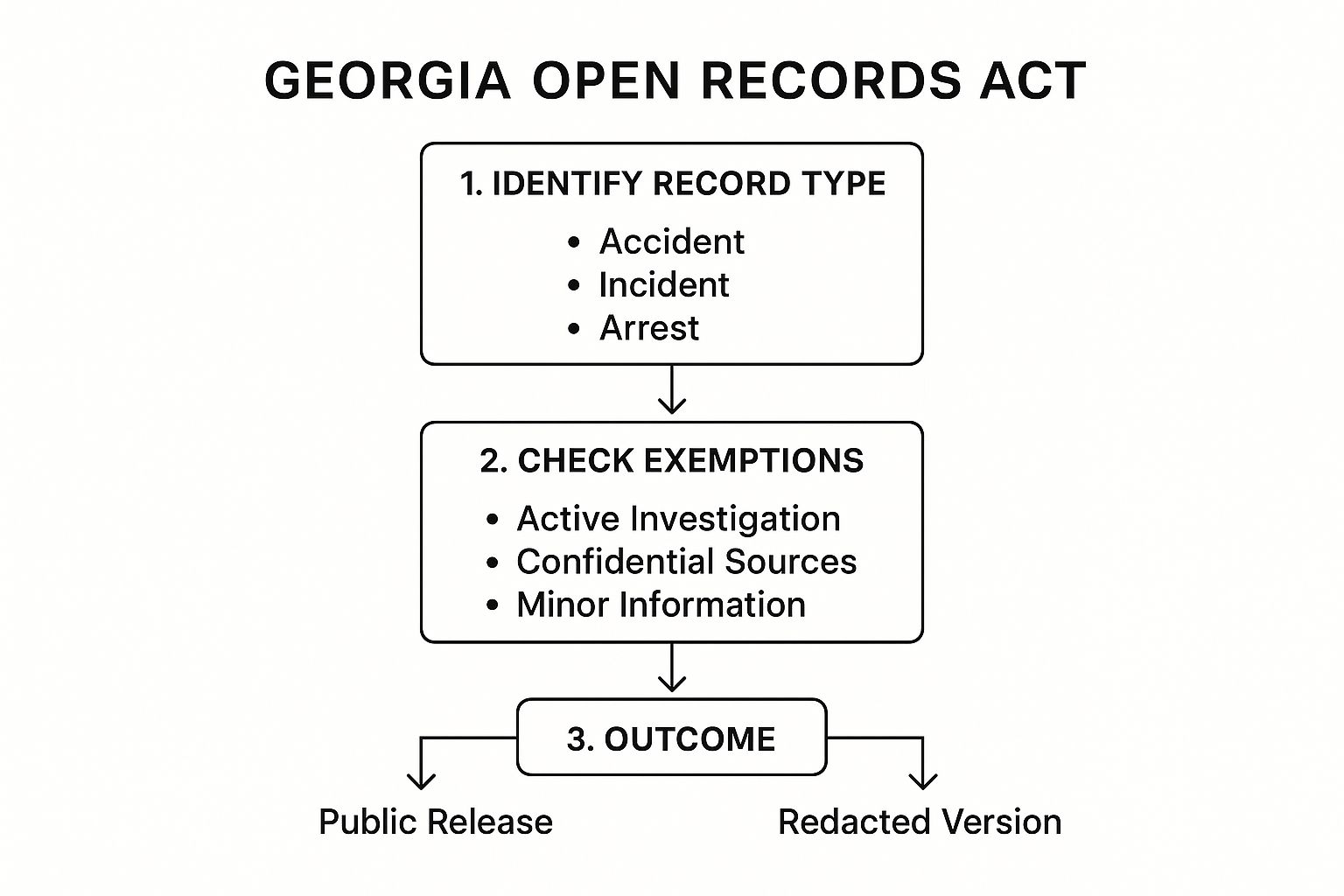
As the chart shows, the main question is whether a legal exemption applies. This determines if you'll get a complete copy of the record or one with certain information blacked out.
Why Some Information Gets Blacked Out
It can be frustrating to get a report back with black bars running through it. This is called redaction, and while it looks like secrecy, it's a required legal step to protect specific types of information exempted from disclosure under the Act.
Here are the most common reasons for redactions:
- Protecting an Active Investigation: This is the big one. If releasing a witness's name or a key detail could jeopardize an ongoing criminal case, it will be withheld.
- Confidential Informant Details: The identity of a confidential source is always protected to ensure their safety and encourage others to come forward.
- Information Involving Minors: To protect their privacy, the names and identifying details of juveniles are almost always removed from public records.
- Personal Privacy: Things like Social Security numbers, bank account details, or unlisted phone numbers are removed to prevent identity theft and privacy violations.
It's important to understand the difference between a redaction and a denial. A redacted report means the agency has complied with your request while following the law to protect sensitive data. A full denial means the agency believes the entire document is exempt from disclosure.
If you get a denial, the agency must provide a written explanation citing the specific legal exemption they are using. Knowing these rules helps you manage expectations and craft a request that is clear, specific, and more likely to be fulfilled quickly. For a deeper dive into the specific legal terms, our firm’s legal dictionary offers simple definitions that can clear up a lot of confusion.
How to Properly File Your Records Request
Now that you know the rules, let's get practical. Filing the request correctly from the very start can save you a ton of time and prevent the frustrating back-and-forth I see all too often.
Your goal is simple: give the records clerk everything they need to find your document on the first try. Whether you're sending an email or using an online portal, clarity is key. A vague request gets put at the bottom of the pile; a specific one gets results.
Assembling the Essential Information
Before you type a single word, pull together every detail you have. The more precise you are, the faster this whole process goes. Think of it as giving the clerk a map directly to your file.
At a bare minimum, your request should include:
- Case or Report Number: This is the golden ticket. If an officer gave you a card or a slip of paper with this number, make sure it’s the first thing the clerk sees in your request.
- Date and Time of the Incident: Be as exact as you can. If you don't know the precise time, a narrow window like "between 2:00 PM and 2:30 PM" is much better than nothing.
- Location of the Incident: Provide the street address or the closest intersection. "The corner of Peachtree Street NE and 10th Street NE in Atlanta" is perfect.
- Names of Involved Parties: Include your full name and the names of any other drivers, passengers, or witnesses you know.
Having this information ready makes all the difference. It shows you’re serious and helps the department do its job efficiently.
A Simple Template for Your Request
You don't need to sound like a lawyer. In fact, a straightforward, polite request is far more effective. Here’s a basic template you can adapt. Just fill in your details.
Subject: Open Records Act Request – Report #[Your Case Number, if known]
Dear Records Division,
I am writing to request a copy of an [Accident/Incident] Report under the Georgia Open Records Act, O.C.G.A. § 50-18-70.
The incident occurred on [Date of Incident] around [Time of Incident] at or near [Location of Incident].
The parties involved were [Your Name] and [Other Party's Name, if known].
The case or report number is [Report Number, if you have it].
Please let me know the cost for a copy of this report and the accepted payment methods. You can reach me at [Your Phone Number] or by replying to this email.
Thank you for your assistance.
Sincerely,
[Your Name]
This template covers all the necessary ground and creates a clear paper trail for your request.
Where and How to Submit in Metro Atlanta
Every police department has its own way of doing things. Using their official channel is always the quickest path to getting your report.
Here’s a quick rundown for some of the major local departments, but always check their website first, as these processes can and do change.
- Atlanta Police Department (APD): APD almost always pushes people to its online portal, often managed by a third-party vendor like BuyCrash.com, for accident reports.
- Cobb County Police Department: Cobb also leans on an online system. Head to their main website and look for a link to the "Records Unit" for specific instructions.
- Gwinnett County Police Department: Like the others, Gwinnett has an online portal. Their website’s records section should have everything you need to get started.
If you hit a roadblock or your situation feels too involved, don't hesitate to contact our office for guidance. We handle these systems every day.
Understanding the Fees and Payment
Finally, expect to pay a small fee. Georgia law allows agencies to charge for their time and material costs. For a standard police report, you’re usually looking at something in the $5 to $15 range.
Online portals typically require a credit card. If you're mailing a request or going in person, you'll likely need a check or money order. Knowing this upfront helps avoid any last-minute snags.
What Happens After You Submit Your Request

Once you've sent your request, the clock starts ticking. This is where patience comes in, but thankfully, Georgia law doesn't leave you guessing forever.
Under the Georgia Open Records Act, a government agency has three business days to respond. Now, a "response" doesn't always mean they'll hand over the full report right away. It simply means the agency must acknowledge your request and let you know its status.
Understanding the Agency's Response
The reply you get will usually fall into one of a few categories, and knowing what they mean is key to figuring out your next move.
Here’s what to expect:
- The Records Arrive: This is the ideal outcome. The agency sends the documents, and your work is done. This happens most often with simple, closed-case requests, like a standard accident report.
- A Request for More Time: The agency might send a notice saying they need more time to find, review, or redact the records. This is perfectly legal, especially for detailed requests. Their notice should give you a new, estimated timeframe.
- A Denial of Your Request: If the agency believes the records are exempt from public disclosure, they'll send a formal denial. This notice has to be in writing and must cite the specific legal code justifying their decision to withhold the information.
From experience, it's a good practice to document everything. Keep a log of when you sent the request, when you got a response, and who you spoke to. This paper trail becomes invaluable if you hit any snags.
Dealing With Common Hurdles
In a perfect world, every request would be handled smoothly. But in reality, you might run into a few common bumps in the road.
Heavily Redacted Reports
You might get a report that looks like someone went wild with a black marker. Redaction is legal to protect sensitive information, but if it feels excessive, you have the right to question it. A polite inquiry asking the records officer to explain the basis for each redaction can sometimes clarify things.
Unexpected Delays
If the three-day response window closes with no word, or the agency blows past its own extended deadline, it's time to follow up. Start with a simple, professional email or phone call to the records clerk. Just restate your original request and ask for a status update.
Don't be afraid to follow up. Records departments are often understaffed and dealing with a high volume of requests. A gentle reminder can move your request from the bottom of the pile to the top without creating any friction.
"We Can't Find the Records"
Occasionally, an agency might say they can't locate the document. This could be due to a simple typo in your request—an incorrect case number or date. The first step is to double-check the details you provided and resubmit if you find an error.
The struggle to access local records is a small-scale version of a much larger global issue. For instance, international police organizations like INTERPOL manage massive databases with millions of records, but this network is strictly for law enforcement, with no public access. You can learn more about how INTERPOL's global databases operate to see the sharp contrast between government access and public transparency.
To help you with the process here in Georgia, the table below breaks down potential agency responses and gives you a clear path forward for each one.
Police Department Response Timelines & Your Next Steps
Here’s a quick guide comparing potential agency responses after you submit a request and what you should do next.
| Agency Response | What It Means | Recommended Action |
|---|---|---|
| Records Provided | The agency has fulfilled your request and you have the documents. | Review the records carefully for accuracy. If you find errors, contact the records department to ask about the process for making corrections. |
| Notice of Delay | The agency needs more than the initial three business days to process your request. | Note the new estimated date of completion. If that date passes without any word, follow up with a polite phone call or email. |
| Denial Letter | The agency claims the record is legally exempt from public disclosure. | Read the denial carefully and look up the legal exemption cited. If you believe the denial is improper, you can begin the appeals process. |
| No Response | The three-day window has passed, and you haven't heard anything from the agency. | Send a polite follow-up email or call the records division. Mention the date of your original request and ask for a status update. |
Keeping this information in mind will help you stay on top of your request and ensure you get the records you need with as little friction as possible.
What to Do If Your Records Request Is Denied
https://www.youtube.com/embed/ZlBqHdqMpZg
Getting a denial letter after trying to get a police report can feel like hitting a brick wall. It’s a frustrating moment, especially when that report is a key piece of your insurance claim or legal case. But here’s something I always tell clients: a denial is not the end of the road.
Under Georgia law, a denial isn't a simple "no." The agency must provide it to you in writing and, more importantly, must cite the specific legal exemption from the Open Records Act that justifies their decision. This written explanation is your roadmap for what to do next.
Understanding the Reasons for Denial
Before you can challenge a denial, you have to know why it happened. Most rejections aren't arbitrary; they’re grounded in specific exemptions written directly into the law.
Here are the most common reasons a request might get turned down:
- Pending Criminal Investigation: This is the big one. If the report is part of an active criminal case, the agency can legally withhold it to protect the integrity of its investigation.
- Contains Juvenile Information: Records that primarily concern a minor are often protected to safeguard their privacy.
- Medical or Psychological Records: A report might contain sensitive medical details exempt from public disclosure under privacy laws like HIPAA.
- Overly Broad Request: Sometimes, the denial is just a matter of how you asked. A request for "all reports involving John Smith" is likely too vague, whereas a request for a specific incident report on a certain date has a much higher chance of success.
The key is to read that denial letter carefully. The specific code section they cite tells you everything about their reasoning. If the reason is a pending investigation, you may just need to wait and re-file your request once the case is over.
Taking Action After a Denial
If you believe the denial was improper or the reason given seems flimsy, you have options. Never assume the first "no" is the final answer.
The first step is usually the simplest. Try reaching out to the agency’s open records officer directly. A polite phone call or email can sometimes clear up a misunderstanding. You might find out you can get the report if you just narrow the scope of your request. This informal approach often works without needing to escalate things.
If that conversation goes nowhere, you can move to a more formal appeal. Georgia has a system for exactly these situations. You can file an appeal with the state's Attorney General through their Open Government Mediation Program. This is a free service designed to resolve disputes between citizens and government agencies without going to court.
An appeal might also be necessary if you're up against a tight deadline. For instance, our guide on the statute of limitations for personal injury in Georgia explains the time limits for filing a lawsuit. Waiting too long for a police report can put your entire case at risk.
When Court Action Is Necessary
In rare cases where mediation fails or the agency just won't budge, your final option is to file a lawsuit in the Superior Court of the county where the records are located. This step forces a judge to review the denial and determine if the agency violated the Open Records Act.
While filing a lawsuit is a significant step, it’s sometimes the only way to hold an agency accountable and get the documents you are legally entitled to. This path ensures you've exhausted every option in your effort to obtain records from police.
Common Questions About Getting Police Records
When you're trying to get a police report in Georgia, a lot of practical questions come up. The process can feel confusing, but having straight answers makes all the difference. Here are some of the most common questions I hear and the answers you need to know.
How Long Are Police Reports Kept?
This is a big one. People worry the report they need is long gone. In Georgia, there's no single answer, as retention schedules vary by department and the type of incident.
Generally, minor traffic accident reports are kept for a few years. Records for more serious crimes, especially felonies, can be stored for decades or even indefinitely.
Your best bet is to always check directly with the agency that created the report. While the Georgia Archives provides general state guidelines, each local police or sheriff's department follows its own internal policy.
Can You Request a Report for an Incident You Weren't Involved In?
Yes, in most cases, you can. The Georgia Open Records Act is designed to make government documents available to the public, not just the people directly named in them.
As long as the report doesn't contain legally protected details—like sensitive information in an ongoing criminal investigation—you should be able to get a copy. You'll just need to provide the records clerk with enough specific information (date, time, location, names involved) for them to find the correct file.
What's the Difference Between an "Accident Report" and an "Incident Report"?
Knowing the lingo helps avoid delays. These terms are not interchangeable, and using the right one matters.
- An accident report (or crash report) is a specific form detailing a traffic collision. It includes diagrams, vehicle information, driver details, and the officer's initial observations.
- An incident report is a more general term for any other event an officer documents, such as a theft, assault, or domestic dispute.
Clarifying the type of report is a small detail that makes a big difference. Asking for an "incident report" for a car wreck might confuse the clerk and cause a delay, so always specify "accident report" for any traffic matter.
What if There's a Mistake in the Police Report?
Finding an error in the official report can be frustrating, but it's often correctable. If you spot a factual mistake—like a misspelled name, wrong address, or incorrect license plate number—contact the department's records division right away.
You can request an amendment or a supplemental report to fix the error. Be prepared to provide proof, like a copy of your driver's license or vehicle registration. The original officer who wrote the report usually has to approve the change. It's important to know that departments will only correct objective, factual errors, not subjective things like witness statements or an officer's opinion on who was at fault.
After you've secured your police records, you might also need to look into how to clear a criminal background if the incident resulted in charges. Understanding these processes empowers you to handle the next steps effectively.
If you've been injured and the hassle of getting the records you need is slowing down your claim, the team at Jamie Ballard Law is here to step in. We handle the paperwork and fight for you so you can focus on getting better. Visit us at https://jamieballardlaw.com for a free, no-obligation case evaluation.