Let’s get right to it: is uninsured motorist coverage worth it for drivers in Atlanta? As personal injury attorneys who see the aftermath of serious accidents every single day, our answer is a firm yes. The simplest way to think about it is as your financial seatbelt—it's there to protect you when the other driver can't pay for the damage they’ve caused.
The Hidden Risk On Atlanta Roads
A startling number of drivers on Georgia's roads have zero insurance or carry only the bare minimum required by law. That minimum is often used up by a single trip to the emergency room, leaving you responsible for the rest. This is where your Uninsured/Underinsured Motorist (UM/UIM) policy steps in to cover your losses.
Imagine you're driving down I-85, and a distracted driver plows into you, totaling your car. You're hurt, the medical bills are already showing up, and you find out the other driver has no insurance. This isn't just a bad dream; it's a harsh reality for many Georgians.
In fact, a study from the Insurance Research Council revealed Georgia's uninsured driver rate was 12.4%. That means about one out of every eight drivers sharing the road with you might have no way to pay for the injuries they cause.
Why This Coverage Is So Important
Without this protection, you could be left facing a mountain of debt from a wreck that wasn't your fault. The consequences can be devastating, affecting your health, your family's well-being, and your financial future for years. This is why having this safety net isn't a luxury—it's an absolute necessity for anyone driving in Atlanta.
Your UM/UIM policy becomes your main source of recovery for:
- Medical Bills: Everything from the ambulance ride and ER visit to ongoing physical therapy.
- Lost Wages: Covering your income if your injuries keep you out of work.
- Pain and Suffering: Compensation for the physical and emotional trauma the accident caused.
UM/UIM coverage is specifically designed to fill the dangerous financial gap left by irresponsible drivers. It ensures your recovery isn’t dependent on the bank account of the person who hit you.
To see the real-world impact, here’s a quick summary of what happens with and without this coverage.
Financial Outcomes After An Uninsured Driver Hits You
| Situation | With Uninsured Motorist Coverage | Without Uninsured Motorist Coverage |
|---|---|---|
| Medical Bills | Your UM policy pays your medical expenses up to your policy limit. | You are personally responsible. Your health insurance may cover some costs, but deductibles and copays are on you. |
| Lost Wages | You can file a claim against your UM policy to recover lost income. | You have no source to recover lost wages unless you sue the driver personally (who likely has no assets). |
| Pain & Suffering | Your UM policy provides compensation for your physical pain and emotional distress. | You receive nothing. The at-fault driver's lack of insurance means there is no one to pay this part of your claim. |
| Overall Outcome | You have a clear path to financial recovery. | You are left with overwhelming debt and uncompensated losses. |
The difference is clear. With UM coverage, you have control; without it, you're a victim twice over.
Who Is At Risk?
It isn't just for people behind the wheel. This protection is also vital for Atlanta's pedestrians and cyclists. If an uninsured driver hits you while you're out for a walk or a bike ride, your own auto policy's UM coverage can step in to cover your injuries.
The risk is particularly high in crashes involving large vehicles. A collision with a commercial truck, for example, can result in life-altering injuries where state-minimum insurance policies are exhausted almost instantly. Understanding the devastating impact of Atlanta truck accidents makes the case for robust UM coverage even clearer.
Ultimately, asking is uninsured motorist coverage worth it means honestly assessing the very real risks we face every day on our local roads.
Understanding What Uninsured Motorist Coverage Actually Does
To figure out if uninsured motorist coverage is worth it, you first have to understand what it's not. Most people assume their basic liability policy covers them in a wreck. It doesn't. Your liability coverage is there to pay for the damage and injuries you cause to other people. It does nothing for you.
Uninsured Motorist (UM) and Underinsured Motorist (UIM) coverages are the exact opposite—they are designed to protect you, your family, and anyone else in your car. Think of UM/UIM as your personal financial safety net. When the at-fault driver has no insurance or not enough to cover your bills, your UM/UIM policy steps in to fill the gap.
This is a key layer of defense between you and financial disaster.
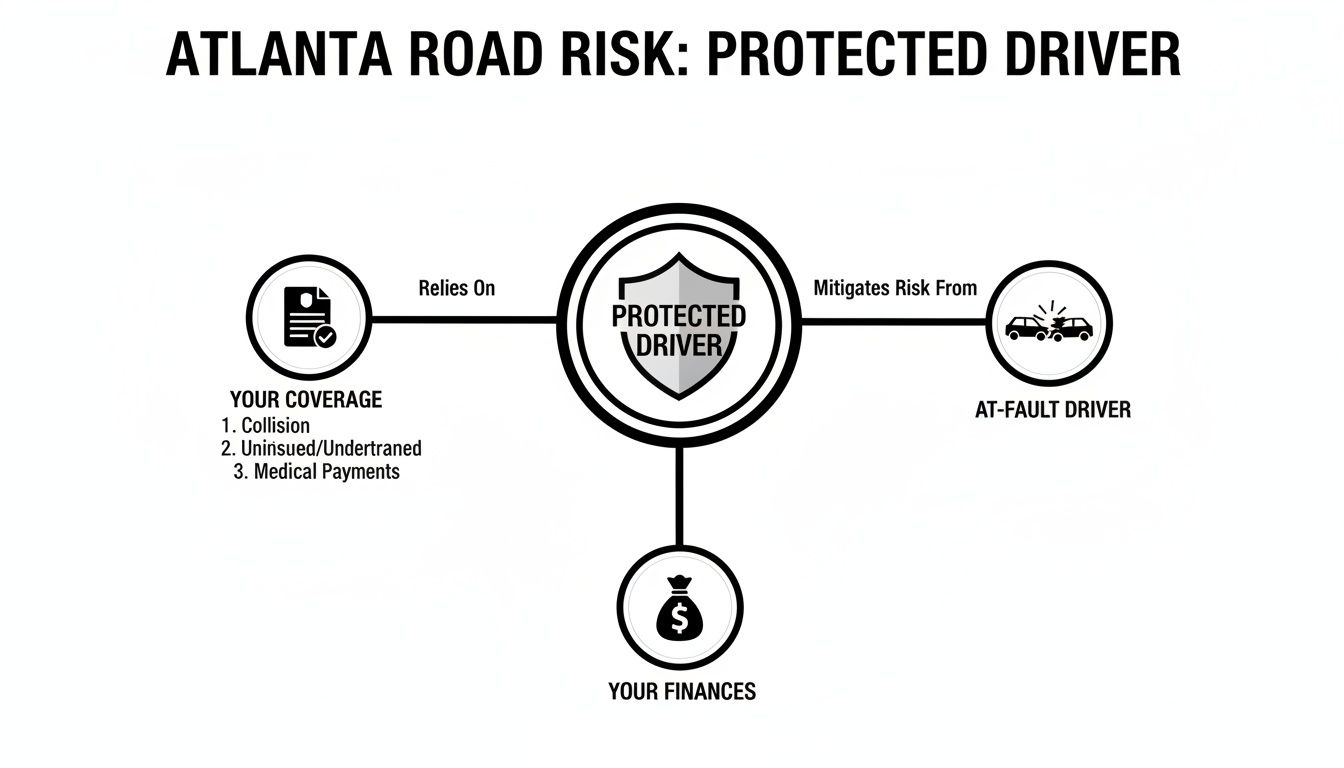
As you can see, a protected driver uses their own coverage to shield their finances from the consequences of another driver's negligence. Without that shield, you’re left to face the medical bills, lost paychecks, and other costs all on your own.
Two Key Types Of UM Coverage In Georgia
Here in Georgia, UM/UIM coverage comes in two flavors, and the difference between them is massive. You absolutely need to know which one your insurance agent is offering you.
- Add-On (or Excess) Coverage: This is the one you want. Period. Your UM/UIM coverage limit is added on top of whatever the at-fault driver’s insurance pays. Let’s say you have $100,000 in Add-On UIM coverage and the other driver has the state minimum of $25,000. You now have access to a total of $125,000 to cover your losses.
- Reduced-By (or Non-Stacking) Coverage: This type offers far less protection. Your UM/UIM coverage is reduced by the amount the other driver's insurance pays out. In that same scenario, the $25,000 from the at-fault driver would be subtracted from your $100,000 policy, leaving you with only $75,000 from your own insurer.
Always ask for and select Add-On coverage. It provides the maximum financial protection and ensures you get the full value of the premiums you paid.
What Does UM And UIM Actually Pay For?
So, where does the money go? This coverage is designed to pay for the exact same damages that the at-fault driver’s insurance should have paid for. It covers your tangible financial losses as well as the intangible human cost of the wreck.
Your policy can cover things like:
- Medical Bills: This isn't just the emergency room. It includes the ambulance ride, surgeries, hospital stays, physical therapy, medication, and any future medical care your doctors say you'll need.
- Lost Wages: If your injuries keep you out of work, UM/UIM can replace those lost paychecks. It can also compensate you for a loss of future earning capacity if you can no longer do the same job.
- Pain and Suffering: This is compensation for the physical pain, emotional trauma, anxiety, and the overall disruption the wreck has caused to your life.
The Special Case Of Hit-And-Run Accidents
UM coverage is your only real line of defense after a hit-and-run. When the driver who caused the wreck takes off and is never found, there’s no one else to hold accountable. You can't file a claim against a ghost.
In a hit-and-run, your own UM policy essentially becomes the insurance for the phantom driver. To use it, Georgia law requires you to prove there was actual physical contact between the vehicles. This is why getting a police report and finding witnesses is so important. If you need help with the terminology, our firm created a legal dictionary to make sense of it all.
Without UM coverage, victims of hit-and-run crashes are often left with no way to pay their bills. That fact alone should make answering "is uninsured motorist coverage worth it" a clear "yes."
When Your UM And UIM Coverage Can Help You
So, when does this coverage actually kick in? Understanding the answer is the key to knowing why this protection is so important on Georgia roads.
Your UM/UIM policy acts as your financial safety net in three specific—and unfortunately, all too common—scenarios. Think of these events as the triggers that activate the coverage you wisely put in place for yourself and your family.
The Driver Has Zero Insurance
This is the most straightforward situation. You’re in a wreck, and the at-fault driver either has no insurance or gives you fake information. Under Georgia law, all drivers must carry liability coverage, but plenty of people ignore that rule.
When this happens, there's no insurance company to file a claim against for your medical bills, lost wages, or pain and suffering.
Without UM coverage, your only real option is to sue the driver personally. But let's be honest: someone driving illegally without insurance is highly unlikely to have the assets to cover a serious injury claim. Your UM policy steps in to fill that gap, becoming the insurance the other driver should have had.
The Hit-And-Run Accident
A hit-and-run is one of the most infuriating things that can happen to a driver. Someone hits you, causes serious damage, and then speeds off, leaving you to deal with the aftermath alone.
Because the driver can't be identified, Georgia law treats them as an "uninsured motorist."
In a hit-and-run, your UM coverage is often the only path to financial recovery for your injuries. Your policy stands in for the phantom driver, providing the funds you need to heal and move forward.
For UM to apply after a hit-and-run in Georgia, a couple of rules usually come into play:
- Physical Contact: There has to be evidence of actual physical contact between the fleeing vehicle and yours.
- Prompt Reporting: The wreck must be reported to the police right away to document what happened.
The Driver Is Underinsured
This scenario is more subtle but can be just as financially devastating. Here, the at-fault driver has insurance, but their policy limits are nowhere near high enough to cover your actual damages. This is what we call being "underinsured."
Georgia's minimum required liability coverage is just $25,000 per person and $50,000 per accident for bodily injury. A single trip to the emergency room, an MRI, or one surgery can easily blow past that $25,000 limit.
Let’s look at a real-world Atlanta example:
- The Wreck: A distracted driver runs a red light and T-bones your car in Midtown.
- The Injuries: You suffer a herniated disc and a broken arm, requiring surgery and months of physical therapy. You can’t work for three months.
- The Math: Your medical bills hit $65,000, and your lost wages add up to $10,000. Your total damages are $75,000.
- The Problem: The at-fault driver only carries Georgia's minimum $25,000 liability policy.
Their insurance pays their $25,000 policy limit, but you're still left with a $50,000 hole. This is exactly where your Underinsured Motorist (UIM) coverage comes to the rescue. If you have "Add-On" UIM coverage, your policy pays that remaining $50,000, making you whole. Without it, you'd be stuck with that debt.
Comparing The Costs And Benefits
When you're trying to figure out if uninsured motorist coverage is worth it, the first thing you probably look at is the price. We all check our insurance bills and wonder where we can cut costs. But looking at UM/UIM coverage as just another expense is the wrong way to think about it. It’s an investment in your financial survival.
The reality is, adding solid UM/UIM protection to your policy usually costs very little—often just a few extra dollars a month. It’s the kind of expense that gets lost in the noise of a few weekly coffees. But the protection it buys is massive.
Let’s stack that small monthly cost against the financial catastrophe of a serious Atlanta car accident.

A Real-World Atlanta Accident Scenario
Picture this: you’re driving on GA-400 when a driver, distracted by a text and speeding, slams into your lane. It’s a bad one. And the at-fault driver? They only have Georgia's minimum liability coverage of $25,000.
Your injuries are significant. You need an ambulance ride, a three-day hospital stay with surgery for a broken leg, and months of physical therapy afterward. On top of that, you have to miss six weeks of work.
Let’s run the numbers on what those immediate costs look like:
- Ambulance and ER Visit: $4,500
- Three-Day Hospital Stay & Surgery: $55,000
- Follow-up Orthopedic Care & PT: $8,000
- Lost Wages (6 weeks at $1,200/week): $7,200
Your total economic damages quickly hit $74,700. And that number doesn't even touch the compensation you deserve for your physical pain and emotional trauma.
The Two Financial Outcomes
Now, let’s see how this scenario plays out—first without UIM coverage, and then with it.
Outcome 1: You Have No UIM Coverage
The at-fault driver’s insurance pays its policy limit of $25,000. That’s every penny you will ever get from them. This leaves you with a crippling $49,700 in unpaid medical bills and lost income. Your health insurance might cover some hospital costs, but you're still on the hook for deductibles, co-pays, and out-of-network fees. The rest becomes your personal debt.
Outcome 2: You Have $100,000 in Add-On UIM Coverage
The other driver's insurance still pays its $25,000 limit. But then, your own UIM policy kicks in to handle the rest. It covers the remaining $49,700 in bills and lost wages and provides an additional source of recovery for your pain and suffering. Instead of facing financial ruin, you are made whole.
The risk of this happening is very real. These drivers, often carrying just the state minimums like Georgia's 25/50/25 limits, pose a huge financial threat. With the average hospital stay easily topping $50,000, that $25,000 policy is gone in a flash, leaving you to cover the massive shortfall. You can explore additional findings on this trend from the insurance industry's leading research council.
The core question isn't whether you can afford to have UM/UIM coverage. It's whether you can afford not to have it.
Coverage Cost vs Accident Cost: A Financial Snapshot
When you put the numbers side-by-side, the value of this coverage becomes crystal clear. That small annual premium is a tiny price to pay to avoid a potential five- or even six-figure debt from a wreck you didn't cause.
Here's a straightforward look at what you’re paying for versus what you’re protecting yourself against.
| Expense Item | Typical Annual UM/UIM Premium | Potential Uncovered Accident Costs |
|---|---|---|
| Medical Bills | A small fraction of this total | $49,700+ |
| Lost Wages | A small fraction of this total | $7,200+ |
| Pain & Suffering | A small fraction of this total | $0 (No source for recovery) |
| Total Annual Cost vs. Potential Debt | ~$100 – $300 | $56,900+ |
This comparison makes it obvious. Passing on this coverage to save a few hundred dollars a year is a terrible gamble, especially on busy Atlanta roads. The protection it offers is one of the smartest financial decisions a driver can make. Ultimately, the peace of mind that comes from knowing you are protected is why uninsured motorist coverage is worth it.
How To File A UM Claim And What To Expect

Filing a claim against your own insurance company should be simple. After all, you’ve paid your premiums on time, month after month. But when it comes to UM or UIM claims, the reality is often the exact opposite.
Suddenly, your insurer can start to feel more like an adversary than a partner. It’s a jarring experience, but understanding the process and the games they play is the first step toward protecting yourself.
Immediate Steps After The Accident
The aftermath of a wreck is pure chaos. Your adrenaline is pumping, and it’s tough to think clearly. But a few key actions right then and there can build a solid foundation for your UM claim. While we manage this entire process for our clients, it’s helpful to know what’s involved.
- Call 911 Immediately: Always get the police involved, no matter how minor the accident seems. An official police report is your proof—it documents the who, what, where, and when. For a UM claim, especially a hit-and-run, that report is non-negotiable.
- Gather Information: If the other driver actually stopped, get their name, phone number, and whatever insurance information they’ll give you, even if it feels sketchy. Take a picture of their license plate, their driver’s license, and the damage to both cars.
- Document the Scene: Use your phone to take photos and videos of everything. I’m talking about the position of the cars, any skid marks on the pavement, nearby traffic signals, and any visible injuries you have. You can't have too much evidence.
- Look for Witnesses: Did anyone see it happen? Ask for their name and contact information. An independent witness who can confirm the other driver was at fault is worth their weight in gold.
Notifying Your Insurance Company
As soon as you are safe, you need to report the accident to your own insurance company. Check your policy—most have a strict deadline for reporting a potential claim. When you make that first call, stick to the basic, undisputed facts.
This is where the dynamic shifts. Your insurer will open a claim and assign an adjuster to "investigate." Remember, that adjuster works for the insurance company, not for you. Their primary job is to protect the company's money by paying out as little as possible.
Even though it's your own insurer, a UM/UIM claim places you in an adversarial position. Your insurance company steps into the shoes of the at-fault driver's insurer, and they will defend the claim just as aggressively to protect their bottom line.
Common Tactics Used By Insurance Adjusters
It’s a tough pill to swallow, but your insurance carrier is not your friend after an accident. They are a business, and big payouts are bad for profits. You need to be ready for the common tactics they use to lowball, delay, or deny legitimate UM claims.
- Requesting a Recorded Statement: One of the first things an adjuster will do is ask for a recorded statement. You are not required to give one, and you shouldn’t. They are trained to ask tricky questions designed to get you to downplay your injuries ("I'm just a little sore") or accidentally admit partial fault.
- Pressuring for a Quick Settlement: Don’t be surprised if you get a settlement offer almost immediately. This is a classic move to get you to accept pennies on the dollar before you understand the true extent of your injuries and medical bills.
- Disputing Medical Treatment: The adjuster may start questioning your doctor's recommendations. They might claim your physical therapy is excessive or that your injuries aren’t even related to the wreck.
- Using Your Own Words Against You: Every single conversation is documented. A simple, polite answer like "I'm doing okay" can be twisted in their notes to mean your injuries are not serious.
Dealing with these roadblocks is a huge part of what we do. For a broader overview of the claims process, you can learn more about how to file a car accident claim in Atlanta in our guide.
Ultimately, knowing is uninsured motorist coverage worth it also means being prepared for the fight to collect the benefits you rightfully paid for.
Common Questions About UM and UIM Coverage
When you're trying to figure out if uninsured motorist coverage is worth it, a lot of questions come up. As Atlanta personal injury attorneys, we hear the same concerns from clients every day. Getting clear, straightforward answers is the best way to feel confident about the protection you've chosen for your family.
Here are the answers to some of the most common questions we get about UM and UIM coverage in Georgia.
How Much UM and UIM Coverage Should I Get?
Our advice is always simple: buy as much UM/UIM coverage as you can comfortably afford.
At an absolute minimum, your UM/UIM limits should match your own bodily injury liability limits. Think about it—why would you protect a stranger on the road more than you protect yourself and your own family? It just doesn't make sense.
A good starting point for most Georgia families is:
- $100,000 per person
- $300,000 per accident
But with the sky-high cost of medical care these days, a serious injury can exhaust those limits in a hurry. A policy with limits of $250,000 per person and $500,000 per accident provides a much stronger financial safety net and is often surprisingly affordable.
Does UM Coverage Apply If I Was a Pedestrian or Cyclist?
Yes, and this is an important detail many people miss. Your auto insurance policy's UM/UIM coverage generally follows you, not just your vehicle.
This means if you are hit by an uninsured or underinsured driver while you're out for a walk, jogging, or cycling anywhere in Atlanta, you can file a claim under your own UM policy. This protection is invaluable for anyone who is active in a busy city where pedestrian and bicycle accidents are a constant risk.
One of the most important but least-known benefits of UM/UIM coverage is its ability to protect you and your resident family members even when you aren't in a car.
Will Filing a UM Claim Make My Insurance Rates Go Up?
In Georgia, it is against the law for an insurance company to raise your premiums for using your UM/UIM benefits if the accident was not your fault.
The law is crystal clear on this. O.C.G.A. § 33-9-40 specifically prohibits an insurer from penalizing you for a claim when their own insured was not at fault. You pay your premiums for this exact scenario—to be protected from someone else's negligence. You should never be punished for using the coverage you paid for.
What If My Own Insurance Company Denies My UM Claim?
It's frustrating and feels like a betrayal, but it happens more often than you would think. Your own insurer might try to deny your claim for any number of reasons. They might argue the other driver wasn't entirely at fault, dispute the severity of your injuries, or claim your medical treatments were unnecessary.
This is exactly when you need an experienced personal injury attorney in your corner.
If your claim is unfairly denied, you have the right to fight back. We can step in, handle all communication with the adjuster, and build the strongest possible case with medical records and expert opinions. If the insurance company still refuses to pay what you're owed, we can file a lawsuit against them to hold them accountable to the policy you paid for. You don't have to take "no" for an answer.
Remember, strict deadlines apply. You can learn more about Georgia's statute of limitations for personal injury on our site.
Understanding what to do after an accident with an uninsured driver can be overwhelming, but you don’t have to do it alone. At Jamie Ballard Law, we handle these types of claims every day. If you have questions about your coverage or need help getting the compensation you deserve, contact us for a free, no-obligation case evaluation. Let our experience work for you. Visit us at https://jamieballardlaw.com.