That denial letter from your insurance company is not the final word. As an Atlanta personal injury attorney, I've seen firsthand that this is often the start of a conversation, not the end of the road. To get the outcome you deserve, you must be methodical and act fast. Learning how to appeal insurance denial begins the moment you open that letter.
What to Do Immediately After a Denial
The first few hours after receiving a denial notice are important. They set the stage for your entire appeal. It’s natural to feel frustrated or angry, but you need to channel that energy into focused, organized action. Do not just toss the letter aside.
That piece of paper is your roadmap. It holds the most important clue you need to get started: the exact reason they denied your claim.
Find the “Why” in Your Denial Letter
By law, the insurance company must tell you why they rejected your claim. Read that section of the letter carefully, maybe two or three times. Sometimes, the reason is surprisingly simple—a clerical error, a misspelled name, or an incorrect policy number. Other times, it’s more involved, like a dispute over whether the treatment was medically necessary.
Once you pinpoint the "why," you know exactly what you need to challenge and what evidence you'll have to gather to build your case.
To get a clearer picture of what you might be up against, here’s a quick breakdown of common denial reasons and what they really mean for you.
Common Denial Reasons and Your First Moves
| Denial Reason | What It Really Means | Your First Action Item |
|---|---|---|
| Administrative or Clerical Error | Someone made a typo. A name, code, or date is wrong. | Call the insurer immediately. This can often be fixed over the phone with corrected information. |
| Lack of Pre-Authorization | Your plan required approval before you got the service, and they say you didn't get it. | Check your records and your doctor's files. Prove that authorization was requested or argue why it wasn't required. |
| Not a Covered Service | The treatment you received isn't included in your specific policy's benefits. | Request your full policy documents. Scrutinize the "Exclusions" and "Covered Services" sections for ambiguity or exceptions. |
| Not Medically Necessary | The insurer's medical reviewer decided the treatment wasn't essential for your condition. | This is a major battleground. You'll need a strong letter from your doctor explaining why the treatment was so important for your health. |
This is a simplified look, but it shows how identifying the reason dictates your next move. It’s about building a targeted response, not a generic complaint.
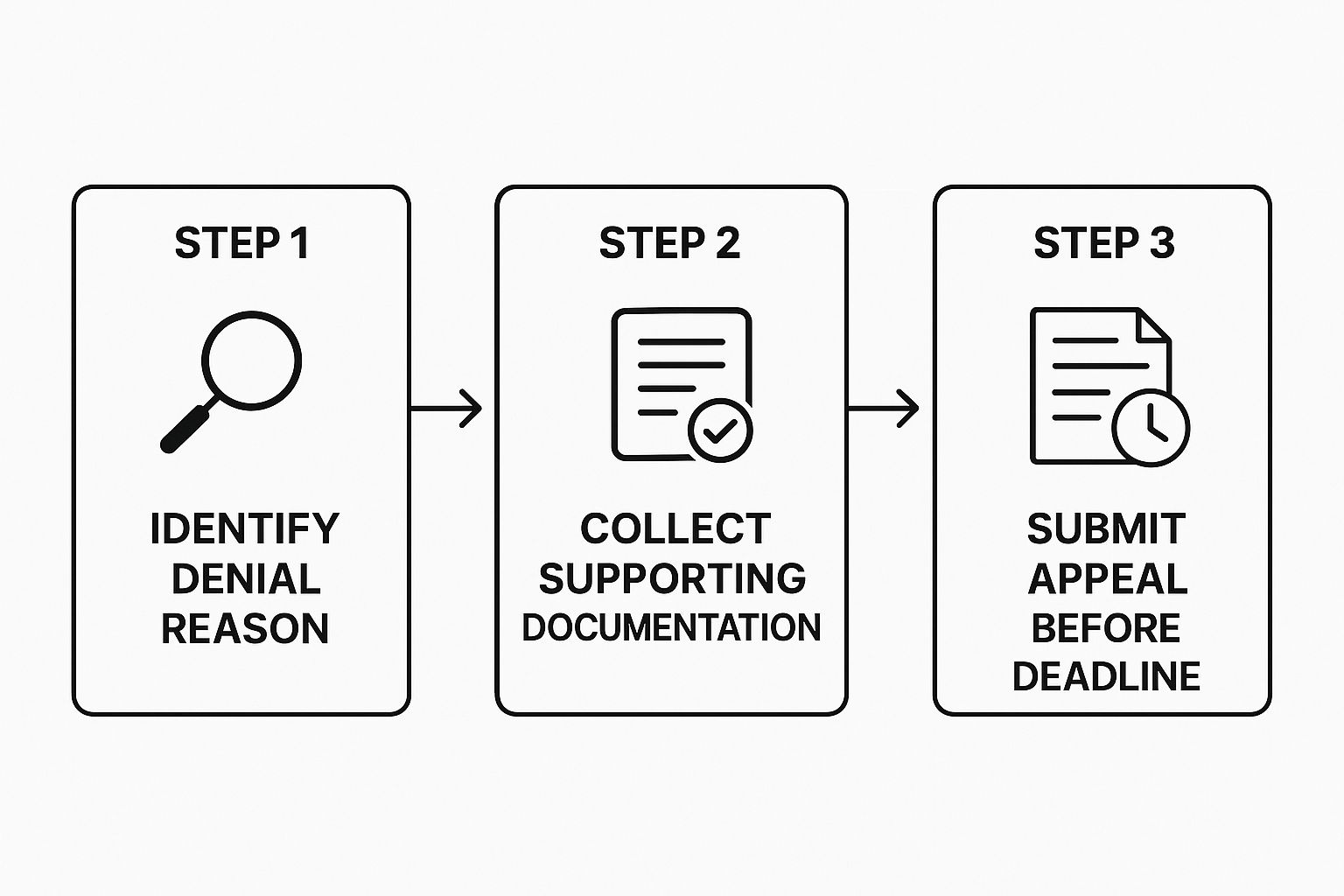
As this shows, the process is straightforward at the start: find the reason, get your proof, and move before time runs out.
Take Action and Meet Your Deadlines
You’re on the clock. The denial letter must state your deadline for filing an internal appeal, which is typically 180 days from the date you received the notice. Circle that date on your calendar. Highlight it. Do whatever you need to do to remember it. If you miss this deadline, you could lose your right to fight the decision entirely.
Here’s something that might surprise you. While in-network denial rates for certain health plans hover around 19%, an incredibly small number of people—less than 1%—actually appeal. But for those who do, the results are encouraging: 44% of internal appeals successfully overturn the denial. The odds are better than you think, but only if you act.
Your next step is to formally request your complete claim file and all related policy documents from the insurer. This is your legal right. Having this paperwork is non-negotiable; it's the foundation for building an effective appeal. We've seen firsthand how prompt, organized action at this stage can make all the difference for our clients. You can learn more about our team's dedicated approach to these cases.
Building an Unshakeable Case for Your Appeal
Once you know why the insurer denied your claim, the next step is to gather the evidence that proves your claim should be covered. Think of it as methodically dismantling their reasoning with hard facts, piece by piece, until your position is undeniable.
A cornerstone of your appeal is a compelling letter of medical necessity from your treating physician. This isn't just a simple note. It must clearly explain why the service or treatment was essential for your health, linking it directly to your diagnosis and the expected medical outcome.
Your Evidence-Gathering Checklist
To support that letter, you’ll need to assemble a complete file of related medical documents. Leave nothing out. Your goal is to create a complete and indisputable picture of your medical situation.
- Physician’s Notes: These detailed notes from your appointments show your doctor's ongoing assessment and treatment plan in their own words.
- Test Results and Lab Work: Include all relevant imaging scans (like MRIs or X-rays), blood tests, and other diagnostic results that objectively confirm your condition.
- Treatment Histories: A timeline of previous treatments can show that you’ve already tried less intensive or less expensive options, which strengthens the case for the denied service.
- Clinical Practice Guidelines: This is a pro-tip we often share with clients. Find and include established guidelines from respected medical associations that endorse the treatment you received for your specific medical condition. You can often find these through organizations like the National Institutes of Health (NIH).
Organize all of this information neatly. I recommend creating a cover sheet that lists every document included. This simple step makes it much easier for the reviewer to follow your logic and grasp the strength of your case.
Why Your Effort Matters
It's easy to feel like the odds are stacked against you, but the data tells a different story. A 2022 analysis showed that while only about 10% of certain Medicare Advantage denials are appealed, an incredible 83.2% of those appeals lead to the denial being partially or fully overturned.
The problem isn't that appeals fail; it's that most people never start the process. A well-supported appeal is incredibly effective.
A Personal Tip: Remember, your insurance policy is a legal contract. It outlines the company's obligations to you. Being able to understand its terms is a powerful part of building your appeal.
Since insurance policies are legal contracts, understanding their terms—even without a legal background—is vital. Learning about contract review for non-lawyers can give you an edge by helping you spot the exact policy language that supports your claim.
When you combine strong medical evidence with a clear understanding of your policy, you present a formidable argument that is much harder for an insurer to ignore. This detailed preparation is how you begin to successfully appeal an insurance denial.
How to Write a Powerful Appeal Letter
This is where the rubber meets the road. Your appeal letter is the single most important document you’ll create. It’s your chance to connect the dots for the reviewer, turning a stack of medical records and forms into a coherent, persuasive argument.
Forget generic templates. A powerful letter is crafted, not copied. Your job is to make it impossible for the reviewer to uphold their original denial. This isn’t about emotion; it’s about a firm, professional, and fact-based presentation.
Structuring Your Letter for Maximum Impact
Think of your letter as a roadmap leading the reviewer to the only logical conclusion: approving your claim. Make their job easy.
-
The Introduction: Get straight to the point. Start with your full name, policy number, and claim number. In the first paragraph, state your purpose clearly. For example: "I am writing to formally appeal the denial of claim number [Your Claim Number] for [Service/Treatment Name], which took place on [Date of Service]."
-
The Body: This is where you dismantle the denial, piece by piece. Address each reason they gave you, one at a time, and counter it with the evidence you gathered. If they claimed a procedure wasn't medically necessary, you’ll introduce your doctor's letter and reference the specific clinical justifications within it.
-
The Desired Outcome: Don't be vague. Tell them exactly what you want. "I am requesting full reimbursement of the $XXX.XX I paid out-of-pocket for this covered service," or "I am requesting pre-approval for the upcoming procedure as recommended by my physician." Be direct and specific.
When you're drafting the letter, paying attention to the small details in phrasing and structure can make a huge difference. You can find excellent expert tips on writing legal documents that apply here, helping you make your case as clear and compelling as possible.
Pro-Tips for a Winning Appeal Letter
A few small, professional touches can have a big impact on how your appeal is received. A well-organized packet shows you are serious, organized, and prepared.
Our Advice: Never send a loose stack of papers. Create a simple table of contents or an "Exhibit List" on a separate page. This lists every document you’ve included (e.g., Exhibit A: Denial Letter; Exhibit B: Dr. Smith’s Letter of Medical Necessity). It forces the reviewer to see and acknowledge all your evidence at a glance.
The U.S. Department of Labor even provides guidance on the essential information needed for claims and appeals, as you can see below.

This official guidance highlights just how important it is to be thorough. Missing information is an easy excuse for them to delay or deny your appeal on a technicality. Don't give them one.
Finally, always send your appeal packet via certified mail with return receipt requested. This is non-negotiable. It provides you with undeniable proof of the exact date the insurance company received your letter, which is vital for holding them to strict appeal deadlines. It's a simple step, but it protects your rights and gives your case the best possible chance of success.
The Difference Between Internal and External Appeals
When your insurance company denies a claim, it’s not the end of the road. The process for how to appeal insurance denial is actually a tiered system. You get two distinct chances to fight back: first with an internal appeal, and then, if necessary, with a powerful external review.
Think of it as a two-step process designed to give you a fair shot.

The First Step: Your Internal Appeal
Your first move is always an internal appeal. This is your formal request asking the insurance company to take a second look at its own decision. You are directly telling them, "I believe you've made a mistake, and here is the evidence to prove it."
During this phase, someone new within the insurance company—who was not involved in the original denial—reviews your case. They'll look at your claim, your appeal letter, and all the supporting documents you’ve gathered.
The clock is ticking for them, not just you. Insurers are legally required to give you a decision within specific timeframes.
- For post-service claims (after you've received care), they have 60 days.
- For pre-service claims (before you receive care), it's a tighter 30-day window.
If your situation is medically urgent, you can request an expedited appeal, which forces a much faster turnaround.
While this is a required first step, it’s important to manage your expectations. You're asking the same company that already said "no" to reverse its own decision. Sometimes they will, but often they double down. If that happens, don't get discouraged. Your strongest tool is next.
Your Most Powerful Tool: The External Review
If the internal appeal fails, you have the right to request an external review. This is where things get serious. Your case is sent to an independent, third-party organization with zero connection to your insurer.
These reviewers are typically medical professionals who will give your claim a completely unbiased look based on medical necessity, standard of care, and the specific language in your policy. The process is usually managed by your state’s Department of Insurance or a similar regulatory body, like the Georgia Office of Commissioner of Insurance and Safety Fire. They don't work for the insurance company, and their decision is legally binding.
The external review is a game-changer. It takes the final say away from a profit-focused insurance company and places it in the hands of an impartial medical expert. This is the stage where many of our Atlanta-area clients see success, which is why we handle cases throughout the region. You can see the areas we serve here.
The data backs this up. One analysis found that when patients escalate their case to an independent review, between 60% and 80% of denials are overturned. Specifically, denials for treatments deemed "not medically necessary" were reversed 60% of the time.
This shows just how valuable that impartial, expert eye can be. When someone without a financial stake in the outcome reviews the facts, the decision often favors the patient.
Understanding these two distinct levels of appeal is key. It gives you a clear path forward and ensures you use every available option in learning how to appeal insurance denial and get the coverage you paid for.
What to Do After You Submit Your Appeal
Hitting "send" on your appeal is a major milestone, but don't close the file just yet. The waiting game that follows can be nerve-wracking, and what you do during this period is just as important as the work you put into building your case. This is where organized, polite persistence pays off.
The moment your appeal is officially submitted, start a communication log. Keep a detailed record of every single interaction with the insurer—every phone call, email, or letter. Jot down the date, time, the name of the representative you spoke with, and a quick summary of what was discussed. This log becomes your evidence, and it can be invaluable if the insurer causes delays or creates confusion.
Understanding the Possible Outcomes
Once the insurance company finishes its review, you’ll receive a formal decision. This outcome will dictate your next move, so it's best to be prepared for either of the two main possibilities.
Here’s a breakdown of what you can expect and the next steps you should take for each scenario.
What Your Appeal Outcome Means for You
This table clarifies what each potential decision from the insurer means and what your immediate course of action should be.
| Appeal Outcome | What It Means | Your Recommended Next Step |
|---|---|---|
| Appeal Approved | Congratulations! The insurance company has reversed its initial decision and sided with you. | Scrutinize the approval letter. It should specify when to expect payment or service authorization. Follow up to confirm they process it correctly and on time. |
| Appeal Denied (Again) | The insurer reviewed your appeal but decided to stand by its original denial. | Don’t give up. The denial letter is legally required to explain how to initiate an external review. This is your immediate next step. |
Knowing these pathways ahead of time helps you stay in control of the process, no matter which way the decision goes.
When Your Internal Appeal Is Approved
An approval is a huge win—take a moment to celebrate it! Your approval letter is the key document here. If it’s for a medical service you haven’t received, the letter now acts as your pre-authorization. If it’s for a claim you’ve already paid out-of-pocket, it should detail the reimbursement amount and the payment timeline.
Stay on top of it. Make sure the insurer follows through on its commitment without unnecessary delays.
If Your Appeal Is Denied Again
Another denial is definitely discouraging, but this is far from the end of the road. You now have the right to request an external review, which means an independent, third-party medical professional will examine your entire case. For many people, this is the most important and often most successful stage of the appeals process.
Our Proactive Approach: If the external review also results in a denial, it’s time to escalate. Your options may include filing a formal complaint with a state-level regulator like the Department of Insurance or exploring your legal options.
When you're facing repeated denials and feel the insurer is acting in bad faith, it’s wise to seek professional legal advice. An experienced personal injury attorney can clarify all your remaining avenues for recourse. If you’ve reached this point and need guidance, you can always get in touch with our team for a free evaluation of your case. By staying proactive, you can maintain control and be ready for whatever comes next.
Common Questions About Insurance Appeals

When you're fighting an insurance company, it's natural to have a lot of questions. Based on my experience helping people across Atlanta, having clear, direct answers is the first step toward building a confident and effective appeal. Here are the most frequent questions I encounter about the process of how to appeal insurance denial.
How Much Time Do I Have to File an Insurance Appeal?
This is the first and most important question. While the general rule is 180 days from receiving the denial letter, this timeline isn't universal. It can shift based on your specific insurance plan and state laws.
Your denial letter must state the exact deadline. Find it, circle it, and put it on your calendar immediately. Missing this window can permanently close the door on your right to appeal, so there's no room for error here.
Can My Doctor's Office Help Me with the Appeal?
Yes, and they should be your first call. Your doctor’s office is often your most powerful ally in this process.
They are the ones who can provide the "Letter of Medical Necessity"—a cornerstone of any strong appeal. Their staff can also help you pull together the necessary medical records, lab results, and physician’s notes that form the backbone of your case. Many medical practices have administrative staff who are well-versed in handling insurance bureaucracy and can be an invaluable resource.
A key takeaway here is that you don't have to do this alone. Your medical team's input is not just helpful; it’s a central part of a successful appeal. Their professional opinion gives weight and credibility to your claim that the insurer cannot easily dismiss.
What if My First (Internal) Appeal Is Denied?
It's incredibly frustrating to get a second "no," but this is a very common part of the process. Do not give up. This is precisely where the next stage of your rights kicks in.
Your next move is to request an external review, often called an independent medical review. Under the Affordable Care Act, you have a guaranteed right to this for most health insurance denials. An unaffiliated, third-party medical professional will review your entire case. Their decision is legally binding on the insurance company.
The second denial letter you receive is legally required to give you clear instructions on how to start the external review.
Should I Hire a Lawyer to Appeal an Insurance Denial?
For many straightforward internal appeals, you can manage the process yourself with good organization and a solid, evidence-based letter.
However, you should strongly consider consulting with an attorney if your situation involves any of the following:
- The treatment or surgery in question is very expensive.
- Your medical condition is severe or involves a catastrophic injury.
- Your external appeal has also been denied.
An experienced attorney can outline your remaining legal options, which may include filing a lawsuit against the insurer for acting in bad faith. Knowing how to appeal insurance denial effectively also means knowing when it’s time to bring in professional legal support.
At Jamie Ballard Law, we believe no one should have to battle an insurance company while recovering from an injury. If a denial has left you feeling overwhelmed, our team is ready to step in with the guidance and legal muscle you need. We take on the fight, so you can focus on getting better. For a free, no-obligation evaluation of your claim rejection, visit us at https://jamieballardlaw.com.