When you are hurt because someone else was not careful, the path to recovery can feel uncertain. The legal principles that protect you in Atlanta did not appear overnight; they were built over centuries through landmark courtroom decisions. Understanding some of the most influential cases about negligence provides powerful insight into how your own personal injury claim might be evaluated under Georgia law. These historical rulings are more than just legal trivia. They form the very foundation of your right to seek justice and hold responsible parties accountable.
This article breaks down eight pivotal legal battles that shaped modern personal injury law. For each case, we will explore:
- The Core Legal Principle: A clear explanation of the rule the case established, such as duty of care or proximate cause.
- Key Facts and Outcome: A brief summary of the story and the court's final decision.
- Actionable Takeaway for Atlantans: Practical advice on how these historical precedents apply to common accidents on our city's streets, from a car wreck on I-285 to a slip and fall at a local business.
By examining these foundational rulings, you will gain a clearer understanding of the four elements of a negligence claim: duty, breach, causation, and damages. This knowledge empowers you to better understand the legal journey ahead and recognize the key factors that can strengthen your claim. This curated collection of cases about negligence is designed to demystify the legal process and highlight the enduring principles that protect the injured.
1. Donoghue v Stevenson (1932) – Where the Modern Duty of Care Began
The story of a snail in a bottle of ginger beer may seem strange, but it is the origin point for many modern cases about negligence in Atlanta and worldwide. This landmark case from Scotland established the very idea that we owe a responsibility, or a "duty of care," to others, even if we don't have a contract with them. It is the foundation upon which nearly all personal injury law is built.
In 1928, May Donoghue's friend bought her a bottle of ginger beer. After drinking some of it, she poured the rest into her glass and was horrified to see the decomposed remains of a snail emerge. She suffered from gastroenteritis and nervous shock. The problem? She hadn't bought the drink herself, so she had no contract with the cafe owner. The manufacturer, David Stevenson, argued he had no direct relationship with her and therefore owed her nothing.
Strategic Breakdown and Legal Significance
The court's final decision changed everything. The ruling judge, Lord Atkin, introduced the "neighbour principle," a revolutionary idea that defines who we are responsible for.
The Neighbour Principle: "You must take reasonable care to avoid acts or omissions which you can reasonably foresee would be likely to injure your neighbour… persons who are so closely and directly affected by my act that I ought reasonably to have them in contemplation as being so affected when I am directing my mind to the acts or omissions which are called in question."
This principle created a general duty of care owed by a manufacturer to the final consumer. It meant that Mr. Stevenson's duty was not limited to the distributor he sold the ginger beer to; it extended to Mrs. Donoghue, the person who would ultimately drink it. This set a powerful precedent for product liability and general negligence claims.
Actionable Takeaways for Atlanta Injury Victims
While this case happened long ago in another country, its core lesson is vital for anyone injured in Atlanta today.
- You Don't Need a Direct Contract: If you are injured by a defective product, like a faulty car part that causes a wreck or contaminated food, you can hold the manufacturer accountable. You don't need to be the original purchaser.
- Foreseeability is Key: Your claim depends on showing that the at-fault party should have reasonably foreseen that their actions (or inaction) could cause harm. A driver running a red light in Atlanta should foresee they might hit another car. A store owner should foresee that a wet floor could cause a slip and fall.
- Document the Defect: Just as the snail was the core evidence for Mrs. Donoghue, preserving the evidence in your case is essential. Take photos of the hazardous condition, keep the defective product, and get contact information from witnesses.
This historic ruling ensures that businesses and individuals cannot hide behind a lack of a direct relationship to escape responsibility. It empowers consumers and victims, forming the basis for many modern cases about negligence. For more information on this case, see its detailed history on Wikipedia.
2. Palsgraf v. Long Island Railroad Co. (1928) – Foreseeability and Proximate Cause
A bizarre chain reaction on a train platform in New York established a vital limit on liability in many modern cases about negligence. This ruling introduced the concept that for a person to be held liable, the harm caused must be a foreseeable result of their actions. It answers a key question: how far does a person's responsibility for their carelessness extend?
The incident occurred in 1924 as a man carrying a package wrapped in newspaper ran to catch a departing train. Two railroad guards, attempting to help him board, negligently pushed him from behind and pulled him from the front. In the process, the man dropped his package, which, unknown to anyone, contained fireworks. The package exploded upon hitting the rails. The force of the blast caused a heavy set of scales on the platform to topple over, striking and injuring Helen Palsgraf, who was standing a considerable distance away. She sued the railroad for the guards' negligence.

Strategic Breakdown and Legal Significance
The court, led by Judge Benjamin Cardozo, ultimately sided with the railroad. The decision established that a defendant owes a duty of care only to those individuals who are within the "zone of danger," meaning those who could foreseeably be harmed by their actions.
The Zone of Danger: "The risk reasonably to be perceived defines the duty to be obeyed… it is risk to others within the range of apprehension."
In this case, the court reasoned that the railroad guards could not have possibly foreseen that helping a passenger board a train would lead to an explosion that would injure someone standing far away. While their actions may have been negligent toward the man with the package (they could have foreseen he might fall), Mrs. Palsgraf was an "unforeseeable plaintiff." This principle of proximate cause prevents defendants from being liable for every bizarre and unpredictable consequence of their actions, no matter how remote.
Actionable Takeaways for Atlanta Injury Victims
This century-old case has direct implications for how personal injury claims are evaluated in Atlanta today. It underscores the importance of connecting the negligent act directly to a foreseeable injury.
- You Must Be a Foreseeable Victim: To have a valid claim, you must show that the defendant should have reasonably anticipated that their carelessness could harm someone in your position. A driver speeding through a school zone should foresee injuring a child, but not necessarily someone inside a building two blocks away who is startled by the sound.
- Causation Isn't Enough: It's not sufficient to show that the defendant’s action was a cause of your injury; you must prove it was the proximate or legal cause. This means the link between the act and the injury cannot be too indirect or bizarre.
- Focus on Reasonable Expectations: When building your case, concentrate on what a reasonable person would expect to happen. Would a reasonable store owner expect a poorly stacked shelf to fall and injure a shopper? Yes. That is a foreseeable risk.
This case serves as a reality check in the world of personal injury law, ensuring that liability is tied to reasonable foreseeability. It remains a cornerstone of analysis in many cases about negligence. You can learn more about how these principles apply to modern personal injury claims and see a visual explanation of the case below.
3. Bolton v Stone (1951) – The Reasonable Person Standard in Negligence
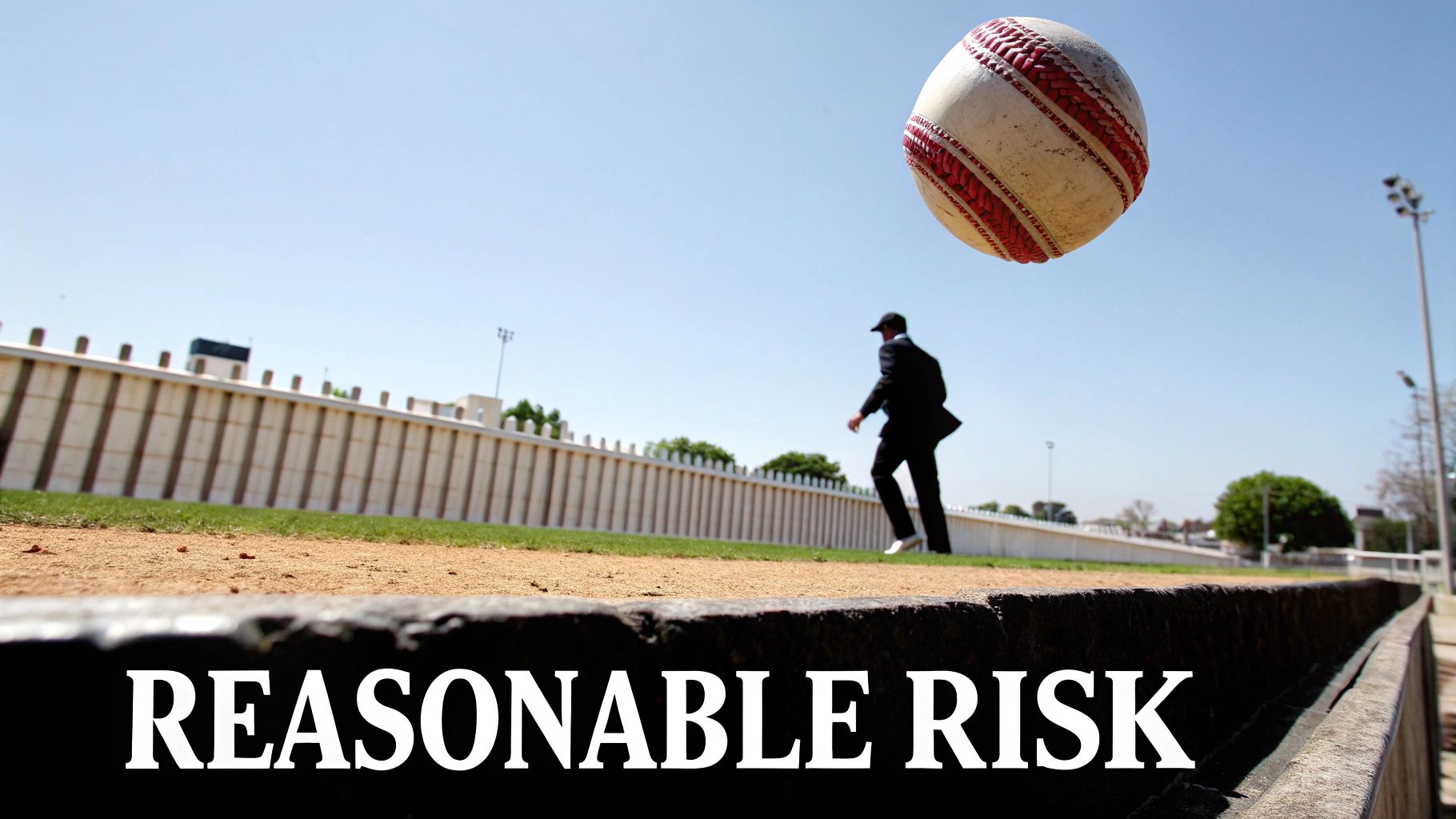
How far does a property owner's duty to prevent accidents extend? The famous case of a cricket ball leaving a sports ground helps define the limits of responsibility in many cases about negligence in Atlanta and beyond. This foundational ruling from the British House of Lords explored the difference between a remote possibility of harm and a reasonably foreseeable risk, refining what is expected of a "reasonable person."
In 1947, Miss Stone was standing outside her home when she was struck and injured by a cricket ball. The ball had been hit from a nearby cricket ground, clearing a 17-foot-high fence and traveling about 100 yards. Evidence showed that a ball had been hit that far only about six times in the previous 30 years, and no one had ever been injured before. Miss Stone sued the cricket club, arguing they were negligent for not taking greater precautions.
Strategic Breakdown and Legal Significance
The court ultimately found that the cricket club was not negligent. The decision hinged on the low probability of such an event happening and causing injury. The ruling judge, Lord Reid, made a key distinction between foreseeable risks that are substantial versus those that are extremely remote.
The Reasonable Risk Principle: "I think that reasonable men do, in fact, take into account the degree of risk and do not act on a bare possibility as they would if the risk were more substantial… The standard of care is the standard of an ordinarily careful man… but an ordinarily careful man does not take precautions against every foreseeable risk."
This established that for a defendant to have breached their duty of care, the risk of harm must not only be foreseeable but also significant enough that a reasonable person would have taken steps to prevent it. The court considered the great social utility of cricket and the high cost of preventing such a rare event (like ceasing to play cricket there entirely) outweighed the minuscule risk. This principle is central to many Atlanta premises liability claims today.
Actionable Takeaways for Atlanta Injury Victims
The lessons from this case are vital for understanding the "breach of duty" element in a negligence claim in Atlanta, particularly in slip and fall or other premises liability incidents.
- Risk Must Be More Than a Possibility: To hold a property owner liable, you must show the danger was a reasonably probable risk, not just a freak accident. A loose railing on a crowded staircase presents a probable risk; a meteorite striking a building's entrance does not.
- Context and Cost Matter: Courts will consider the practicality and cost of preventative measures against the likelihood and severity of potential harm. A business is expected to mop a wet floor but not necessarily to build a fortress to prevent every conceivable injury.
- Document the Foreseeability: When injured on someone's property, gather evidence showing the owner knew or should have known about the specific hazard. This could include photos of a long-neglected spill, maintenance records showing a known defect, or witness testimony about a recurring danger.
This landmark case helps clarify that the law does not require people to guard against every imaginable danger. Instead, it focuses on what a reasonable person would do to prevent substantial, foreseeable harm, a key concept in all modern cases about negligence.
4. Rylands v Fletcher (1865) – Strict Liability for Dangerous Things
While most injury claims require proving someone was careless, some cases about negligence fall under a special category where fault isn't the main issue. The 19th-century English case of Rylands v Fletcher established the powerful legal doctrine of "strict liability," which holds a person responsible for harm caused by an abnormally dangerous activity or substance on their land, regardless of whether they were actually negligent.
In this case, a mill owner, Rylands, hired contractors to build a reservoir on his land to power his mill. Unbeknownst to them, the reservoir was built over abandoned coal mine shafts. When the reservoir was filled, the water burst through the old shafts and flooded the active mine tunnels of his neighbor, Fletcher. Fletcher sued, and even though Rylands himself was not negligent (his contractors were), the court held him liable for the damages.
Strategic Breakdown and Legal Significance
The court's decision created a new rule for situations involving things that are not naturally on the land and are inherently dangerous if they escape. This principle means that if you choose to bring something hazardous onto your property, you do so at your own peril and are responsible for any harm it causes.
The Rule in Rylands v Fletcher: "…the person who for his own purposes brings on his lands and collects and keeps there anything likely to do mischief if it escapes, must keep it in at his peril, and, if he does not do so, is prima facie answerable for all the damage which is the natural consequence of its escape."
This established that for certain activities, the duty to the community is so high that the defendant is held strictly liable. It shifts the focus from the defendant's carelessness to the inherently dangerous nature of the activity itself. This concept is a direct ancestor of modern product liability law, where manufacturers are held responsible for defective products without the victim needing to prove negligence in the manufacturing process.
Actionable Takeaways for Atlanta Injury Victims
The principle of strict liability is a vital tool in specific injury cases in Atlanta, particularly those involving hazardous materials or defective products.
- Focus on the Danger, Not Just Carelessness: If you were harmed by a chemical leak from a nearby factory, a blasting operation that damaged your home, or even a defective product, your case might fall under strict liability. The key is the "abnormally dangerous" nature of the activity or item, not just proving the owner was careless.
- Identify the "Non-Natural Use": This rule typically applies to activities that are not a common or natural use of the land. Storing large quantities of industrial chemicals in a residential Atlanta neighborhood would likely be considered a non-natural use.
- Causation is Everything: You must still prove a direct link between the escaped dangerous thing (the chemical, the explosion's force, the defective part) and your injury or property damage. Documenting the harm and its source is essential.
This landmark case ensures that those who profit from or engage in abnormally dangerous activities bear the full responsibility for the risks they create. It provides a path to justice in many modern cases about negligence and product-related injuries. For more information on how this applies to defective products, you can explore Atlanta product liability law.
5. Caparo Industries v Dickman (1990) – The Three-Part Test for Duty of Care
While the "neighbour principle" opened the door, the courts needed a more refined tool to decide when a duty of care should exist. This UK case provided that tool, creating a structured test that helps evaluate modern cases about negligence in Atlanta and across the world. It provides a more detailed roadmap for determining responsibility when the relationship between parties isn't as direct as a manufacturer and consumer.
Caparo Industries purchased shares in a company called Fidelity plc, relying on the annual accounts prepared by the auditor, Dickman. After taking over the company, Caparo discovered the accounts were inaccurate and that Fidelity was in much worse financial shape than represented. Caparo sued Dickman for negligence, claiming the auditor owed a duty of care to them as potential investors who would rely on the audit.
Strategic Breakdown and Legal Significance
The court ultimately found that the auditors did not owe a duty of care to the public at large or to individual shareholders who might decide to buy more shares. To prevent a flood of lawsuits for "indeterminate liability," the court established a clear, three-stage test to determine if a duty of care exists.
The Caparo Three-Part Test: For a duty of care to arise in negligence, the situation must meet three criteria:
- Foreseeability: The harm must be a reasonably foreseeable result of the defendant's conduct.
- Proximity: There must be a relationship of proximity or "neighbourhood" between the claimant and the defendant.
- Fair, Just, and Reasonable: It must be fair, just, and reasonable for the law to impose a duty in the situation.
This test moved beyond just foreseeability. It added the requirements of a close relationship (proximity) and a public policy check (is it fair to impose this duty?). The court decided it wasn't fair to make an auditor liable to an infinite number of potential investors, only to the company as a whole. This decision is fundamental to many professional negligence and economic loss cases about negligence today.
Actionable Takeaways for Atlanta Injury Victims
The Caparo test provides a sophisticated structure that Atlanta attorneys often use to argue for or against the existence of a duty of care in unique situations.
- Establish a Close Connection (Proximity): Your case is stronger if you can show a direct relationship. For example, a property owner has a clear, proximate relationship with an invited guest, creating a duty to keep the premises safe. This is more direct than a relationship with a random passerby.
- Foreseeability is Still Foundational: You must still show the defendant should have anticipated the harm. A construction company in Atlanta should foresee that leaving tools unsecured on a high-rise could injure a pedestrian below.
- Consider Fairness and Policy: In less straightforward cases, think about whether imposing a duty is fair. Is it reasonable to expect a social media platform to be liable for every user's actions? Courts will weigh these policy considerations, and your argument must address why imposing a duty is just.
This case refines the duty of care, providing a vital analytical tool for situations that are not clear-cut. For more details on this important legal test, see its entry on Wikipedia.
6. Mustapha v Culligan of Canada Ltd (2008) – Negligence and Psychiatric Harm
The idea that a negligent act can cause real, compensable psychological damage is a cornerstone of many modern cases about negligence. This landmark Canadian Supreme Court case involving bottled water and a dead fly set a modern standard for when a person can be compensated for psychiatric injury, even without any physical harm. It recognizes that mental health injuries are just as real as physical ones, but also sets limits on when they can be claimed.
For years, Mr. Mustapha was a loyal customer of Culligan water. One day, while replacing an empty water bottle, he saw a dead fly and part of another fly in the new, unopened bottle. He became obsessed with the event, developing a major depressive disorder, phobia, and anxiety. He sued Culligan for the psychiatric harm he suffered. Culligan admitted its negligence in providing the contaminated bottle but argued it couldn't have foreseen such an extreme reaction.
Strategic Breakdown and Legal Significance
The court's decision provided a clear test for when purely psychological injuries are compensable. While acknowledging the reality of Mr. Mustapha's suffering, the court found that the defendant was not liable because his severe reaction was not a reasonably foreseeable consequence of the negligence.
The "Person of Ordinary Fortitude" Test: For a psychological injury to be compensable, the plaintiff must show that a person of "ordinary fortitude" or "normal fortitude" would have suffered a serious and prolonged disturbance as a result of the defendant's negligent act.
This principle prevents liability for every minor emotional upset or for reactions that are highly unusual and unforeseeable. It establishes that while a defendant has a duty of care to avoid causing mental distress, this duty is not limitless. The court clarified that the harm must be a "recognizable psychiatric illness," not just simple anxiety or grief. This case refined the duty of care by connecting it directly to the foreseeability of a specific type of injury: a serious psychiatric one.
Actionable Takeaways for Atlanta Injury Victims
While this is a Canadian case, its logic strongly influences how courts in Atlanta and across the U.S. handle claims for emotional and psychological distress.
- Document Your Psychological Harm: If you suffer from anxiety, PTSD, or depression after an accident, it is not enough to simply say so. You need a formal diagnosis from a medical professional, like a psychiatrist or psychologist. Medical records are essential evidence.
- Foreseeability is the Standard: To succeed, you must show that a person of average mental resilience would likely suffer a serious psychological injury from what happened. Witnessing a traumatic car crash is a common example where such harm is considered foreseeable.
- Connect the Negligence to the Injury: You must draw a clear line from the at-fault party's action (e.g., the car accident) to your diagnosed psychiatric condition. Testimony from your therapist can establish this causal link.
This ruling affirms that mental health injuries are legitimate grounds for a lawsuit, but it also provides a structure that requires solid proof and foreseeability. It is a key reference for cases about negligence involving non-physical damages. For more information on this case, see its summary on CanLII.
7. Marc Rich & Co v Bishop Rock (The Nicholas H) (1976) – Economic Loss and Negligence
This maritime case explores a vital boundary in cases about negligence: when can you sue for purely financial losses? The story of the ship, The Nicholas H, is a key precedent that often limits claims for what is called "pure economic loss," meaning financial damage that is not a direct result of physical injury to a person or their property. It defines when a negligent act that only costs you money is legally actionable.
The case involved a ship, The Nicholas H, that developed cracks in its hull. A surveyor from a classification society, Bishop Rock, negligently approved temporary repairs. Relying on this survey, the ship was allowed to continue its voyage, but it sank shortly after, taking its entire cargo with it. The cargo owners recovered some money from the shipowners but were still out of pocket. They sued the classification society for the remaining financial loss, arguing their negligent survey caused the ship to sink.
Strategic Breakdown and Legal Significance
The House of Lords ultimately ruled against the cargo owners. The court decided that the classification society did not owe a duty of care to the cargo owners to avoid causing them pure economic loss. This decision set a high bar for such claims, establishing that courts are reluctant to award damages for financial losses that are not connected to physical harm.
The Economic Loss Rule: A legal doctrine that generally prevents a party from recovering damages for purely economic losses in a negligence lawsuit. Recovery is typically limited to situations where there is personal injury or damage to other property.
The court was concerned about opening the "floodgates" to an indeterminate number of claims. If the surveyor were liable to the cargo owner, who else could they be liable to? This principle is meant to create certainty and prevent a single negligent act from resulting in endless financial liability. It reinforces that negligence law is primarily for physical harm, while contract law is the main avenue for protecting economic expectations.
Actionable Takeaways for Atlanta Injury Victims
The economic loss rule has significant implications for Atlanta residents, especially in business disputes and some personal injury scenarios.
- Physical Damage is the Gateway: If a negligent act causes you only to lose money (e.g., a power outage from a nearby construction accident shuts down your business for a day), you may not be able to sue in negligence. However, if that same accident also caused physical damage to your storefront, your claim for lost profits becomes much stronger because it is tied to property damage.
- Special Relationships Matter: The rule is not absolute. If you have a "special relationship" with the defendant, like an accountant, lawyer, or financial advisor, they owe you a professional duty of care. Negligent advice from them that causes purely financial loss can be grounds for a lawsuit.
- Explore Other Legal Avenues: If you've suffered a purely economic loss due to someone else's mistake, a negligence claim might not be your best option. You may have a stronger case based on breach of contract, misrepresentation, or fraud.
This case is a reminder that not all harm is treated equally under the law. It clarifies the type of damages recoverable in many cases about negligence, drawing a distinct line between physical and purely financial harm. For more information on this legal doctrine, see the overview on Wikipedia.
8. Jane Doe v Toronto (Metropolitan) Police Commissioners (1998) – Duty of Care and Police Negligence
When does law enforcement's duty to protect the public become a specific duty to protect an individual? This Canadian case explores the difficult boundaries of police responsibility, providing important lessons for cases about negligence in Atlanta that involve government or police action. It clarifies that while police have a broad duty to the public, this does not automatically translate into a specific, actionable duty of care to every individual citizen.
The case centered on a serial rapist who targeted women in second-story apartments in a specific Toronto neighborhood. The police identified a pattern and even used a victim, Jane Doe, as bait in an attempt to catch him, but they failed to warn the women in the area about the specific danger. Jane Doe was subsequently raped by the same attacker. She sued the police, arguing they were negligent for failing to warn her and other potential victims.
Strategic Breakdown and Legal Significance
The court's decision hinged on whether the police owed a specific duty of care to Jane Doe as an individual, not just a general duty to the public. The ruling established that police actions are often governed by policy decisions, which are typically immune from negligence claims. However, it also carved out an important exception.
The Anns Test and Policy Decisions: The court applied a test (known as the Anns test) to determine if a duty of care existed. It found that a close enough relationship existed between the police and the potential victims for a duty to arise. However, it also considered if there were "overriding policy considerations" to negate that duty. While general police investigation strategies are policy, the court found that the failure to warn Jane Doe and others in her specific group was an operational failure, not a protected policy decision.
The court ultimately found the police liable, stating their failure to warn the potential victims was a breach of their duty of care. This decision affirmed that while police have broad discretion, they can be held liable when they create or increase a risk to a specific, identifiable group of people and then fail to act reasonably.
Actionable Takeaways for Atlanta Injury Victims
While suing the police in Georgia is very difficult due to sovereign immunity laws, this case offers strategic insights for claims against government bodies.
- Immunity is Not Absolute: Government entities, including police departments in Georgia, are protected by sovereign immunity. However, this protection has limits. Your case must demonstrate that the police's actions fell outside of their discretionary, policy-making functions and created a specific danger to you.
- Identify a "Special Relationship": To overcome immunity, you must often prove a "special relationship" existed. This could happen if an officer explicitly promised to protect you, took direct control of a dangerous situation, or increased the specific risk you faced through their actions. A delayed response to a 911 call is rarely enough.
- Focus on Operational Failures: The key is to distinguish between a general policy decision (like how to allocate patrol cars) and a specific operational failure (like an officer causing a crash during a non-emergency). Claims are more viable when they target a specific, negligent act rather than a broad strategy.
This case is a vital reminder that while holding public authorities accountable is challenging, it is not impossible. Understanding the line between protected policy and negligent operations is the foundation for these unique cases about negligence. For more on the legal principles in this case, you can review its details on Wikipedia_Commissioners_of_Police).
Comparison of Eight Landmark Negligence Cases
| Case | Implementation complexity 🔄 | Resource requirements ⚡ | Expected outcomes ⭐📊 | Ideal use cases 💡 | Key advantages |
|---|---|---|---|---|---|
| Donoghue v Stevenson (1932) — The Foundation of Modern Negligence Law | Moderate — establishes broad duty via foreseeability | Moderate — proof of defect/causation required | High ⭐⭐⭐⭐ — strong foundation for duty of care and product liability | Product defects, manufacturing standards, workplace safety | Broad, widely cited precedent; converts contractual limits into general duty |
| Palsgraf v. Long Island Railroad Co. (1928) — Foreseeability and Proximate Cause | High — proximate cause/foreseeability analysis is nuanced | Moderate — factual evidence about foreseeability and plaintiff’s position | Variable ⭐⭐ — narrows liability to foreseeable plaintiffs; limits remote claims | Argue against liability for indirect or unforeseeable harms | Clarifies limits of liability; protects defendants from unlimited claims |
| Bolton v Stone (1951) — The Reasonable Person Standard in Negligence | Moderate — balances probability of harm against social utility | Low–Moderate — demonstrate actual risk probability and precautions | Moderate ⭐⭐⭐ — restricts liability where risk is slight; emphasizes proportionality | Sports, occupier’s liability, low-probability risk scenarios | Refines reasonable person test; weighs precautions against risk magnitude |
| Rylands v Fletcher (1865) — Strict Liability for Dangerous Things | Moderate — strict liability but narrow (non‑natural use, escape) | Moderate — show escape and causal link; no breach proof needed | High ⭐⭐⭐⭐ — strong recovery without fault when doctrine applies | Hazardous storage, toxic escapes, reservoir/tank failures | Imposes accountability for dangerous uses; incentivizes safety measures |
| Caparo Industries v Dickman (1990) — The Three-Part Test for Duty of Care | High — multi-factor test (foreseeability, proximity, policy) | High — requires factual and policy evidence (proximity, fairness) | Variable ⭐⭐ — gatekeeping reduces inappropriate duty findings | Professional liability, pure economic loss, novel duty questions | Provides structured framework to determine duty; limits expansive liability |
| Mustapha v Culligan of Canada Ltd (2008) — Negligence and Psychiatric Harm | Moderate — specific foreseeability for psychiatric injury | High — robust medical and causal evidence necessary | Moderate ⭐⭐⭐ — recognizes psychiatric harm but requires strict foreseeability | Claims for nervous shock/psychiatric injury from negligent acts/products | Modern recognition of mental harm; sets threshold for psychiatric claims |
| Marc Rich & Co v Bishop Rock (The Nicholas H) (1976) — Economic Loss and Negligence | Moderate — legal distinction between pure economic loss and physical damage | Moderate — documentary/contractual evidence to show special duty | Low ⭐⭐ — restricts recovery for pure economic loss absent special relationship | Defending economic loss claims; commercial and professional disputes | Protects defendants from unlimited economic liability; clarifies recovery limits |
| Jane Doe v Toronto (Metropolitan) Police Commissioners (1998) — Duty of Care and Police Negligence | High — policy-driven analysis with public‑law considerations | High — must prove special undertaking or exceptional circumstances | Low ⭐ — police duties to the public generally non‑justiciable; limited remedies | Defending police negligence claims; cases involving public-policy immunity | Preserves police discretion; limits tort exposure where policy concerns predominate |
How These Legal Principles Come Together for You
The historic legal battles we've explored might seem distant, but their principles are argued every single day in courtrooms and insurance negotiations right here in Atlanta. From the duty of care established by a snail in a bottle in Donoghue v Stevenson to the rules of foreseeability from a train platform explosion in Palsgraf, these concepts form the building blocks of modern personal injury claims. These foundational cases about negligence are not just academic exercises; they are the strategic tools used to establish fault and secure justice for the injured. Understanding them is the first step toward recognizing the strength of your own potential claim.
These landmark rulings provide a clear roadmap for proving a negligence claim. Proving your case requires methodically showing that a duty of care was owed, that duty was breached through a careless act or omission, and that the breach directly and foreseeably caused you damages. While the specific facts of your accident are entirely unique, the legal structure is built upon these very precedents.
The Four Pillars in Action
Seeing how these pillars of negligence work in the real world is essential. Let's revisit the core takeaways and see how they apply to common Atlanta injury scenarios:
- Duty of Care: Just as the manufacturer in Donoghue owed a duty to the end consumer, a trucking company on I-285 owes a duty to every other driver to maintain its vehicles and properly train its operators. A grocery store on Peachtree Street owes a duty to its shoppers to keep its aisles clear of hazards.
- Breach of Duty: The concept of the "reasonable person" from Bolton v Stone is the standard. A driver who texts while driving has failed to act as a reasonable driver would, breaching their duty of care. A property owner who ignores a broken handrail for weeks has failed to act as a reasonable property owner would.
- Causation: The link between the breach and the injury must be direct and foreseeable, as highlighted in Palsgraf. If a speeding driver runs a red light and T-bones your car, the causation is clear. The careless act directly led to the collision and your injuries.
- Damages: You must have suffered actual harm. This includes more than just medical bills. It can encompass lost wages from being unable to work, the cost of future medical treatment, and compensation for physical pain and emotional suffering, a concept explored in cases like Mustapha v Culligan.
Actionable Steps for Atlanta Residents
If you've been injured, the principles from these historic cases about negligence guide what you should do next. To build a strong claim, you must document everything. Preserve evidence like photos of the accident scene, contact information for witnesses, and detailed medical records. Keep a journal of your pain levels, daily limitations, and emotional state. This documentation is the modern evidence used to prove the same elements argued in courtrooms for over a century. For those practicing law and dealing with complex liability claims, a comprehensive guide for legal professionals can provide invaluable insights into these nuanced areas.
Ultimately, these foundational legal principles empower you to seek the accountability you deserve. They ensure that your right to safety is not just a vague idea but a legally enforceable standard. Understanding the logic behind these famous cases about negligence demystifies the legal process and helps you see the path forward to recovery.
If you are trying to understand how the principles from these cases apply to your accident in Atlanta, our team at Jamie Ballard Law can help. We focus on applying these established legal standards to the unique facts of your situation to build a compelling case for the compensation you need to heal. Contact us for a straightforward discussion about your rights and options at Jamie Ballard Law.