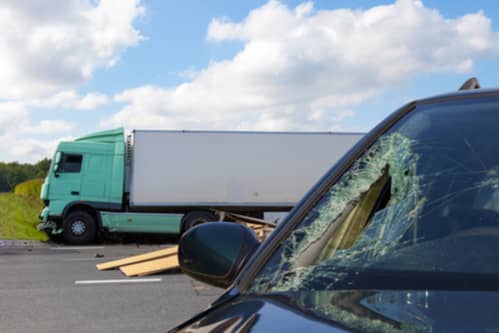
After a car wreck, one of the first questions on your mind is, can you claim car accident without police report? It’s a common worry, especially after a minor collision where calling the police didn't seem necessary at the moment. The good news is that you can still pursue a claim.
The short answer is yes, you can absolutely file an insurance claim in Georgia without a police report. While it requires you to be more diligent, it is entirely possible to get the compensation you need. Understanding how to proceed is the first step toward a successful outcome.
Why You Can Still File a Claim in Atlanta
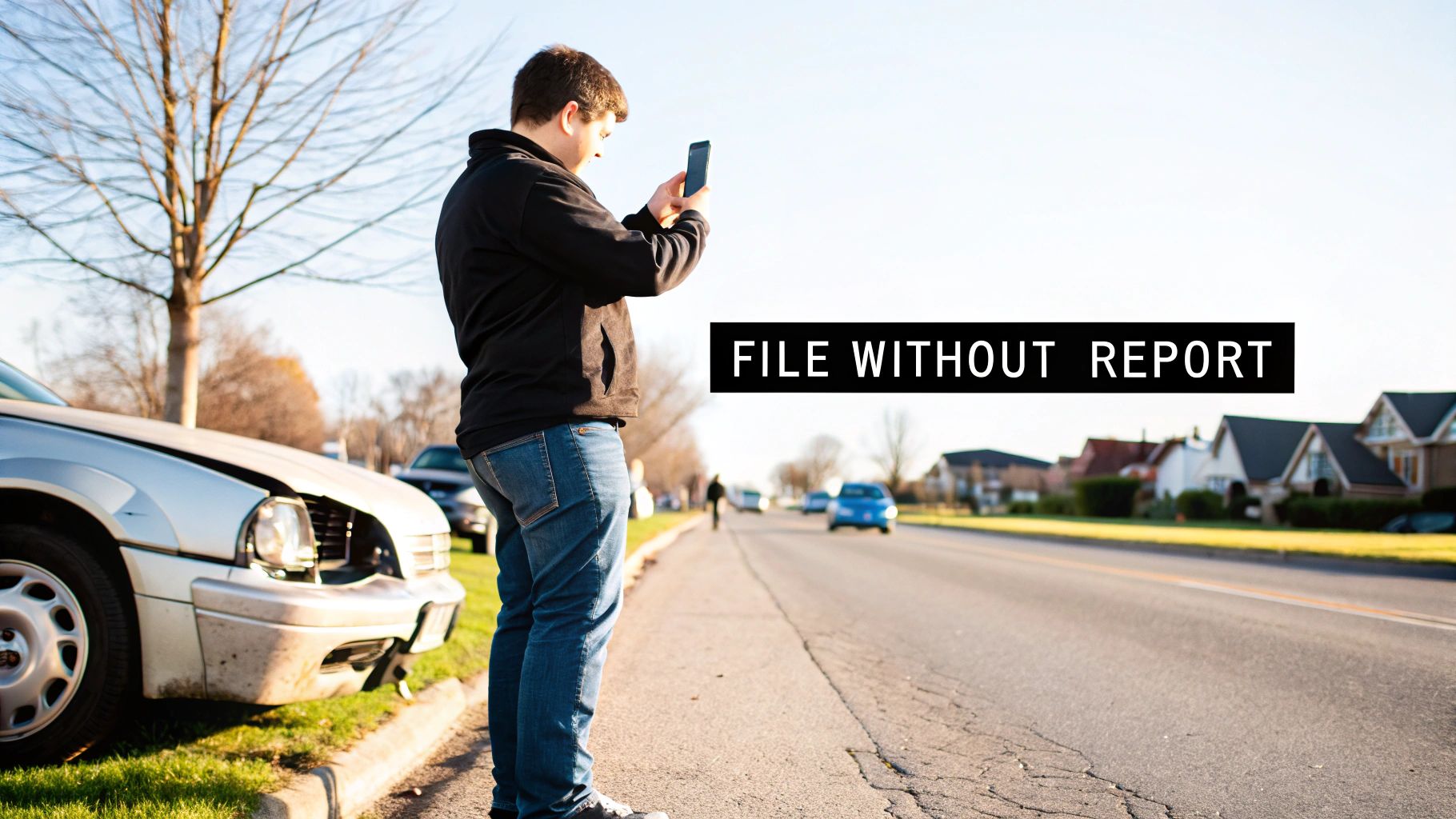
It’s a persistent myth that a missing police report is an automatic deal-breaker for your claim. The truth is, while an officer's report is a helpful piece of evidence, it isn't the only piece of evidence an insurance company or a court will look at. Think of a police report as a shortcut to establishing the facts—but its absence doesn't mean the road to compensation is closed.
There are plenty of reasons why an accident might not have an official report. Sometimes, police won't respond to a minor fender-bender if there are no injuries, especially if it happened on private property like a grocery store parking lot. Other times, the other driver might talk you out of calling, promising to pay for everything out-of-pocket.
No matter the reason, the path forward is clear: the job of proving what happened now falls squarely on your shoulders.
Your Role Shifts from Victim to Investigator
When there's no official account from an officer, it's up to you to build the case from scratch. This means your personal evidence collection becomes the absolute cornerstone of your claim. A missing report isn't a dead end; it's a signal that you have to be extra methodical in gathering your own proof.
To successfully move your claim forward, you'll need to provide clear, compelling evidence that proves:
- How the accident happened: The play-by-play of the collision.
- Who was at fault: Proof that the other driver’s negligence caused the wreck.
- The extent of your damages: Solid documentation of your vehicle repairs, medical bills, and lost income.
This is a bigger lift, for sure. But understanding how to file a car accident claim in Atlanta without this key document is the first step toward getting the compensation you deserve.
What an Insurance Adjuster Looks For
When an insurance adjuster gets a claim that's missing a police report, their skepticism meter goes way up. They're going to scrutinize every single piece of evidence you provide with a fine-toothed comb, looking for consistency, credibility, and concrete proof.
Without the objective summary from a law enforcement officer, the adjuster's job is to reconstruct the accident using only what you and the other party provide. Your collection of photos, witness statements, and personal notes must paint a picture so clear that there is little room for dispute.
A well-documented case can absolutely overcome the absence of a report. The table below breaks down exactly what a police report usually provides and what you’ll need to gather to fill those gaps.
Police Report vs Your Evidence: What Your Claim Needs
When a police report is missing, you have to recreate the information it would have contained. Here’s a look at how your own evidence can step in to do the job.
| Information Needed for Claim | How a Police Report Provides It | Your Alternative Evidence |
|---|---|---|
| Identities of Parties | Officer records names, licenses, insurance, and contact info. | Your own photos of their documents, notes, and information exchange. |
| Date, Time, & Location | Officially recorded with cross-streets and landmarks. | Timestamped photos, location-tagged images, or your detailed notes. |
| Sequence of Events | Officer's narrative based on statements and scene evidence. | Your written account, witness statements, and photos of the final crash scene. |
| Initial Fault Assessment | Officer may issue a citation or note contributing factors. | Witness testimony, photos of vehicle positions, and traffic camera footage. |
| Vehicle Damage | Official description of damage to all vehicles involved. | Extensive photos and videos from multiple angles, plus repair estimates. |
| Witness Information | Officer collects names and contact details of bystanders. | You must get names, phone numbers, and a brief statement from anyone who saw it. |
A strong collection of alternative evidence can build a powerful and undeniable narrative. The key is knowing that while you can file a claim without a police report, your success hinges entirely on the strength of the proof you gather yourself.
The Role of a Police Report in a Car Accident Claim
When you're trying to figure out if you can claim car accident without police report, it helps to first understand what that report actually does. Think of a police report as the official, third-party story of the crash. Insurance adjusters and legal teams almost always use it as their starting point because it neatly bundles all the key details into one document.
A typical accident report is a snapshot of the incident. It includes the date, time, and location, plus the names, contact info, and insurance details for everyone involved. It often contains witness statements, a diagram of the scene, and sometimes, the officer’s initial take on who was at fault. This neutral summary can make the claims process a lot smoother.
But let's be clear: its absence doesn't automatically kill your claim. There are plenty of legitimate reasons why a report might not exist for an Atlanta car wreck.
Why You Might Not Have a Police Report
It’s a common scenario. Atlanta police may not respond to minor accidents, especially if there are no obvious injuries and the crash happened on private property, like a shopping center parking lot. Sometimes, the other driver might talk you out of calling 911, promising to handle everything directly to keep insurance or law enforcement out of it.
Whatever the reason for the missing report, the key takeaway is this: its absence is not a roadblock, but a detour. It means the responsibility to prove what happened, who was at fault, and the extent of your damages now rests entirely on you.
You essentially become the lead investigator for your own case. Without an officer’s objective account, the evidence you gather has to be strong enough to tell the story clearly and convincingly to an insurance adjuster.
The Impact on Your Insurance Claim
Insurance companies love police reports because they provide an impartial foundation for their investigation. When a report is missing, the adjuster will lean much more heavily on the evidence you and the other driver provide. This can quickly spiral into a "he said, she said" situation if your stories don't match up.
This reality is more common than you might think. Data from the National Highway Traffic Safety Administration (NHTSA) showed that in 2022, roughly 14% of vehicle-related insurance claims were successfully filed without a police report. This statistic shows that a significant number of claims get through the system based on other forms of proof, especially for minor accidents and property damage claims. You can discover more insights about these accident claim statistics and see that it is quite possible to move forward.
The absence of a report simply raises the stakes for your own documentation. Your photos, videos, witness contacts, and detailed personal notes become the primary evidence used to determine fault and calculate compensation. So while it is certainly possible that you can claim car accident without police report, your success will depend entirely on how well you build your case.
How to Build a Strong Case on Your Own
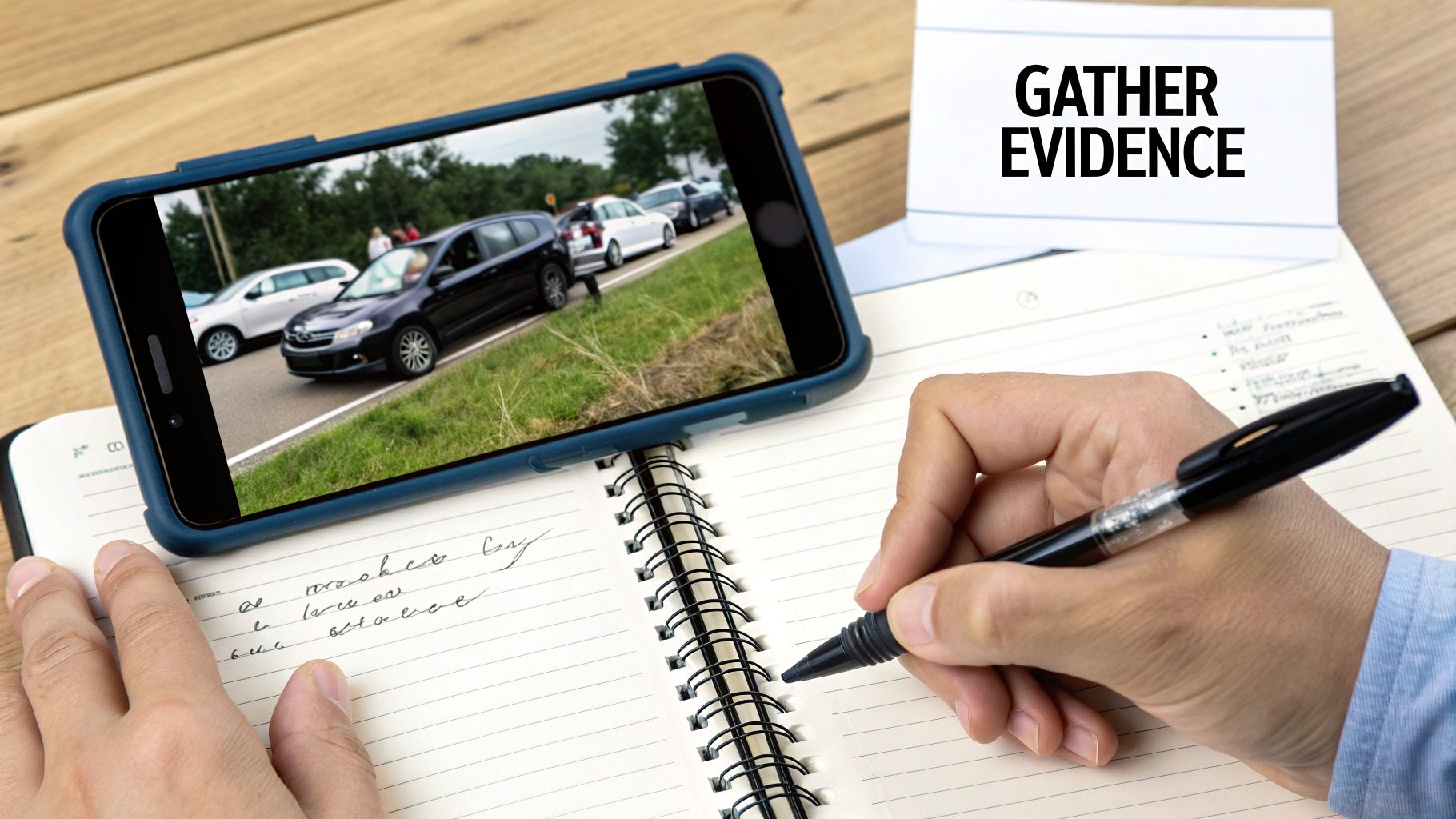
Without a police report, the evidence you gather becomes the bedrock of your entire claim. Your job is to create a record of events so clear and compelling that an insurance adjuster has no room to second-guess what happened.
Fortunately, the most powerful evidence-gathering tool you have is already in your pocket: your smartphone.
If it's safe to do so, start documenting everything immediately after the collision. You need to think like a crime scene investigator, capturing the scene exactly as it is before anything gets moved or memories start to fade. This kind of visual proof is almost always more persuasive than a verbal account alone.
Take far more photos and videos than you think you’ll need. Get shots from every conceivable angle—close-ups of the damage on both cars, wider shots showing their final positions on the road, and pictures of the general area. This helps build a complete visual story.
Creating an Indisputable Visual Record
To build a truly solid case with just your phone, you need to capture specific details that tell the full story. These elements are what an adjuster or legal team will use to reconstruct the accident with precision.
Your photo and video checklist should include:
- Vehicle Damage: Get close-up shots of every dent, scratch, and broken part on all vehicles involved. Step back and take wider photos to show the full extent of the damage in context.
- The Scene: Document the final resting positions of the cars before they are moved. This is very important for establishing the point of impact and the forces at play.
- Road Evidence: Look for skid marks, debris scattered from the collision, and any other physical evidence left on the pavement.
- Surroundings: Photograph nearby traffic signs (like stop signs or speed limit postings), traffic lights, and the general road conditions. Was it raining? Was the sun causing a glare? Context is everything.
- License Plates and VINs: Get clear, readable photos of the license plates and Vehicle Identification Numbers (VINs) for every car.
This level of thorough documentation makes it incredibly difficult for the other driver to change their story later.
A picture is worth a thousand words, especially to an insurance adjuster reviewing dozens of cases a day. A comprehensive photo library can shut down disputes about impact severity or the sequence of events before they even start.
Gathering Information and Witness Accounts
Once you’ve thoroughly documented the scene, your next step is collecting information. Politely exchange details with the other driver, but don’t just rely on them scribbling down a number. Take photos of their documents.
Get clear pictures of their:
- Driver's License
- Insurance Card
- Vehicle Registration
This simple step prevents typos and ensures you have completely accurate information.
If anyone stopped to help or saw the accident happen, their input is gold. A statement from a neutral, third-party witness can easily break a "he said, she said" stalemate. Be sure to ask for their full name and phone number.
Documenting Your Own Recollection
Finally, as soon as you can, write down everything you remember. Stressful events can make memories fuzzy or jumbled over time, so creating a written record right away is a powerful move.
In your notes, detail the sequence of events leading up to the crash, what you were doing, what you saw the other driver do, and any specific conversations at the scene. Did they apologize or say something like, "I'm so sorry, I didn't even see you"? Write that down.
This personal account, supported by your photos and any witness information, forms the core of your argument. It’s this evidence that will define the outcome of your personal injury claims when you have to claim car accident without police report. You can absolutely succeed, but only if your own evidence is complete and convincing.
Understanding Georgia Law for Accidents Without Reports
When you’re trying to figure out if you can claim car accident without police report, the first place to look is Georgia's own traffic laws. The state has very clear rules about when you must call the police, and those rules can affect your case.
Under Georgia law—specifically O.C.G.A. § 40-6-273—you are legally required to report any crash that involves an injury, a death, or apparent property damage of $500 or more. If your collision hits any of those marks, not having a report can create serious headaches later.
But what about truly minor fender-benders? For a small scrape in a parking lot with damage that’s obviously under the $500 threshold, a police report isn't legally mandated. This is an important distinction, as it provides a legitimate reason why some accidents don't have an official police record.
Georgia’s Reporting Threshold Explained
The law draws a clear line in the sand with that $500 figure. Here’s a look at the actual text of the statute that sets this requirement for reporting accidents in Georgia.
This screenshot confirms a driver’s duty to immediately report any accident causing injury, death, or significant property damage. The takeaway is simple: the law focuses on severity. This is why a minor incident might not have an official report, and that’s perfectly legal.
This legal setup also reflects a practical reality. The sheer number of collisions is staggering. According to the World Health Organization, road traffic crashes cause about 1.19 million deaths annually worldwide and injure tens of millions more. With numbers that high, police resources are stretched thin, making minor damage calls a low priority. You can read the full fact sheet on global road traffic injuries to see the full scope of the problem. As a result, insurance companies have had to adapt, creating their own solid processes for handling claims that don’t come with police paperwork.
How Fault is Determined Under Georgia Law
Even more important to your claim is how Georgia handles fault. We operate under a "modified comparative negligence" rule, which is outlined in O.C.G.A. § 51-12-33. This legal principle is what decides if you can get any money for your damages—and if so, how much.
Under this rule, you can recover damages as long as you are found to be less than 50% at fault for the accident. If your share of the blame is 50% or more, you are barred from recovering anything from the other party.
Your final compensation is also reduced by your percentage of fault. It’s not an all-or-nothing system unless you hit that 50% mark.
- Example: Let’s say you’re in a crash and have $20,000 in damages.
- The insurance adjuster investigates and determines you were 10% at fault.
- Your compensation would be reduced by that 10%, meaning you could recover $18,000.
When there's no police report offering an officer's initial take on what happened, this fault determination falls entirely on the evidence you and the other driver can provide. Those photos, witness contacts, and notes you took at the scene become the adjuster's entire playbook for assigning these important percentages.
It's also essential to act fast. Deadlines for taking legal action are strict. For a complete breakdown of these timelines, you can learn more about the statute of limitations for personal injury in Georgia in our detailed guide. Understanding these laws is non-negotiable when you need to successfully handle a claim where you can claim car accident without police report.
Communicating with the Insurance Company
Talking to an insurance adjuster can feel like walking through a minefield, especially when you need to claim a car accident without a police report. You have to remember one thing: the adjuster's job is to protect their company's bottom line. That means they are professionally trained to find reasons to minimize or outright deny your claim.
When you file, expect them to zero in on the missing police report. They will ask pointed questions about why law enforcement wasn't called, and every piece of evidence you submit will be put under a microscope. This is standard procedure, not a personal attack, so don't let it intimidate you.
How to Prepare for the Conversation
The key to a productive conversation is being calm, organized, and unshakable in your account of the facts. Before you even think about dialing their number, get all your evidence in one place. Your photos, witness contact information, repair estimates, and a detailed written statement of what happened should all be ready to go.
Presenting a clear, well-organized file from the start shows the adjuster you're serious and prepared. It forces them to work from your narrative, rather than trying to piece together a story that might not be in your favor.
Here are a few ground rules for those first conversations:
- Stick to the Facts. Never guess about speeds, distances, or what the other driver was thinking. If you don't know, say so.
- Do Not Apologize. Even a simple, well-meaning "I'm so sorry" can be twisted into an admission of fault.
- Be Brief and Factual. Answer the questions asked, but don't volunteer extra information. Let your evidence do the heavy lifting.
What to Say and What to Avoid
Every word you say to an adjuster matters. They are listening for inconsistencies, admissions, or anything that could weaken your claim. Keep your statements simple and direct.
An insurance adjuster can use your own words to increase your percentage of fault under Georgia's comparative negligence rule. A seemingly innocent comment can be misinterpreted to reduce your settlement or even result in a denial of your claim.
Here’s a quick guide to help you frame your statements:
| What to Say (Factual and Neutral) | What to Avoid (Speculative or Emotional) |
|---|---|
| "The other car merged into my lane." | "The other driver was being reckless and just swerved at me." |
| "I am getting medical care for my neck." | "I think I have whiplash, but I'm not sure." |
| "I have photos of the vehicle damage." | "It doesn't look that bad, but it might be expensive to fix." |
Protecting Yourself During the Process
Documentation is your best shield throughout the entire claims process. Keep a detailed log of every single interaction with the insurance company.
Document Everything:
- Date and Time of Call: Note the exact time and date of every phone call.
- Adjuster's Name: Get the full name and title of the person you spoke with.
- Summary of Conversation: Write down the key points discussed and any information or promises the adjuster made.
- Follow Up in Writing: After a phone call, send a brief email to the adjuster confirming your understanding of the conversation. This creates a paper trail.
Be cautious if the adjuster asks for a recorded statement. They often request one right away, but you are under no legal obligation to provide it immediately. It's almost always wise to politely decline until you've had a chance to organize your evidence and fully understand the extent of your injuries and damages.
By staying organized, sticking to the facts, and carefully documenting all your interactions, you give yourself the best possible chance to keep your claim on track, even if you have to claim a car accident without a police report.
Immediate Steps After an Accident with No Police Report
So, the accident happened, and for whatever reason, no police report was filed. Don't panic. Even if you've already left the scene, you can still take important steps to protect your right to claim a car accident without a police report. What you do in the hours and days that follow is very important for building your insurance claim, especially when there's no official officer's narrative.
Your first move, always, is to address your health. If you feel any pain at all—even a minor ache or stiffness—get checked out by a doctor immediately. Injuries like whiplash or concussions often don't show up right away, and a medical evaluation creates a professional record linking your injuries directly to the crash. Without it, you're handing the insurance company an easy way to argue your injuries came from something else entirely.
Next, you absolutely must notify your own insurance company. Pretty much every policy has a clause that requires you to report an accident promptly. Waiting too long gives them an excuse to deny your claim. When you make the call, stick to the bare facts of what happened. Avoid saying anything that sounds like you're admitting fault, like "I'm so sorry" or "I didn't see them."
Strengthening Your Case After the Fact
Realize you didn't grab enough evidence at the scene? It's not too late. You can still go back and build a stronger case file for yourself.
- Return to the Scene: As soon as it's safe, go back to the accident location. Take clear photos of the intersection, traffic signals, speed limit signs, and anything that might have obstructed your view.
- File a Self-Report: Georgia gives you a powerful tool here. You can file your own report directly with the Georgia Department of Driver Services using a Self-Reporting Accident Form (SR-13). It's not the same as a police-filed report, but it creates an official, time-stamped record of your version of events.
- Gather All Documents: Start a folder and keep everything. That means your photos, medical bills as they arrive, and any quotes you get for vehicle repairs. Organization is your friend.
This infographic breaks down the basic flow for organizing your documents, communicating with the insurance company, and keeping a record of everything.
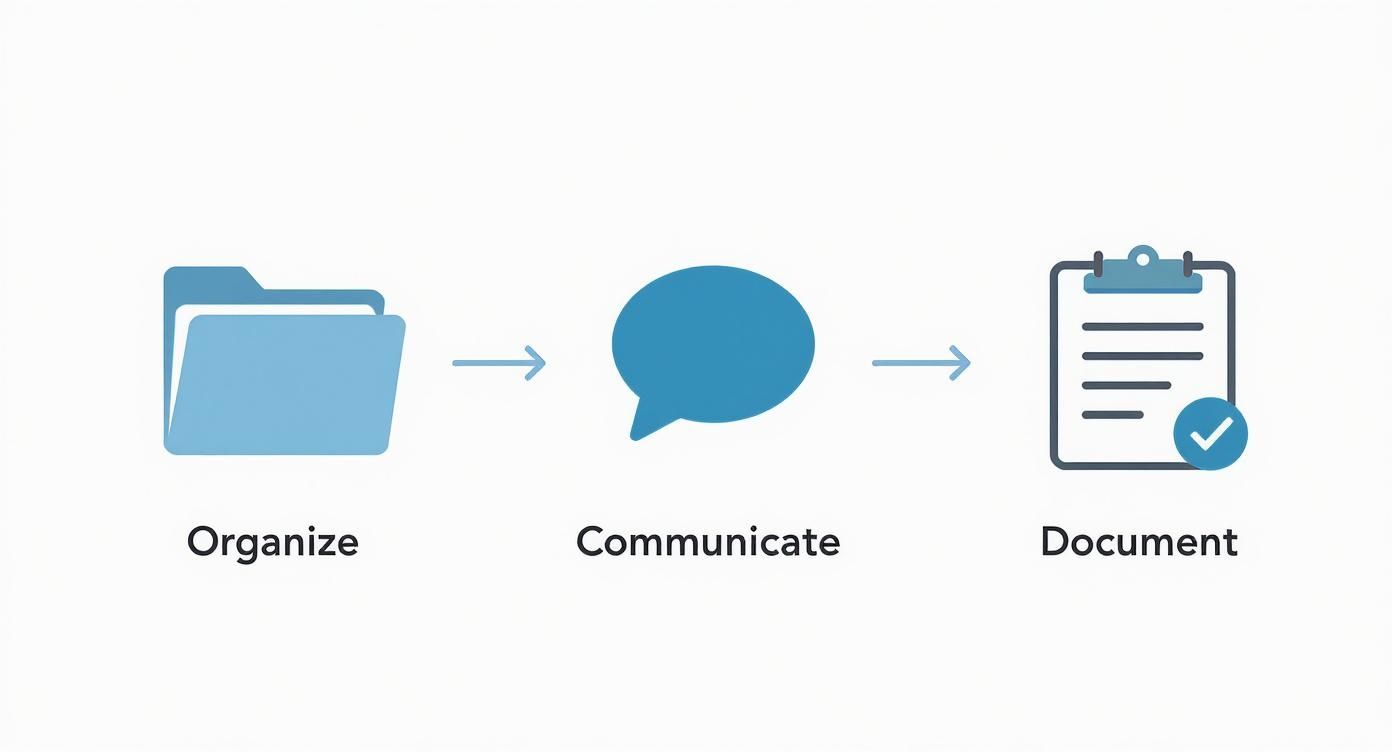
Think of it this way: when a police report is missing, a structured, well-documented file becomes your primary asset. You have to create the official record yourself. Different states have unique rules for this; some may require more comprehensive alternative evidence like sworn witness statements to make up for the lack of a police report.
For more general car accident advice that applies whether you have a police report or not, broader automotive resources can be helpful. By following these steps, you put yourself in a much stronger position to successfully claim a car accident without a police report.
Common Questions About Claims Without Police Reports
When you're trying to claim a car accident without a police report, it's completely normal to feel overwhelmed with questions. Here in Atlanta, we see a lot of people in this exact situation, and the same concerns come up time and time again. Let’s walk through some of the most frequent questions to bring some clarity.
What If the Other Driver Changes Their Story?
This is, without a doubt, one of the biggest risks you face when there's no official police report. The claim can quickly dissolve into a messy "he said, she said" argument, where the other driver outright denies what happened—or even denies they were there at all. This is precisely why the evidence you gather yourself becomes your most powerful tool.
Your best defense against a shifting narrative is solid proof:
- Photographic Proof: Time-stamped photos from the scene are incredibly difficult to dispute. Capture the damage to both cars, their positions on the road, and any relevant surroundings.
- Witness Information: A statement from an impartial third party who saw the crash can be the key to breaking a stalemate. Get their name and number.
- Digital Trail: Any text messages, voicemails, or emails exchanged with the other driver after the accident can serve as an admission that the collision occurred.
Can I Get a Police Report Filed After the Fact?
Trying to get an officer to create a formal report days after an accident is next to impossible. Police need to investigate the scene as it happened to document it accurately. But that doesn't mean you can't create an official record of your own.
You can go to an Atlanta police precinct and file an incident report. While it doesn't hold the same legal weight as a report filed at the scene, it officially documents your version of events. Even better, if the crash involved an injury or more than $500 in property damage, you can file a Self-Reporting Accident Form (SR-13) directly with the Georgia Department of Driver Services.
Filing your own SR-13 with the DDS creates a formal, dated record of the incident. This document shows an insurance adjuster you took the proper steps to report the crash, which adds credibility to your claim.
Will My Insurance Rates Go Up Without a Police Report?
Filing any claim has the potential to affect your insurance rates, whether a police report exists or not. The two factors that really matter are who was at fault and the total cost of the claim.
If you were clearly not at fault and the other driver's insurance covers the damages, your rates are unlikely to go up. But if you're found to be partially or fully responsible, an increase is much more probable. The absence of a report just means you have to rely on your own evidence to prove you weren't at fault. For a deeper dive into specific legal terms, our firm offers a helpful legal dictionary to clear up any confusion.
The bottom line is simple: fault, not the report itself, is what drives rate changes after you claim car accident without police report.
If you're hitting a wall with a difficult claim or the insurance company is giving you the runaround, you don't have to handle it alone. The team at Jamie Ballard Law is here to help you build the strongest case possible and fight for the full compensation you deserve. Contact us today for a free, no-obligation case evaluation at https://jamieballardlaw.com.