When you’ve been hurt in an accident, the first question that pops into your head is almost always, “Who’s going to pay for all of this?” The answer usually begins with something called liability insurance.
So, as an Atlanta personal injury attorney, I want to break down exactly what is liability insurance coverage for you. Think of it as a financial shield for the person who caused the accident. It protects them from having to pay for the damages out of their own pocket. For you, the injured person, it’s the primary source of funds meant to cover your medical bills, lost wages, and pain and suffering. Understanding what liability insurance coverage is can help you protect your rights.
The Financial Shield After An Accident
Liability insurance coverage is designed to protect people and businesses from financial ruin when they are found legally responsible for someone else's injuries or property damage. This insurance is what pays for the legal fees, settlements, and court judgments, but only up to the limit of the policy.
In the United States, where a serious accident can easily lead to overwhelming medical and legal costs, this coverage is a basic necessity. It ensures the at-fault party's insurer has to step in and handle the financial fallout.
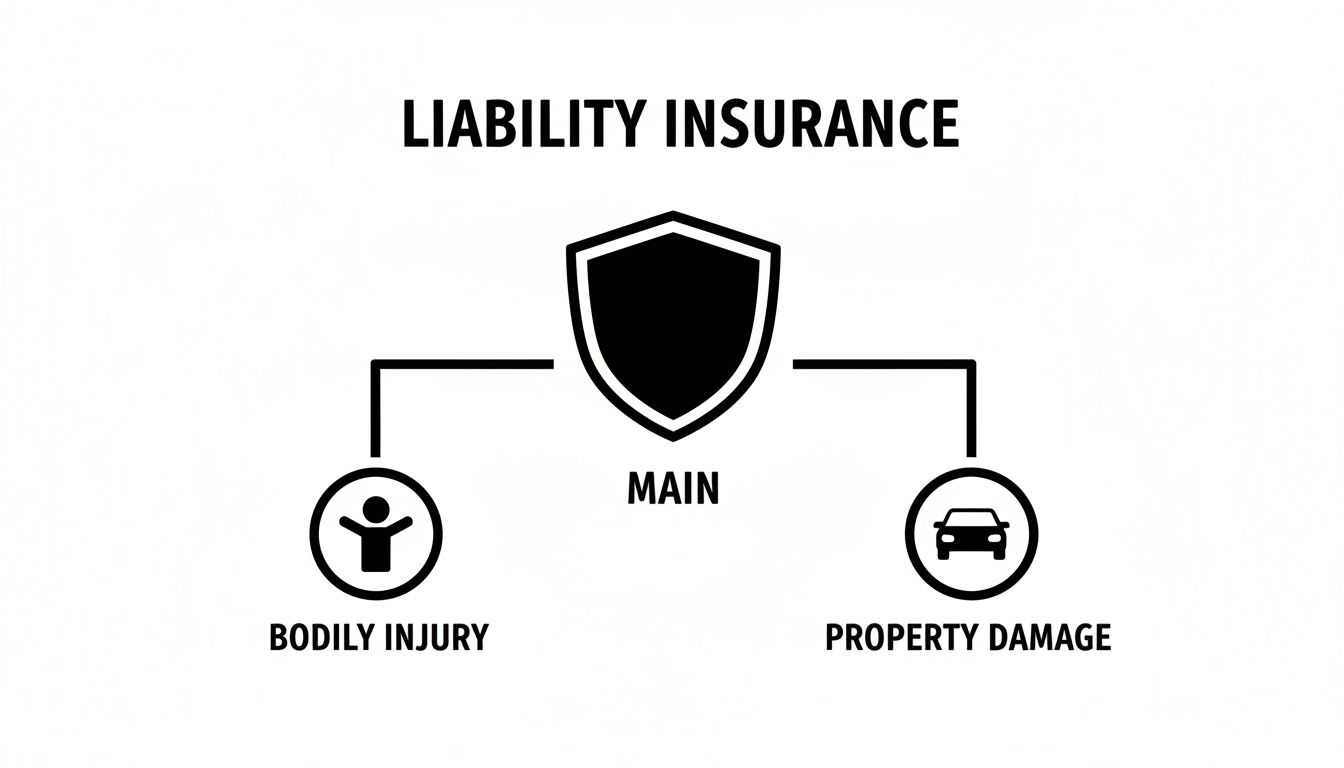
At its heart, liability insurance is split into two main parts. Imagine them as two separate buckets of money available to compensate you after an incident.
- Bodily Injury (BI) Coverage: This covers the human cost of an accident. It’s what pays for the ambulance ride, the hospital stay, physical therapy, and even the income you lose from being unable to work.
- Property Damage (PD) Coverage: This is for the "stuff" that was damaged. It covers repairs to your car after a crash or fixes a broken fence if someone drives through your yard.
Understanding The Two Main Components
These two types of coverage work hand-in-hand, but they are completely separate. The at-fault person’s insurance policy will have different limits for each one. This means there’s a maximum amount the insurance company will pay for your injuries and a separate, distinct maximum for your damaged property.
It's easy to get lost in the legal jargon, so if you ever come across unfamiliar terms, you can check out our firm's legal dictionary for plain-English explanations.
This table breaks down the two core components of liability insurance to show what each part typically covers after an accident.
Liability Insurance At A Glance Bodily Injury vs Property Damage
| Coverage Type | What It Pays For | Example Scenario |
|---|---|---|
| Bodily Injury (BI) | Medical bills, lost income, physical therapy, pain and suffering, funeral costs. | You're rear-ended and suffer whiplash. The at-fault driver's BI coverage pays for your doctor visits and missed workdays. |
| Property Damage (PD) | Repair or replacement of another person's vehicle or property. | A driver runs a red light and totals your car. Their PD coverage pays for the value of your vehicle. |
Having these separate coverages ensures that both your physical recovery and your property losses are addressed, though each is subject to its own policy limits.
How It Applies In Different Situations
Liability insurance isn’t just for car accidents. It comes into play in many situations where one person's carelessness causes harm to someone else.
For example, a homeowner's insurance policy has a liability component that could cover a guest who slips and falls on a wet floor. Likewise, a business's general liability policy would cover a customer who gets injured by a falling object inside a store.
For a deeper dive into how these protective agreements are structured, you can explore this complete guide to a homeowners insurance policy.
My goal here is to give you a solid foundation for understanding what is liability insurance coverage. Knowing how Bodily Injury (BI) and Property Damage (PD) cover your losses after a car, truck, or slip-and-fall accident in Atlanta is the first step. From here, we can dig into the specifics that will directly impact your claim.
How Bodily Injury and Property Damage Coverage Works
To really get a handle on what liability insurance coverage is, you have to see it as two distinct policies rolled into one. When an accident happens, one part of the policy covers the human toll, while the other handles the physical wreckage.
These two components are Bodily Injury (BI) coverage and Property Damage (PD) coverage. While they operate under a single policy, they are completely separate. They cover different kinds of losses and, importantly, have different pools of money to pay for those losses.
Covering the Human Cost: Bodily Injury Liability
Bodily Injury (BI) liability is the part of an at-fault driver's insurance that pays for the physical harm they cause to other people. This is the most important part of any liability policy, because the financial impact of serious injuries can be devastating and last for years.
When you're hurt in a crash that wasn't your fault, the other party’s BI coverage is on the hook for a wide range of costs tied directly to your injuries. This includes:
- Immediate Medical Care: Covers the ambulance ride, emergency room treatment, and any surgeries needed right after the wreck.
- Ongoing Treatment: Pays for follow-up doctor visits, physical therapy, chiropractic care, prescriptions, and medical equipment like crutches or walkers.
- Lost Wages: If your injuries keep you out of work, this coverage is meant to compensate you for the income you've lost.
- Pain and Suffering: This is compensation for the physical pain, emotional trauma, and disruption to your life caused by the accident. Under Georgia law, this is a real and compensable harm.
Think about a major pile-up on I-285. A distracted driver looks down at their phone and plows into the car ahead, triggering a chain reaction. That driver's BI coverage is responsible for the medical bills of every single person injured in the crash, up to the limits of their policy.
Repairing the Damage: Property Damage Liability
While BI coverage handles the people, Property Damage (PD) liability takes care of the things. Its sole purpose is to pay for the repair or replacement of any physical property the at-fault party damaged or destroyed.
It's a common mistake to think PD coverage is just for cars. It actually covers nearly any type of property, including buildings, fences, guardrails, mailboxes, or even a laptop that was ruined in a collision.
For example, if a delivery truck misjudges a turn and smashes into the front of a shop in Buckhead, the trucking company's PD liability insurance pays to fix the storefront. If that same truck also sideswiped a parked car, the PD coverage would pay for those repairs, too. The key is that it covers property belonging to others—not the at-fault driver's own vehicle.
You can learn more about Georgia's accident responsibility laws directly from the state's Department of Public Safety.
Understanding this fundamental split between covering people and property is the first step in protecting your rights. When you are injured, your claim is against the BI portion of the policy. Your auto body shop, on the other hand, will deal with the PD adjuster. Knowing which is which helps you manage the claims process and demand fair compensation for everything you lost. This is the practical side of understanding what is liability insurance coverage.
Understanding Policy Limits And Why They Matter In Georgia
Every auto insurance policy has a cap on what it will pay out after a crash. We call this the policy limit, and it's the absolute maximum an insurer is on the hook for. When you look at a liability policy, you'll often see these limits written as three numbers, like 25/50/25. This isn't just industry jargon—each number represents a specific dollar amount available to cover the harm someone else causes.
Think of an insurance policy as a bucket of money reserved for a single accident. The policy limits define how big that bucket is. Once the money is paid out, the bucket is empty, and the insurance company’s job is done. This is true no matter how high your medical bills or other losses climb.
Decoding The Numbers On A Georgia Auto Policy
So, what do those numbers actually mean for you? In Georgia, the law requires every driver to carry a minimum amount of liability coverage. Under the Official Code of Georgia Annotated (O.C.G.A.) § 33-7-11, those state minimums are:
- $25,000 per person for Bodily Injury (BI). This is the most the at-fault driver's insurance will pay for any one person’s injuries.
- $50,000 per accident for Bodily Injury (BI). If multiple people are hurt, this is the total amount the insurer will pay for all injuries combined.
- $25,000 per accident for Property Damage (PD). This is the maximum available to fix or replace property, like your vehicle, that was damaged in the crash.
This structure puts a firewall between the funds available for physical injuries and the funds available for property repairs, with separate limits for each.
When The Minimum Is Not Enough
Here in Atlanta, a $25,000 bodily injury limit can disappear in the blink of an eye. A single ambulance ride and a trip to the ER after a serious truck accident can easily surpass that amount. Once the at-fault driver's policy limit is hit, their insurance company won't pay a penny more, potentially leaving you with a staggering amount of unpaid medical debt.
Liability insurance is a massive industry—the global market was valued at $291.86 billion in 2024, and North America accounts for 46% of that total. As detailed in this liability insurance report, a primary reason for this is the high risk of litigation in the U.S., which makes having enough coverage absolutely necessary.
So what happens when your losses are greater than the at-fault driver’s policy limits? This is where your own insurance policy can step in to become your most important financial safety net.
Your Safety Net: Uninsured And Underinsured Motorist Coverage
This is exactly why carrying Uninsured/Underinsured Motorist (UM/UIM) coverage on your own policy is so important. It’s designed to protect you in two all-too-common situations:
- Uninsured Motorist (UM): The at-fault driver has no insurance at all, or they flee the scene in a hit-and-run.
- Underinsured Motorist (UIM): The at-fault driver has insurance, but their policy limits are too low to cover the full extent of your damages.
Let’s say your medical bills hit $80,000, but the driver who hit you only carries the state minimum $25,000 BI limit. Their insurer pays the $25,000, and that's it. Your own UIM coverage could then kick in to cover the remaining $55,000, up to the limits you purchased. Without it, you'd likely be responsible for that bill yourself. Understanding how these coverages work together is central to knowing what is liability insurance coverage and how to protect yourself.
How Insurance Companies Evaluate Your Injury Claim
It’s a common misconception that after a serious accident, you just send your medical bills to the at-fault party’s insurance company and wait for a check. If only it were that simple.
The reality is quite different. The moment a claim is filed, the insurance carrier opens an investigation with one primary objective: to minimize how much they have to pay. It’s not personal—it’s just business.
An insurance adjuster is assigned to your case, and their entire job is to scrutinize every single detail. They will work to determine fault, review every page of your medical history, verify lost income, and ultimately place a dollar value on your pain and suffering. They have a specific playbook, and understanding their methods is the first step in building a strong response.
The Adjuster's Investigation Playbook
The adjuster starts by gathering evidence, much like an attorney would, but their goal is the opposite. They are actively looking for reasons to reduce or deny your claim.
Here’s what they focus on:
- The Official Police Report: They’ll comb through the narrative, diagrams, and any citations issued to see who the officer believed was responsible.
- Witness Statements: Adjusters will try to contact anyone who saw the accident. Their goal? To find inconsistencies in your story or statements that shift blame.
- Photos and Scene Evidence: Pictures of vehicle damage, skid marks, and the surrounding area help them reconstruct the accident from their point of view, not yours.
- Medical Records and Bills: This is a major focus. They hunt for any pre-existing conditions, gaps in your treatment, or doctor’s notes that might suggest your injuries aren’t as severe as you claim.
They methodically build a file on you, documenting every shred of information that supports their side. This is why the information you provide—and how you provide it—is so important. You can learn more about how this unfolds in our guide on personal injury claims.
Calculating The Settlement Offer
Years ago, an adjuster might have evaluated a claim based on experience and intuition. Those days are largely gone. Today, many large insurance companies rely on sophisticated software to calculate settlement offers.
They input data from your case—things like your medical diagnosis codes, the type of treatment you received, and how long your therapy lasted—and the software spits out a settlement range.
This software-driven approach completely fails to capture the true human cost of an injury. A computer can't understand the chronic pain that keeps you from sleeping, the trauma of the accident itself, or the simple fact that you can no longer pick up your child without wincing.
The process is always evolving, with new technologies like artificial intelligence playing an even bigger role. To get a sense of how insurers might be using these tools, you can find insights on AI in insurance claims. This is why the first offer you receive is almost always a lowball. It’s a number generated by an algorithm, not one based on a compassionate understanding of your life.
Knowing their playbook allows you and your attorney to build a counter-strategy. We gather our own evidence, present your medical story in a compelling way, and demonstrate the full, real-world impact the injury has had on your life. By anticipating their tactics, we can effectively challenge a lowball offer and fight for the full compensation you actually deserve.
Common Policy Exclusions To Be Aware Of
While liability insurance provides a broad financial safety net, it's important to understand that it doesn't cover everything. Every policy has a section detailing its exclusions—specific situations, actions, or types of damage the insurance company simply will not pay for.
Knowing these limitations upfront can save you from the shock and frustration of a denied claim right when you need help the most.
Think of it this way: your liability coverage is like a highly trained bodyguard hired to protect you from financial harm you accidentally cause. But that bodyguard has a strict set of rules and won't step in if the harm was caused on purpose.
Intentional Acts and Harm
This is the most fundamental exclusion you'll find in nearly any liability policy. If a person intentionally harms someone or deliberately damages their property, their liability insurance will not cover it. Insurance is designed to manage the financial risk of accidents and negligence, not to underwrite malicious acts.
For example, if a driver gets into a road rage incident and purposely rams your car, their auto liability carrier will almost certainly deny the claim. They will cite the "intentional acts" exclusion, leaving you to pursue compensation directly from the individual—a much harder path to recovery.
Business Use of a Personal Vehicle
Another common exclusion kicks in when a personal vehicle is used for business purposes. Standard auto liability policies are priced for typical commuting and personal errands, not commercial activity.
If you are hit by someone driving for a rideshare company, making deliveries, or performing other work-related tasks, their personal auto policy may deny the claim. This is why commercial drivers are legally required to carry separate, more expensive commercial auto insurance policies designed to cover the higher risks of being on the road for work.
Family and Household Exclusions
Liability policies often contain what’s known as a household exclusion. This clause typically prevents you from filing a liability claim against a family member who lives with you if they cause an accident while driving your car. The original intent was to prevent fraudulent claims within a family.
It’s also important to remember that the at-fault party's liability insurance never pays for their own injuries or property damage. If a driver causes a crash, their BI/PD coverage only pays for the harm they caused to others. To cover their own medical bills, they would need separate coverage like MedPay or to use their personal health insurance.
Understanding the boundaries of what is liability insurance coverage is just as important as knowing what it does cover. Exclusions define the edges of that financial protection, and being aware of them helps you manage your expectations after an accident.
The legal climate directly impacts how insurance companies structure these policies. For instance, while global property and casualty insurance rates saw modest increases recently, the United States experienced a significant 8% spike. This was largely attributed to what the industry calls "adverse litigation trends"—like large jury verdicts—which directly influence the cost and scope of coverage. You can explore more data on how litigation affects liability insurance trends here.
This is exactly why insurers are so specific about what they will and will not cover. By clearly defining these exclusions, they manage their financial exposure in an increasingly expensive legal landscape. It reinforces just how important it is for you to know what a policy for what is liability insurance coverage actually entails.
Steps To Protect Your Claim After An Accident
The moments right after an accident are a blur of stress and confusion. It’s hard to think straight. But the actions you take in those first few hours can make or break your ability to get fair compensation.
Knowing what to do ahead of time helps protect your rights when you’re most vulnerable. Here’s a practical, step-by-step guide on what to do.

Prioritize Your Health and Safety
Your well-being is the absolute first priority. Seek medical attention immediately, even if you think you’re not seriously hurt. Adrenaline is powerful and can easily mask the pain from significant injuries.
Some of the most severe injuries, like internal bleeding or concussions, don’t show symptoms for hours or even days. Getting checked out at an ER or urgent care clinic creates a vital medical record that links your injuries directly to the accident. That documentation becomes hard evidence when you’re dealing with the at-fault party's insurer.
Document Everything at the Scene
If you are physically able, start gathering evidence right away. Skid marks get washed away by rain and cars get towed. Capturing the scene as it is, right after the crash, is essential.
- Call 911: Always report the accident to the police. The official police report is a powerful piece of evidence that provides an objective account of the incident.
- Take Photos and Videos: Use your smartphone. Get pictures of everything—the damage to all vehicles, license plates, skid marks, traffic signs, and the overall scene from several different angles.
- Get Witness Information: Did anyone see what happened? If so, ask for their name and phone number. Testimony from an independent witness can be incredibly persuasive.
Report the Incident and Speak Carefully
Once you are safe, it’s time to start the official claims process. Be very strategic about how you communicate. You have to notify your own insurance company about the accident promptly, as your policy requires.
But when the other driver’s insurance company calls, be careful. You are under no obligation to give them a recorded statement. Their adjusters are trained to ask leading questions designed to get you to say something that weakens your claim.
It is always best to politely decline a recorded statement until you have spoken with an attorney. You can simply say, "I am not prepared to give a statement at this time." This simple phrase protects you from unintentionally damaging your own case.
Following these initial steps builds a strong foundation for your claim. You can find a more detailed walkthrough in our article on how to file a car accident claim in Atlanta.
It's an interesting fact that when motor vehicle accident cases actually go to trial, defendants only win about 39% of the time. Contrast that with medical malpractice cases, where defendants win 81% of the time. While most cases settle long before a trial, these liability case statistics and trends show the facts often favor the injured person in a collision. By taking these steps, you build a solid case that shows exactly what happened and why your liability insurance coverage should pay for your recovery.
Common Questions About Liability Insurance Claims
When you're trying to make sense of the claims process, it's natural to have questions. Over my years of practicing law in Atlanta, I've heard just about all of them from my clients. To help you better understand what is liability insurance coverage actually means in a real-world scenario, here are some straightforward answers to the most common questions people ask.
These are the issues that come up again and again in car, truck, and premises liability cases. My goal is to give you clear, practical information you can use.
What If The At-Fault Driver's Insurance Is Not Enough To Cover My Bills?
This is a very common and incredibly stressful problem, especially after a serious crash. If the other driver's bodily injury liability limits are maxed out, your next move is to look at your own auto insurance policy.
This is exactly why you have Uninsured/Underinsured Motorist (UM/UIM) coverage. It's designed to step in and cover your remaining medical bills, lost wages, and pain and suffering, right up to your own policy limits. We always help clients track down every single source of available coverage to bridge that financial gap.
How Long Do I Have To File An Injury Claim In Georgia?
In Georgia, the time limit to file a lawsuit for most personal injury claims is generally two years from the date of the injury. This deadline is known as the statute of limitations.
If you miss that two-year window, you will almost certainly lose your right to pursue compensation forever. A few rare exceptions exist, but you should never count on them. It is always in your best interest to act fast to preserve important evidence and meet all legal deadlines. To learn more, you can read our detailed guide on the statute of limitations for personal injury in Georgia.
A common mistake is waiting, hoping the insurance company will eventually do the right thing. Unfortunately, any delay almost always benefits the insurer, not the person who was hurt.
Should I Give a Recorded Statement To The Other Driver's Insurance Company?
My advice is simple: No. I strongly advise against giving a recorded statement to the at-fault party's insurance adjuster without first speaking to a lawyer. Adjusters are trained professionals, and their primary job is to minimize their company's payout.
They know exactly how to ask leading or confusing questions designed to trick you. They want you to unintentionally say something that harms your claim, like admitting partial fault or downplaying how much pain you're in. Even a simple, out-of-context comment can be twisted and used against you later on.
It is far safer to let an experienced attorney handle all communications with the other side's insurer. This protects your rights at every turn and prevents you from falling into the common traps adjusters set. It allows you to maintain control over your claim and focus on what truly matters—your recovery.
If you've been injured and are dealing with an insurance company, you don't have to face it alone. At Jamie Ballard Law, we're here to answer your questions and fight for the full compensation you deserve. Contact us for a free, no-obligation case evaluation at https://jamieballardlaw.com.