Getting into a car wreck is bad enough. But when the driver who hit you doesn't have insurance, a bad situation can quickly turn into a financial nightmare. This is where uninsured motorist coverage in Georgia becomes your single most important line of defense. Think of it as a safety net that catches you when the person at fault simply can't pay for the damage they've caused. I've seen firsthand how this coverage can be the one thing standing between a family and financial disaster. Understanding the details of uninsured motorist coverage in Georgia is a key part of protecting yourself on the road.
Your Financial Shield Against Uninsured Drivers

Picture this: you're driving down I-75 when another car slams into you. The driver is at fault, but they've been breaking the law by driving without insurance. Who is going to pay for your medical bills? What about the income you'll lose while you recover? Without the right coverage, the answer could very well be you.
This is the exact scenario Uninsured Motorist (UM) coverage was created for. It’s a part of your own insurance policy that you can use when the at-fault driver has no liability insurance whatsoever. It’s also helpful in those incredibly frustrating hit-and-run accidents where you never find out who hit you.
What Does Uninsured Motorist Coverage Handle?
Essentially, your UM coverage steps into the shoes of the insurance the other driver should have had. It’s not just for fixing your car; it’s about making sure you and your family are taken care of after a collision.
It’s designed to cover a wide range of very real losses, including:
- Medical Bills: From the ambulance ride and emergency room visit to follow-up appointments and physical therapy.
- Lost Wages: If your injuries prevent you from working, this helps replace that lost income so you can keep your finances stable.
- Pain and Suffering: This compensates you for the physical pain, emotional distress, and disruption to your life caused by the accident.
The Uninsured Driver Problem in Georgia
The reality is, the risk of getting hit by an uninsured driver in Georgia is higher than most people think. The Insurance Research Council estimates that a staggering 12% to 18% of drivers on our roads are uninsured.
This risk is made even worse by our location. Florida has the highest rate of uninsured drivers in the entire country—nearly 27%—and the constant flow of traffic across our state line means Georgia drivers face an elevated risk every single day. You can get a deeper look into Georgia’s unique auto insurance landscape in this detailed article.
It's a dangerous misconception that your health insurance is enough. While it may cover some medical bills, it does absolutely nothing for your lost wages, property damage, or the very real pain and suffering that comes with a serious wreck.
This guide will break down how uninsured motorist coverage in Georgia works. We’ll also cover its close cousin, underinsured motorist (UIM) coverage, which protects you when the at-fault driver has insurance, but not nearly enough to cover your damages. Understanding both is the key to being fully protected on the road.
How Georgia Insurance Law Protects You
While carrying uninsured motorist coverage in Georgia isn't mandatory, state law puts a safety net in place. Insurance companies can't just leave this protection off your policy; they are legally required to offer it to you. This "opt-out" system is a fundamental safeguard designed to make sure every driver consciously decides whether to accept or decline this vital coverage.
The law is very specific here. You can't just tell your agent over the phone that you don't want it. Your rejection of UM coverage must be done in writing. This creates a clear paper trail, proving you understood the offer and made an intentional choice to refuse it. If an insurer can't produce that written rejection, the coverage is often considered part of your policy by default.
The Minimum Offer You Must Receive
Georgia's legal code sets firm ground rules for what insurers must propose. Under state law, specifically O.C.G.A. § 33-7-11, your insurer is required to offer you UM coverage with at least the state's minimum liability limits.
These minimums are:
- $25,000 per person for bodily injury.
- $50,000 per accident for bodily injury if multiple people are hurt.
- $25,000 per accident for property damage.
This statute was strengthened significantly back in 2009. The Georgia legislature amended the law to make "stacking" (or 'added-on') coverage the default option that must be offered. This is a far more protective form of UM coverage, and you can learn more about these specific statutory requirements to understand your rights.
Of course, these are just the starting points. You always have the option to purchase higher limits for greater financial protection—something we strongly encourage everyone to consider.
How The State Tracks Uninsured Drivers
Georgia takes the problem of uninsured drivers very seriously and has a robust system in place to identify them. The Georgia Electronic Insurance Compliance System (GEICS) is a database that lets law enforcement instantly verify a vehicle's insurance status during a traffic stop. This real-time check makes it much harder for uninsured drivers to fly under the radar.
Driving without insurance in Georgia is not a minor slip-up. The penalties are serious and can have a major impact on your life, highlighting just how important it is to maintain proper coverage for yourself and others on the road.
The consequences for getting caught without valid insurance are stiff and can include:
- Substantial fines and court fees.
- Suspension of your driver's license and vehicle registration.
- Potential jail time, especially for repeat offenders.
This strict enforcement drives home a key point: while you can't control whether other drivers obey the law, you can control your own preparedness. Having robust uninsured motorist coverage in Georgia is the single best way to shield yourself from the financial fallout caused by someone else's illegal and irresponsible choice to drive uninsured.
Multiplying Your Coverage With Stacking
When you're sorting through your options for uninsured motorist coverage in Georgia, you'll eventually run into the term "stacking." It's a powerful feature that can make a world of difference in your financial protection after a crash, but it’s often misunderstood by drivers.
Think of your insurance policies like building blocks. Stacking lets you pile them on top of each other to build a much bigger financial safety net.
In Georgia, stacking is officially called “add-on” coverage. It allows you to combine the UM limits from multiple vehicles on your policy, adding them together to create a larger pool of money available to you if an uninsured driver injures you.
How Stacking (Add-On) Works in Practice
Let’s walk through a simple, real-world example. Imagine you have two cars in your household, and each is insured with a $50,000 uninsured motorist policy limit.
- Car A: $50,000 in UM coverage
- Car B: $50,000 in UM coverage
If you choose to stack these policies, you’re essentially combining their power. This gives you a total of $100,000 in available UM benefits, regardless of which car you were in when the accident happened. This "add-on" approach gives a serious boost to your potential recovery.
The infographic below shows how Georgia law requires insurers to offer these protective options to drivers, putting the choice in your hands.
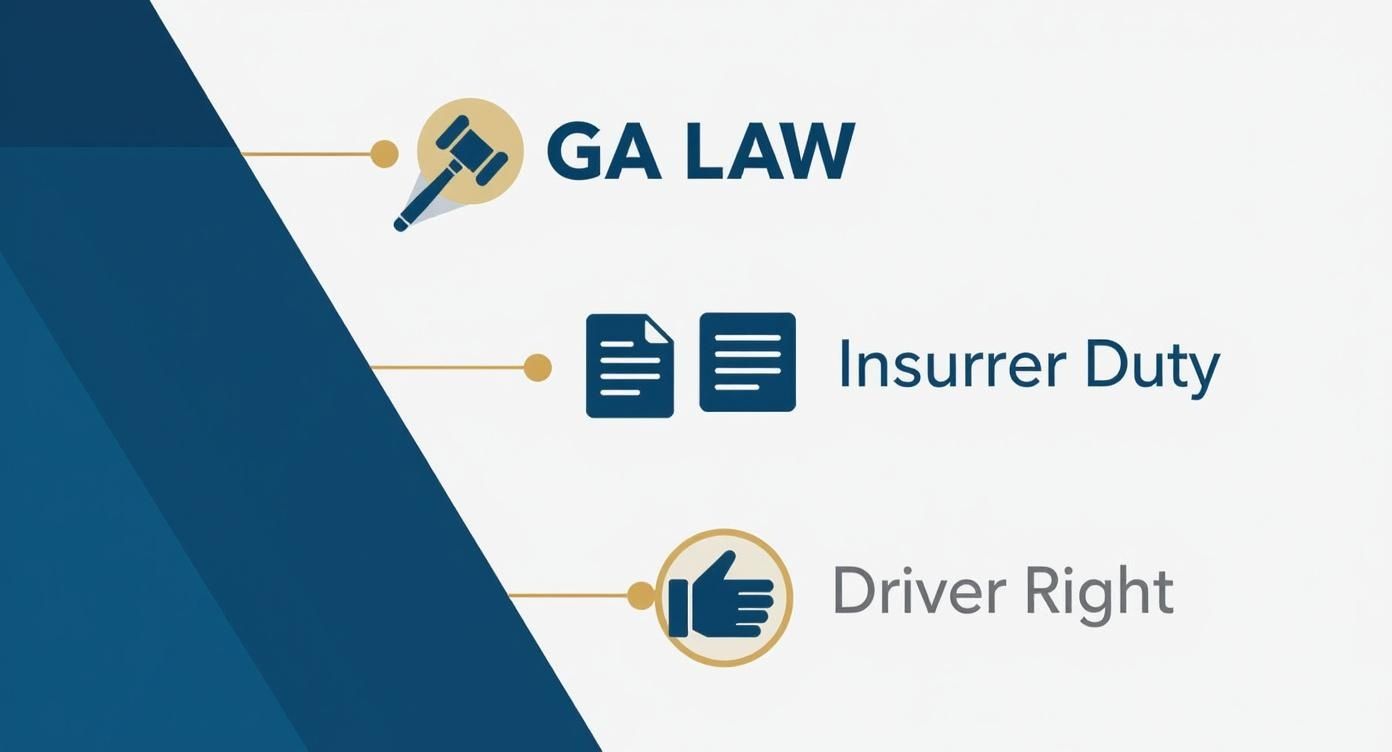
The key thing to remember is that Georgia law mandates that insurers offer this enhanced coverage, giving you the right to this higher level of protection.
The Alternative: Non-Stacking (Reduced-By) Coverage
The opposite of stacking is non-stacking, which Georgia calls “reduced-by” or "offset" coverage. With this policy, you can’t combine limits from different vehicles. You’re stuck with the UM limit of only the specific vehicle you were occupying during the collision.
Worse yet, a "reduced-by" policy means any payment you get from the at-fault driver's insurance is subtracted from your own UM coverage. If the at-fault driver has Georgia's minimum $25,000 liability coverage and you have a $50,000 "reduced-by" UM policy, your own insurance will only pay a maximum of $25,000 ($50,000 minus the $25,000 you already received). That can leave a massive hole in your financial recovery.
It's essential to know that under Georgia’s insurance regulations, "add-on" (stacking) coverage is the default that must be offered. To get the less protective "reduced-by" option, you have to specifically reject stacking in writing.
To see how big the difference is, let's compare how these policies would perform in a real scenario where your medical bills and other damages total $80,000.
Stacking vs Non-Stacking Payout Example
This table breaks down how each policy type responds after you've received the at-fault driver's policy limit of $25,000.
| Scenario Detail | Stacking (Add-On) Policy | Non-Stacking (Reduced-By) Policy |
|---|---|---|
| Your Total Damages | $80,000 | $80,000 |
| At-Fault Driver's Insurance Pays | $25,000 | $25,000 |
| Your Stacked UM Coverage (2 cars @ $50k) | $100,000 available | Not Applicable |
| Your Non-Stacked UM Coverage (1 car @ $50k) | Not Applicable | $50,000 available |
| Your UM Payout (Add-On Rule) | $55,000 (Your policy pays on top) | Not Applicable |
| Your UM Payout (Reduced-By Rule) | Not Applicable | $25,000 ($50k limit – $25k paid) |
| Total Recovery | $80,000 (Fully Covered) | $50,000 (Leaves a $30,000 Gap) |
As you can see, the choice makes a huge difference. By choosing stacking, you give yourself the best possible chance to be made whole again. When you review your policy, asking your agent specifically about "add-on" uninsured motorist coverage in Georgia is one of the smartest financial moves you can make.
The Real Cost Versus Value of UM Coverage
Most drivers are understandably cautious about adding options to their auto policy, fearing a higher monthly premium. When it comes to uninsured motorist coverage in Georgia, however, the small cost is trivial compared to the immense financial protection it offers. It’s less of a luxury and more of a non-negotiable shield against a potentially ruinous financial loss.
Thinking about the price is smart, but it’s important to view it in the proper context. What are you actually buying? You are securing peace of mind and a guarantee that you won’t be buried in medical debt because of another driver's failure to carry insurance.
Breaking Down the Actual Cost
So, what does this protection actually cost? The affordability might surprise you. Industry data consistently shows that even basic uninsured motorist coverage is remarkably inexpensive.
A policy providing $25,000 per person for injuries often costs between $3 and $6 per month. That's less than a single specialty coffee. When you weigh that minimal monthly expense against the potential for tens—or even hundreds—of thousands of dollars in medical bills and lost wages, its value becomes undeniable.
Weighing the Cost Against the Risk
The need for this coverage isn't some abstract "what-if" scenario; it’s a statistical reality you face every day on Georgia roads. The Insurance Research Council reports that a staggering 15.4% of drivers nationwide were uninsured as of 2023. That means more than one out of every seven cars sharing the road with you has no liability coverage.
In Georgia, the risk is even more acute. Our state's uninsured motorist rate is higher than the national average, sitting at a troubling 18.1%. In any given traffic jam, there is a very real probability that the driver in the next lane is uninsured.
This is far more than a minor inconvenience. A serious collision can easily trigger a cascade of medical expenses that spiral out of control, not to mention the income you lose while recovering. For just a few dollars a month, you transfer that enormous financial risk from your family to your insurance company. You can review more details about these uninsured motorist statistics to see how our state compares.
Considering these numbers, the modest cost of UM coverage is a profoundly sensible investment in your financial security. The consequences of a major accident can be life-altering, and understanding your options is the first step toward safeguarding your future. If you ever find yourself in this situation, our guide on navigating personal injury claims can provide additional vital information. This small monthly payment ensures that if the worst happens, you have a reliable safety net, cementing why uninsured motorist coverage in Georgia is so essential.
How to File a UM Claim After a Collision
It’s one thing to know you have uninsured motorist coverage in Georgia, but it’s another to know exactly what to do when you need it. After a collision with an uninsured driver or a hit-and-run, the steps you take are absolutely important. Acting with a clear, methodical plan can make all the difference in building a successful claim with your own insurance company.
The process doesn't start in an office—it starts right there at the scene. In the shock and confusion of an accident, focusing on a few key actions will protect your health and your right to recover your losses.
Immediate Steps to Take at the Accident Scene
Your first priority is always your safety. Check on yourself and your passengers for any injuries. If anyone is hurt, your first call should be to 911 for emergency medical services. Don't hesitate.
Once you've addressed any urgent medical needs, follow these steps:
- Report the Accident to the Police: Always call 911 to get law enforcement on the scene, no matter how minor the collision seems. A police report creates an official, third-party record of what happened. This document is invaluable for your UM claim, especially if the other driver fled. It proves the accident actually occurred.
- Gather Information (If Possible): If the at-fault driver stopped, get their name, phone number, and any insurance information they can provide, even if you suspect it's fake. If it was a hit-and-run, try to recall the vehicle’s make, model, color, and license plate number. Every detail helps.
- Document Everything: Your phone is your best tool. Take photos and videos of everything—the damage to all cars from every angle, skid marks, nearby traffic signs, the weather conditions, and any visible injuries. You can't have too much documentation.
- Speak to Witnesses: If anyone saw the crash, get their name and phone number. An independent witness can provide powerful testimony that supports your side of the story and confirms the other driver was at fault.
Notifying Your Insurance Company Promptly
After leaving the scene and getting medical attention, your very next call should be to your own insurance provider. Do not put this off. Nearly every insurance policy includes a clause requiring "prompt" or "timely" notice of any potential claim. If you wait too long, the insurance company might use it as an excuse to question or even deny your claim.
When you call, stick to the basic facts. State clearly that you were hit by an uninsured driver or were the victim of a hit-and-run. This is the official trigger that starts your UM claim. Your insurer will assign an adjuster and give you a claim number—keep this number somewhere safe, as you'll need it for every future conversation.
A huge part of the claims process is showing the full extent of what you've lost. To negotiate effectively, especially when injuries are involved, you need to understand the formal process. Learning what is a demand letter is a great first step in understanding how a settlement package is officially presented to the insurer.
Building Your Claim with Strong Documentation
Once your claim is open, the adjuster will need proof to evaluate your damages. It’s up to you to provide the documentation that proves your case. Get organized from day one.
Start a file—physical or digital—and collect everything related to the accident:
- Medical Records and Bills: Save every single bill, doctor's note, prescription receipt, and therapy report. These documents create a clear picture of your injuries and the financial cost of your treatment.
- Proof of Lost Income: You'll need a letter from your employer that details your normal pay rate, the hours you missed, and your total lost wages. If you're self-employed, invoices, tax returns, or bank statements can demonstrate the financial hit you took.
- The Police Report: As soon as the official accident report is available, get a copy. This is a cornerstone of any strong claim.
- Repair Estimates: Get at least two written estimates from trusted auto body shops to document the cost of repairing your vehicle's damage.
Managing a claim successfully comes down to consistent communication and solid evidence. For a deeper dive, check out our guide on how to file a car accident claim in Atlanta. Remember, thorough preparation is your best tool for securing the full benefits you're entitled to under your uninsured motorist coverage in Georgia.
When Your Insurance Company Denies Your Claim
It’s an incredibly frustrating moment. You’ve faithfully paid your premiums, counting on your insurer to be there for you, only to have them deny your claim for uninsured motorist coverage Georgia. Suddenly, the company you trusted for protection feels more like an adversary.
This is a tough spot to be in, but it’s not an uncommon one. An insurer might deny your claim or make a rock-bottom settlement offer for several reasons. Understanding their logic is the first step toward fighting back.
Common Reasons for a UM Claim Denial
Insurance companies are businesses, and their goal is to minimize payouts. Your adjuster might point to a number of justifications—some more legitimate than others—to deny your claim.
Some of the most frequent reasons we see include:
- Disputes Over Fault: The insurer may argue you were partially or entirely at fault for the crash, even if the police report says otherwise.
- Questions About Your Injuries: They might claim your injuries were pre-existing or not as severe as your medical records clearly indicate.
- Lapse in Coverage: The company could allege your policy wasn't active at the time of the collision.
- Late Reporting: If you waited too long to report the accident or file your claim, they may use that delay as grounds for denial.
The key takeaway is this: An initial denial is not the final word. It's the start of a conversation, and you have every right to challenge their decision with a formal appeal.
How to Respond to a Denial
Getting a denial letter is disheartening, but it's important to act strategically, not emotionally. Your response must be organized, factual, and backed by solid evidence. This is where all your diligent record-keeping really pays off.
First, demand the denial in writing. The letter must state the specific reason(s) for the decision, referencing the part of your policy they believe justifies it. This document is the foundation of your entire appeal.
Next, organize all your evidence to build a stronger case. This means gathering the police report, all medical records, photos from the scene, witness statements, and proof of lost wages. Your goal is to systematically dismantle every point the insurer made in their denial letter. Keep a detailed log of every phone call, email, and letter you exchange with them, noting the date, time, and name of every person you speak with.
It's also essential to keep an eye on the clock. Georgia has strict deadlines for taking legal action after an accident. To learn more about these time limits, review our detailed information on the statute of limitations for personal injury in Georgia. Missing this deadline could permanently bar you from recovering the compensation you deserve.
Finally, while you can handle an appeal on your own, this is often the point where getting advice from a personal injury attorney is a smart move. An experienced attorney knows how to present evidence effectively and can take over negotiations for you, ensuring your rights are protected under your uninsured motorist coverage Georgia policy.
Common Questions About UM Coverage in Georgia
Even with the basics covered, I know that specific questions about uninsured motorist coverage in Georgia almost always pop up. This section is designed to give you clear, direct answers to the most frequent inquiries we hear from drivers across the state. Getting straightforward information is key to making the best decisions for your policy.
My goal here is to clear up any lingering uncertainties you might have. Think of this as your quick reference guide for how UM coverage works in very specific, real-world situations.
Does UM Cover Me as a Pedestrian or Cyclist?
Yes, in most cases, it absolutely does. If you are hit and injured by an uninsured driver while walking, jogging, or riding your bicycle, your own UM policy is designed to cover your injuries.
This is a feature that many people don't realize exists. The policy follows you, not just your vehicle, acting as a personal safety net against uninsured drivers, no matter how you're traveling when an accident happens.
What Happens in a Hit-and-Run?
A hit-and-run accident is treated just like an accident with a known uninsured driver. You can file a claim under your own UM policy to cover your injuries and related damages.
However, there are a couple of strict requirements you must meet:
- You must report the accident to the police right away. An official police report is non-negotiable proof that the incident occurred.
- You generally need to provide some form of proof that there was physical contact from the unknown vehicle. This could be a witness statement or physical evidence from the scene.
Will My Insurance Rates Go Up for a UM Claim?
This is a very common worry, but you can rest easy on this one. Under Georgia law (O.C.G.A. § 33-9-40), an insurer is legally prohibited from raising your premium or canceling your policy just for filing a UM claim where you were not at fault.
You are simply using a benefit you paid for to protect yourself from someone else's negligence. For more helpful legal information, you can explore the topics in our online resources section.
Can I Buy More UM Than Liability Coverage?
No, you cannot. In Georgia, the amount of uninsured/underinsured motorist coverage you buy cannot exceed your policy's liability limits. Your UM limits must be equal to or less than your primary liability coverage.
This rule ensures a balanced policy structure and is just one of the many nuances of uninsured motorist coverage in Georgia.
At Jamie Ballard Law, we believe every injured person deserves a clear understanding of their rights and options. If you've been in an accident and are unsure of your next steps, we're here to help. For a free, no-obligation case evaluation, please contact us at https://jamieballardlaw.com.