When you've been seriously hurt in Atlanta, the last thing you need is another bill landing on your doorstep. That’s why a contingency fee personal injury lawyer operates on a simple promise: you pay absolutely nothing upfront. Our fee is entirely contingent on winning your case. This payment model ensures everyone gets a fair shot at justice, no matter their financial situation. This guide is designed to give you helpful information about how a contingency fee arrangement with an Atlanta personal injury attorney works for you.
Your Guide To A Contingency Fee Agreement
Recovering from an injury should be your only job. You shouldn't have to stress about how to pay for a lawyer to fight for you. The contingency fee arrangement removes that burden and levels the playing field against large insurance companies.
Think of it as a partnership. A lawyer agrees to represent you, investing their time and resources into your case without asking you for a dime. In return, their fee is a pre-agreed percentage of the settlement or court award they secure for you. If we don't recover any money, you don't owe us any attorney fees. It’s that straightforward.
How The System Aligns Our Interests
This payment structure instantly aligns our goals with yours. We only get paid if you get paid. This means we are both completely motivated to achieve the maximum possible compensation for your injuries. This shared incentive is the foundation of the attorney-client relationship in personal injury law.
It opens the courthouse doors to everyone, not just those who can afford to write a check for a retainer. It gives you the power to hire an experienced professional who can go toe-to-toe with massive insurance carriers and their legal teams.
The core principle of a contingency fee is access to justice. Your right to seek compensation for your injuries should never be limited by the amount of money you have in your bank account.
What to Expect in an Agreement
Every contingency fee agreement is a formal, written contract. It’s designed to be transparent and lays out all the terms so there are no surprises down the road. Every legitimate agreement will clearly define a few key things:
- The Fee Percentage: This spells out the exact percentage of the recovery that will go toward the attorney's fee.
- Handling of Case Costs: It explains how out-of-pocket expenses—like court filing fees or paying for expert witnesses—are managed.
- Clarity on No Recovery: The contract will explicitly state that if the case is not successful, you owe zero attorney fees.
Getting a handle on the basics of various personal injury claims is a great start. This guide will keep building on these concepts, giving you a complete picture of what to expect when you partner with a personal injury lawyer on a contingency fee basis.
Understanding The Standard Attorney Fee Percentage

When you team up with a contingency fee personal injury lawyer, one of the first things you'll probably want to know is, "So, what percentage does the lawyer actually take?" It’s a perfectly reasonable question. Knowing the numbers upfront helps you see exactly how your potential settlement will be divided.
The most common arrangement in personal injury law is a percentage of the total amount we recover for you. Typically, this figure lands somewhere between 33.3% and 40%. So, if your case settles, your attorney's fee is simply a slice of that final number.
This model is all about making sure that anyone who has been hurt can get high-quality legal help without paying a dime out of pocket. The exact percentage isn't set in stone, though, and it’s important to understand why it can vary.
Why The Percentage Can Change
No two personal injury cases are identical, so the fee percentage can shift to reflect the work, time, and risk involved. Many agreements use a "sliding scale," where the percentage changes based on how far the case has to go.
Here are a few common reasons the final percentage might change:
- Case Resolution Stage: A case that settles quickly after we send a demand letter takes far less work than one that goes all the way to a jury trial. The fee might be lower for an early settlement and higher if we have to file a lawsuit and fight in court.
- Overall Risk and Difficulty: Some cases are just more straightforward than others. A rear-end collision with clear fault might stick to a standard fee, while a serious medical malpractice case could justify a higher percentage due to the inherent challenges.
- Significant Resources Invested: When a case demands extensive expert witness testimony, accident reconstruction specialists, and hours of depositions, the law firm is putting significant financial resources on the line.
The core idea is simple: the fee should reflect the effort and resources needed to win. The more work and risk your attorney takes on for you, the more the fee might adjust to match that commitment.
This structure keeps your attorney motivated to fight for the best possible outcome at every single stage. You can learn more about how firms handle the financial side, including how to get a free consultation to discuss costs.
A Simple Settlement Example
Let's break this down with a clear, hypothetical example to see it in action.
Imagine you were injured in a car wreck and your lawyer secured a $90,000 settlement. Your signed agreement specifies a 33.3% contingency fee.
- Total Settlement: $90,000
- Attorney's Fee (33.3%): $29,970
- Remaining Amount (before costs): $60,030
It's important to note that this calculation is made before any case-related costs are deducted. We'll dig into the difference between fees and costs in the next section, but this gives you a clear picture of how a contingency fee is calculated from the total recovery.
Attorney Fees Versus Case Costs: What Is The Difference?
When you bring on a contingency fee personal injury lawyer, it’s essential to understand the two financial parts of your case: attorney fees and case costs. They sound similar, but they cover completely different things. Getting them mixed up can cause a lot of confusion when it’s time to look at the final settlement breakdown.
Attorney fees are simple—that's the percentage your lawyer earns for their work, expertise, and the time they invest in your case. This is the 33% to 40% figure we’ve talked about, and it’s our firm's payment for the professional legal services we provide.
Case costs, on the other hand, are all the out-of-pocket expenses required to build and move your case forward. You can think of these as the operating budget for your claim—money paid to other people and companies to gather the evidence needed to win.
What Are Common Case Costs?
Every case is unique, but most require certain expenses to prove what happened and show the full extent of the damages you've suffered.
Some of the most frequent costs include:
- Court Filing Fees: Every lawsuit officially starts by filing documents with the court, and the courthouse always charges a fee for this.
- Medical Record Retrieval: We need to get a copy of every medical record from every doctor, hospital, and clinic you've visited since the accident. Those providers charge for their time and effort to copy and send us these important documents.
- Deposition Costs: This involves paying a certified court reporter to record and type up sworn testimony from witnesses, the person you are suing, and expert witnesses.
- Expert Witness Fees: Many cases need experts—like accident reconstruction specialists or medical doctors—to explain technical issues to a jury. Their professional time is a significant but often unavoidable expense needed to build a winning case.
It's standard practice for a law firm like ours to front these case costs for you. That means you don't have to pay for anything as we go. We track every expense and get reimbursed for them out of the final settlement or verdict.
This chart gives you a simple visual of how a contingency model stacks up against a traditional hourly rate, really showing the difference in financial risk.
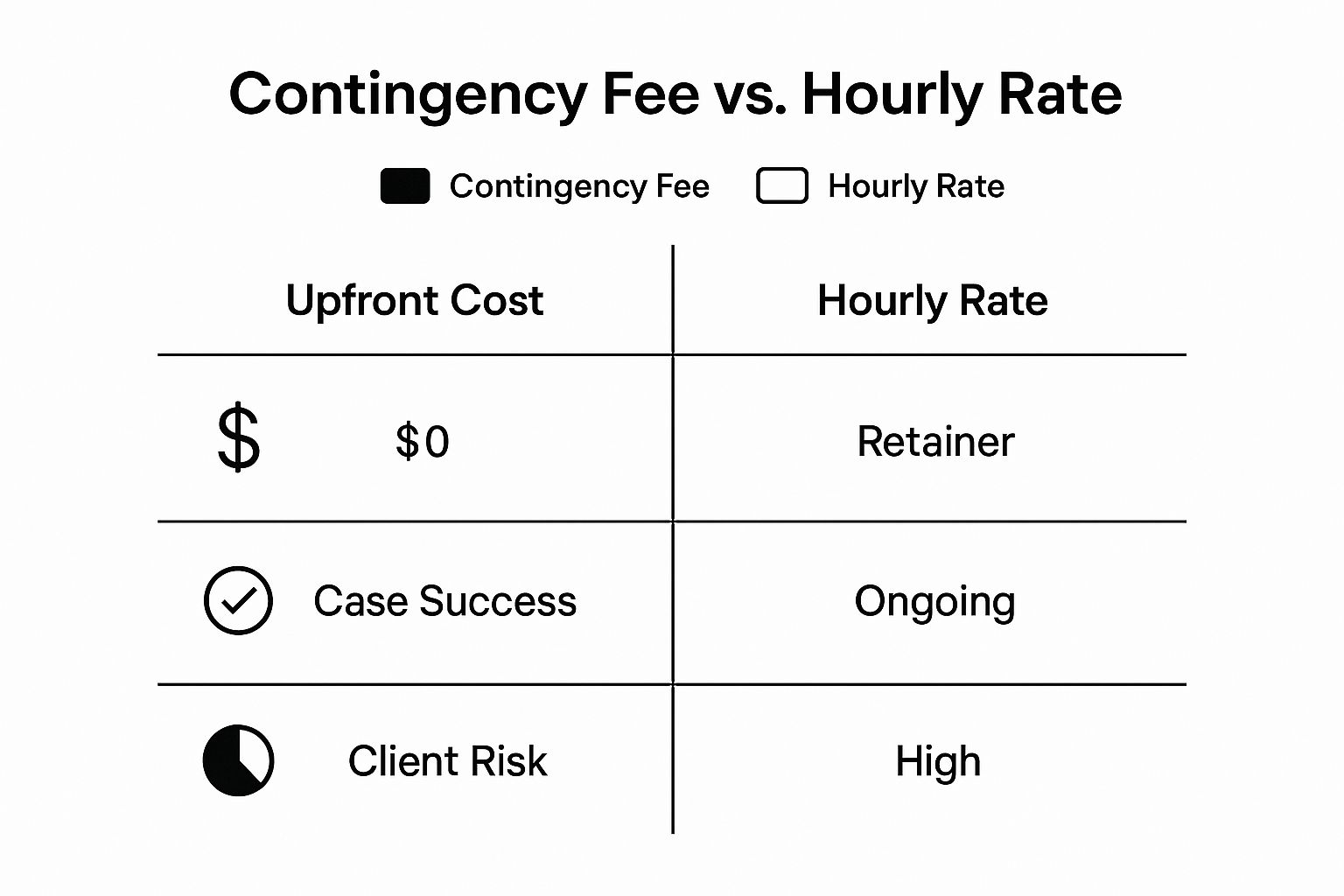
As you can see, the contingency fee setup gets rid of upfront payments and takes the financial risk off your shoulders.
So, how does it all add up in the end? Typically, the attorney's fee is calculated first, taken from the gross settlement amount. After that, the case costs that the firm paid for are reimbursed from what's left. The final amount is your net recovery—the money that goes directly to you.
Understanding the entire personal injury lawsuit process can give you even more context on when these costs pop up.
Attorney Fees vs. Case Costs at a Glance
To make it even clearer, let's break down the differences in a simple table. This helps you see exactly what each term covers so there are no surprises down the road.
| Attribute | Attorney Fees | Case Costs |
|---|---|---|
| Purpose | Payment for the lawyer's time, skill, and legal services. | Reimbursement for out-of-pocket expenses to build the case. |
| Who Gets Paid | The law firm representing you. | Third parties like courts, medical providers, and expert witnesses. |
| How It's Calculated | A pre-agreed percentage of the total recovery (e.g., 33.3%). | The sum of all individual expenses paid out by the firm. |
| When It's Paid | Only paid if and when you win your case. | Reimbursed to the firm from the settlement after attorney fees. |
This clear separation is a key part of working with a transparent contingency fee personal injury lawyer. You should always know exactly where your money is going.
Weighing the Pros and Cons of a Contingency Fee
Deciding to hire a contingency fee personal injury lawyer is a major step. Like any important financial decision, there are clear benefits and some potential drawbacks to consider. Understanding the complete picture helps you make the right call for your unique situation.
The entire model is designed to give you a fighting chance when you’re at your most vulnerable.
Its most significant advantage? Instant access to justice. After an accident leaves you with medical bills and lost income, you can hire an experienced attorney without paying a dime upfront. This levels the playing field, empowering you to challenge massive insurance companies and their endless resources.
The Upsides: What You Gain
This model gives your lawyer a powerful, built-in reason to fight hard for you. Since we only get paid if you win, our financial interests are perfectly aligned with yours. We’re driven to secure the highest possible compensation for your injuries, medical bills, and lost wages. It’s that simple.
A key part of this is our expertise in effectively dealing with insurance adjusters, which lets you step back and focus completely on your recovery.
Here’s a quick rundown of the major benefits:
- No Upfront Costs: You don’t need a penny to hire a top-tier lawyer. This immediately removes the financial barrier that stops so many people from seeking justice.
- Zero Financial Risk: If your case doesn't succeed, you owe absolutely no attorney fees. The law firm shoulders all the financial risk of building and pursuing your claim.
- Shared Motivation: Your attorney is 100% invested in getting you the best possible result because their payment is directly tied to it.
The Potential Downsides: A Realistic Look
It’s just as important to look at the other side of the coin. While the contingency model is a lifesaver for most personal injury victims, there are a few scenarios where it might not be the most economical path.
For instance, imagine you have a straightforward case where the other party is clearly at fault, and it settles quickly for a very large amount. In that rare situation, the percentage-based fee could end up being more than what you might have paid an attorney by the hour. It’s not common—most cases demand extensive work—but it’s a possibility worth knowing.
Think of a contingency agreement as a trade-off. You exchange a percentage of a future recovery for zero upfront cost and zero financial risk today. It's about access and motivation.
You also need to be crystal clear on how case costs are handled. These are the out-of-pocket expenses for things like expert witnesses, court filing fees, and medical records. These expenses are typically reimbursed to the firm from the final settlement, which will reduce the amount you ultimately take home.
Always make sure your agreement clearly explains how fees and costs are calculated before you sign anything. That kind of transparency is the mark of a trustworthy contingency fee personal injury lawyer.
How Contingency Fees Work In Other Countries

The contingency fee personal injury lawyer is a bedrock of the American justice system, but this "no win, no fee" approach isn't the standard everywhere. Taking a quick look at how other countries handle legal fees really drives home why this model is so important for injured people in the United States. It’s a system built from the ground up to give everyday people a fighting chance against deep-pocketed insurance companies and corporations.
While the core idea of paying a lawyer only if you win exists elsewhere, the rules often look quite different. The United Kingdom, for example, uses something called "Conditional Fee Agreements" (CFAs). They operate similarly, but can also include a "success fee" tacked on top of the lawyer's normal hourly rate—a completely different way to structure the final payment.
A Global Snapshot of Legal Fees
The legality and the fine print of these agreements vary dramatically from one country to another. The table from Wikipedia, shown above, gives you a bird's-eye view of where contingent fees stand across the globe.
As you can see, while many common law countries like Canada and the UK have embraced some form of contingency fees, a surprising number of nations haven't. This patchwork of rules underscores just how unique the American system is in providing such broad access to legal help for injury victims.
- Canada: Every province allows contingency fees, but some put caps on the percentage a lawyer can take or limit the types of cases where they can be used.
- Australia: The system is much more restrictive here. Taking a direct percentage of a settlement is banned. Instead, lawyers can use "conditional fee agreements" that allow for an "uplift" fee of up to 25%—but it’s 25% of the lawyer's costs, not the total recovery amount.
- Russia: In stark contrast, the Russian legal system doesn't recognize contingency fee agreements at all, making them legally unenforceable.
This global perspective shows that while the goal is often the same—helping injured people get justice—the methods can be very different. The American model is specifically designed to transfer the financial risk from the injured client to the law firm.
These international differences highlight why it's so important to work with a local contingency fee personal injury lawyer who is an expert in the state and federal laws that govern your case. For a deeper dive, you can learn about the history of contingent fees and how they compare worldwide.
Common Questions About Contingency Fees
When you’re looking at hiring an Atlanta contingency fee personal injury lawyer, it’s smart to have questions. This fee arrangement is built to protect you, but you should have total clarity before you agree to anything. Let's walk through some of the questions we hear most often from clients.
Our only goal here is to give you direct, clear answers so you can move forward with confidence. We'll cover everything from what happens if you don’t win your case to whether the fee percentage can be adjusted.
What Happens If I Lose My Case?
This is usually the first and most important question, and the answer gets right to the heart of the contingency fee model. If we don’t recover any money for you—whether through a settlement or a jury verdict—you owe us zero attorney fees.
That’s the promise. Our law firm takes on all the financial risk of investing the time, resources, and expertise needed to build your case. This "no win, no fee" guarantee means you can fight for justice without worrying you'll end up with a legal bill you can’t possibly pay.
Can the Contingency Fee Percentage Be Negotiated?
Yes, the fee percentage isn’t always set in stone and is often open to discussion. The final percentage we agree on will depend on the specific details of your situation.
Factors that influence the percentage include:
- Case Specifics: A straightforward rear-end collision with undisputed fault might fall into a standard fee structure. A serious medical malpractice claim, on the other hand, will require a far greater investment and a different structure to match.
- Likely Timeline: If a case is probably headed for a quick settlement, the work involved is less than a case destined for a full trial. The percentage may reflect that expected commitment of time and resources.
- The Firm's Risk: Some cases are simply harder to win than others. When we take on a case with a higher chance of being unsuccessful, the fee may reflect that increased level of risk.
The most important thing is to have a frank conversation about fees during your initial consultation. Any attorney worth hiring will be completely transparent about their fee structure and the reasons behind it.
How Are My Medical Bills Handled During the Case?
This is a major point of stress for anyone recovering from an injury. While your case is moving forward, the medical bills are technically still your responsibility. Don't panic—we help you manage this.
We can often arrange for your doctors and hospitals to place a lien on your future settlement. This is a formal agreement where they consent to wait for payment until your case is over. Once we secure your compensation, their bills get paid directly from those funds. This lets you get the medical care you need to recover without paying out-of-pocket while you're hurt and unable to work.
A lien is a legal claim a creditor (like a hospital) has on your property—in this case, your settlement proceeds—to ensure a debt is paid. It’s a standard tool that helps injury victims get treatment without immediate financial strain.
Getting comfortable with the language of the law can make you feel more in control. For simple explanations of legal words you might come across, feel free to check out our firm's own legal dictionary. For definitions of more general legal terms, other great resources are also available online.
Who Pays for the Case Costs If We Lose?
This is another important detail that your fee agreement must spell out clearly. Just like our attorney's fees, if your case is unsuccessful, you are typically not on the hook to repay the case costs our firm paid for upfront.
These expenses—for things like hiring expert witnesses, court filing fees, and ordering deposition transcripts—can add up to thousands of dollars. Our firm fronts these costs to give your case the best possible chance of success, and if we don't win, we absorb that loss. It's another way we remove financial risk from your shoulders, making the services of a contingency fee personal injury lawyer a truly risk-free decision for you.
At Jamie Ballard Law, we believe every injured person in Atlanta deserves a powerful ally, regardless of their financial situation. If you have more questions or need to discuss your accident, we are here to help 24/7. Contact us for a free, no-obligation case evaluation and let us fight for the justice and compensation you deserve. You can reach us at https://jamieballardlaw.com.