The chaos and shock in the moments after a car crash can be overwhelming. Knowing what to do after a car accident is absolutely essential for your safety and any future claim you might need to file. From my experience as an Atlanta personal injury attorney, your priorities are simple: check for injuries, secure the scene, and call for help. Staying as calm as you can and following these first few steps can make a real difference for everyone involved.
Your First Moves at the Accident Scene
In the disorienting aftermath of a crash, your mind might be racing, but having a clear plan is your best defense. The actions you take in the first 15 minutes are the foundation for both your physical recovery and protecting your legal rights. Your immediate focus has to be on safety above all else. Before you even think about insurance or legal questions, you need to deal with the human element of the situation.
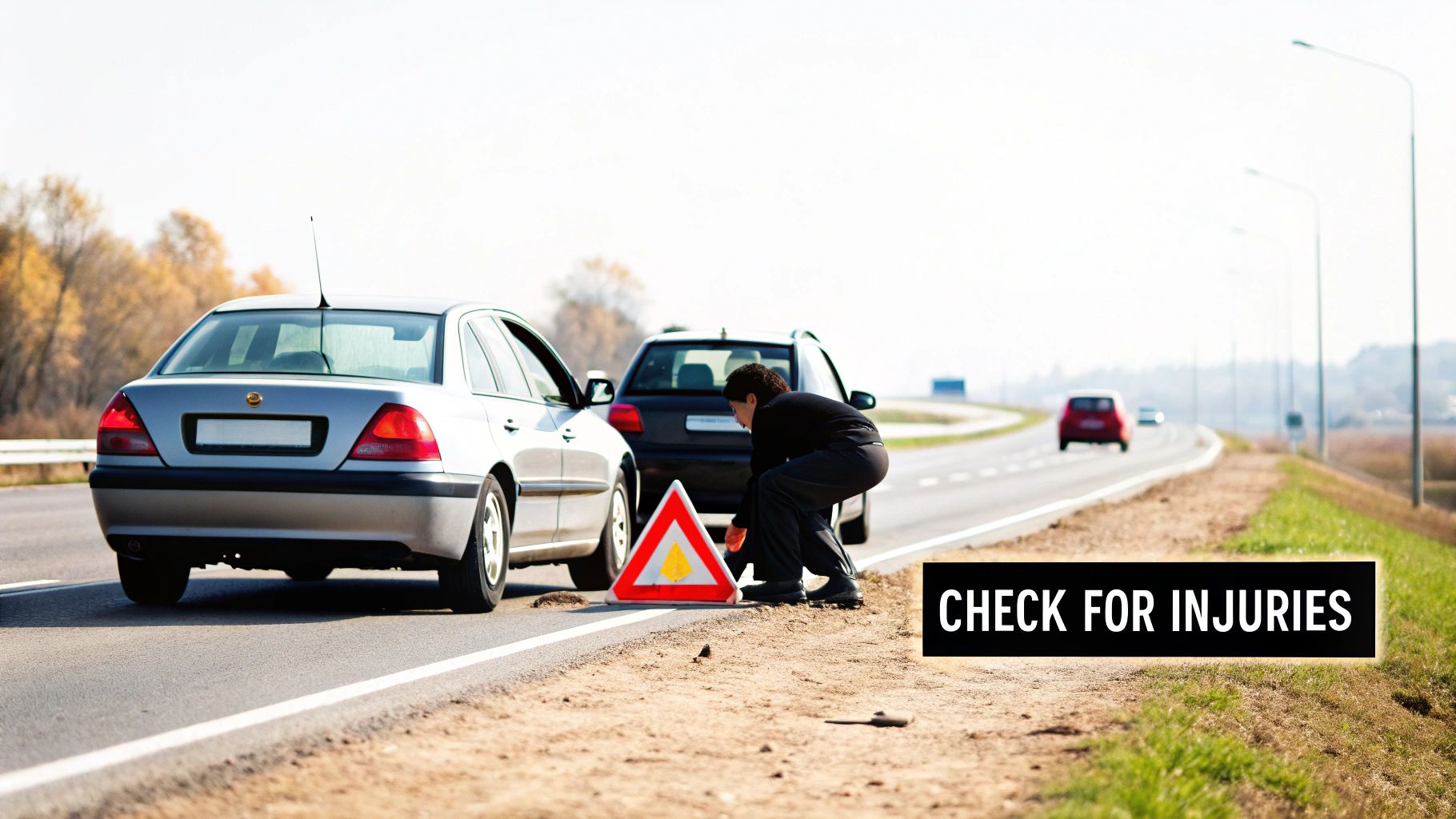
First, check on yourself and your passengers. Are you hurt? Is anyone unconscious or complaining of neck or back pain? If there's a serious injury, it's best not to move them unless their current location is dangerous, like being in the path of oncoming traffic or near a fire. Adrenaline is a powerful painkiller and can easily mask serious injuries, so a careful self-assessment is key.
Securing the Area and Calling for Help
Once you've checked on everyone, your next move is to make the area as safe as possible to prevent another collision. If your car is drivable and the accident was minor, carefully move it to the shoulder or another safe spot out of traffic. Immediately turn on your hazard lights to warn other drivers.
No matter how minor the accident seems, always call 911. In Atlanta, a police report is the official record of what happened, and it's invaluable later on. When you call, be ready to provide:
- Your exact location: Use a cross-street, a mile marker, or a nearby business as a landmark.
- A quick summary of the situation: For example, "There's been a two-car accident, and one person is complaining of neck pain."
- How many vehicles and people are involved: This helps the dispatcher send the right number of emergency responders.
This flowchart breaks down the absolute first things you need to do at the scene.
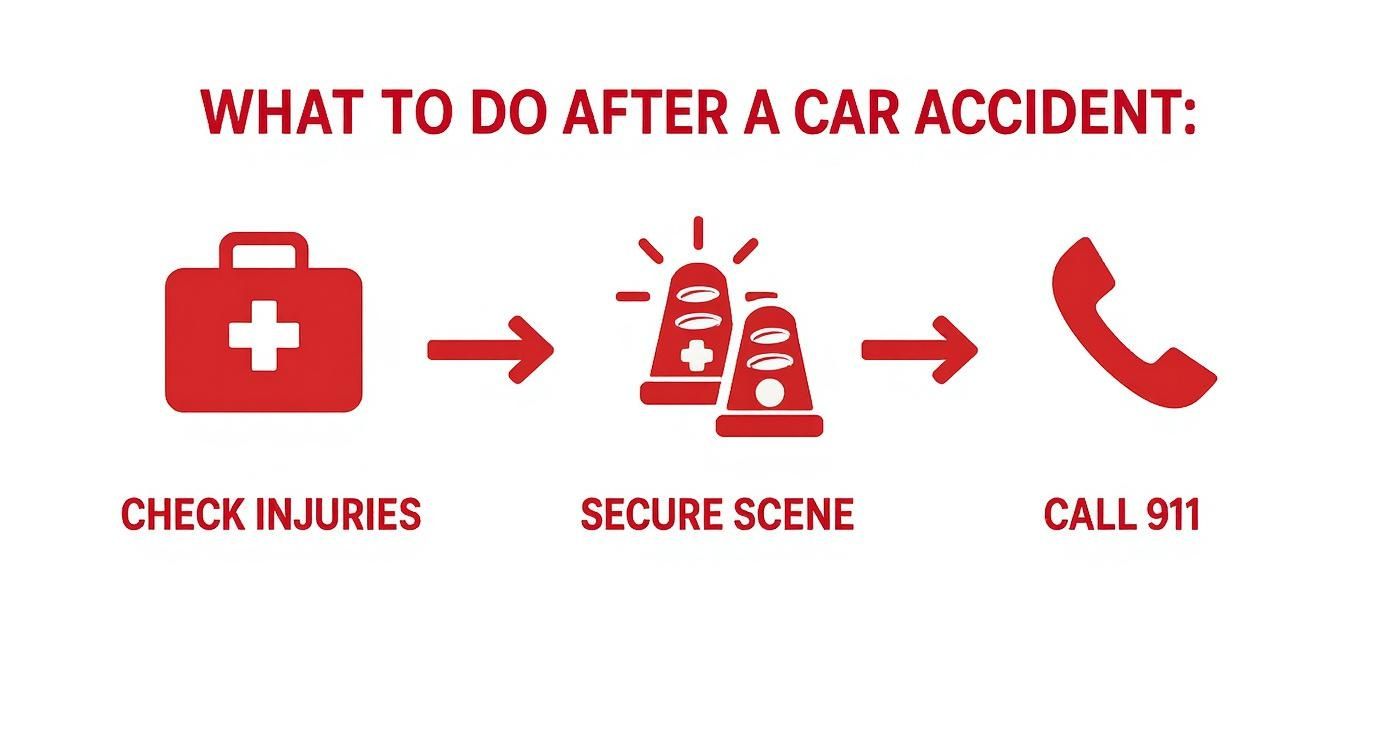
Following this sequence—checking for injuries, securing the scene, and then calling 911—establishes a clear, safety-first protocol in a stressful situation.
Immediate Post-Accident Safety Checklist
This table is a quick reference guide for what to prioritize in the first 15 minutes after a crash. Keep it simple and focus on these important tasks.
| Action Item | Why It's Important | Quick Tip |
|---|---|---|
| Check for Injuries | Your health is the top priority. Adrenaline can mask pain from serious injuries. | Ask everyone involved, including yourself, if they are okay. Don't move anyone with a potential neck or back injury. |
| Move to Safety | Prevents secondary accidents and protects you from oncoming traffic. | If your car is drivable, pull over to the shoulder. If not, turn on your hazard lights. |
| Call 911 | Creates an official police report and ensures medical help is dispatched if needed. | Even for minor accidents, a police report is essential for insurance claims. State that you need police and, if necessary, an ambulance. |
| Exchange Information | Legally required and necessary for filing an insurance claim. | Get the other driver's name, address, phone number, license plate, and insurance information. Don't discuss fault. |
Focusing on these steps immediately after a collision will help you manage the scene effectively and protect your interests down the road.
Understanding the Importance of Quick Action
Why are these initial steps so important? The numbers paint a sobering picture. Every year, about 1.19 million people worldwide die in car crashes, and another 20 to 50 million suffer injuries that can lead to long-term disabilities. The World Health Organization provides detailed road safety statistics that highlight the global impact of these events, which also carry a heavy economic cost.
The moments right after a crash can feel like a blur. Your priority list is simple: people, safety, police. Everything else can wait. By focusing on these three things, you create a controlled environment in a chaotic situation.
Staying at the scene, remaining calm, and methodically addressing safety concerns sets the stage for everything that follows. Never leave the scene of an accident, even a minor one, until the police have arrived and given you the all-clear. Following this initial checklist ensures you know exactly what to do after a car accident to protect yourself and others.
Documenting Everything at the Scene
Once you're sure everyone is safe and first responders are on their way, your focus has to shift to gathering information. This is a very important window. What you do in the moments after a crash is about becoming a methodical record-keeper, and the information you collect can make or break an insurance claim or future legal action. Your smartphone is your best friend right now.
Think of yourself as an investigator. Your job is to create a perfect snapshot of the scene exactly as it is, right now. Why? Because cars get towed, memories fade, and stories change. A clear, factual record is your best defense against that. The first thing to tackle is the information exchange with the other driver.
Exchanging Key Information
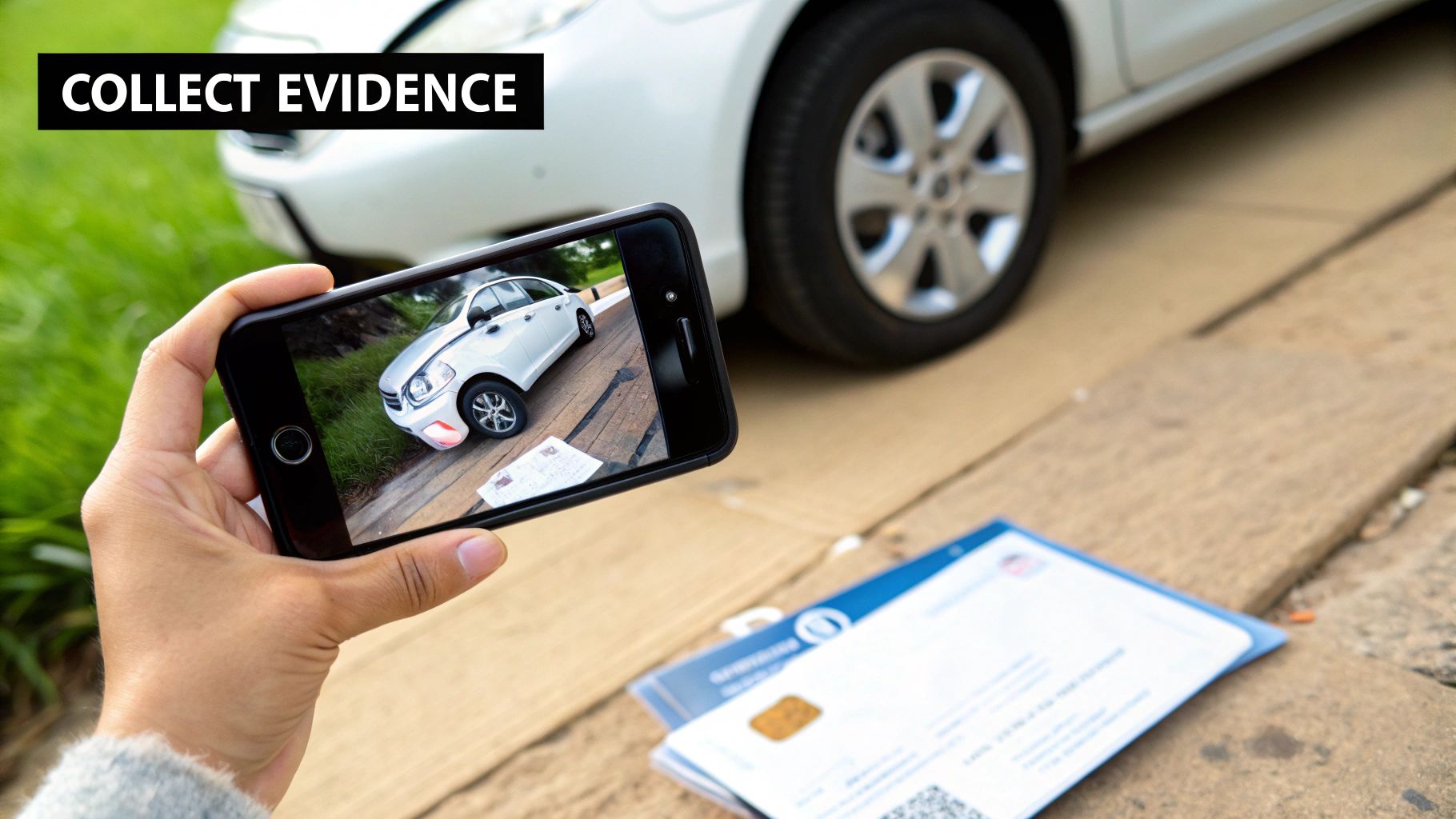
You are legally required to exchange specific details with any other drivers involved. It's fine to speak, but from my experience, the best approach is to use your phone to take clear pictures of their documents. This eliminates any chance of writing something down wrong, especially when you're feeling shaken and your adrenaline is high.
At a minimum, you need photos of:
- Their Driver's License: This confirms their legal name, address, and identity.
- Their Insurance Card: Snap a picture that clearly shows the policy number, the name of their insurance company, and the contact information.
- Their License Plate: Get a clear, readable photo of the license plate on their vehicle.
Also, get their phone number. Keep the exchange calm and polite. This is not the time to argue or discuss who was at fault. Just stick to the facts. The information you gather here becomes the foundational documentary evidence that will support your case down the road.
Creating a Comprehensive Photo Record
Pictures tell a story that words simply can't. Don't just take one or two shots of the damage; you can't have too many. Your goal is to capture the scene from every angle to give a complete view of what happened.
Make sure your photo list includes:
- The Overall Scene: Step back (safely!) and take wide shots showing the final resting positions of all vehicles. Try to show the direction each car was traveling.
- Vehicle Damage: Get detailed photos of the damage to every car involved, not just yours. Take close-ups of the impact points and then wider shots to put the damage in context.
- The Surrounding Area: Document any skid marks on the road, debris from the crash, and damage to public property like signs or guardrails.
- Road Conditions & Signals: Photograph nearby traffic lights, stop signs, and speed limit signs. Make a note if the road was wet or if there were obvious hazards like potholes.
The photos taken in the first 20 minutes after a collision are often the most powerful and honest pieces of evidence we can get. They are raw, unfiltered, and capture reality before anything gets moved or cleaned up.
Looking for Witnesses and Other Evidence
While you're documenting the physical scene, don't forget to look around. Independent eyewitnesses can provide a neutral account of what happened, which is incredibly valuable.
If you see someone who stopped to help or who clearly saw the accident, politely ask them for their name and phone number. Do not press them for their story or ask them to take sides—just get their contact information so your attorney or the insurance adjuster can follow up.
Also, scan the area for cameras. Many businesses along Atlanta's busy roads have security cameras pointing toward the street. Make a quick note of any nearby stores, banks, or buildings that might have caught the incident on video. This is urgent. That footage is often recorded on a short loop and can be deleted within 24 to 48 hours.
Proper documentation is the cornerstone of any strong case, especially if you need to explore your options with personal injury claims. Taking these steps protects your rights from the very beginning.
Official Reporting With Police and Insurers
Once you've made sure everyone is safe and you’ve gathered your own evidence, it’s time to make it official. Knowing what to do after a car accident means engaging with two very important groups: law enforcement and your insurance company.
I know it feels like a major hassle, especially for what might seem like a minor fender-bender. But trust me, skipping these reporting steps is a mistake that can haunt you down the road. An official police report and a prompt insurance claim are the cornerstones of protecting your rights.
Think of the police report as the definitive, unbiased account of what happened. Stories change. I've seen it countless times where the other driver, who was incredibly apologetic at the scene, suddenly tells their insurance company you slammed on your brakes for no reason. Having a police officer document the facts creates a powerful, objective record that insurance adjusters take very seriously.
When the Atlanta Police or Georgia State Patrol arrive, just stay calm and stick to what you know. They'll ask for your version of events, so describe what happened clearly without guessing. Avoid saying things like "I think…" or "Maybe…" If you're not sure about your exact speed or some other detail, it's far better to say so.
Interacting With Law Enforcement
When you speak with the responding officer, your only job is to provide clear, factual information. You don't need to have all the answers, but you should be ready to share the basics.
Your conversation should stick to these key points:
- The sequence of events: Explain what you saw and what you did right before the collision.
- Your direction of travel: Clearly state the street you were on and which way you were headed.
- Location of damage: Point out the damage to your car and any others involved.
- Witness information: If you managed to get contact details from any witnesses, pass them along to the officer.
Before the officer leaves, they will give you a case number. This number is essential. You’ll need it to get a copy of the official crash report. You can usually request it from the local Atlanta precinct or online through the Georgia Department of Transportation.
Notifying Your Insurance Company
Call your own insurance company as soon as you can—ideally within 24 hours. Nearly every insurance policy has a clause that requires you to report any accident promptly, even if you weren't at fault. This call is what officially starts the claims process.
Have your policy number and the basic accident details ready when you call. And just like with the police, stick to the facts. Do not admit fault or speculate about what caused the crash. You are simply reporting that an accident occurred.
Be extremely cautious when speaking to an insurance adjuster, especially one from the other driver’s company. Their primary goal is to settle the claim for the least amount of money possible. I strongly advise against giving a recorded statement until you've spoken with an attorney.
Recent data shows a slight decline in traffic fatalities, which is good news, but accidents remain tragically common. Enhanced collaboration between agencies and better law enforcement responses are part of the reason for this improvement. As you can learn more about these traffic fatality trends, it highlights why proper reporting is so important for accountability and safety. Understanding how to file a car accident claim in Atlanta will help you manage this process correctly.
If you hit a wall with the insurance company or feel your claim is being unfairly denied or lowballed, knowing how to dispute an insurance claim effectively can make a huge difference. Following the right procedure for what to do after a car accident is the best way to ensure you're treated fairly by everyone involved.
Looking After Your Health After a Crash
After any kind of collision, the absolute first priority is your well-being. Knowing what to do after a car accident isn’t just about collecting evidence and calling the police; it’s about putting your health above everything else. I’ve seen it happen countless times: a client feels perfectly fine at the scene, only to wake up the next day in excruciating pain.
This is a classic case of your body’s own defense mechanisms working against you. A crash triggers a massive adrenaline rush, which is nature’s painkiller. It’s powerful enough to completely mask serious injuries for hours, sometimes even days. You might walk away feeling a little rattled but otherwise okay, completely unaware of the damage beneath the surface.
Why You Must See a Doctor—No Exceptions
Even if you think you’re unhurt, getting a professional medical evaluation is non-negotiable. Many common crash-related injuries—whiplash, soft tissue damage, internal bleeding, or even a traumatic brain injury—don’t show obvious symptoms right away. A doctor can spot these hidden issues before they escalate into something far more serious.
Think of it this way: your car is going straight to a mechanic for a full diagnostic check. Your body deserves the same meticulous care. In Atlanta, you have a few solid options:
- Emergency Room: If you have obvious pain, feel dizzy or confused, or see any visible injuries, head to the ER immediately. It’s the right call for any severe or potentially life-threatening symptoms.
- Urgent Care Clinic: For less severe issues that still need fast attention, an urgent care center is a great alternative. They can handle exams, X-rays, and initial treatments without the long wait of an ER.
- Your Primary Care Physician: If it’s not an emergency, get an appointment with your family doctor as soon as you can—ideally within 24-48 hours. They have your full medical history and are in the best position to conduct a thorough evaluation.
Many people don't realize that the ache in their neck or the slight headache they feel could be a sign of something much more serious. Below is a table of common injuries that often show up days after the initial impact.
Common Delayed-Symptom Injuries After a Car Accident
| Injury Type | Common Symptoms | When Symptoms May Appear |
|---|---|---|
| Whiplash | Neck pain, stiffness, headaches, dizziness, fatigue | 24-48 hours after the accident |
| Concussion/TBI | Headaches, confusion, memory issues, sensitivity to light | Hours, days, or even weeks later |
| Soft Tissue Injuries | Muscle sprains, bruising, swelling, limited range of motion | 1 to 3 days after the crash |
| Internal Bleeding | Abdominal pain, deep bruising, dizziness, fainting | Can take hours or days to become noticeable |
| Herniated Disc | Back or neck pain, numbness or tingling in limbs | Days or weeks following the incident |
Recognizing these delayed symptoms is the first step, but documenting them is what protects your legal rights.
The Importance of a Medical Paper Trail
From your very first doctor's visit, you are creating an official record of your injuries. This documentation is invaluable. It serves as concrete proof connecting your injuries directly to the accident, establishing a clear timeline of your symptoms, diagnoses, and treatments. Every exam, prescription, and physical therapy session adds another layer to that proof.
This paper trail is the evidence we use to show the full impact the crash has had on your life, which is very important for any future personal injury claim. Certain injuries, like concussions, can have subtle but long-lasting effects. Knowing what to look for is important, and you can learn more from our guide on what to look for after a concussion injury.
The single biggest mistake you can make is delaying or skipping a medical evaluation. What feels like a minor ache today could easily become chronic pain tomorrow. Seeking immediate care protects both your health and your legal right to fair compensation.
The global statistics on traffic accidents paint a sobering picture, highlighting the vulnerability of pedestrians and cyclists who account for over half of all road fatalities worldwide. You can explore the data on road safety to understand the broader context. This reality only reinforces why prompt medical attention after any crash is so vital. The first and most important step in knowing what to do after a car accident is always taking care of yourself.
Deciding If You Need to Speak With a Lawyer

It’s one of the first questions that crosses your mind after a crash: do I really need a lawyer? Honestly, it depends. If you were in a minor fender-bender with no injuries and everyone agrees on what happened, you might be fine handling it yourself.
But the moment things get complicated, getting professional guidance is very important. Knowing what to do after a car accident isn’t just about the immediate steps; it’s also about recognizing when you need to bring in an expert.
When Legal Guidance Is a Good Idea
The aftermath of an accident is chaotic. Between insurance adjusters calling and medical appointments, it's easy to get overwhelmed. Certain scenarios, however, are clear signals that you should at least talk to an attorney.
Consider getting legal advice if:
- Anyone was injured. This is the number one reason. If you or a passenger suffered any injury—from seemingly minor whiplash to broken bones—a lawyer is essential to ensure you are compensated for medical bills, lost work, and pain.
- Fault is disputed. If the other driver is blaming you, or if their story suddenly changes, you need someone to investigate and establish the facts.
- The other driver was uninsured or underinsured. Dealing with your own insurance company for an Uninsured/Underinsured Motorist (UM/UIM) claim is surprisingly adversarial. They are not always on your side.
- The insurance company's offer seems too low. First offers from adjusters rarely cover the full scope of your losses. An attorney knows how to calculate the true value of your claim and negotiate effectively.
A free consultation costs you nothing. It’s a no-risk way to get a professional opinion on your case and understand your rights. Think of it as a chance to get clarity and peace of mind before making any big decisions.
Hiring a lawyer isn’t about starting a fight. It’s about leveling the playing field. Insurance companies have teams of professionals working to protect their bottom line. You deserve to have your own advocate doing the same for you.
What a Personal Injury Attorney Actually Does
Most people think an attorney’s job is just arguing in a courtroom, but that’s only a tiny fraction of the work. A good personal injury lawyer manages your entire claim from start to finish, letting you focus on your recovery.
Here’s a look at what we handle for our clients:
- Full Investigation: We immediately start gathering evidence—the police report, witness statements, medical records, and photos. If needed, we hire accident reconstruction experts to prove what happened.
- Handling All Communications: We take over all calls and emails with insurance adjusters. You won’t have to deal with their recorded statements, confusing questions, or pressure tactics.
- Calculating Your True Damages: We work with you and your doctors to document the full value of your claim. This goes beyond current medical bills to include future treatment needs, lost income, and the non-economic damages of pain and suffering.
- Negotiating a Fair Settlement: The vast majority of car accident cases settle out of court. We build a strong case and negotiate aggressively to secure the best possible settlement offer.
- Taking Your Case to Court: If the insurance company refuses to be reasonable, we are always prepared to file a lawsuit and fight for you in court.
Preparing for a Free Consultation
If you decide to talk to a lawyer, a little bit of prep work can make that first meeting incredibly productive. The more information you can provide upfront, the faster we can give you a clear assessment of your case.
Try to bring these documents with you:
- The official police report or the case number the officer provided.
- Any photos or videos you took at the scene.
- The other driver’s name, contact info, and insurance details.
- A copy of your own auto insurance policy.
- Any medical bills or records you have received.
This isn't a sales pitch—it's about making sure you’re protected. Understanding the car accident lawsuit process in Atlanta can also show you what’s involved if your case doesn’t settle. Ultimately, making an informed choice about legal representation is one of the most important things you can do after a crash.
Common Questions After an Atlanta Car Accident
After a crash, it's completely normal for your mind to be flooded with questions. The moments, days, and weeks that follow are confusing, and understanding what to do after a car accident can feel overwhelming.
I hear many of the same concerns from my clients time and time again. Let’s walk through some of the most common questions that come up after a wreck in Atlanta and get you some clear, straightforward answers.
How Long Do I Have to File a Claim in Georgia?
This is easily one of the most important questions I get, and for good reason—these deadlines are absolute. Georgia law sets a specific time limit to take legal action, which is called the statute of limitations. You can find more information about this legal principle on Wikipedia.
For personal injury claims—the ones that cover your medical bills, lost wages, and pain and suffering—the deadline is typically two years from the date of the accident. If you're only claiming damage to your vehicle, the window is a bit longer at four years.
But here's my advice: don't wait. Evidence gets lost, witnesses move away, and memories fade. The sooner you start building your case, the stronger it will be.
What if the Other Driver Was Uninsured or Fled the Scene?
It’s an incredibly frustrating scenario. You follow the rules, carry insurance, and then you’re hit by someone who either has no coverage or just drives away. It feels unfair, but you still have options.
This is where your own insurance policy becomes your lifeline, specifically your Uninsured/Underinsured Motorist (UM/UIM) coverage. I tell every driver in Georgia that this coverage is a must-have. It allows you to file a claim with your own insurance company to cover your losses when the at-fault driver can't.
If it was a hit-and-run, the very first thing you need to do is report it to the police. This official report is the key to unlocking your UM claim. For more specifics, the Georgia Office of Insurance and Safety Fire Commissioner has detailed resources on what coverage is required.
Keep this in mind: once you file a UM claim, your relationship with your own insurance company changes. They are now on the other side of the table, and their goal is to pay out as little as possible. This is precisely why having an advocate fighting for you is so important.
Should I Give a Recorded Statement to the Other Driver's Insurance?
My advice here is almost always a firm and simple no. You should never give a recorded statement to the at-fault driver’s insurance company without talking to an attorney first.
While you do have a duty to cooperate with your own insurer, that obligation does not extend to the other party's representative. Their insurance adjuster is a professional negotiator trained to ask questions designed to get you to say something that hurts your claim.
A simple, innocent answer like, "I'm doing okay," can be twisted to argue your injuries aren't serious. It's best to politely decline their request and tell them your attorney will be in touch.
How Do My Medical Bills Get Paid While My Case Is Pending?
This is a huge source of stress. The medical bills start arriving long before your case is settled, and you need a way to manage them.
While we build and negotiate your claim, your medical costs can be covered through a few different channels:
- Your Health Insurance: This is often the first line of defense for covering immediate medical treatment.
- Medical Payments (MedPay) Coverage: If you have this on your auto policy, it pays for medical bills up to your coverage limit, no matter who was at fault. It’s an excellent safety net.
- Healthcare Liens: In many situations, we can arrange for your doctors to treat you on what's called a medical lien. This is an agreement where the provider waits to get paid out of the final settlement.
This strategy ensures you get the treatment you need without the immediate financial pressure. The final settlement is structured to reimburse these sources and cover any future care you might require. Knowing how to handle this is a vital part of figuring out what to do after a car accident.
If you've been injured in an accident and need clear guidance on your next steps, the team at Jamie Ballard Law is here to help. We offer free case evaluations to help you understand your options with no strings attached. Visit us at https://jamieballardlaw.com to get the support you need.