After an injury, the fallout goes far beyond just a pile of medical bills. When you're hurt, the real question becomes: how do you prove pain and suffering? It's not about just telling an insurance company you're in pain; it's about methodically documenting the true physical and emotional cost of your injury with concrete evidence so you can get the pain and suffering settlement you deserve.
What Pain and Suffering Means for Your Georgia Claim
In an Atlanta personal injury claim, "pain and suffering" isn't just a vague term for being hurt. It's a legal concept that covers the total human cost of an injury—all the ways your life has been disrupted beyond the clear-cut financial losses like medical expenses and lost wages. A fair settlement must account for this.
Think of it as two sides of the same coin: the physical toll and the emotional one. Each piece is an important part of your story.
The Physical Impact of an Injury
This is the part most people understand instinctively. It’s the actual, physical hurt you feel from the accident and its aftermath. But it's much more than just the initial pain.
Physical pain and suffering includes:
- Ongoing Discomfort: This isn't just about the acute pain right after the accident. It's the chronic back pain that never quite goes away, the constant ache in your knee, or the recurring headaches that are now a part of your daily life.
- Permanent Limitations: Maybe you can no longer lift your kids, stand for more than a few minutes without searing pain, or enjoy a simple walk like you used to. These are permanent losses.
- Scarring and Disfigurement: Visible, permanent changes to your appearance can have a profound and lasting impact on your self-confidence and how you interact with the world.
A broken leg, for instance, isn't just a bone that needs to heal. It’s weeks stuck on crutches, the frustration of not being able to drive, and the humbling experience of relying on others for simple tasks. It could even mean a limp you have to live with forever.
The Mental and Emotional Toll
This is often the most overlooked part of an injury, yet it can be the most debilitating. Mental anguish refers to the emotional trauma and psychological fallout from the accident. You can't see it on an X-ray, but it is just as real and just as damaging as any physical injury.
A serious injury doesn't just damage your body; it can fundamentally change your sense of security, your mood, and your ability to enjoy the life you had before. Recognizing this is the first step toward seeking fair compensation.
Examples of mental anguish include:
- Anxiety and Fear: It's common to develop a fear of driving after a bad car crash or to feel intense anxiety in situations that remind you of how you were injured.
- Depression and Sadness: When you can no longer participate in your favorite hobbies, work, or family activities, it's easy to spiral into feelings of isolation and depression.
- Loss of Enjoyment of Life: This is the legal term for when an injury robs you of the ability to do the things that once brought you joy—whether that was gardening, playing sports, or simply going out with friends.
These non-economic damages often make up a significant portion of a settlement. In fact, some jurisdictions see average pain and suffering awards exceed $500,000 for serious claims, which shows just how much weight the legal system gives this aspect of an injury. You can learn more about general personal injury statistics on sites like the Bureau of Justice Statistics. The journey through the legal system to document these losses is detailed in our guide to Atlanta personal injury claims. Successfully showing how an injury has truly affected you is the key to proving your pain and suffering.
Building a Powerful Case with Smart Documentation
To convince an insurance company of what you've endured, your word alone isn't enough. Learning how to prove pain and suffering means assembling solid, tangible evidence that tells the undeniable story of your experience. Each document you collect helps translate your personal struggle into a language insurers are forced to understand.
This diagram shows the clear line from an accident to the physical and emotional trauma that follows.
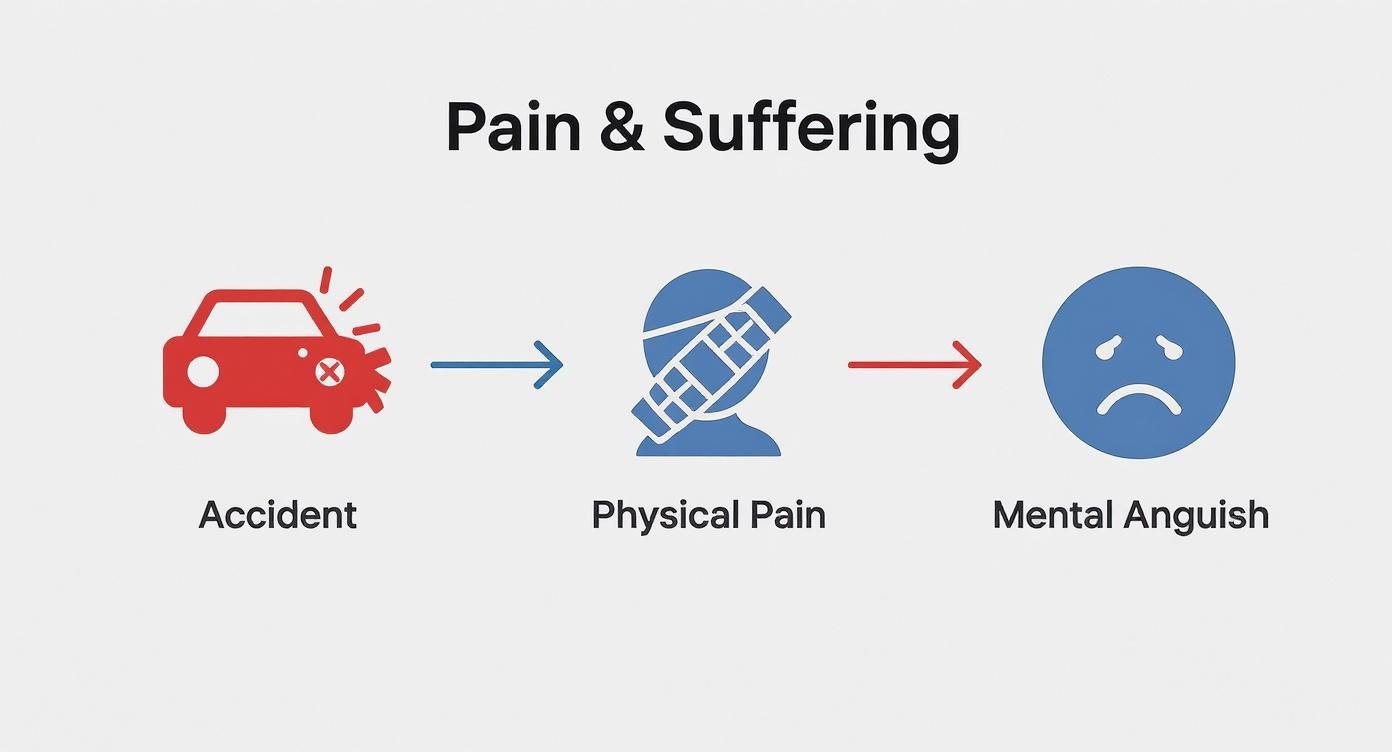
It’s a visual reminder that the physical injury is just the start. That initial harm is what triggers the mental anguish that truly defines a victim's suffering.
Your Medical Records Are the Foundation
Your medical records are the bedrock of any personal injury claim. They offer an objective, professional account of your injuries, the treatment you received, and what doctors expect for your future.
It's important that these records paint a complete and accurate picture.
When you speak with your doctors, be specific. Don't just say your back hurts. Describe it—is the pain sharp, dull, or burning? Does it shoot down your leg? This detail creates a clear medical narrative that validates your claim.
Follow every piece of medical advice. Go to every appointment. Fill every prescription. Any gap in your treatment history will be used by an insurance adjuster to argue your injuries aren't as severe as you say. For chronic conditions, showing you've explored all options, including strategies for treating chronic back pain, reinforces the seriousness of your situation.
The Power of a Personal Pain Journal
Medical files are vital, but they don't capture the daily grind of your recovery. This is where a personal journal becomes an incredibly powerful tool. It provides a consistent, firsthand account of how the injury has upended your life.
Your entries don't have to be long. Just a few notes each day can make a massive difference. Focus on these key points:
- Pain Levels: Rate your pain daily on a scale of 1 to 10. Note where it hurts and describe the sensation.
- Daily Challenges: Did you struggle to get out of bed? Button a shirt? Cook a simple meal? Write it down.
- Emotional State: Document feelings of anxiety, frustration, depression, or insomnia.
- Missed Activities: Note any family events, social plans, or hobbies you were forced to skip because of your injuries.
This journal evolves into a detailed log that is incredibly persuasive. Documenting that you missed your daughter's soccer game because you couldn't stand for more than five minutes paints a much more vivid picture than a medical bill ever could. This type of consistent record-keeping is a core part of building a strong claim, a process we detail in our guide on how to file a car accident claim in Atlanta.
Visual Evidence Makes an Undeniable Impact
A picture is worth a thousand words—and in a personal injury claim, it might be worth thousands of dollars. Visual evidence shows the real-world effects of your injury in a way words simply can't.
Photographs and videos give an immediate, unfiltered look at your reality. They stop an insurance adjuster from downplaying the physical toll of your injuries.
Start taking photos immediately after the accident and continue throughout your recovery. This visual timeline is compelling.
Types of Visuals to Collect:
- Photos of Your Injuries: Document bruises, cuts, stitches, and surgical scars as they heal. A photo of a fresh wound versus a healing scar tells a story of recovery time.
- Photos of Property Damage: A crushed vehicle or a hazardous spill on a floor helps establish the severity of the incident itself.
- Videos of Mobility Issues: A short clip of you struggling to walk, climb stairs, or lift a grocery bag can be far more impactful than a written description.
Statements from Those Who Know You Best
Sometimes the most credible evidence comes from the people who witness your struggle every day. Statements from family, friends, and coworkers can add a helpful human element to your claim.
These individuals can offer a "before and after" perspective, explaining the person you were before the accident versus who you are now. They can testify to changes in your mood, your new physical limitations, or your withdrawal from activities you once loved.
This outside validation makes it much harder for an insurer to dismiss your claims as exaggerated. Having this kind of detailed, multi-faceted proof is the most effective way to demonstrate the true extent of your pain and suffering.
How Insurance Companies Put a Price on Your Pain

It always feels a bit cold and clinical to put a dollar figure on someone's suffering. But in a personal injury claim, that's exactly what has to happen. Insurance companies don't just pull a number out of thin air; they use specific formulas to translate your documented pain into a monetary value.
Understanding how to prove pain and suffering means getting familiar with these methods. When you know how they calculate their offers, you're in a much better position to negotiate. Let’s pull back the curtain on the two most common approaches adjusters use.
The Multiplier Method Explained
By far, the most common approach is the Multiplier Method. The idea is simple: an adjuster totals up your hard economic damages—like medical bills and lost income—and multiplies that figure by a specific number. This "multiplier" usually falls somewhere between 1.5 and 5.
The multiplier isn't just a random choice. It's directly tied to the severity of your injuries and how they'll impact your life long-term.
A higher multiplier is reserved for more serious cases. Factors that push that number up include:
- Permanent Injuries: Things like visible scarring, a permanent limp, or the loss of a limb will always justify a higher multiplier.
- Invasive Medical Care: If your recovery involved major surgeries, a long hospital stay, or months of physical therapy, the multiplier should reflect that.
- Clear Medical Proof: Hard evidence is your best friend here. X-rays, MRIs, and detailed notes from your doctor that confirm a serious injury give the adjuster a reason to use a higher number.
- Major Life Disruption: Can you no longer work, enjoy your hobbies, or even take care of your family? This kind of impact demands a higher multiplier.
On the flip side, a low multiplier (like 1.5 or 2) is typically used for minor injuries—think sprains and bruises that heal up quickly with little medical fuss.
A Quick Example:
Imagine you were rear-ended and suffered a herniated disc. Your medical bills add up to $20,000. Given how painful that injury is and the fact that it requires ongoing physical therapy, the adjuster might use a multiplier of 3. The calculation for your pain and suffering would be $20,000 x 3 = $60,000. This figure is then added to your economic damages to reach a total settlement demand.
Understanding the Per Diem Method
Another valuation tool, though less common for severe injuries, is the Per Diem Method. "Per diem" is just Latin for "per day." This method assigns a daily rate to your suffering, then multiplies it by the number of days you were in pain and recovering.
The daily rate is often benchmarked against what you earned per day before the accident. The logic is that enduring a day of pain is at least as valuable as a day's work. This approach works best for injuries with a fairly predictable recovery period.
Here’s how it works:
- A daily rate is set (often your daily wage).
- The adjuster counts the number of days from the accident until you reach Maximum Medical Improvement (MMI)—the point where your doctor confirms you've recovered as much as you're going to.
- The daily rate is multiplied by the number of days.
For instance, if you earned $200 a day and your recovery took 90 days, the pain and suffering calculation would be $18,000 ($200 x 90).
A Look at Claim Valuation Methods
To give you a clearer picture, this table compares the two main methods insurance companies use to put a price on pain and suffering. This is how they start the conversation, so knowing the difference gives you an edge.
| Valuation Method | How It Works | Best Suited For | Potential Downside |
|---|---|---|---|
| Multiplier Method | Total economic damages (medical bills, lost wages) are multiplied by a number (1.5-5) based on injury severity. | Serious, long-term, or permanent injuries where the impact goes far beyond medical costs. | Can feel arbitrary, as the multiplier is subjective and heavily debated. |
| Per Diem Method | A daily rate (often tied to your wages) is multiplied by the number of days you were in recovery. | Short-term injuries with a clear and definable recovery timeline. | Doesn't account for permanent or chronic pain that continues after recovery ends. |
Remember, these valuation methods are just the start of the negotiation, not the final word. While they provide a baseline, they can't fully capture what you've been through.
It’s worth noting that how pain and suffering is quantified varies dramatically worldwide. The legal systems in places like Germany or France might lead to substantial awards for injuries, while compensation standards in other nations are much lower. You can learn more about these global personal injury trends on egenerationmarketing.com.
Ultimately, a strong case built on compelling evidence is what truly drives the final value of your claim. These formulas are just the tools insurers use to get started.
Presenting a Compelling Claim in Your Demand Letter

Once you’ve collected all your evidence, the next move is to assemble it into a formal demand letter. This document is far more than just a request for money; it’s a strategic narrative that walks the insurance adjuster through your entire ordeal. A well-crafted demand letter is one of the most powerful tools available to show an insurer how to prove pain and suffering through a clear, persuasive, and undeniable story.
Your letter should open with a concise summary of the facts. State when and where the collision occurred, who was at fault, and the immediate injuries you suffered. This sets the stage and provides the adjuster with the core details of your claim.
Weaving Your Medical Journey into the Narrative
From there, you'll guide the adjuster through your medical treatment. This is where your detailed records and pain journal become absolutely essential. Don't just list your injuries—describe them within the context of your recovery.
Explain what it was like to endure each procedure, the pain that came with it, and the side effects of your prescriptions. Pull direct quotes from your journal to highlight specific days when the pain was at its worst or when your physical limitations felt overwhelming. This is how you transform a stack of cold medical bills into a compelling human story.
For instance, you might write:
"My medical records from Northside Hospital confirm a diagnosis of a C5-C6 disc herniation. But what those records can't convey is the constant, radiating nerve pain this injury caused. As I noted in my journal on May 15th, it was 'a burning sensation that made it impossible to sleep for more than two hours at a time.'"
This simple technique connects objective medical proof to your subjective, real-world experience. For a deeper dive into structuring these arguments, reviewing a comprehensive guide to personal injury demand letters offers excellent examples.
Connecting Injuries to Real-World Consequences
An adjuster needs to see that your injuries weren't just a medical issue—they were a life-altering event. The most persuasive section of your demand letter will draw a direct line from your physical injuries to the very real impact they’ve had on your day-to-day existence.
This is your chance to detail all the ways your life has been diminished. I always advise clients to create a clear, bulleted list outlining these consequences:
- Lost Hobbies and Activities: List the specific things you can no longer enjoy. Was it your weekly softball game? Gardening on the weekends? Or something as simple as lifting your grandchild? Be specific.
- Strain on Family Relationships: Explain how the injuries have impacted your role as a spouse, parent, or caregiver. Maybe you can no longer manage household chores, forcing your partner to shoulder the entire burden.
- Career and Financial Impact: Go beyond lost wages. Discuss how the injury has limited your ability to perform your job duties or even jeopardized your long-term career path.
This isn't about complaining; it's about painting a vivid picture. It's not enough to say you were in pain. You must show the adjuster the life that was taken from you because of that pain.
Presenting Your Settlement Demand
Finally, the letter must clearly state your calculated damages. You’ll present a specific number for your economic losses (medical bills, lost income) and a separate, well-justified figure for your non-economic damages based on the multiplier or per diem method. State your total settlement demand with confidence.
Your goal is to deliver a complete, meticulously supported package that leaves no room for doubt about the severity of your suffering. A powerful demand letter kickstarts productive negotiations and is a very important part of the larger Atlanta car accident lawsuit process. It is your single best opportunity to show exactly how to prove pain and suffering in terms an insurance company cannot ignore.
Key Georgia Laws That Affect Your Injury Claim
Legal rules aren't the same everywhere. Knowing the specific laws here in Georgia is fundamental to understanding how to prove pain and suffering and what your claim is truly worth.
These aren't just minor details—they are the rules that govern your right to seek compensation. From firm deadlines to how fault is assigned, let’s go over the key Georgia statutes that will directly shape your personal injury claim.
The Clock Is Ticking: The Statute of Limitations
In Georgia, there's a strict deadline for filing a personal injury lawsuit, known as the statute of limitations. For the vast majority of personal injury cases, you have just two years from the date of the injury to file your claim.
That might sound like a lot of time, but it disappears quickly when you're focused on healing. If you miss this deadline, the court will almost certainly refuse to hear your case. You lose your right to recover any compensation, no matter how strong your evidence is.
It's a harsh deadline, but it's a firm one. The two-year window is designed to ensure evidence remains fresh and witnesses are still available. Waiting too long can jeopardize your entire claim.
I’ve seen too many people try to handle things on their own with the insurance company, only to realize too late that the deadline is looming. You can learn more about the statute of limitations for personal injury in GA and why acting fast is so important.
Georgia’s Modified Comparative Negligence Rule
What happens if the insurance company tries to say you were partially at fault for the accident? This is an extremely common tactic, and Georgia law has a specific rule for this exact situation. It’s called modified comparative negligence.
This rule, outlined in the official state code, dictates how compensation is handled when more than one person is to blame.
Here is the text of the actual Georgia statute that governs this rule:
So, what does that legal jargon actually mean for you?
- You Can Recover if You Are Less Than 50% at Fault: If you are found to be 10% at fault for the accident, your total settlement will be reduced by that percentage. If your damages total $100,000, you would receive $90,000.
- You Cannot Recover if You Are 50% or More at Fault: This is the most important part of the rule. If a jury determines that you were 50% or more responsible for what happened, Georgia law bars you from recovering any compensation. You get nothing.
Because of this rule, insurance adjusters will work hard to shift as much blame as possible onto you. Even assigning a small percentage of fault can save their company thousands of dollars.
Are There Caps on Pain and Suffering Damages in Georgia?
Finally, a bit of good news. Some states place a limit, or a "cap," on the amount of non-economic damages (like pain and suffering) that a person can be awarded in a personal injury case.
Fortunately, for most personal injury claims in Georgia—such as those from car accidents, truck accidents, or slip and falls—there are no caps on pain and suffering damages.
The Georgia Supreme Court has struck down such caps, ruling that they are unconstitutional. This means there is no artificial limit on the amount of compensation a jury can award you for what you have endured. This is an important aspect when learning how to prove pain and suffering for a Georgia-based claim.
Common Questions About Proving Pain and Suffering
After an accident, it’s natural to have a lot of questions. When the issue is something as personal as your pain and suffering, the legal process can seem confusing and intimidating. Here in Atlanta, I hear many of the same concerns from clients who are just trying to understand their rights and figure out how to prove pain and suffering in a way an insurance company will actually respect.
Let's walk through some of the most frequent questions I get. The answers should give you a much clearer picture of what you're up against.
Do I Really Need a Lawyer to Prove Pain and Suffering?
Legally, you can represent yourself. But in reality, trying to prove pain and suffering on your own is an uphill battle. Insurance adjusters are trained negotiators whose primary job is to minimize claim payouts. They will argue your pain is exaggerated, unrelated to the accident, or not as severe as you say.
An experienced personal injury attorney knows these tactics and how to counter them. We build a powerful case by:
- Gathering the right evidence: We know precisely which documents, medical records, and witness statements are persuasive.
- Consulting with experts: We work with medical professionals who can provide expert testimony to validate the severity and long-term impact of your injuries.
- Crafting a compelling narrative: We weave all the evidence together to tell the true story of what you've endured in a way an insurer simply can't ignore.
By handling the entire process, a lawyer frees you up to focus on what truly matters—your recovery.
Can My Social Media Posts Weaken My Claim?
Yes, absolutely. This is one of the biggest and most common mistakes I see clients make. You must assume the insurance company's investigators will be scrutinizing every single one of your social media profiles.
If you claim a back injury prevents you from lifting, but you post a photo of yourself helping a friend move, they will use it against you. Even something that seems innocent—like a picture of you smiling with family at dinner—can be twisted to argue that your suffering isn't as bad as you've described.
My advice is always the same: set all your social media profiles to private immediately after an accident. More importantly, do not post anything about your accident, your recovery, or your daily activities until your case is fully resolved. It's best to act as if everything you post will be seen by the opposing side.
What if My Injuries Are Purely Emotional?
This is a very tough road in Georgia. A claim for what's known as "negligent infliction of emotional distress" is difficult to win without an accompanying physical injury. Our state generally follows the "impact rule."
The impact rule means you typically must show there was a physical impact (like a car crash) that directly caused your emotional distress, such as post-traumatic stress disorder (PTSD). The exceptions to this rule are extremely narrow. To have a chance of proving purely emotional damages, you would need extensive, detailed documentation from mental health professionals—for example, a psychiatrist who formally diagnosed you with a condition directly linked to the at-fault party's actions. These are highly specific cases, and you should always discuss the facts with an attorney to see if your situation might qualify. You can review general guidance provided by the State Bar of Georgia for more information on your rights.
How Long Does a Pain and Suffering Settlement Take?
There is no single answer to this, as every case is unique. A straightforward claim with clear liability and minor injuries might settle in a few months. A case involving severe, long-term injuries could easily take a year or more, especially if a lawsuit is necessary.
The single most important factor controlling the timeline is reaching Maximum Medical Improvement (MMI). MMI is the point where your doctor confirms you are as healed as you are going to be. We can't know the full value of your claim until we understand the full extent of your damages, both past and future.
Settling before you reach MMI is almost always a mistake, as you could be leaving significant money on the table for future medical care. Patience is key; it ensures we have all the information needed to fight for the fair and full compensation you deserve for everything you have endured. That's the ultimate goal of learning how to prove pain and suffering.
If you've been injured and are facing the challenge of proving your pain and suffering, you don't have to do it alone. The team at Jamie Ballard Law is here to provide the guidance and support you need to secure the compensation you deserve. We handle the legal work so you can focus on healing. For a free, no-obligation evaluation of your case, visit us at https://jamieballardlaw.com or call us 24/7.