As an Atlanta personal injury attorney, I've seen firsthand how a car wreck with an uninsured driver can completely upend someone's life. This guide will walk you through everything you need to know about GA uninsured motorist coverage. This type of auto insurance is your financial safety net—a layer of protection for you and your family when the unexpected happens on the road.
Understanding Your Financial Safety Net

Let’s picture a common scenario. You’re driving on an Atlanta highway when another driver blows through a red light and smashes into you. You're hurt, your car is wrecked, and then you get the bad news: the at-fault driver has no insurance.
So, who pays for your medical bills and car repairs? This is exactly where uninsured motorist (UM) coverage steps in. It’s a specific part of your own auto policy designed to cover your losses when you’re hit by a driver who has no liability insurance. It essentially stands in for the insurance the other driver was supposed to have.
The Two Sides of UM Coverage
In Georgia, this protection comes in two main forms, and understanding the difference is important. For a deeper dive into the legal terms we use, our firm’s online legal dictionary offers clear, simple definitions.
- Uninsured Motorist (UM): This is for when the at-fault driver has zero insurance. It also applies in hit-and-run accidents where the other driver is never found.
- Underinsured Motorist (UIM): This kicks in when the at-fault driver does have insurance, but their policy limits are too low to cover all of your damages. If your medical bills total $75,000 but their policy maxes out at $25,000, your UIM coverage can help make up the remaining $50,000.
To help clarify how these coverages work, here is a simple breakdown.
At-a-Glance Look at GA Uninsured Motorist Coverage
| Coverage Type | What It Covers | When It Applies |
|---|---|---|
| Uninsured Motorist (UM) | Your medical bills, lost wages, and pain and suffering. | The at-fault driver has no insurance or is a hit-and-run. |
| Underinsured Motorist (UIM) | The gap between your total damages and the at-fault driver’s low policy limit. | The at-fault driver has insurance, but not enough to cover all your costs. |
This table shows how both UM and UIM coverage protect you from different, but equally serious, financial risks posed by other drivers.
The odds of needing this coverage are higher than you might think. According to the Insurance Research Council, one in eight drivers on the road is uninsured.
Considering the average injury claim from an uninsured motorist accident is nearly $20,000, going without this protection is a huge gamble.
Simply put, Georgia uninsured motorist coverage protects you from the financial fallout of another driver’s irresponsibility. It ensures one person's bad decision doesn't destroy your financial well-being by covering your medical bills, lost income, and pain and suffering.
Choosing Between Add-On and Reduced-By Coverage
When you buy GA uninsured motorist coverage, you're not getting a one-size-fits-all product. In Georgia, you have a key choice to make between two types: Add-On and Reduced-By (sometimes called "traditional" or "non-stacking"). This decision directly controls how much money you can recover after a crash.
Think of it this way: your medical bills, lost wages, and other damages are a bucket that needs $100,000 to be filled. How you get that bucket full depends entirely on which coverage you select.
The Power of Add-On Coverage
Add-On coverage does exactly what the name suggests—it adds on to whatever the at-fault driver's insurance pays. It sits on top of their policy, giving you a much better chance of being fully compensated for your losses.
There's a reason Georgia law defaults to this option. Insurers are legally required to offer you Add-On coverage, and you have to specifically reject it in writing to get the lesser version.
Let's go back to our $100,000 bucket example.
- Your total damages are $100,000.
- The at-fault driver carries Georgia's minimum liability coverage of $25,000.
- You wisely have $100,000 in Add-On UM coverage.
Here, you would collect the $25,000 from the other driver's insurance first. Then, your own Add-On policy provides up to another $100,000. This creates a total recovery pool of $125,000 to cover your $100,000 in damages, ensuring you are made whole.
Key Takeaway: Add-On coverage lets you "stack" your policy limit on top of the at-fault driver's liability coverage. It is, without question, the superior form of protection for Georgia drivers.
How Reduced-By Coverage Works
Now for the other option: Reduced-By coverage. This type is far more restrictive. As the name implies, your UM coverage is reduced by the amount the at-fault driver's insurance pays out. It only fills the gap between their policy and yours, nothing more.
While it might save a few dollars on your premium, the financial hit after a serious accident can be devastating. This option essentially penalizes you for being a responsible driver who purchased higher limits. For a deeper dive into your rights, the official Georgia Office of Insurance and Safety Fire Commissioner website is an excellent state-run resource.
Let's use the same accident scenario to see the stark difference.
- Your damages are still $100,000.
- The at-fault driver still only has $25,000 in liability coverage.
- But this time, you have $100,000 in Reduced-By UM coverage.
The math works out very differently:
- You start with your $100,000 UM policy limit.
- You then subtract the $25,000 paid by the at-fault driver's policy.
- The maximum you can now claim from your own insurance is only $75,000.
You get $25,000 from their policy and $75,000 from yours, totaling $100,000. While that covers your damages in this specific case, there's zero cushion. If your damages had been $120,000, you'd be short $20,000. The Add-On policy created a $125,000 safety net; the Reduced-By policy capped your total recovery at your own $100,000 limit.
Checking Your Own Policy
So, which type of GA uninsured motorist coverage are you paying for? The fastest way to find out is to look at your policy's declarations page—that's the summary of your coverages your insurer sends you.
Scan the page for a line item like "Uninsured/Underinsured Motorist." You'll want to look for specific keywords that tell you what you have:
- "Add-On" or "Added-On"
- "Reduced-By," "Traditional," or "Non-Stacking"
- Sometimes, insurers use codes like "UMADD" or "UMTR."
If you can't find it or the wording is confusing, don't guess. Call your insurance agent immediately and ask them to confirm in writing which type of UM coverage is on your policy. Always push for Add-On coverage—it delivers the robust protection every Georgia driver needs on the road.
How Stacking Your UM Coverage Works
One of the most powerful—and most misunderstood—features of GA uninsured motorist coverage is the ability to "stack" your policies. Stacking lets you combine the UM coverage limits from multiple vehicles on your policy, creating a much larger financial safety net after a serious wreck.
Think of your UM coverage like individual water bottles, one for each car you insure. If a fire breaks out (your accident), one bottle might not be enough. Stacking allows you to pour all those bottles into one big bucket, giving you far more resources to handle the emergency.
Stacking in Action: A Simple Example
Let's say you insure three family vehicles, and each car has $50,000 in UM bodily injury coverage.
- Without Stacking: If you're hit by an uninsured driver, you can only access the $50,000 of coverage for the specific car you were in.
- With Stacking: You can combine the limits. Your $50,000 from car one, $50,000 from car two, and $50,000 from car three are "stacked." This creates a total UM coverage limit of $150,000 for your injuries from that single accident.
This is a key distinction because severe injuries can easily lead to medical bills and lost wages that blow past a single policy limit. Stacking provides a financial cushion when you need it most. You can explore a variety of helpful articles and guides in our online legal resources section to better understand your rights.
This infographic helps visualize the difference between Add-On and Reduced-By coverage, which is a key concept for understanding how stacking benefits you.
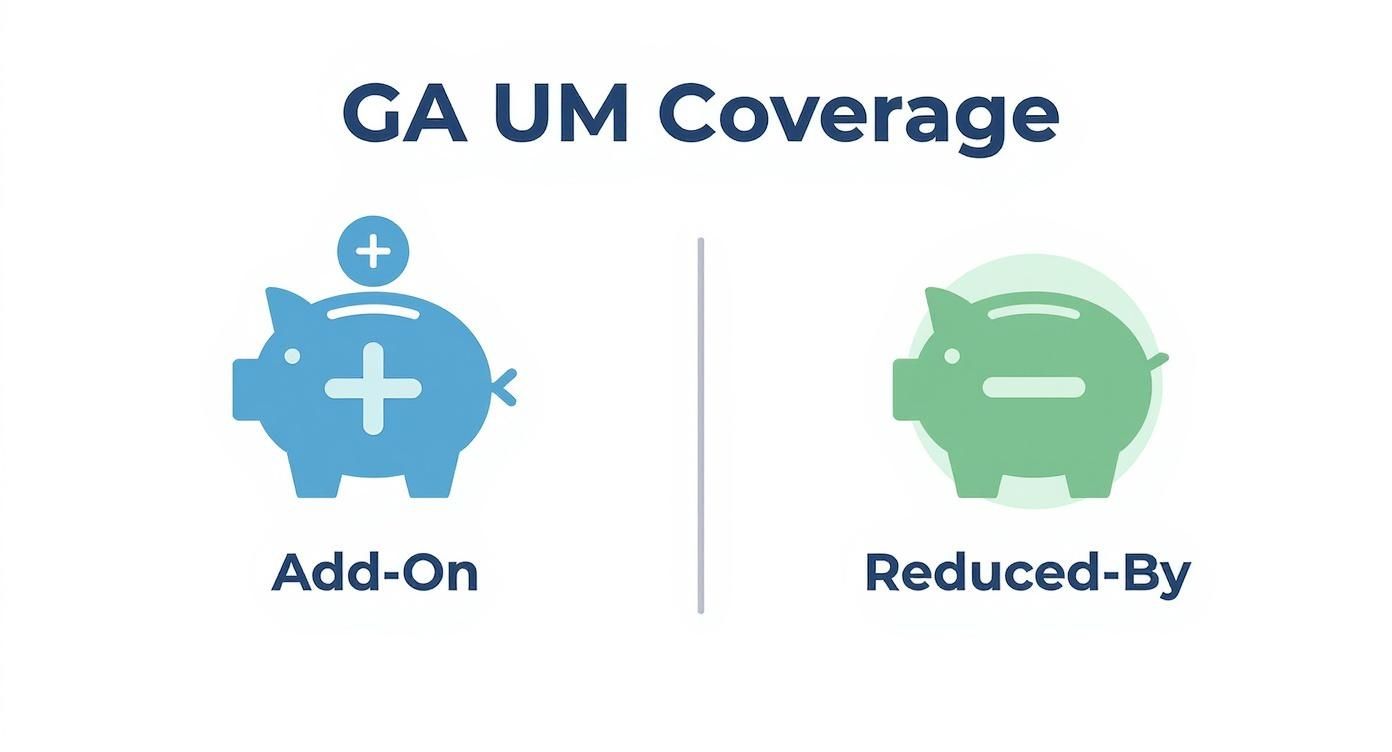
As the image shows, Add-On coverage adds to your recovery potential. Reduced-By subtracts from it. That's exactly why Add-On is the superior choice for stacking.
Who Is Covered by Stacked UM Policies?
Another key benefit is how broadly this protection applies. Generally, stacked GA uninsured motorist coverage protects more than just the person who signed the policy.
Coverage typically extends to you and any "resident relatives"—family members who live in your household. This means if your spouse or child who lives with you is injured by an uninsured driver, they may also be able to access the stacked coverage limits, even if they were a pedestrian or riding a bicycle at the time.
With so many uninsured drivers on the road, this broad protection has become more important than ever. The risk is so high that as of 2023, at least 20 states and the District of Columbia now require drivers to carry UM coverage.
This isn't just a minor issue; it's a widespread problem affecting road safety across the country.
Your Step-by-Step Guide to Filing a UM Claim

Knowing you have the right GA uninsured motorist coverage is a huge relief, but it’s only half the battle. When an accident actually happens, what you do next is fundamental to making that coverage work for you.
The minutes after a crash are chaotic and stressful. Having a clear plan of action is the best way to protect your health and your right to fair compensation. This guide breaks down exactly what to do after a collision with an uninsured or underinsured driver.
Immediate Actions at the Scene
Your first priority is always health and safety. Before doing anything else, check on yourself and your passengers. Call 911 immediately to request medical and police assistance. A formal police response is fundamental, even for what seems like a minor fender-bender.
Once everyone is safe, focus on documenting the scene:
- Don't Move Your Vehicle: Unless your car is creating a serious hazard, leave it where it stopped until the police arrive. This preserves the scene and helps officers create an accurate report.
- Exchange Information: Get the other driver's name, address, and phone number. Ask for their insurance details, even if they claim not to have any. You should also get contact information from anyone who witnessed the crash.
- Take Photos and Videos: Use your smartphone to capture everything. Get pictures of both vehicles from multiple angles, the license plates, the road conditions, debris, and any visible injuries.
The official police report is a vital piece of evidence. It provides an objective, third-party account of the incident and will be one of the first documents your insurance company asks for when you open a claim.
Notifying Your Insurance Company
You need to contact your own insurance company as soon as you can after the accident. Don't put this off. Nearly every insurance policy includes a clause requiring you to report a potential claim "promptly."
When you call, state clearly that you were in an accident and believe the at-fault driver is uninsured or underinsured. This is the trigger that starts the UM claim process. Your insurer will assign an adjuster to your case and give you a claim number.
From here on out, keep a detailed log of every conversation you have with your insurance company. Note the date, time, the name of the person you spoke with, and a summary of the discussion. Meticulous records are your best friend during this process.
Building Your Case for Damages
A UM claim is unique because you’re dealing with your own insurance company, not the other driver's. However, the burden of proof is still on you. You must prove the full extent of your losses, just as you would if you were filing against the at-fault party's insurer.
Start a dedicated folder and keep every single document related to the accident in one place:
- Medical Records and Bills: Gather every bill, receipt, and report from doctors, hospitals, physical therapists, and pharmacies.
- Proof of Lost Income: Obtain a letter from your employer that details your normal rate of pay and confirms the time you missed from work due to your injuries. Include recent pay stubs.
- Other Expenses: Don't forget to keep receipts for related costs, like paying for rides to medical appointments or hiring help for household chores you can no longer do.
If your UM claim involves serious injuries or your insurer is disputing your damages, it's wise to consult a car accident law firm near you to explore your legal options. Presenting your adjuster with a well-organized and fully documented claim is the most effective way to recover the full value of your GA uninsured motorist coverage.
Why You Must Reject UM Coverage in Writing
In Georgia, the law is written to protect you, not the insurance company. When you buy a car insurance policy, your insurer is required by law to offer you GA uninsured motorist coverage with limits matching your liability coverage. This isn't just a friendly suggestion—it's a mandatory safeguard. The state knows just how financially devastating a crash with an uninsured driver can be.
If you decide to pass on this important protection, a simple "no, thanks" over the phone won't cut it. You must formally reject the coverage in writing using a specific form from your insurer. This isn't just a bureaucratic step; it's a legal requirement designed to make you stop and think before giving up a right that could save you from financial ruin.
The Law Behind the Form
This rule is a powerful consumer protection tool. It forces a moment of deliberate consideration, preventing anyone from accidentally waiving their UM coverage without understanding the consequences. The requirement for a written rejection is laid out in the Official Code of Georgia Annotated (O.C.G.A.) § 33-7-11.
The burden is entirely on the insurance company to get your signature on that rejection form. If they can't produce a signed copy after you've been in an accident, Georgia law may force them to act as if you had the coverage all along.
The screenshot below shows the actual language from the Georgia statute that establishes these rules, sourced from the official Georgia General Assembly website.
As the legal text shows, the insurer is only off the hook if the coverage is "rejected in writing." That signature becomes an incredibly important legal act.
What Does a Rejection Form Look Like?
These forms are usually straightforward and included in your initial stack of policy paperwork. They are designed to be clear and unambiguous.
A standard UM rejection form will typically have:
- A Clear Statement: Language confirming that you are knowingly rejecting Uninsured/Underinsured Motorist Bodily Injury and/or Property Damage coverage.
- Coverage Options: It will often let you choose lower limits or reject the coverage entirely.
- Your Signature and Date: This is your legally binding confirmation that you understand you are giving up this protection.
Signing this form to save a few dollars a month is one of the biggest gambles a driver can take. A single serious wreck with an uninsured driver can easily lead to hundreds of thousands of dollars in medical bills and lost wages—a catastrophe that a proper GA uninsured motorist coverage policy would have handled. Before you sign, ask yourself if the small monthly savings is worth that enormous risk.
Clearing Up Common UM Coverage Myths
There's a ton of bad information out there about uninsured motorist (UM) coverage, and unfortunately, those misunderstandings can lead to some costly mistakes. As an Atlanta personal injury attorney, I’ve heard just about every myth in the book—and seen the real-world consequences when people underestimate this protection.
Let's cut through the noise and get straight to the facts so you understand just how valuable your GA uninsured motorist coverage really is.
One of the biggest misconceptions is that UM coverage is just an expensive, pointless add-on. That couldn't be further from the truth. In reality, this coverage usually costs just a few extra bucks a month, but it delivers a massive financial safety net in return.
Think of it like a fire extinguisher. You hope you never have to use it, but if a fire ever breaks out, you'll be incredibly glad you made that small investment.
Is My Health Insurance Enough?
Another myth I hear all the time is that health insurance is all you need after a car wreck. While your health plan is obviously helpful for covering your medical bills, its job stops there. It does absolutely nothing for all the other major losses you're facing.
This is where UM coverage really shines. It's designed to step in and cover everything health insurance won't touch:
- Lost Wages: If your injuries keep you out of work, UM coverage is there to replace that lost income.
- Pain and Suffering: This is compensation for the physical agony and emotional trauma the accident has put you through.
- Future Medical Needs: It can also cover long-term care, physical therapy, or surgeries you might need down the road.
On top of that, your health insurance company may try to get its money back from any settlement you receive. This process is called subrogation. Your UM coverage, however, is a separate source of funds dedicated entirely to your accident-related damages.
To see the difference more clearly, let's break down what each type of insurance does and doesn't cover for you after a wreck.
UM Coverage vs. Other Insurance Types
| Damage Type | Covered by Health Insurance? | Covered by Collision Coverage? | Covered by UM Bodily Injury? |
|---|---|---|---|
| ER & Hospital Bills | Yes, subject to deductibles | No | Yes |
| Lost Wages | No | No | Yes |
| Pain & Suffering | No | No | Yes |
| Future Medical Care | Potentially, with limits | No | Yes |
| Damage to Your Car | No | Yes | No |
As you can see, UM Bodily Injury is the only policy that specifically covers the human cost of an accident—your lost income and your suffering—when the at-fault driver has no insurance.
Does It Cover Hit-and-Run Accidents?
Many people assume that if a driver smashes into them and takes off, they're just out of luck. Thankfully, your uninsured motorist coverage is built for exactly these kinds of nightmare scenarios.
In Georgia, a hit-and-run driver is legally treated as an uninsured motorist.
But there are a couple of important rules to follow. To file a claim, there usually needs to have been physical contact between the hit-and-run car and your own. You also must report the accident to the police right away.
With the national rate of uninsured drivers still a major issue, and auto insurance costs rising partly because of this risk, understanding your policy has never been more important. You can learn more about these national trends and how they impact insurance costs.
Busting these myths helps you see your GA uninsured motorist coverage for what it truly is: a powerful shield against financial ruin.
Answering Your Questions About Georgia UM Coverage
As a personal injury attorney in Atlanta, I've heard just about every question you can imagine when it comes to car wrecks and insurance. For GA uninsured motorist coverage, the same handful of questions pop up again and again. Let's get you some straightforward answers so you can understand your policy and your rights.
How Much UM Coverage Should I Actually Buy in Georgia?
Georgia's minimum liability limits are set at $25,000 per person and $50,000 per accident. Let me be blunt: these amounts are almost never enough to cover the fallout from a serious injury.
The smartest move is to match your UM coverage to your own liability limits. If you have a $100,000/$300,000 liability policy to protect your assets from someone else, you should have the exact same amount to protect yourself.
Think about the reality of a bad wreck:
- Health Insurance Deductibles: Do you have $5,000 or $10,000 sitting around to cover a deductible on short notice?
- Lost Wages: Could your family get by if you were out of work for months with no income?
- Medical Bills: It’s no exaggeration—serious injuries can easily rack up six-figure medical bills.
When you're deciding on coverage, it's always better to have a little more protection than you think you'll need.
Can I Still Use My UM Coverage If I Was Partially At Fault?
Yes, in most cases, you absolutely can. Georgia operates under a legal rule called modified comparative negligence. In simple terms, this means you can still recover damages as long as a jury decides you were less than 50% responsible for the crash.
Your total recovery is just reduced by whatever percentage of fault is assigned to you. For instance, if you have $100,000 in damages but are found to be 10% at fault, you could still recover $90,000. Your UM insurance carrier basically steps into the shoes of the uninsured driver, meaning they only have to pay what that driver would have been legally required to pay.
What if the At-Fault Driver’s Insurance Company Denies Their Claim?
This is a fantastic question because it happens far more often than people realize. If the other driver's insurance company denies the claim for a valid reason—maybe the driver wasn't listed on the policy or they were driving for a rideshare service without the proper coverage—then that driver is now considered "uninsured" as far as your accident is concerned.
In that scenario, your own UM coverage can kick in. The single most important thing you need is a formal denial letter from the at-fault driver's insurance company. Your insurer will require this document as proof before they'll open a claim under your GA uninsured motorist coverage.
It's also important to act fast. Georgia’s personal injury laws have very strict deadlines. You can read our guide on the statute of limitations for personal injury in GA to get a handle on those time limits. This resource from Georgia Legal Aid provides a clear overview of the deadlines you must meet. Understanding your options for GA uninsured motorist coverage is a key part of protecting yourself on the road.
If you've been hurt in an accident with an uninsured driver and need help figuring out what to do next, Jamie Ballard Law is here. We offer free, no-obligation case evaluations to give you the clarity and support you deserve. Visit us at https://jamieballardlaw.com to learn more.