The moments after a crash are a blur of confusion and adrenaline. What you do next can define the entire path of your car accident recovery. The single most important thing is to stay as calm as you can and methodically document everything. Your focus should be on safety, gathering facts, and clear communication—and absolutely avoiding any talk of who was at fault. As an Atlanta personal injury attorney, my goal is to provide helpful information so you can feel more in control during a difficult time.
Your First Steps at the Accident Scene
I’ve seen time and again how a few key actions at the scene make all the difference later. The shock makes it incredibly hard to think straight, so having a mental checklist helps keep you grounded and protects your rights. Safety is always number one.
First, check on yourself and your passengers. Are you hurt? Then, if you're able, check on the people in the other car. Call 911 immediately to report the crash and ask for an ambulance if anyone needs medical help. Even for a minor fender-bender, a police report creates an official, unbiased record of what happened. That document is invaluable. You can learn more about how police reports are used from official sources like the Georgia Department of Public Safety.
Securing the Scene and Gathering Evidence
If your car still runs and it’s safe, move it to the shoulder or out of the flow of traffic. The last thing you want is to cause another collision. Flip on your hazard lights to warn other drivers. It’s a small step that protects everyone, including the first responders on their way.
Once you’re in a safe spot, it’s time to start documenting. Your smartphone is your best tool here. Take pictures and videos from every angle you can think of. Make sure you capture:
- Damage to both vehicles: Get wide shots showing where the cars ended up and close-ups of the impact points.
- The surrounding area: Photograph traffic signs, skid marks, weather conditions, and anything else in the environment that might have played a role.
- License plates and insurance cards: A clear photo is always better than trying to scribble down information while you're shaken up.
- Visible injuries: If you have any cuts, bruises, or scrapes, take pictures of them right away.
This visual guide shows the simple, yet essential, flow of actions to take immediately after an accident.
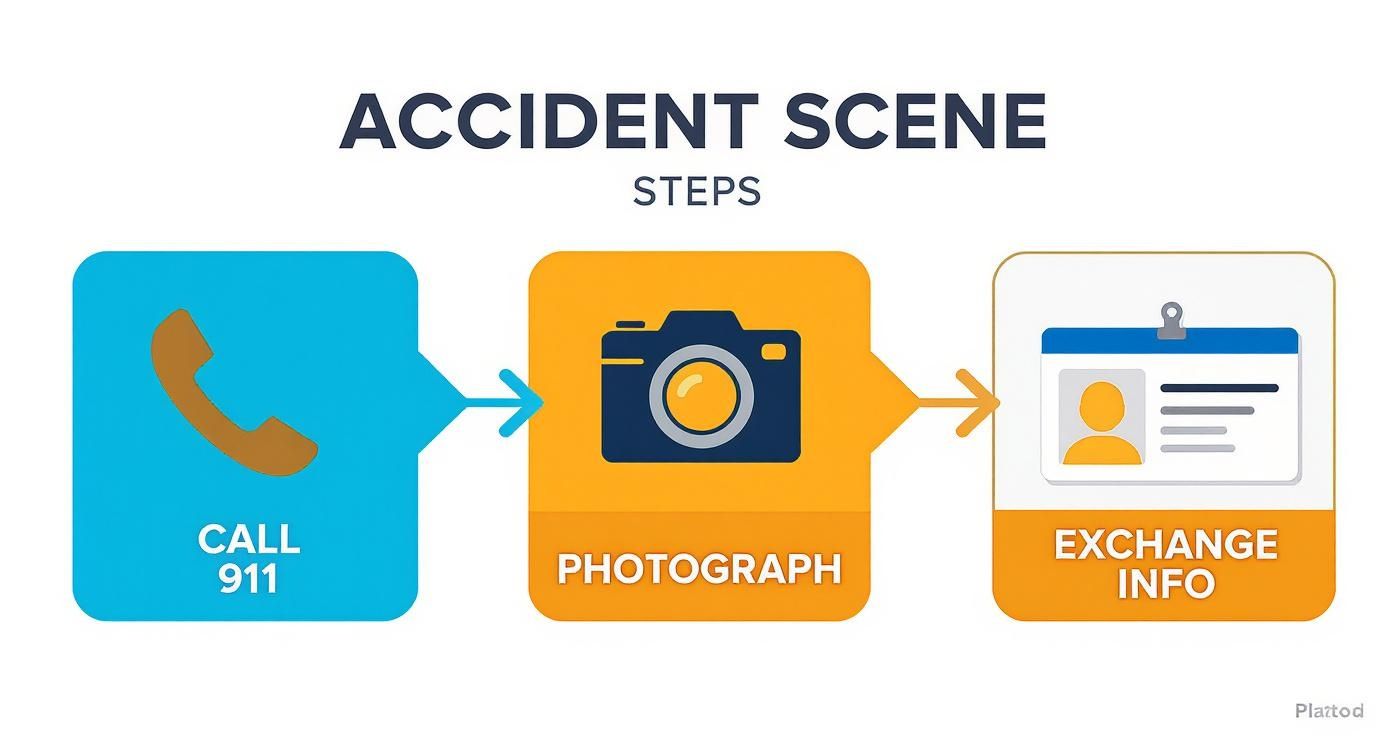
This process—calling for help, documenting the scene, and exchanging information—builds the solid foundation your claim needs.
Exchanging Information the Right Way
After you've taken your photos, you need to exchange information with the other driver. Be polite but direct. Get their name, address, phone number, driver’s license number, and their insurance policy details. If there were any witnesses, get their contact information, too. An objective third-party account can be incredibly helpful.
A key piece of advice I give every client is this: Do not apologize or admit fault. Stick strictly to the facts. A simple "I'm so sorry" can be twisted by an insurance company into an admission of guilt, even if you were just being courteous.
Following these steps isn't about pointing fingers at the scene. It’s about collecting the objective facts needed to ensure a smooth and successful car accident recovery.
Why Medical Care Is Your Top Priority
After a crash, the adrenaline surge can easily fool you into thinking you’re unhurt. But your first and most important step in any car accident recovery is to get a professional medical evaluation.
Many severe injuries—like whiplash, concussions, or even internal bleeding—don't show clear symptoms for hours or sometimes days. Waiting to see a doctor is a gamble with both your health and your potential insurance claim.
Seeking medical care right away creates an official, direct link between the collision and your injuries. That medical record becomes a cornerstone of your evidence if you need to file a claim.

Different Types of Medical Support You May Need
Your medical journey often starts in the emergency room but rarely ends there. Depending on the nature of your injuries, your primary doctor will likely refer you to specialists for targeted treatment.
Common specialists you might see include:
- Orthopedists: For broken bones or serious joint damage.
- Neurologists: If you have headaches, dizziness, or other signs pointing to a head injury.
- Physical Therapists: To help you rebuild strength, flexibility, and range of motion.
- Chiropractors: For spinal adjustments to manage back and neck pain.
Following through on every single appointment and treatment plan is non-negotiable. It proves to the insurance company that you're taking your injuries seriously and are committed to your recovery. The Georgia Department of Public Health is a solid resource for finding trusted local medical professionals.
Documenting the Severity of Your Injuries
The statistics are sobering. Each year, road traffic accidents cause an estimated 1.19 million deaths worldwide, while another 20 to 50 million people sustain injuries that can lead to long-term disabilities. You can find more on these global traffic safety statistics from the World Health Organization. This context highlights just how important it is to document every detail of your own injury for your future well-being.
What you feel on day one is not always the full story. I've had clients who felt a little sore, only to wake up a week later in debilitating pain from a herniated disc. Your medical records tell the objective story of your pain and suffering.
If the accident results in a spinal injury like a herniated disc, exploring treatments such as manual care for disc herniation can be essential for lasting relief.
To help you understand what to look for, here's a quick guide to some common post-accident injuries and what to do first.
Common Post-Accident Injuries and Recommended Medical Steps
| Injury Type | Common Symptoms | Recommended First Medical Step |
|---|---|---|
| Whiplash | Neck pain, stiffness, headaches, dizziness | See a primary care doctor or visit an urgent care clinic. |
| Concussion | Confusion, memory loss, sensitivity to light, nausea | Go to the emergency room immediately for evaluation. |
| Herniated Disc | Sharp back or neck pain, numbness in limbs | Consult your primary care doctor for a referral to a specialist. |
| Fractures | Severe pain, swelling, inability to move the limb | Seek immediate emergency room care for X-rays and casting. |
| Internal Bleeding | Abdominal pain, bruising, dizziness, fainting | This is a medical emergency; go to the ER without delay. |
Remember, this table is a general guide. Your symptoms and needs are unique, so always follow the advice of a qualified medical professional.
Sticking with your treatment plan isn't just about feeling better—it's about building the strongest possible foundation for both your physical and financial car accident recovery.
Organizing Your Accident-Related Documents
A successful insurance claim is built on a foundation of solid evidence. Think of yourself as the lead investigator of your own case—your path to a fair car accident recovery starts with meticulous organization.
After a crash, you're hit with a tidal wave of paperwork from doctors, mechanics, and insurance companies. The first thing to do is simple but effective: get a dedicated folder or box. It doesn't need to be fancy, but every single piece of paper related to the accident goes in it. This keeps essential proof from getting lost in the shuffle of everyday life.
The Essential Paper Trail
Your collection of documents is what tells the complete story of the accident and its aftermath. Each piece of paper is a building block for your claim, so you’ll want to gather and keep everything, no matter how small it seems.
Here’s a checklist of what you absolutely need to hold onto:
- The Official Police Report: Request a copy as soon as it becomes available from the responding agency, like the Atlanta Police Department. It contains the officer's initial, unbiased findings.
- Medical Records and Bills: This means everything—from the initial ER visit to follow-up appointments, physical therapy sessions, and even receipts for prescriptions.
- Proof of Lost Wages: Ask your employer for an official letter detailing the exact dates you missed work and the total income you lost because of your injuries.
- Vehicle Repair Estimates: Keep every quote you get, plus the final bill from the auto body shop that does the work.
Many of these documents use specific legal terms that can be confusing. To get a better handle on the language, it can be helpful to review a legal dictionary for clear, straightforward definitions.
I always tell my clients to keep a simple journal alongside their official documents. This personal record adds a powerful, human element that medical bills alone can't capture. It shows the real-world impact the accident had on your life.
The Power of a Personal Journal
While bills and official reports establish the facts, a daily journal illustrates the human cost of the accident. This doesn’t have to be a long, elaborate diary. Just a few quick notes each day will do.
Jot down how you're feeling, both physically and emotionally. Note your pain level on a scale of 1 to 10, mention any new symptoms, and describe how your injuries are affecting your daily routines. Can you no longer lift your child, walk the dog, or enjoy your hobbies? These details paint a vivid picture for an insurance adjuster of how the crash truly impacted your life, strengthening your overall case for a fair car accident recovery.
How to Talk to Insurance Adjusters
It won't take long for the phone to ring. After an accident, you can expect a call from an insurance adjuster—fast. Knowing how to handle this conversation is a key part of your car accident recovery.
It's helpful to remember who the adjuster works for: the insurance company. Their job is to protect the company’s bottom line, which often means settling your claim for as little money as possible.
That first phone call is really a fact-finding mission for them. Be careful, because anything you say can and will be used to devalue your claim down the road. You are not legally required to give a recorded statement, and it’s almost always in your best interest to politely say no until you're fully prepared.
Just stick to the basic, undisputed facts:
- When and where the crash happened.
- Who was involved.
That's it.

What to Say and What to Avoid
When you finally do speak with an adjuster, choose every word with care. Less is always more in this situation. Don't guess about details or give your opinion on how you're feeling.
A simple, "I'm still under a doctor's care" is a much safer response than "I feel okay." An adjuster will hear "okay" and interpret it as you not being seriously hurt, even if that's not what you meant.
Here are a few key pointers for that first conversation:
- Do Not Admit Fault: Never, ever apologize or say anything that sounds like you're taking responsibility for the accident.
- Do Not Speculate: If you don't know the answer, just say so. Don't guess about your speed, the distance between cars, or any other detail.
- Do Not Discuss Your Injuries in Detail: Simply state that you are receiving medical treatment. The full extent of your injuries is still unknown.
- Do Not Agree to a Recorded Statement Immediately: Politely tell them you're not ready to provide a recorded statement at this time.
While handling these calls, it also helps to understand the common reasons why an insurance company might refuse a claim. This knowledge helps you provide clear, factual information without accidentally damaging your own case. For a deeper dive into the claims process, check out our guide on how to file a car accident claim in Atlanta.
Understanding Your Own Insurance Policy
Before you even get on the phone with the other driver’s insurer, take a minute to pull out your own policy. Many Georgia drivers have valuable coverage they don't even know about. Two of the most important are MedPay (Medical Payments) and Uninsured/Underinsured Motorist (UM/UIM) coverage.
Never sign any documents or accept a settlement offer from an insurance company without having a complete understanding of what you're agreeing to. A quick settlement might seem tempting, but it often means signing away your rights to future compensation if your injuries turn out to be more severe than you initially thought.
The road to recovery can be long. You should never rush the claims process—your full damages may not be clear for months.
Addressing the Emotional Side of Recovery
A car accident isn't just about bent metal and broken bones. While physical healing is front and center, the emotional aftermath is just as real and often lasts much longer. It's a part of car accident recovery that's easy to overlook but impossible to ignore.
The sudden violence of a crash can leave you feeling rattled and vulnerable. You might find yourself struggling with a new fear of getting behind the wheel, or maybe you're dealing with anxiety and sleepless nights. These feelings are a completely normal response to a traumatic event. Acknowledging this emotional toll is the very first step toward a complete recovery.
Recognizing the Signs of Emotional Trauma
Your mind needs time to process what happened, and sometimes it needs a little help to get there. The key is to pay attention to changes in your mood and behavior in the days, weeks, and even months after the accident.
Some of the most common signs of emotional trauma include:
- Persistent Anxiety or Panic: This often spikes when you think about the crash or have to get into a car.
- Intrusive Thoughts or Nightmares: You might find yourself reliving the moment of impact over and over again.
- Irritability or Mood Swings: It's common to feel angry or on edge without any obvious reason.
- Avoidance Behavior: You might start going out of your way to avoid driving or even riding as a passenger.
If these sound familiar, they could be signs of post-traumatic stress, which is a recognized medical condition you can learn more about from resources like Wikipedia. It's also a clear signal that you should consider seeking professional support. It can also be helpful to know you're not the only one going through this. You can read about the journeys of some of our past clients https://jamieballardlaw.com/personal-injury-testimonials/ to see how others handled similar challenges.
Give yourself grace during this time. Healing is never a straight line—you will have good days and bad days. That’s perfectly okay. The goal is progress, not perfection.
Talking to a qualified therapist who specializes in trauma can give you the tools you need to process the event and get your confidence back. Organizations like the National Institute of Mental Health (NIMH) are excellent resources for finding help. Addressing this "invisible injury" is an essential part of a full car accident recovery.
Common Questions About Atlanta Accident Claims
After a crash, your head is spinning with questions. The entire process feels overwhelming, and getting clear, straightforward answers is a huge step in your car accident recovery. I've put together some of the most common questions I hear from my Atlanta clients to help you understand what’s ahead.

The goal here is simple: to give you the basic information needed to make informed decisions for yourself and your family.
How Long Do I Have to File a Claim in Georgia?
This is one of the most important questions I get. In Georgia, you generally have two years from the date of the accident to file a personal injury lawsuit. This deadline is known as the statute of limitations.
If you miss this two-year window, you will almost certainly lose your right to seek compensation for your injuries forever. It’s a hard deadline, which is why acting promptly is so important.
Should I Accept the First Settlement Offer?
My advice is almost always a firm no. The initial offer from an insurance company is rarely their best one. It’s usually a lowball number designed to close your case quickly and cheaply.
Think about it from their perspective. Early on, you might not even know the full extent of your injuries. What feels like a minor backache could later be diagnosed as a herniated disc that requires surgery and months of physical therapy.
Accepting a quick settlement means you sign away your right to any future compensation for that accident. Once you take their check, you can't go back and ask for more if your medical condition gets worse.
It's far better to wait until you have a complete picture of your medical needs and lost income before you even start negotiating.
What If the Other Driver Was Uninsured?
This is a scary thought, but it doesn’t mean you’re out of options. If the at-fault driver has no insurance, you can often turn to your own policy for help. This is exactly what Uninsured/Underinsured Motorist (UM/UIM) coverage is for.
- Uninsured Motorist (UM): This covers your expenses if the at-fault driver has no insurance at all.
- Underinsured Motorist (UIM): This helps cover the gap if the at-fault driver has insurance, but their policy limits aren't high enough to cover all of your damages.
I strongly recommend that every driver in Georgia carry this coverage. It acts as an important safety net. To understand all the details of what can be included in a claim, you can learn more about the different types of personal injury claims and what they cover.
Knowing your rights and the rules of the road is the best way to ensure you are treated fairly throughout your entire car accident recovery.