If you've been hurt because someone else acted negligently in Georgia, one of the first questions on your mind is likely, "How long do I have to take legal action?" As an Atlanta personal injury attorney, this is a question I answer every day. The legal term for this deadline is the personal injury statute of limitations, and it's something you must get right.
For most personal injury cases in our state, the answer is two years from the date you were injured. This isn't a guideline; it's a firm deadline set by law.
Understanding the Legal Countdown Clock
Think of the statute of limitations as a countdown clock that starts the moment an injury happens. This law sets a hard deadline for filing a lawsuit in court. If you miss that deadline—even by a single day—the court will almost certainly throw out your case, no matter how strong your evidence is. Missing this window means you lose your right to seek financial compensation for good.
These time limits exist for a very practical reason: they ensure legal claims are pursued while evidence is still fresh and reliable. With time, memories fade, witnesses can become hard to locate, and important physical evidence can be lost or destroyed. These deadlines encourage timely action, which is fundamental for a fair legal process for everyone involved.
To give you a clearer picture of these time limits, here's a quick summary of the most common personal injury deadlines in Georgia.
Georgia Personal Injury Filing Deadlines at a Glance
This table breaks down the standard legal timeframes for filing different types of personal injury lawsuits in Georgia.
| Type of Injury Claim | Standard Filing Deadline |
|---|---|
| Personal Injury (e.g., car accidents, slip and falls) | 2 years from the date of injury |
| Medical Malpractice | 2 years from the date of injury or discovery of injury |
| Wrongful Death | 2 years from the date of death |
| Property Damage (e.g., vehicle damage) | 4 years from the date the damage occurred |
| Loss of Consortium | 4 years from the date of the spouse's injury |
Please remember, these are the standard deadlines. Certain exceptions can change these timeframes, which is why it's so helpful to discuss your specific situation with an attorney.
Why Every Day Truly Counts
Missing the statute of limitations isn't a small procedural mistake; it's a permanent barrier to justice. Insurance companies are well aware of these deadlines. It's not unusual for them to use delay tactics during settlement discussions, hoping the clock will run out on your right to file a lawsuit.
This is exactly why understanding the specific personal injury statute of limitations that applies to your case is the first and most important step in protecting your legal rights after an accident. To help you visualize where this kind of official information comes from, the image below shows an example of a government resource page where state codes and legal information are published.

This screenshot is a good example of how state government websites provide public access to the laws that define these filing deadlines. Knowing where to find these rules—and more importantly, how to interpret them for your specific situation—is absolutely essential.
Why This Legal Filing Deadline Exists

When you're focused on recovering from a serious injury, a legal deadline is often the last thing on your mind. That's completely understandable. The whole idea of a personal injury statute of limitations can even feel unfair.
But these time limits are not arbitrary. They exist for clear reasons designed to protect the integrity of the legal process, striking a balance between the rights of the injured person and the need for a functional justice system. The two primary goals are preserving the quality of evidence and providing finality for all parties.
Promoting Fairness Through Timely Action
Think about it this way. If I asked you to describe a conversation you had yesterday, you could probably recall it with decent accuracy. But what about a conversation from five years ago? The details would be hazy, and your memory would be far less reliable.
The same principle applies to legal cases. The more time that passes between an incident and a lawsuit, the greater the chance that valuable evidence will be lost.
- Fading Memories: Eyewitnesses forget key details. Over time, their testimony becomes less credible and more open to challenge in court.
- Lost Evidence: Physical evidence disappears. Skid marks fade, surveillance footage gets overwritten, and the defective product that caused your injury might be thrown out or repaired.
- Unavailable Witnesses: People move, change phone numbers, or even pass away. Their essential testimony can become impossible to get.
By requiring you to act within a specific timeframe, the law helps ensure that cases are built on the freshest, most dependable evidence available.
The American Bar Association explains that these laws prevent "stale" claims. The logic is direct: a person with a legitimate claim will typically pursue it with reasonable diligence.
Providing Certainty and Closure
This legal clock also serves an important purpose for the person or company being sued—the defendant. Without a statute of limitations, they would live under the constant, indefinite threat of a lawsuit. Imagine a small business owner or a driver never knowing if a minor incident from a decade ago could suddenly become a major legal battle.
This deadline allows individuals and businesses to close the books on past events after a reasonable amount of time. It provides what’s known as "legal repose," giving them the certainty needed to move forward without the perpetual fear of old claims surfacing. It also helps the justice system operate more efficiently by encouraging cases to proceed while the facts are still clear.
The goal is to strike a fair balance. The system gives injured people a reasonable opportunity to prepare and file their claim while ensuring the legal process remains just and functional for all. The personal injury statute of limitations isn’t a penalty; it’s a foundation of a predictable and fair legal system.
Deadlines for Specific Injury Claims in Georgia
While Georgia’s general two-year rule is a good starting point, it’s not a one-size-fits-all answer. The timeline you must follow for your personal injury statute of limitations can change based on the specific details of your case—how you were hurt and who was responsible.
Getting this detail right is absolutely fundamental. A wrong assumption about your deadline can, unfortunately, mean losing your right to seek compensation entirely. To help you understand these important differences, we've broken down the filing deadlines for the most common injury claim scenarios here in Georgia.
Standard Injury and Wrongful Death Claims
For most personal injury cases, the timeline is quite direct. This includes common incidents like:
- Car, Truck, and Motorcycle Accidents: If another driver's negligence causes a collision where you're injured, you have two years from the accident date to file a lawsuit.
- Slip and Fall Incidents: When you get hurt on someone else's property due to an unsafe condition, that same two-year deadline from the date of the fall applies.
- Wrongful Death Claims: If you have tragically lost a family member because of someone's negligence, your family has two years from your loved one's date of death to file a claim.
These cases make up a huge part of the legal landscape. The personal injury market in the U.S. was valued at around $57 billion in 2023. Interestingly, only about 4-5% of these cases ever go to a full trial; the vast majority settle out of court.
Special Deadlines for Government and Medical Claims
This is where things can get more layered and require immediate action.
When a government entity is involved, the standard two-year clock doesn't apply in the same way. You’re facing a much shorter, preliminary deadline that you absolutely must meet first.
If your injury was caused by a city, county, or state employee—for instance, you were hit by a city bus or tripped on a badly broken public sidewalk—you have to provide a formal written notice of your claim. This is called an 'ante litem' notice. The deadline for this notice is often just six months for a city and 12 months for the county or state. If you miss this initial notice period, you will be barred from ever filing a lawsuit.
Medical malpractice cases also operate under their own specific rules. While the lawsuit deadline is two years, Georgia law includes something called a "statute of repose." This is an absolute, final deadline of five years from the date of the negligent medical act, no matter when you actually discovered the injury. You can find the full details in the Official Code of Georgia Annotated (O.C.G.A.).
The image below shows some key situations that can pause, or "toll," these legal deadlines.
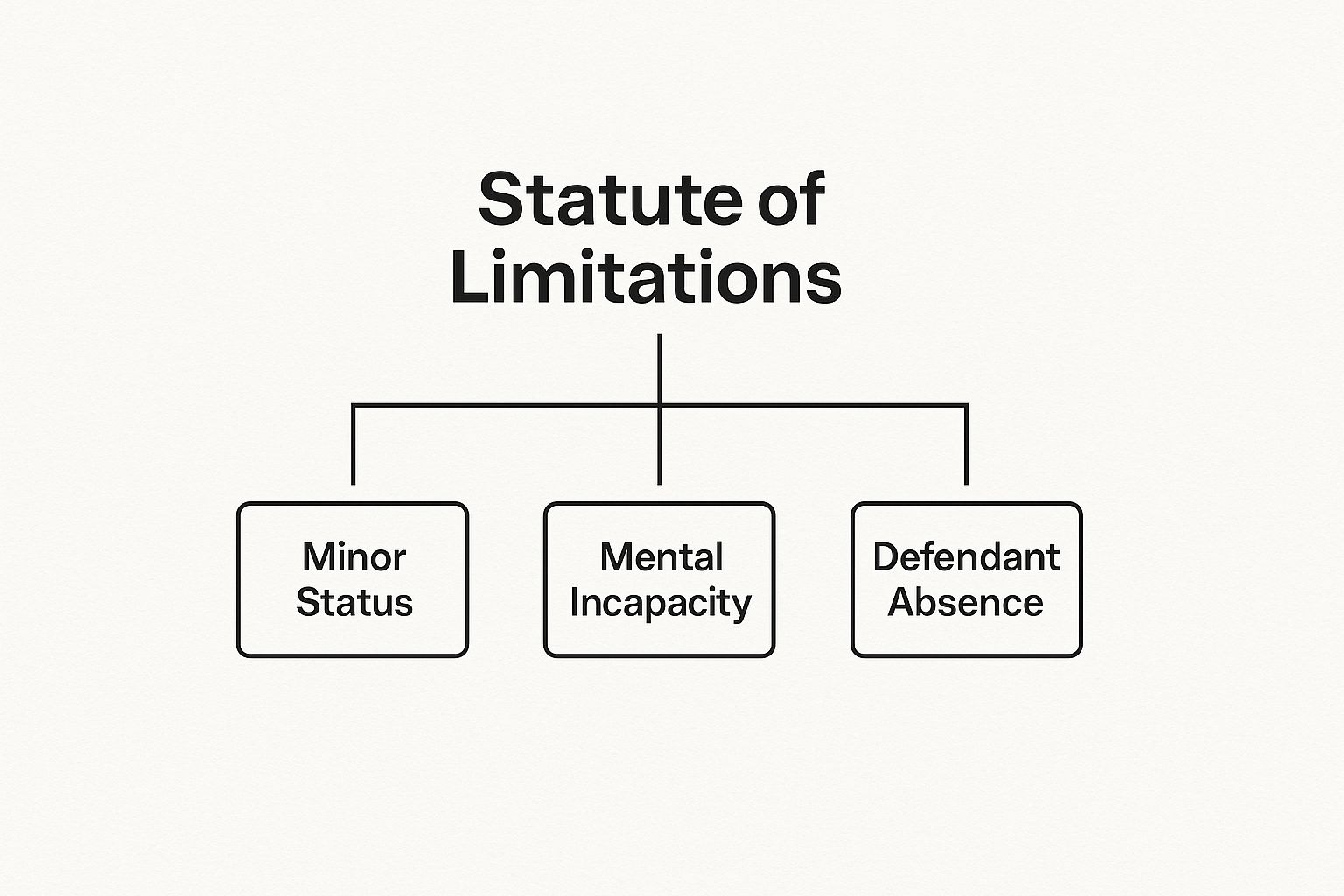
This visual highlights how certain factors, like the injured person being a minor, can change the standard rules. Understanding which of these specific timelines and potential exceptions applies to your situation is the single most important part of protecting your rights under the personal injury statute of limitations.
When the Filing Deadline Can Be Paused

While the two-year deadline for most Georgia injury claims is firm, the law recognizes that certain situations make it unfair to start the clock on day one.
This is where a legal principle called "tolling" comes into play. You can think of tolling as hitting the pause button on the countdown for your personal injury statute of limitations. It’s an important protection that gives you extra time when specific, legally recognized circumstances prevent you from filing a lawsuit.
The Discovery Rule for Hidden Injuries
One of the most important exceptions is known as the discovery rule. It’s designed for situations where an injury isn't immediately obvious. In a typical car wreck, for example, the harm and its cause are usually clear from the moment of impact.
But what if they aren't? Imagine a surgeon accidentally leaves a medical instrument inside a patient. The pain and complications might not surface for months, or even years. The same goes for exposure to a toxic substance, where a serious illness might not be diagnosed until long after the exposure occurred.
In cases like these, the discovery rule states that the statute of limitations clock doesn't start on the date of the negligent act. Instead, it begins on the date you discovered your injury, or reasonably should have discovered it. This ensures you don't lose your right to a claim before you even know you have one.
Other Key Reasons for Tolling the Deadline
Beyond hidden injuries, Georgia law has other specific scenarios that can pause the filing deadline. These exceptions usually relate to the injured person's status or the at-fault party's actions.
Here are the most common reasons for tolling the personal injury statute of limitations:
- The Injured Person Is a Minor: When a child under 18 is hurt, the law recognizes they can't file a lawsuit themselves. The clock is paused until their 18th birthday, at which point the standard two-year deadline begins to run.
- The Injured Person Is Mentally Incapacitated: If an injury leaves someone mentally incompetent and unable to manage their own affairs, the filing deadline may be tolled. The clock can stay paused for as long as the legal incapacity lasts.
- The At-Fault Party Leaves Georgia: If the person who caused your injury leaves the state to avoid a lawsuit, you won't be penalized. The time they are absent from Georgia typically does not count against your two-year filing period.
- A Criminal Case Is Pending: If the incident also led to criminal charges (like in a DUI accident), the civil deadline may be paused. This tolling can last until the criminal case is fully resolved. You can learn more about how state laws are structured from resources like the Cornell Law School Legal Information Institute.
Please keep in mind that courts apply these exceptions narrowly. You can't just claim one applies; you must prove that your situation fits the specific legal requirements for tolling.
These rules exist to make the system more just, but they also add another layer of detail to a time-sensitive process. Because the exceptions for pausing the personal injury statute of limitations are so specific, having an experienced attorney review your case is the only sure way to know exactly what deadline applies to you.
How the Statute of Limitations Works in Real Life
Understanding the rules of the personal injury statute of limitations is one thing, but seeing how they apply to real people brings their importance into sharp focus. The legal clock doesn't always run in a straight line; it can speed up, slow down, or have extra steps depending on the situation.
Let’s look at a couple of stories to see how these timelines work in practice.
Imagine a woman named Maria who is hurt in a car crash on May 1st. Based on the standard two-year rule, she believes she has until May 1st two years from now to file her lawsuit. However, she later discovers the driver who hit her was a county employee driving a government vehicle while on duty. This one detail completely changes her timeline.
When Extra Deadlines Appear
Because a government entity is involved, Maria must first file a special document called an 'ante litem' notice with the county. This notice has its own deadline—just 12 months from the date of the accident.
It’s a mandatory first step. If she misses it, her right to file a lawsuit is gone forever, even though the two-year deadline for the suit itself hasn't passed. This shows how important it is to identify every party responsible for an injury right away.
Injuries are a widespread public health issue, impacting millions. The World Health Organization reports that injuries lead to about 4.4 million deaths worldwide each year, with traffic accidents being a major contributor. These statistics underscore why having clear time limits is essential for a functional justice system. You can discover more insights about these global injury trends from the WHO fact sheet.
The Discovery Rule in Action
Now, consider James, who was injured while using a new power tool. He initially assumed his injury was his own fault, but three years later, he receives a notice that the tool has been recalled for a dangerous defect. That defect perfectly matches what happened to him.
In this scenario, James is well past the standard two-year deadline. However, this is a classic example where the "discovery rule" might apply. The legal clock for his claim could be seen as starting not when he was hurt, but when he discovered (or reasonably should have discovered) that the tool's defect was the true cause.
The NHTSA provides regular updates on traffic statistics, as seen in the screenshot below, highlighting trends in incidents that often lead to these types of personal injury claims.
This data shows a slight decrease in fatalities but still represents thousands of families impacted by road accidents, each with its own timeline for seeking justice. These stories and statistics prove that the specifics of your case truly matter when it comes to the personal injury statute of limitations.
Actionable Steps to Protect Your Claim After an Injury
Knowing Georgia's statute of limitations is the first step. The second, more important step is taking decisive action to protect your right to file a claim. You cannot afford to wait—evidence disappears, memories fade, and legal deadlines get closer every day.
Here is a practical, step-by-step guide to what you should do immediately following an accident.
1. Seek Immediate Medical Attention
Your health is the top priority. Beyond that, getting a medical evaluation right away creates a time-stamped, official record of your injuries. This documentation from a doctor or hospital is a powerful piece of evidence that directly connects your harm to the incident. Without it, an insurer can easily argue your injuries weren't caused by the accident.
2. Officially Report the Incident
Creating an official report is a non-negotiable step.
- For a car accident, call the police and ensure an officer files a report.
- For a slip and fall on commercial property, file an incident report with the manager or owner on duty.
This formal paper trail establishes a clear record of when and where the event occurred. You can typically find information on obtaining police reports through local government portals, like the Atlanta Police Department's public records page.
A formal report is your first line of defense. It prevents the at-fault party from later claiming the incident never happened or that the facts were different.
3. Gather and Preserve All Evidence
Evidence is fragile and can vanish quickly. Use your smartphone to take as many pictures and videos as you can: the accident scene, property damage, and your visible injuries. If there were any witnesses, get their names and phone numbers before they leave the scene.
You should also start a dedicated file to keep all related documents organized, such as:
- Medical bills and pharmacy receipts
- Repair estimates for your car or other damaged property
- Pay stubs showing any lost wages
- All letters or emails from insurance companies
4. Be Cautious When Speaking with Insurance Companies
Shortly after an accident, expect a call from the other party's insurance adjuster. It's important to be careful. You are not legally obligated to provide a recorded statement, and you should never accept a quick settlement offer. These initial offers are almost always far less than what your claim is actually worth and are designed to close your case before the full extent of your injuries is known.
5. Discuss Your Case with a Legal Professional
Ultimately, the most reliable way to protect your rights and understand your specific deadline is to speak with a personal injury attorney. A lawyer can analyze the specific facts of your case, confirm the correct filing date under the personal injury statute of limitations, and explain all of your legal options. This single step removes the guesswork and ensures you don’t accidentally forfeit your right to compensation.
Common Questions About Georgia's Injury Deadlines
When you're dealing with a legal deadline as strict as the personal injury statute of limitations, it’s natural to have questions. Frankly, I see clients wrestle with these same concerns every day. Let's cut through the noise and get some clear, direct answers.
What Happens If I Miss the Statute of Limitations Deadline?
This is the most important question, and the answer is unforgiving. If you miss the filing deadline, the court will almost certainly dismiss your case permanently. It doesn’t matter how clear the fault is or how devastating your injuries are.
Once that legal window slams shut, your right to sue the at-fault party is gone. Forever. Georgia courts enforce this rule with very little room for error.
Does Talking to an Insurance Company Pause the Clock?
No, and this is a dangerously common mistake. Negotiating a settlement with an insurance adjuster has zero effect on the statute of limitations. The clock keeps ticking, day after day, whether you are on the phone with an adjuster or not.
You must file a formal lawsuit in court before the deadline to protect your legal rights. This is true even if you fully expect the case to settle. For more consumer-focused guidance on insurance matters, the Georgia Office of Commissioner of Insurance and Safety Fire provides helpful state resources.
This distinction is vital: Negotiating a claim with an insurer is not the same as filing a lawsuit. Only filing a formal lawsuit in court stops the clock on the statute of limitations.
How Do I Know the Exact Expiration Date for My Claim?
In most injury cases, the clock starts on the very day the injury occurred. You would simply count forward exactly two years from that date to find your deadline.
But life is rarely that simple.
- What if you didn't discover the injury right away?
- What if the final day to file falls on a weekend or a court holiday?
Because getting this date wrong is fatal to your claim, the only truly safe approach is to have a legal professional review the specific facts of your case. An attorney can pinpoint the correct start date and calculate the final day to file with certainty.
What Is a Statute of Repose and How Is It Different?
A statute of repose acts like an absolute, final deadline that isn't affected by when you discover an injury. While a statute of limitations usually runs from the date of injury or discovery, a statute of repose runs from a specific, fixed event—like the day a product was manufactured.
For example, Georgia has a ten-year statute of repose for product liability claims. This means that even if a defective product injured you nine years after it was made, you can’t file a lawsuit if more than ten years have passed since the product was first sold. It’s an ultimate cutoff on liability, as detailed in the Official Code of Georgia Annotated (O.C.G.A.). Understanding both the personal injury statute of limitations and any related statutes of repose is absolutely essential.
If you have more questions or are worried about your legal deadline, the team at Jamie Ballard Law is here to provide clarity and guidance. We offer free case evaluations to help you understand your rights and options. Contact us at https://jamieballardlaw.com to get the answers you need.