A car accident with a truck is a violent, terrifying event. In the disorienting moments that follow, your actions can make all the difference for your health and your ability to recover financially. Your first priority is simple: safety. Dealing with the aftermath of a commercial truck collision requires a clear head and a methodical approach to protect yourself and your potential claim.
Immediate Actions at the Scene of the Truck Crash
The aftermath of a truck wreck is chaotic, but a few calm, deliberate steps can protect you. The sheer physics are staggering—a passenger car is no match for an 80,000-pound semi-truck. These collisions are rarely minor. While big trucks make up only about 10% of vehicle miles traveled, the crashes they're involved in are disproportionately severe, often causing catastrophic, life-altering injuries.
Your focus has to be on safety. If you can, move your vehicle to the shoulder, well away from traffic. If the car is disabled or it's unsafe to move, immediately flip on your hazard lights to warn oncoming drivers.
Prioritizing Safety First
Before doing anything else, check yourself and your passengers for injuries. Adrenaline is a powerful painkiller, so you might be hurt worse than you think. Don't make any sudden movements. If someone appears seriously injured, it's best not to move them unless there's an immediate, life-threatening danger like a fire.
Once you've assessed your own vehicle, and if it's safe to get out, you can check on the truck driver and anyone else involved. But keep it simple. This is not the time to argue or discuss who was at fault. The goal is just to make sure everyone is okay until first responders arrive.
This flowchart breaks down the essential process to follow right at the scene.
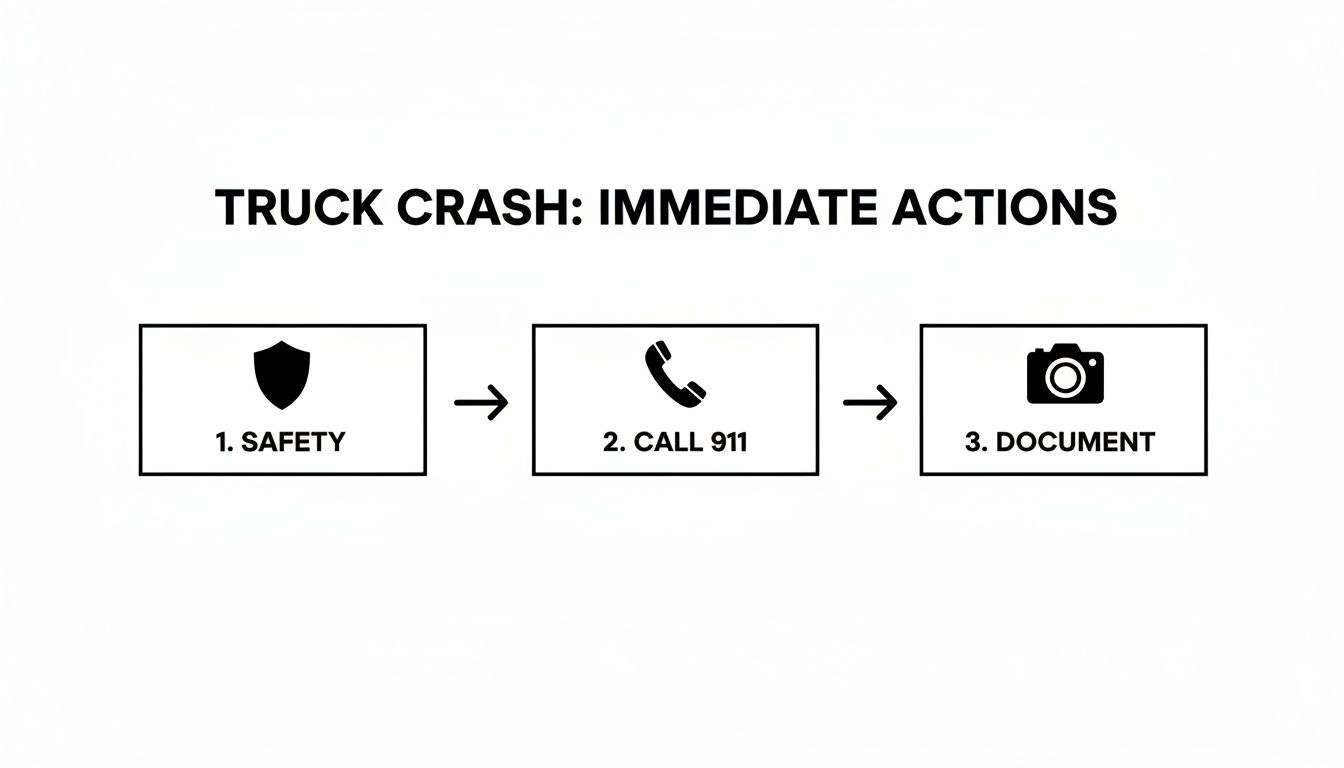
Stick to these three fundamentals—stay safe, call 911, and document what you can. Getting these right lays the groundwork for everything that comes next.
Calling 911 and What to Say
You must call 911 after any collision involving a commercial truck, no matter how minor it seems. The official police report is a key piece of evidence. When you speak to the dispatcher, be clear and stick to the facts.
Provide this key information:
- Your exact location. Use mile markers, cross-streets, or any nearby landmarks. A good resource for this is looking up your location on your phone's map application.
- How many vehicles are involved. Be sure to mention one is a large commercial truck.
- Any known injuries. Be specific if you can about the number of people hurt and how severe it looks.
- Immediate hazards. Report things like leaking fuel, fire, downed power lines, or anything blocking traffic.
My advice is to stay on the line with the operator until they tell you it's okay to hang up. They might have follow-up questions or instructions for you while you wait for help to get there.
Once the call is made, don't go anywhere. Leaving the scene of an accident, particularly one involving injuries, is a serious offense. This is just the first step in a long road, and what you do right here, right now, after a collision is so important.
To help you remember what's most important in a high-stress situation, here is a quick checklist.
On-Scene Action Checklist
| Action Item | Why It Matters for Your Case |
|---|---|
| Ensure Safety | Protects you from further harm and shows you acted responsibly. |
| Call 911 | Creates an official police report, a cornerstone of any injury claim. |
| Check for Injuries | Documents the immediate physical impact of the crash for medical records. |
| Document the Scene | Photos and videos capture important evidence before it's cleared away. |
| Get Driver Info | Collects names, insurance, and contact details for all parties. |
| Talk to Witnesses | Independent accounts can powerfully support your version of events. |
| Do NOT Admit Fault | Admitting fault, even apologetically, can be used against you by insurers. |
| Seek Medical Attention | Establishes a direct link between the crash and your injuries. |
Following these steps provides a strong foundation for your case. For more checklists and guides, you can explore our additional personal injury resources.
How to Gather Essential Evidence at the Crash Site
Once you've made sure everyone is safe and you’ve called 911, the clock starts ticking. The crash scene itself is a temporary, invaluable source of information that will be cleared away quickly. This is your one and only opportunity to capture a true snapshot of what happened before evidence disappears and memories fade.
You have to act as your own best advocate right from the start. The trucking company and its insurance carrier often have rapid-response teams heading to the scene, and their job is to protect their own interests—not yours. By gathering your own evidence with your smartphone, you start to level the playing field immediately.
What to Photograph Immediately
Think of your phone's camera as your most powerful tool in these important moments. Don't just snap a few quick pictures of the damage to your car. Your goal is to document the entire scene from every conceivable angle and distance.
Here’s a practical checklist of what to capture:
- All Vehicles Involved: Start with wide shots showing the final resting positions of your car and the commercial truck. Then, move in for close-up photos of the damage to every vehicle from multiple angles.
- Skid Marks and Debris: Get clear photos of any tire marks on the pavement and any scattered debris from the collision, like broken glass or plastic fragments. This is the kind of evidence accident reconstruction experts use to determine speed and points of impact.
- Road and Weather Conditions: Was the road wet or slick? Were there potholes or uneven pavement? Was it an active construction zone with confusing signage? Document it.
- Traffic Signs and Signals: Take pictures of any nearby stop signs, yield signs, speed limit signs, or traffic lights. If it's safe to do so, try to show the status of the traffic signal.
- The Big Picture: Carefully step back to a safe location and take panoramic photos of the entire scene. Including nearby landmarks helps provide context for how the collision unfolded.
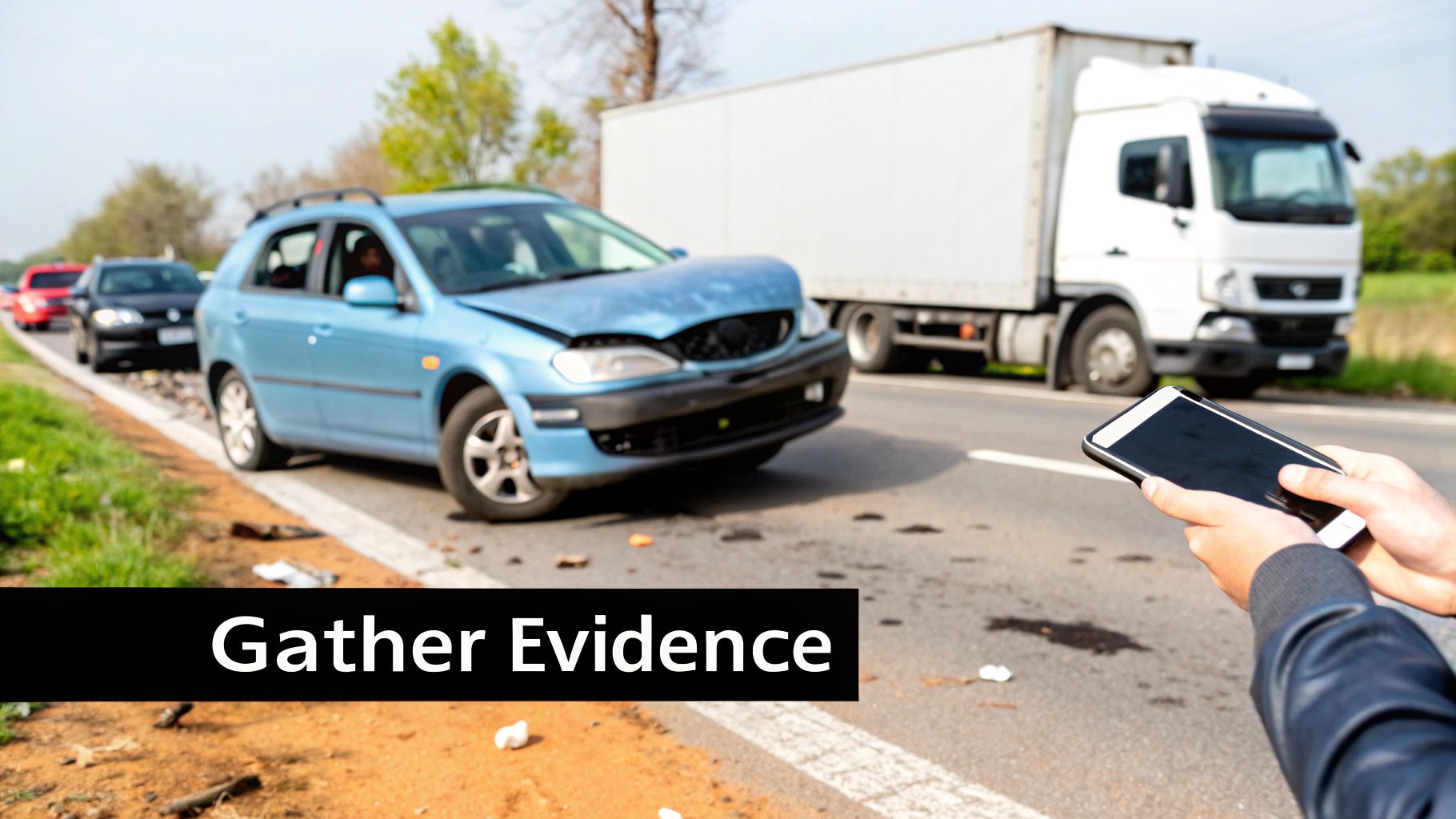
This visual record is often far more compelling than a written statement because it captures the scene factually, without bias.
Documenting Key Trucking Information
A collision with a commercial truck is fundamentally different from one with a standard passenger car. The driver is a professional operating on behalf of a large company, which means you need to gather more than just a personal insurance card.
Politely ask the driver for the following details, and if possible, take a picture of each document:
- Their full name and contact information.
- Their Commercial Driver's License (CDL).
- The full name of their employer (the motor carrier) and its main office location.
- The truck’s license plate number and its USDOT number, usually displayed on the side of the cab.
- The trucking company’s insurance policy information, not just the driver's personal insurance.
Gathering this information is vital because, in many truck accident cases, the trucking company itself can be held liable in addition to the driver. Federal regulations hold these carriers to strict standards for everything from driver hours to vehicle maintenance, and this information is the key to investigating their compliance. For more details on this, see our guide to Atlanta truck accidents.
The Importance of Witness Accounts
Independent witnesses are incredibly valuable. They have no financial stake in the outcome and can offer an objective, third-party account of what they saw happen.
If anyone stopped to help or saw the collision occur, simply ask for their name and phone number.
A simple, direct approach works best: "Did you see what happened? Would you be willing to share your name and number in case the police or insurance companies need to speak with you?" Most people are happy to help.
Don't press them for a detailed story or try to get them to take sides on the spot. Your only goal is to secure their contact information. Later, when stories conflict—and they often do—a neutral witness can make all the difference.
Communicating With Police and Insurance Adjusters
After a crash with a commercial truck, the conversations that follow are often as significant as the collision itself. You'll be speaking with law enforcement at the scene and, almost immediately after, an insurance adjuster from the trucking company. It's important to understand their roles are very different.
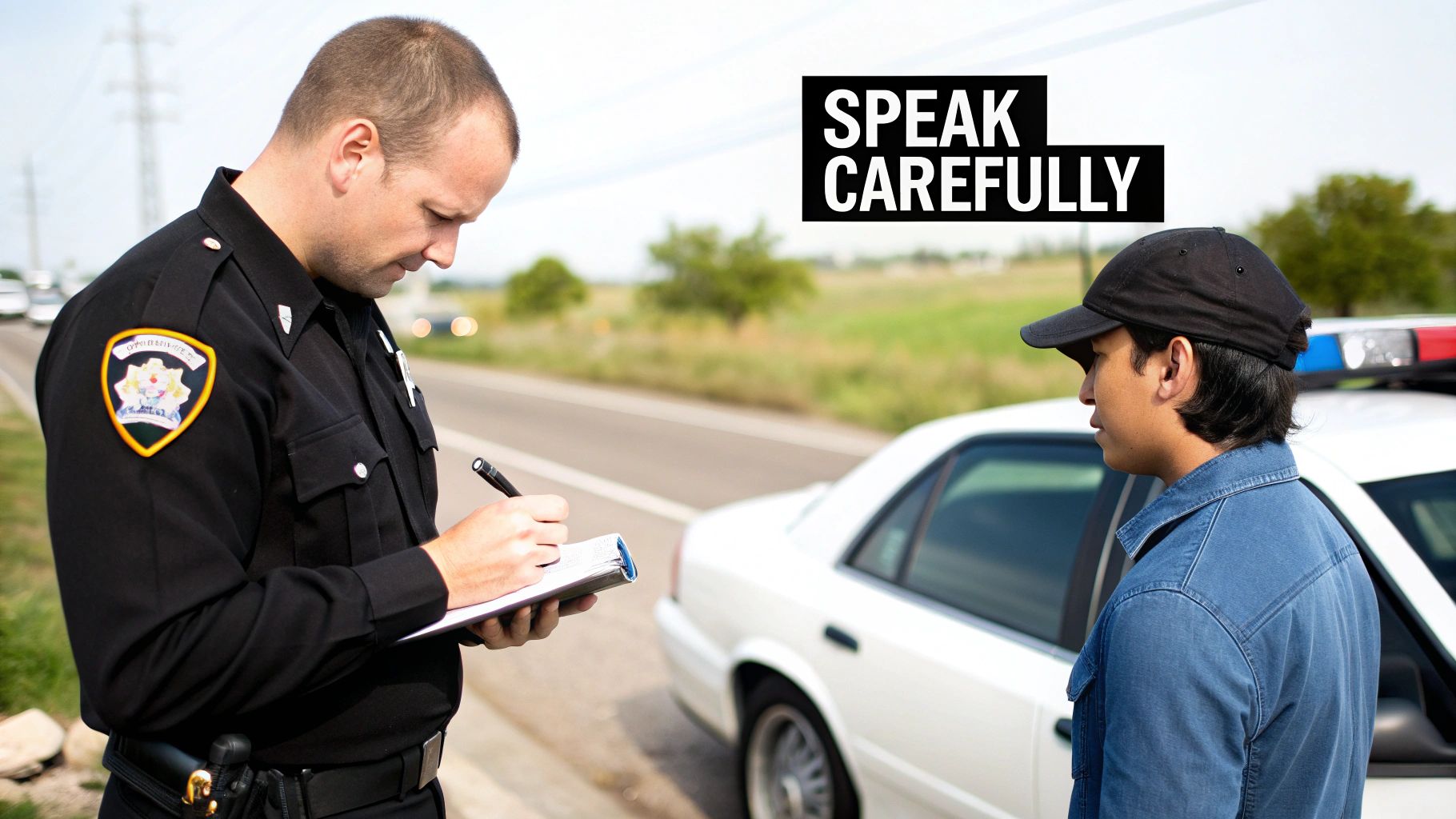
Knowing what to say—and what not to say—is about protecting your rights. The goal is to provide facts without offering opinions, apologies, or any statement that could be twisted later on.
Interacting With Law Enforcement at the Scene
When police arrive, their job is to secure the scene, render aid, and create an official report. Stay calm and be cooperative. Have your driver's license, registration, and proof of insurance ready.
When the officer asks what happened, stick only to what you know for sure.
- "I was driving east in this lane."
- "The traffic light was green."
- "I saw the truck coming from the left, and then the collision occurred."
Do not guess or speculate. Avoid estimating the truck's speed or what you think the driver was doing. Very importantly, avoid saying anything that sounds like an admission of fault, even a simple, "I'm so sorry." An officer can note these statements in their report, and they can absolutely be used against you.
Remember, the police officer did not see the crash. They are piecing together a narrative from statements and physical evidence. Your clear, factual account helps ensure the official record is accurate.
Once their on-scene investigation is finished, the officer will file an official crash report. This document is a cornerstone of your claim. In Georgia, you can typically get a copy a few days later from the official portal managed by the Georgia Department of Transportation.
Handling the First Call From the Insurance Adjuster
Don't be surprised to get a call from the trucking company's insurance adjuster within 24 to 48 hours. They often sound friendly and concerned, but make no mistake: their primary job is to protect their company's bottom line. That means minimizing or denying your claim.
The adjuster will almost certainly ask you to provide a recorded statement. You are not legally required to give one, and from my experience, it's a huge mistake to do so without speaking to a lawyer first. Adjusters are trained to ask leading questions designed to get you to undermine your own case.
Here are a few common tactics they use:
- Requesting a Recorded Statement: Their goal is to lock you into a story before you understand the full extent of your injuries or the vehicle damage.
- Offering a Quick Settlement: A fast check might seem tempting, but it's often a lowball offer designed to get you to sign away your rights before you realize your case is worth much more.
- Asking Vague Questions: "How are you feeling today?" If you instinctively answer "I'm fine," they will use that against you later to argue your injuries weren't serious.
You should only provide the bare minimum of information on this first call.
- Your name and contact information.
- The date and location of the crash.
- Your vehicle's make and model.
From there, you can politely decline to go into further detail. A simple, "I'm still processing everything and am not prepared to give a detailed statement right now" is enough. This protects you while you figure out your next steps. Eventually, a formal demand letter to an insurance company for an auto accident will be necessary, but that comes much later. Right now, your priority is protecting your rights after a serious car accident with a truck.
Understanding Why Truck Accident Claims Are Different
A collision involving a commercial truck is fundamentally different from a standard car wreck. It isn't just about the size of the vehicles; it's about a separate world of federal law, corporate liability, and unique types of evidence that simply don't exist in a passenger car accident. Recognizing these distinctions is the first important step toward protecting your rights.
Unlike a crash between two private drivers, a wreck with a commercial truck brings a professional driver and a large business entity into the picture. This completely alters the legal landscape. You're not just up against another driver's insurance—you're facing a sophisticated transportation company and its aggressive, high-stakes insurance carrier.
Federal Regulations Shape Every Case
The trucking industry operates under a thick layer of federal rules enforced by the Federal Motor Carrier Safety Administration (FMCSA). These aren't just suggestions; they are comprehensive, nationwide safety mandates that govern nearly every facet of a commercial trucking operation.
Think of it this way: a normal driver needs a license to operate their car. A commercial driver and their company must adhere to a massive federal rulebook just to stay on the road.
These regulations dictate important safety standards, including:
- Hours of Service: These are strict limits on how long a driver can be behind the wheel before taking mandatory rest breaks. The goal is to prevent driver fatigue, which is a leading cause of catastrophic truck wrecks.
- Vehicle Maintenance: Federal law requires documented, regular inspections and repairs of essential equipment like brakes, tires, and lights. A trucking company cannot legally ignore a known mechanical problem.
- Driver Qualifications: Companies must follow strict protocols for hiring, training, and drug and alcohol screening. They have a legal duty to put safe, qualified drivers on our roads.
When a crash occurs, one of the first questions we ask is whether the driver or the company violated an FMCSA regulation. A violation often serves as powerful evidence of negligence.
The Black Box and Other Unique Evidence
Modern commercial trucks are equipped with technology that records staggering amounts of data. The most valuable piece of hardware is the Electronic Data Recorder (EDR), often called the "black box."
This device captures a digital snapshot of what the truck was doing in the seconds before, during, and after a collision. An EDR can tell us:
- The truck's speed just before impact.
- Whether the driver hit the brakes.
- The engine's RPM and steering wheel inputs.
- If cruise control was active.
This data is invaluable because it is objective. It doesn't rely on a driver's memory or carry a bias—it simply reports the facts. However, this electronic evidence can be overwritten or erased quickly, making it absolutely important to send a preservation notice immediately.
Beyond the EDR, other vital evidence unique to truck cases includes the driver's logs, post-trip inspection reports, maintenance records, and the trucking company's internal safety policies and procedures.
More Than Just a Negligent Driver
In a typical car wreck, the at-fault driver is usually the only party held responsible. With commercial trucks, the legal responsibility—or liability—often extends far beyond the person driving. This is known as carrier liability.
The trucking company (the motor carrier) can be held directly liable if its own carelessness contributed to the crash. Common examples include:
- Negligent Hiring: Putting a driver on the road with a known history of reckless driving or failed drug tests.
- Poor Training: Failing to adequately train a driver on safety protocols or how to operate their specific truck.
- Pressuring Drivers: Encouraging or even forcing drivers to violate hours-of-service rules to meet impossible delivery schedules.
This means a single truck accident claim can involve multiple at-fault parties. Investigating the company's operational practices is just as important as analyzing the driver's actions at the scene. Because these cases involve a mix of federal regulations and corporate liability, it's essential to consult with an experienced Atlanta 18-wheeler accident lawyer. A car accident with truck is never simple and always requires a much deeper, more technical investigation than a standard collision.
Building Your Injury Claim in Georgia
Your top priority after any car accident with a truck is your health. But once your immediate medical needs are addressed, you'll need to turn your attention to the legal and financial recovery process. Handling a personal injury claim in Georgia requires a clear understanding of the rules, deadlines, and types of compensation you're entitled to.

This isn't just about filing paperwork. It's about systematically building a case that proves the full extent of your losses so you can secure the compensation needed to move forward.
Georgia's Statute of Limitations: The Clock is Ticking
The single most important deadline in a Georgia injury case is the statute of limitations. For nearly all personal injury claims, including those from truck crashes, you have just two years from the date of the accident to file a lawsuit.
Two years can feel like a lifetime, but it evaporates when you're focused on doctor's appointments and physical therapy. Missing this deadline is catastrophic—it permanently bars you from seeking compensation in court. Evidence gets lost, witnesses forget key details, and the trucking company’s lawyers get a major head start.
Acting fast is your biggest advantage. Prompt action allows your legal team to secure key evidence like the truck’s black box data and the driver's service logs before the trucking company has a legal right to destroy them.
Understanding the Damages You Can Recover
The foundation of any injury claim is documenting and calculating your "damages"—the legal term for all your losses. The objective is to make you financially whole again.
In a Georgia truck accident claim, damages are typically broken down into three categories:
- Economic Damages: These are your direct, out-of-pocket financial losses. Think medical bills, prescriptions, lost wages, and future lost earning potential if your injuries prevent you from returning to your old job.
- Non-Economic Damages: This category covers the immense human toll of a crash. It includes compensation for your physical pain and suffering, emotional distress, mental anguish, and the loss of your ability to enjoy life.
- Punitive Damages: In egregious cases—for example, if the truck driver was intoxicated or the company knowingly put a dangerous truck on the road—Georgia law permits punitive damages. These are intended to punish the wrongdoer and deter others from similar reckless conduct.
What if the Truck Driver is Uninsured?
It's a terrifying scenario: the truck driver who hit you either has no insurance or not enough to cover your massive medical bills. This is precisely why your own Uninsured/Underinsured Motorist (UM/UIM) coverage exists.
This is a part of your own auto policy that acts as a valuable safety net. If the at-fault party's insurance is insufficient, your UM/UIM policy can step in to cover the gap up to your own policy limits. I always advise clients to pull out their insurance declaration page right away to understand the protections they have. For more details, the Georgia Office of Insurance and Safety Fire Commissioner is a helpful resource.
Building a claim is a deliberate process. From investigating the crash and gathering evidence to negotiating with insurers, every step must be handled strategically. While most cases settle before trial, preparing for litigation from day one is the key to maximizing your recovery after a devastating car accident with a truck.
Frequently Asked Questions After a Georgia Truck Accident
After a wreck involving a commercial truck, your head is probably swimming with questions. It’s a chaotic and stressful time, and the path forward isn't always clear. Here are some straightforward answers to the questions we hear most often from our clients here in Atlanta and across Georgia.
Should I Take the First Settlement Offer From the Trucking Company?
Almost never. That first offer you get from the trucking company’s insurance adjuster isn't a good-faith estimate of your claim's value—it's a business tactic. Their only goal is to close your case for the least amount of money, as quickly as possible.
Think about it. An offer made right after the crash is just a guess. It can’t possibly account for:
- Future medical care: What if you end up needing surgery a year from now? Or long-term physical therapy?
- Lost earning capacity: How will your family cope if you can't return to your job for months, or maybe ever?
- The full scope of your pain: The real, day-to-day impact of a serious injury often doesn't become clear for weeks or months.
Once you accept that check, you sign away your right to ask for another dime, no matter what happens down the road. It’s very important to have a complete picture of your damages before you even think about settling.
What if I Was Partially at Fault for the Crash?
This is a common worry, but it doesn't automatically kill your case. Georgia uses a rule called “modified comparative negligence.” In plain English, you can still recover damages as long as a judge or jury finds you were less than 50% at fault for the collision.
The catch is that your final award gets reduced by your percentage of fault. For example, if you have $100,000 in damages but are found to be 20% responsible, your recovery is cut by that 20%, leaving you with $80,000. This is exactly why a deep, independent investigation is so important—we have to prove exactly what happened and who was truly at fault.
How Long Does It Take to Resolve a Truck Accident Case?
There’s no magic number here; the timeline can vary wildly. A straightforward case where the truck driver’s liability is crystal clear might settle in just a few months.
But a difficult case is a different story. If you're dealing with severe injuries, multiple at-fault parties (like the driver, the carrier, and a parts manufacturer), and a fight over who caused the wreck, it could easily take a year or more, especially if a lawsuit becomes necessary. One of the biggest factors is your medical treatment. We can’t know the true value of your claim until you’ve reached what doctors call "maximum medical improvement" (MMI)—the point where you’re either fully healed or your condition is as good as it’s going to get.
The worst thing you can do is rush. A premature settlement means you'll be paying for future expenses out of your own pocket.
Do I Really Need a Lawyer for My Truck Accident Claim?
Legally, no. Practically, yes. A truck accident claim isn't just a bigger car wreck case—it's a completely different league. You're up against specialized federal trucking regulations, massive corporate legal teams, and aggressive insurance companies that exist to protect their bottom line.
An experienced truck accident lawyer knows to immediately send a spoliation letter to preserve important evidence—like the truck's black box data and the driver's logs—before the trucking company is legally allowed to destroy it. We handle all the deadlines, manage every communication, and build a case designed to get you full compensation. This frees you up to focus on the one thing that matters: your health. And don't forget, Georgia has strict deadlines; you can learn more about the Georgia statute of limitations for a personal injury claim to protect your rights.
If you've been injured and have more questions, the team at Jamie Ballard Law is here to provide the clear answers and guidance you need. We offer a free, no-obligation case evaluation to help you understand your options. Contact us today at https://jamieballardlaw.com.