If you were recently hurt in a slip and fall, you’re probably staring at a growing pile of medical bills, dealing with lost wages, and feeling an immense amount of stress. It’s a lot to handle. Seeking slip and fall injury compensation is about securing the financial support you need to cover these burdens when a property owner's carelessness caused your accident. This guide breaks down how the process works, from building your case to understanding what you might be owed, so you can focus on your recovery.
Understanding Your Right to Compensation After a Fall
When you get hurt on someone else's property because they were careless, the law gives you a path to be made financially whole again. This isn't about hitting the lottery; it’s about covering the very real costs and losses that the injury has forced upon your life. Think of it as restoring the balance after a preventable accident turned your world upside down.
The entire concept is built on a legal principle called premises liability. Here in Georgia, property owners have a duty to keep their spaces reasonably safe for visitors. When they know about a hazard—like a leaky cooler in a grocery store aisle or a broken step on a porch—and fail to fix it, they can be held responsible for the harm that follows.
What Does Compensation Actually Cover?
When we talk about compensation, we're really talking about two different kinds of losses. The first type is straightforward: it covers all the measurable, out-of-pocket expenses you've racked up. These are the bills and financial hits that have a clear dollar figure attached.
The second type is just as real but much harder to put a price on. This part of the claim addresses the profound, personal impact the injury has had on your quality of life and well-being. According to the Centers for Disease Control and Prevention (CDC), falls often cause severe injuries like broken bones and head trauma, which create ripple effects far beyond the initial medical care.
To help clarify what's recoverable, here’s a breakdown of the common types of compensation.
Types of Compensation in a Slip and Fall Claim
- Economic Damages: These are your direct financial losses. This includes medical bills (past and future), lost wages, and any impact on your future earning capacity.
- Non-Economic Damages: This covers the non-financial impact, such as pain and suffering, emotional distress, and loss of enjoyment of life.
Ultimately, compensation is meant to address the full scope of your harm, not just the easily calculated costs.
A slip and fall injury isn't just a physical event; it can also be a significant psychological one. The trauma can lead to anxiety, fear of falling again, and even conditions like post-traumatic stress disorder (PTSD), which deserve to be recognized as part of your recovery.
This is where building a strong claim gets detailed. We have to look at everything, from your first trip to the emergency room to the physical therapy you might need for months to come. To get a better sense of how these cases are managed locally, it helps to speak with an experienced Atlanta slip and fall attorney who knows Georgia's specific laws and court procedures. The goal is to paint a complete and accurate picture of your losses to ensure you can pursue fair and just compensation.
Proving Fault in a Slip and Fall Case

The entire foundation for a successful slip and fall injury compensation claim is proving another party’s negligence caused your accident. This comes down to a legal principle called premises liability—the legal duty property owners have to maintain reasonably safe conditions for people on their property.
As explained by Wikipedia's overview of premises liability, the exact nature of this duty can change based on your status as a visitor. A customer in a store is owed a higher duty of care than a trespasser, for example.
The Three Pillars of a Premises Liability Claim
Think of a solid claim as a three-legged stool. If you remove any one leg, the whole thing topples over. To build a strong case, we must establish three key elements.
-
A Duty of Care Existed: The property owner had a legal obligation to keep the premises safe for you. A grocery store, for instance, has a duty to protect its shoppers from known hazards.
-
The Duty Was Breached: The owner, through carelessness, failed to meet that obligation. This means they didn't act as a reasonably prudent person would have in the same situation.
-
The Breach Caused Your Injuries: Your fall and the harm you suffered were a direct consequence of the owner’s failure. It wasn’t just bad luck; their negligence directly led to your injury.
Each element must be backed by solid evidence to legally establish the owner's fault.
The Importance of 'Notice' in Georgia
Here in Georgia, a key part of proving that the owner breached their duty is establishing 'notice.' In simple terms, we have to show the property owner either knew or should have known about the dangerous condition that led to your fall.
There are two kinds of notice we look for:
- Actual Notice: The owner or an employee was directly aware of the hazard. For example, another customer had already told a manager about a spill just moments before you fell.
- Constructive Notice: The hazard was present for long enough that a reasonably diligent owner should have discovered and corrected it. A puddle from a slowly leaking freezer that has been there for an hour is a classic example.
Proving constructive notice often means searching for clues, like dirty footprints or shopping cart tracks running through a spill, which show it wasn't a fresh hazard.
Common Hazards Leading to Slip and Fall Claims
Negligence can show up in many ways. Some dangers are obvious, but many are hidden until it's too late. These incidents are far from rare and can cause devastating injuries. While we often think of falls happening in stores, they're also a massive problem in workplaces. In 2022 alone, slips, trips, and falls led to 450,540 reported work injuries and 865 work-related deaths in the U.S. You can learn more about these workplace accident figures and their financial impact.
Some of the most common hazards we encounter in these cases include:
- Wet or Slippery Floors: Unmarked spills, freshly mopped areas without "wet floor" signs, or water tracked in from outside.
- Uneven or Damaged Surfaces: Cracked sidewalks, broken floor tiles, or bunched-up carpeting.
- Poor Lighting: Dimly lit staircases, hallways, and parking lots that conceal tripping hazards.
- Obstructions and Clutter: Boxes, merchandise, or equipment left in walkways and aisles.
- Defective Stairs: Broken handrails, worn-down steps, or stairs with inconsistent heights.
Establishing that a property owner knew about a hazard but did nothing is a powerful element in a claim. It moves the case from a simple accident to a clear instance of negligence, strengthening your position when seeking slip and fall injury compensation.
How Your Compensation Value Is Calculated

After an accident, one of the first questions people ask is, "How much is my claim worth?" There’s no simple calculator or magic formula for slip and fall injury compensation. Instead, the value is built by carefully documenting all the ways the injury has upended your life.
The process involves two distinct categories of damages: economic damages and non-economic damages. Think of it like this: economic damages are the black-and-white numbers—the tangible, measurable costs that give the claim its foundation. Non-economic damages are the human elements that define your quality of life, accounting for the personal toll of the injury.
Tallying the Tangible Costs: Economic Damages
Economic damages are the most straightforward part of your claim because they come with a paper trail of receipts, bills, and pay stubs. These are the direct financial losses you suffered because of your injury. The goal here is to account for every dollar the accident has cost you, both today and for the foreseeable future.
A serious injury often requires months or even years of treatment, and your compensation must reflect that long-term reality.
Here are the most common economic damages we track:
- All Medical Bills: This includes every cost from the moment of your injury—the ambulance ride, emergency room visit, hospital stay, surgeries, doctor’s appointments, and diagnostic tests like X-rays or MRIs.
- Future Medical Care: This covers projected costs for ongoing needs like physical therapy, rehabilitation, prescription medications, necessary medical equipment (like a wheelchair), and potential future surgeries.
- Lost Wages: This is the income you lost from being unable to work while recovering. It’s calculated based on your regular pay, including any overtime you would have normally earned.
- Loss of Earning Capacity: If your injury prevents you from returning to your old job or limits the kind of work you can do, this damage covers the long-term hit to your ability to earn a living.
These falls are far from minor inconveniences. Globally, they have a significant impact on people's ability to work. In fact, U.S. data from 2013 showed that same-level slips and falls caused an average of 10 work days lost per incident. You can read more about these workplace fall statistics on PMC.
Valuing the Intangible Impact: Non-Economic Damages
While economic damages cover the calculable costs, non-economic damages address the profound, personal losses that don’t have a neat price tag. For many people, this is where the true impact of the injury lies.
These damages compensate you for the human toll of the accident. It’s one thing to pay for a broken bone; it’s another to account for the pain and frustration that come with it.
Non-economic damages acknowledge that an injury is more than a set of medical bills. It’s the canceled family vacation, the hobbies you can no longer enjoy, and the daily pain that serves as a constant reminder of what happened.
This part of a claim tries to answer an important question: How has this injury diminished your quality of life? Common examples include:
- Pain and Suffering: This covers the physical pain and general suffering you endure, both from the initial accident and any chronic pain that lingers.
- Emotional Distress: An unexpected fall can be traumatic, leading to anxiety, depression, fear, or even post-traumatic stress disorder (PTSD).
- Loss of Enjoyment of Life: This is for the activities and hobbies you can no longer participate in. If you were an avid gardener but can no longer kneel due to a knee injury, or you can’t pick up your grandkids because of a back injury, this damage acknowledges that loss.
There's no fixed calculation for these damages. Their value is tied directly to the severity of your injury and the specific story of how it has personally affected you. Keeping a journal to document these changes provides powerful support for your claim for fair slip and fall injury compensation.
Gathering Evidence to Support Your Claim
A strong slip and fall claim is built on solid proof. Every piece of evidence you collect strengthens your case, and if you are physically able, documenting what happened immediately after the fall is one of the most important things you can do.
Think of yourself as an investigator. Your job is to capture the scene exactly as it was before the property owner can clean it up, make repairs, or argue about what really happened. The evidence you gather in those first few minutes is often the most powerful.
Your Immediate Post-Fall Checklist
Your health is the priority. Only do what you can without causing further injury.
-
Take Photos and Videos: Use your phone to document everything. Get wide shots of the area and close-ups of the specific hazard that caused the fall—a wet spot, cracked flooring, or a poorly placed mat. A short video where you narrate what you see can also be very effective.
-
Report the Incident: Find the manager, owner, or landlord on duty and tell them what happened. Insist that they create an official incident report and ask for a copy. This creates a formal, time-stamped record.
-
Talk to Witnesses: Did anyone see you fall? Did they notice the hazard before your accident? Get their name and phone number. Testimony from a neutral third party is incredibly valuable.
-
Preserve Your Clothing and Shoes: Don't wash the clothes or shoes you were wearing. Put them in a bag and keep them safe. They can serve as physical evidence, perhaps showing the substance that caused you to slip.
Documenting the Aftermath
The evidence doesn't stop at the scene. The true impact of a fall reveals itself over days, weeks, and even months. Documenting your recovery journey is just as important.
An injury isn't a single moment in time—it's an ongoing story of pain, medical appointments, and life disruptions. A detailed journal turns that personal experience into tangible proof, showing the full extent of your damages.
This ongoing record connects the fall directly to its consequences, painting a clear picture for insurance companies and courts.
Your Personal Injury Journal
Keep a simple notebook or a digital file to track everything. This journal is a powerful tool for proving the "non-economic" damages we discussed earlier.
Be sure to include:
- Daily Pain Levels: Rate your pain on a scale of 1 to 10 each day. Describe the location and type of pain (e.g., sharp, throbbing, dull ache).
- Medical Appointments: Log every visit to a doctor, physical therapist, or pharmacy. Note what was discussed, any diagnoses, and the treatments prescribed.
- Impact on Daily Life: Make a note of anything you can no longer do or can only do with difficulty. Maybe you can't walk the dog, play with your kids, or sleep through the night. These details matter.
- Emotional Toll: Falls are traumatic. It's normal to feel anxiety, fear, or depression afterward. Documenting these feelings is important, as psychological harm is a real and compensable part of your injury.
Gathering this information diligently gives your attorney the proof needed to build a persuasive case and fight for the slip and fall injury compensation you are owed.
Important Timelines And Legal Deadlines
When you've been hurt in a fall, keeping track of dates is probably the last thing on your mind. But when it comes to getting slip and fall injury compensation, the clock is already ticking. In Georgia, there's a strict legal deadline for filing a personal injury lawsuit, known as the statute of limitations. You can't afford to ignore it.
For most slip and fall accidents, you have just two years from the date of the incident to file a claim in court. If you miss that deadline, you lose your right to seek compensation forever—no matter how strong your case is. It’s an absolute cut-off, which makes acting quickly so important.
Georgia's Statute of Limitations for Personal Injury
This two-year deadline isn't a suggestion; it's a hard rule established by state law. The first step in protecting your rights is understanding exactly how this timeline applies to your specific situation.
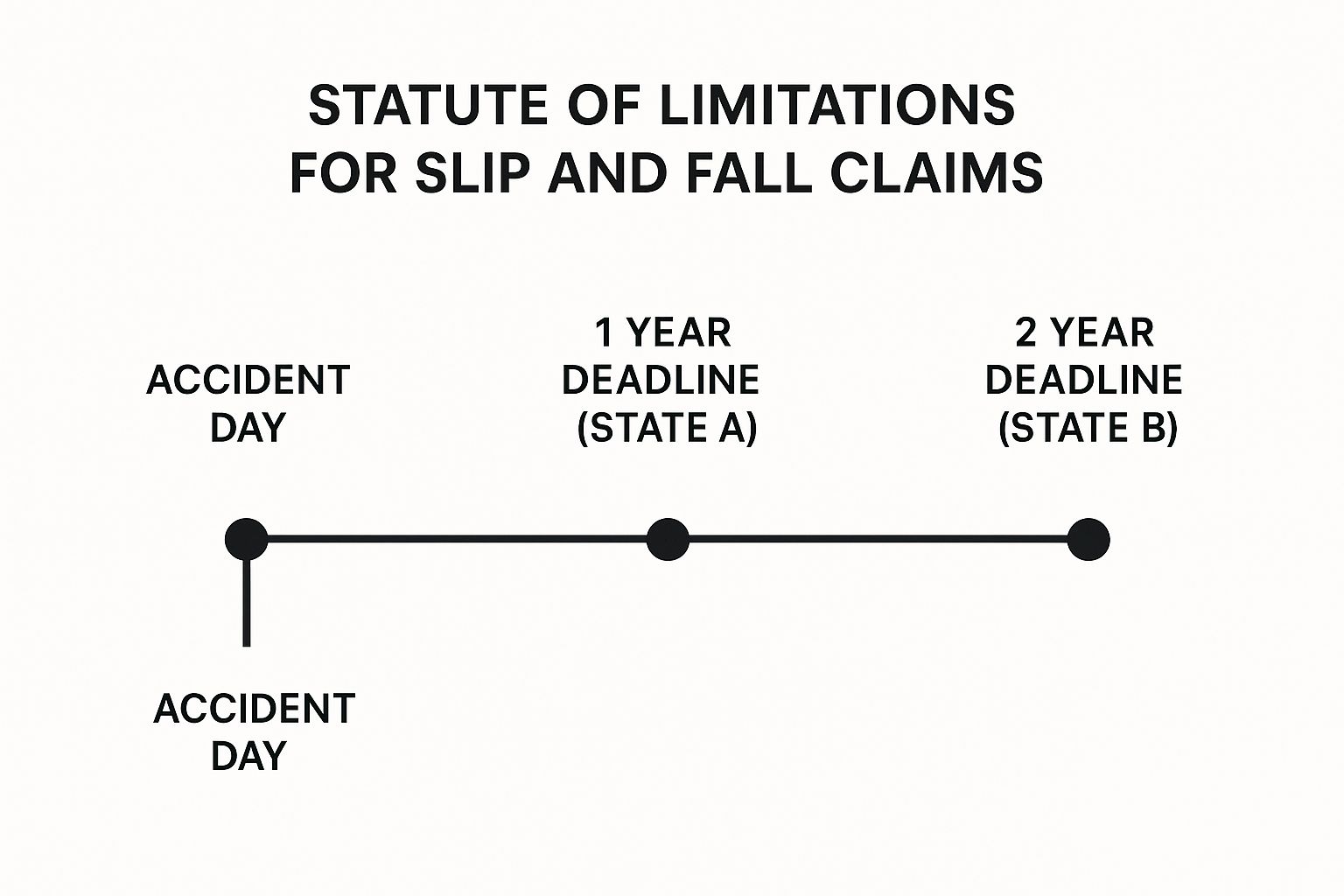
The image above highlights the two-year rule for personal injuries, which is what governs slip and fall claims. We break this down even further in our detailed guide on how the statute of limitations works for personal injury in Georgia.
A Typical Case Timeline From Start To Finish
Knowing the final deadline is one thing, but it’s just as important to understand all the steps along the way. The journey from injury to settlement requires patience and a methodical approach.
While every case is different, most follow a similar path:
- Initial Investigation and Evidence Gathering: This is where we lay the groundwork. It involves collecting photos, witness statements, official incident reports, and all your medical records to build a solid foundation for your claim.
- Sending a Demand Letter: Once your medical treatment has stabilized and we have a full picture of your damages, we send a formal demand letter to the at-fault party’s insurance company. This letter outlines our case and demands a specific settlement amount.
- Negotiation Period: The insurance adjuster will review our demand and almost always come back with a lowball counteroffer. This kicks off a period of back-and-forth negotiation as we fight to get you a fair deal.
- Filing a Lawsuit: If the insurance company refuses to be reasonable, the next step is to file a lawsuit before the statute of limitations runs out. This doesn't guarantee a trial; in fact, most cases still settle before ever seeing the inside of a courtroom.
According to the World Health Organization, falls are the second leading cause of unintentional injury deaths worldwide. This staggering number shows just how serious a "simple" fall can be and underscores why these legal deadlines are so vital.
Your Next Steps After a Slip and Fall

When you're in pain after an unexpected fall, figuring out what to do next can feel overwhelming. The truth is, the steps you take in the minutes and days that follow are important. They can directly impact your ability to secure slip and fall injury compensation.
Let’s be clear: your health is the absolute priority. Everything else is secondary. This guide provides a straightforward action plan to protect both your well-being and your legal rights.
Your Action Plan for Protection and Recovery
Following a specific sequence of steps is about more than just building a legal case; it's about ensuring you get the care you need while preserving your options down the road.
Here is a simple guide to follow:
- Seek Immediate Medical Care: Your health always comes first. Even if you think you feel fine, some injuries have delayed symptoms. Seeing a doctor creates a medical record that officially links your injuries to the fall—a cornerstone of any future claim.
- Report the Incident: Tell the store manager, landlord, or property owner what happened right away. Insist that they file an official incident report and ask for a copy. This simple action creates a time-stamped document of the event.
- Document Everything: As we've covered, evidence is what wins cases. Take photos of the hazard and the surrounding area. Get contact information from anyone who saw what happened. Even the clothes and shoes you were wearing should be set aside, unwashed. Keeping a simple journal about your pain levels and recovery process is also incredibly powerful.
- Be Cautious with Insurance Adjusters: The property owner’s insurance company will likely contact you quickly. Remember, the adjuster’s job is to protect their company’s financial interests by paying out as little as possible. Never give a recorded statement or sign anything without first getting legal advice.
Understanding Your Legal Options
The final, and most important, step is to get a clear picture of your legal rights. Speaking with a personal injury lawyer doesn't obligate you to do anything, but it gives you a professional assessment of your situation. An attorney can explain how Georgia's laws apply to your case, evaluate its strengths, and lay out the potential paths forward.
An unexpected fall can be deeply traumatic, sometimes causing psychological distress like anxiety or even PTSD. This emotional harm is a real part of your injury, and it's a factor that should be considered in your overall claim.
Learning more about how personal injury claims work will give you the confidence to make the right decisions. The goal is to get you the support and knowledge you need to get through this process, so you can focus on what really matters—your recovery. By following these steps, you put yourself in the strongest position to pursue the slip and fall injury compensation you deserve.
Frequently Asked Questions About Slip and Fall Claims
It's completely normal to have a flood of questions after an accident. Getting clear, honest answers is the first step toward understanding your rights and figuring out what to expect if you decide to seek slip and fall injury compensation. Let's tackle some of the most common concerns we hear from people just like you.
What if the Property Owner Says I Was at Fault for My Fall?
Don't be surprised if this happens. It's a standard tactic for a property owner or their insurance company to try and shift the blame. In Georgia, we have a legal rule for this exact situation called "modified comparative negligence."
Think of it as assigning a percentage of fault. As long as you are found to be less than 50% responsible for what happened, you can still recover damages. Your total compensation is just reduced by your percentage of fault. For example, if a jury awarded you $100,000 but decided you were 20% at fault, your final recovery would be $80,000.
Do I Have to Go to Court to Get Compensation?
This is a major source of anxiety for many, but the reality is that most cases never see the inside of a courtroom. The vast majority of personal injury claims, including slip and falls, are settled out of court through skilled negotiation.
Filing a lawsuit is often a strategic step to put pressure on the insurance company and move negotiations forward, but it very rarely leads to a trial. The goal is almost always to secure a fair settlement without the stress and time of a court battle.
A settlement is simply a formal agreement between you and the at-fault party's insurance company. You agree on a specific amount of money to resolve the claim, and the legal dispute comes to an end.
How Much Does It Cost to Hire a Personal Injury Lawyer?
Worries about legal fees should never prevent you from getting the help you need. Most reputable personal injury lawyers work on what's called a contingency fee basis.
Here’s what that means for you:
- You pay zero upfront costs to hire an attorney.
- The lawyer's fee is a set percentage of the final settlement or award they win for you.
- You pay absolutely nothing unless and until your case is successfully resolved.
This system levels the playing field, ensuring everyone can access high-quality legal help, no matter their financial situation.
What if I Fell at a Friend’s House?
This is always a delicate situation because no one wants to sue a friend or family member. It’s important to understand that the claim is almost always filed against their homeowner's insurance policy, not against them personally.
Homeowner's insurance exists specifically to cover these kinds of accidents. Your friend won't have to pay for your slip and fall injury compensation from their own bank account. A skilled Mableton slip and fall lawyer can handle these sensitive claims with professionalism and care, preserving your relationship while protecting your rights.
At Jamie Ballard Law, we believe getting answers should be the easiest part of your recovery. If you have more questions or just want to talk through what happened, we're here. Contact us for a free, no-pressure case evaluation to understand all your options. Visit us at https://jamieballardlaw.com.