It’s a gut-wrenching feeling to be hit by an uninsured driver. In that instant, your world gets turned upside down, and the path forward seems confusing. But here's what you need to know: your own insurance policy, specifically your Uninsured Motorist (UM) coverage, is designed for this exact situation. What you do in the minutes right after the crash is absolutely essential. It lays the groundwork for protecting your rights and getting the compensation you deserve if you've been hit by a driver with no insurance.
Your First Moves After the Accident
The scene of a car accident is chaotic. Adrenaline is pumping, and it’s hard to think straight. Discovering the other driver has no insurance just adds another layer of stress. Staying calm and methodical is your best defense. Your first priority, always, is safety.
Before you do anything else, check on yourself and your passengers. Are you hurt? Even if you feel okay, shock can easily mask serious injuries. If anyone needs medical help or the crash is anything more than a simple fender-bender, call 911 immediately. Ask for both police and an ambulance.
Securing the Scene and Gathering Proof
If the cars are blocking traffic and you can move them safely, pull over to the shoulder. This prevents another collision and keeps traffic flowing. Once you're in a safe spot, it's time to become a detective. Your smartphone is your most important tool right now.
Get pictures and videos of absolutely everything:
- Both cars from every angle. Get close-ups of the damage, the points of impact, and wider shots showing where the cars ended up.
- The other driver’s license plate. This is non-negotiable, especially if they start getting uncooperative.
- The entire area. Capture traffic lights, stop signs, road conditions, and any skid marks on the pavement.
- Any visible injuries. If you have cuts or bruises, document them right away.
This visual proof creates a powerful, objective story of what happened. While you’re at it, get the other driver’s information—name, phone number, and address. Even without insurance, their personal details are important.
A helpful piece of advice: Never admit fault at the scene. Avoid saying things like "I'm sorry" or "I didn't see you." These statements can be twisted and used against you later. Stick to the facts.
If anyone saw the crash, get their name and number. An independent witness can be incredibly valuable, backing up your side of the story when it’s your word against theirs.
Why You Need a Police Report
Always, always insist on a police report. When an officer arrives, they will create an official, unbiased document detailing the accident. This report is a cornerstone of your claim. You can later get a copy directly from the responding police department, like the Atlanta Police Department.
For a quick reference, I've put together a simple checklist to help you remember what to do right after you've been hit.
On-Scene Action Checklist
| Action Item | Why It's Important |
|---|---|
| Call 911 | To get immediate medical help and an official police report. |
| Photograph Everything | Creates an undeniable visual record of damage, injuries, and the scene. |
| Get Driver & Witness Info | Essential for your insurance claim and for holding the at-fault driver accountable. |
| Do Not Admit Fault | Protects you from having your words used against you by insurers. |
| Seek Medical Attention | Documents your injuries and ensures you get proper care, even for delayed symptoms. |
Keeping this checklist in mind can make a huge difference in the chaotic moments after a crash. Every detail helps.
The image below gives you a clear, high-level view of how the process flows when the other driver is uninsured.
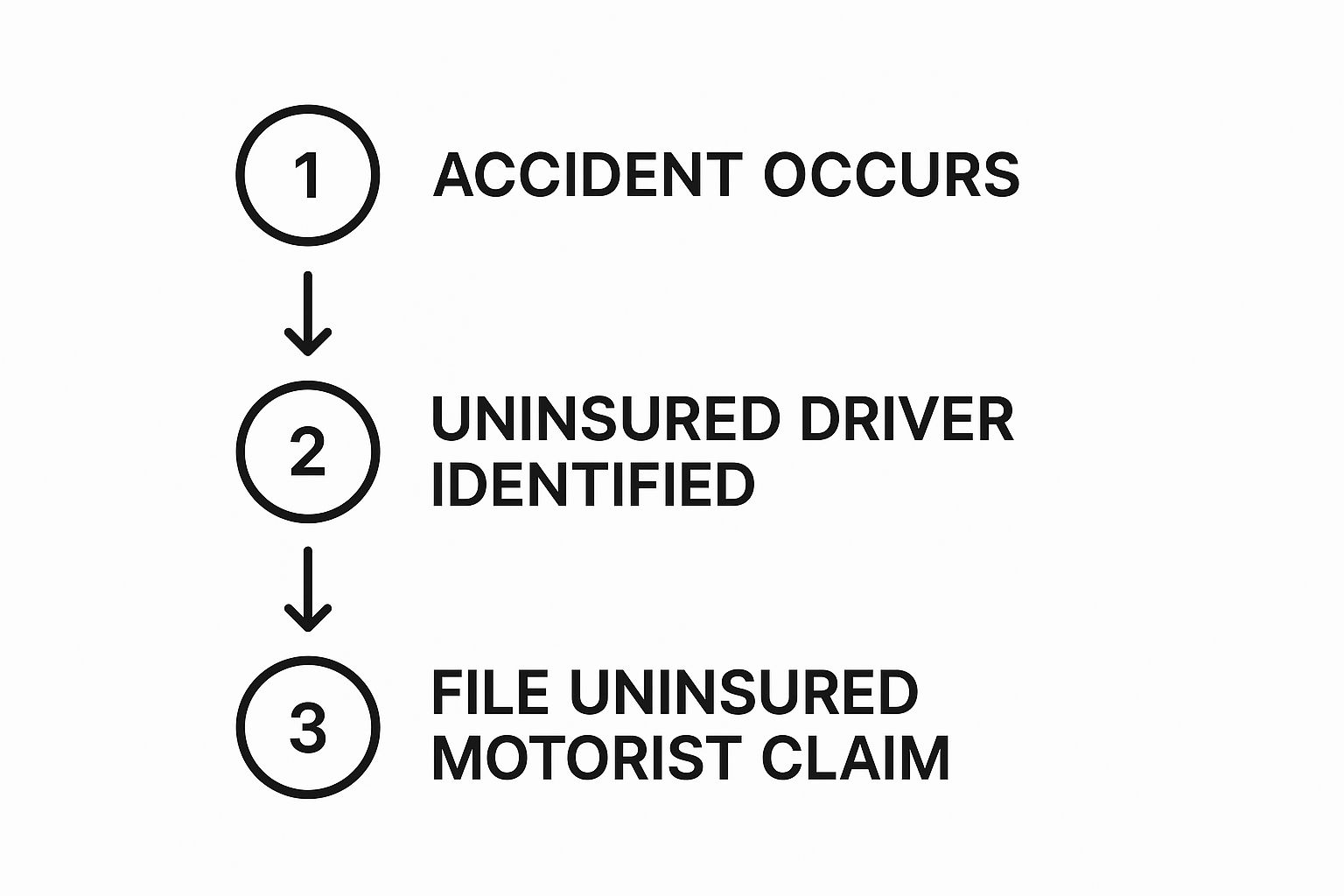
As you can see, the path forward goes directly through your own Uninsured Motorist coverage. Following these initial steps at the scene is the best way to set yourself up for a smooth and successful claims process. Every photo you snap and every note you take strengthens your case when you've been hit by an uninsured driver.
Making Sense of Your Insurance Policy

When you're reeling after a crash and learn the other driver has no insurance, your first thought is probably, "Who's going to pay for this?" The answer, believe it or not, is likely in your own glove box. Your own auto insurance policy is your first line of defense in this exact situation.
Pulling out that policy document can feel like trying to decipher a foreign language. It’s dense with terms and conditions you never think about—until you desperately need to. Let's break down exactly what to look for to get a handle on things.
The Role of Uninsured Motorist Coverage
The single most important part of your policy right now is your Uninsured/Underinsured Motorist (UM/UIM) coverage. This coverage is optional in Georgia, but it's an absolute lifesaver if you have it. Your insurance company essentially steps into the shoes of the at-fault driver's non-existent insurer.
UM coverage is there to pay for your damages, including:
- Medical bills from your injuries.
- Lost wages if the crash keeps you out of work.
- Pain and suffering caused by the accident.
Basically, it covers what you would have claimed from the other driver’s insurance if they had it. The need for this is more common than you'd think. In 2019, an estimated 12.6 percent of drivers on U.S. roads were uninsured. That's more than one in every eight drivers, which makes UM protection a vital safety net. For a deeper look at these statistics, you can review the findings from the Insurance Research Council.
Add-On vs. Reduced-By Policies
Now, here’s a detail that can dramatically affect your recovery. Georgia UM coverage comes in two main types: "add-on" (also called stacking) and "reduced-by" (non-stacking). Knowing which one you carry is vital.
Key Takeaway: The difference between "add-on" and "reduced-by" UM coverage can mean tens or even hundreds of thousands of dollars more—or less—in your final settlement.
Let's use a real-world example to show the difference.
- Add-On Scenario: You have $100,000 in add-on UM coverage. The uninsured driver is liable for $250,000 in damages. Your UM policy will pay you up to its full $100,000 limit.
- Reduced-By Scenario: You have $100,000 in reduced-by UM coverage. Imagine the at-fault driver was underinsured with only a $25,000 liability policy. Your UM coverage would be reduced by that $25,000, leaving you with only $75,000 available from your own policy.
The "add-on" policy is far better because it stacks on top of any other available insurance, giving you the full benefit of the coverage you paid for. Check your policy’s declarations page—it should specify which type you have.
Other Helpful Coverages in Your Policy
While UM coverage is the main event, other parts of your policy can give you immediate help. Think of them as first responders for your finances while the larger UM claim gets sorted out.
Medical Payments (MedPay) Coverage
MedPay is another optional but incredibly valuable coverage in Georgia. It helps pay for your and your passengers' medical bills right away, no matter who was at fault.
- It can cover health insurance deductibles and copays.
- It gives you fast access to funds for ER visits or initial doctor's appointments.
- There's no need to prove fault, which makes the process quick and simple.
Collision Coverage
So, what about your car? If you carry collision coverage, you can file a claim to get your vehicle repaired or, if it's totaled, receive a check for its value.
You’ll have to pay your deductible first. But the good news is that if your insurer successfully recovers money from the at-fault driver later (through a process called subrogation), you should get that deductible back. Using your collision coverage gets your car fixed fast, so you aren't stuck waiting for the UM claim to resolve.
Starting Your Uninsured Motorist Claim

You would think filing a claim with your own insurance company would be a simple, supportive process. You pay your premiums, so they should have your back, right?
But when you've been hit by an uninsured driver, the entire dynamic flips. Your own insurer is suddenly forced to step into the shoes of the at-fault driver's insurance company—a company that doesn't exist. This creates a subtle but immediate conflict of interest. Their goal is to minimize their payout; your goal is to get the full compensation you deserve.
Because of this, how you initiate your Uninsured Motorist (UM) claim is very important. It sets the tone for everything that comes next.
Reporting the Accident to Your Insurer
The very first thing you need to do is notify your own insurance company about the crash. Don’t wait. Nearly every policy has a "timely notice" clause, and delaying can give the insurer a technical reason to fight your claim down the road.
When you call, stick to the bare facts. Be polite but guarded.
- Give them the date, time, and location of the collision.
- Provide the other driver’s name and contact details, if you managed to get them.
- Share the police report number.
- Clearly state that the other driver was uninsured.
You are not required to give a recorded statement right away, and you absolutely should not guess about your injuries. It's perfectly fine—and smart—to say, "I'm sore, but I'm still getting checked out by my doctors." This stops them from using an early, optimistic comment against you if your injuries turn out to be more severe than you initially thought.
The Foundation of Your Claim is Record-Keeping
From this moment on, you need to become a meticulous record-keeper. Every bill, every receipt, and every note is a piece of evidence. This documentation is what builds the value of your claim and serves as your shield against an adjuster's attempts to downplay what you've been through.
I always tell my clients to get a dedicated binder or create a digital folder just for the accident. When an adjuster questions an expense, being able to produce a receipt or doctor’s note instantly shuts down the argument. It’s the most powerful tool you have.
Organizing your documents into key categories will make a world of difference as your claim moves forward.
Tracking Medical Treatment and Expenses
This is the cornerstone of your injury claim. Your insurance company will scrutinize this part of your claim more than any other.
Keep a detailed log of every single medical interaction.
- Every Appointment: Note the date, doctor, facility, and the reason for the visit (e.g., ER, orthopedic follow-up, physical therapy).
- All Medical Bills: Save copies of every bill you get, from the ambulance to the pharmacy. Never assume your insurer has them.
- Doctor's Notes: Keep all instructions, prescriptions, and work-excuse notes. These documents directly tie your treatment to the crash.
The Georgia Office of Insurance and Safety Fire Commissioner has resources for consumers that can help you understand your rights as a policyholder. Reviewing them is a great place to start.
Calculating Your Lost Wages and Other Costs
Your damages are more than just medical bills. You are also entitled to compensation for the income you lost while you were unable to work.
To prove this, you'll need clear evidence. Get a letter from your employer stating your pay rate, normal hours, and the specific dates you missed because of the accident. Keep your pay stubs from before and after the crash to create a clear picture of your lost income.
Finally, don't overlook the small things. They add up fast. These out-of-pocket expenses are part of your claim.
- Mileage driving to and from your doctors.
- Parking fees at hospitals and clinics.
- The cost of your prescriptions.
- Money spent on household help because your injuries kept you from doing daily chores.
A running log with receipts for these costs ensures they are included in your final settlement demand. A well-documented, organized claim is your best defense when an insurer tries to undervalue what you’ve lost after being hit by an uninsured driver.
What Your UM Claim Should Cover
When you’ve been hit by an uninsured driver, one question immediately comes to mind: What can I actually get paid for? The answer is found in your Uninsured Motorist (UM) claim. It’s designed to cover everything you legally could have recovered from the other driver's insurance—if they’d had any.
Your claim will really boil down to two types of losses: the ones with clear price tags and the ones that are deeply personal. In legal terms, we call these economic and non-economic damages. A strong claim demands full payment for both, because together they represent the total impact this crash has had on your life.
The Tangible Costs: Economic Damages
Economic damages are the most straightforward part of your claim. These are the measurable, out-of-pocket financial losses you've racked up because of the accident. Think of these as anything you can prove with a bill, a receipt, or a pay stub.
Your claim should demand reimbursement for every single dollar spent or lost. This includes:
- All Medical Bills: This isn't just the ER visit. It covers the entire medical journey—the ambulance ride, hospital stays, surgeries, specialist appointments, prescriptions, and even future needs like physical therapy or ongoing treatments.
- Lost Income and Earning Capacity: If your injuries forced you to miss work, you are entitled to every dollar of lost wages. This also extends to future earnings if the injury permanently affects your ability to do your job or earn a living at the same level as before.
- Property Damage: This covers the cost to repair your car. If it was totaled, it covers the vehicle's actual cash value at the moment of the crash.
The Personal Losses: Non-Economic Damages
This is where your claim addresses the very real, but less tangible, human cost of the accident. Non-economic damages are meant to compensate you for how the collision has shattered your quality of life. You can't get a receipt for this kind of suffering, but it's a recognized and important part of any serious injury claim.
Globally, the impact of traffic crashes is staggering. These incidents cause an estimated 1.19 million deaths annually and leave tens of millions with life-altering injuries. The economic fallout, including medical care and lost productivity, drains about 3 percent of the GDP for many countries. This global crisis provides a sobering backdrop, showing just how vital protective measures like UM coverage are for individual victims. You can see more on the global impact of these crashes from the World Health Organization.
In my experience as an Atlanta personal injury attorney, a person's pain is just as real as their medical bills. Juries and insurance companies understand that an injury is more than a set of invoices; it’s a disruption to your entire life.
Here’s what non-economic damages typically include:
- Pain and Suffering: This is for the physical pain, chronic discomfort, and general misery your injuries have caused.
- Emotional Distress: This covers the psychological fallout—anxiety, fear, depression, or even post-traumatic stress disorder (PTSD) from the crash.
- Loss of Enjoyment of Life: If your injuries stop you from participating in hobbies, activities, or family life that you once loved, you can be compensated for that loss.
Building a complete claim means documenting both the obvious financial costs and the profound personal impact. When you've been hit by an uninsured driver, accounting for every single loss is the only way to ensure you receive the fair compensation you deserve.
When Your Insurance Company Pushes Back
It’s one of the most frustrating things I see in my practice. You get hit by an uninsured driver, and the biggest battle you end up fighting is against your own insurance company. It feels like a total betrayal. You’ve faithfully paid your premiums, counting on that policy to be your safety net.
But when it's time to file a significant Uninsured Motorist (UM) claim, you quickly realize their primary goal is to protect their bottom line. Minimizing payouts is the name of their game, even if it leaves you holding the bag for someone else's mistake. It's not personal; it's just business. But you have rights, and you need to be ready to stand up for them.
Recognizing Insurance Bad Faith
Under Georgia law, your insurance company has a legal duty to handle your claim in “good faith.” When they unreasonably delay, undervalue, or deny a valid claim without a legitimate reason, they are acting in bad faith.
This doesn't always look like a flat-out "no." More often, it's a series of frustrating tactics designed to wear you down.
- Unreasonable Delays: The adjuster goes silent, taking weeks or months to investigate or return your calls.
- Lowball Settlement Offers: They offer you a fraction of what your documented medical bills and lost wages are actually worth.
- Misrepresenting Your Policy: The adjuster might outright lie about what your UM policy covers or claim your limits are lower than they are.
- Burying You in Paperwork: They demand endless, often unnecessary, documents to make the process so difficult you either give up or accept a low offer.
This is a bigger problem than most people realize. In 2023, data from the Insurance Research Council showed that roughly 15.4% of U.S. motorists—that’s more than one in seven drivers—were uninsured. That trend is only rising, leaving responsible, insured drivers to deal with the fallout.
How to Formally Dispute a Lowball Offer
When that insultingly low offer comes in, don't just get angry. Get organized. Your first move is to formally reject it in writing. A phone call is not enough; you need to create a paper trail that you can rely on later.
Your rejection letter, often called a demand letter, should be professional and direct.
- State your rejection clearly and explain that the offer fails to cover your documented damages.
- Briefly summarize your key losses, referencing the evidence you’ve already sent them (medical bills, pay stubs, etc.).
- Restate the fair settlement amount you are demanding based on that evidence.
- Give them a firm deadline to respond with a better offer, usually 14 or 30 days.
Sending a well-documented, professional letter signals to the adjuster that you are serious. It forces them to justify their lowball number in writing and puts them on notice that you won't be pushed around.
Breaking a Stalemate With Mediation
What if the letters and calls go nowhere? Before jumping into a full-blown lawsuit, mediation is often the best next step. It's a structured negotiation where a neutral third-party—the mediator—helps you and the insurance company find common ground.
A mediator doesn’t issue a ruling. Their job is to facilitate a productive conversation, pointing out the strengths and weaknesses in each side's position to guide you toward a resolution. It’s far less formal and expensive than court and is an incredibly effective way to break a deadlock.
Standing your ground is essential when you’ve been hit by an uninsured driver. This is especially true when your own insurer is the one giving you a hard time.
Frequently Asked Questions About Uninsured Driver Accidents
An accident is jarring enough. But the moment you learn the other driver has no insurance, a whole new layer of stress and uncertainty sets in. It’s a scenario we see all too often, and it always comes with a flood of questions. Here are the straightforward answers you need right now.
What If the Uninsured Driver Leaves the Scene?
If the driver who hit you takes off, you're dealing with a hit-and-run. Legally and for insurance purposes, this is treated almost exactly like an accident with a known, but uninsured, driver. This is precisely why you have Uninsured Motorist (UM) coverage.
Your first two moves are vital:
- Call the police immediately. Make it clear to the 911 operator and the responding officer that the other driver fled the scene. This officially documents the crash as a hit-and-run, which is very important for your claim.
- Tell your insurance company. Report the accident and the hit-and-run as soon as you can.
Even the smallest detail you can recall about the other car—make, model, color, a partial license plate—can be a massive help to the police in their investigation.
Will My Insurance Rates Go Up if I File a UM Claim?
This is probably the most common fear we hear, and it’s completely understandable. Fortunately, Georgia law protects you here.
Under O.C.G.A. § 33-9-40, an insurer is prohibited from raising your premiums or dropping your policy for an accident that wasn't your fault. You can find more consumer protections outlined by the Georgia Office of Insurance.
A UM claim, by its very nature, means the other person was at fault. You pay for this exact protection with every premium payment. Filing a claim isn't asking for a favor; it's using a benefit you are legally entitled to without penalty.
Think of it this way: you're simply activating the safety net you've already paid for. It's designed to cover damages caused by someone else's negligence and shouldn't affect your rates at all.
Can I Sue the Uninsured Driver Personally?
Yes, you absolutely have the legal right to file a lawsuit against the at-fault driver to recover damages for your medical bills, lost income, and pain and suffering.
But we have to be realistic about the practical side of this. A person driving illegally without insurance often doesn't have the money or assets to satisfy a court judgment. It's one thing to win in court; it's another thing entirely to actually collect the money you're owed. That part can be incredibly difficult, if not impossible.
This is why your Uninsured Motorist (UM) claim is nearly always your best and most reliable path to getting compensated. Your own insurance company covers your losses. They may then decide to go after the at-fault driver to get their money back—a process called subrogation—but that battle becomes their problem, not yours. The whole system is structured to protect you when you’ve been hit by an uninsured driver.
If you’re getting the runaround after an accident, the team at Jamie Ballard Law is ready to step in. We manage the legal work and fight the insurance companies so you can focus on your recovery. Contact us for a free, no-pressure case evaluation at https://jamieballardlaw.com.