If you’ve filed a personal injury lawsuit, you will quickly become familiar with the term ‘discovery.’ So, what is the discovery process in litigation? Simply put, it’s the formal, pre-trial phase where both sides are legally required to exchange all relevant information and evidence related to the case. It’s the part of the lawsuit where we uncover all the facts, leaving no stone unturned. This information-gathering stage is foundational to building a strong case.
The Discovery Process and Why It Matters in Your Lawsuit
This is not a casual exchange of information. It’s a structured process governed by strict court rules designed to prevent what we call ‘trial by surprise.’ The main purpose is to make sure each party fully understands the facts, which is important for negotiating a fair settlement or preparing for trial.
I often tell my clients to think of discovery as creating the blueprint for their case. Before you can build a strong structure, you need a detailed and accurate plan. During discovery, we systematically gather every document, statement, and piece of evidence that will form the foundation of your claim.
This information exchange is mandated by legal standards like the Federal Rules of Civil Procedure, which specify what must be shared and the deadlines for doing so.

At the heart of this phase is Rule 26, which establishes the “Duty to Disclose” and defines the “Scope of Discovery.” These rules ensure all parties have seen the important evidence long before any settlement talks or court dates.
How Long Does Discovery Take?
One of the most common questions we get is about the timeline. In most civil litigation, the discovery process typically lasts between 6 to 12 months. For personal injury cases involving car accidents, truck collisions, or slip and fall incidents, this timeframe is important for gathering all necessary medical records, expert opinions, and other proof.
The process follows a set schedule.
- It usually kicks off with a Rule 26(f) conference, where the lawyers for both sides meet to create a discovery plan and schedule.
- Within 14 days of that conference, both parties must exchange their “initial disclosures.”
- These disclosures must include the names of key witnesses, copies of relevant documents, a calculation of the claimed damages, and any insurance policies that may cover the incident.
This phase is just one part of the bigger picture. You can see how it fits into the overall timeline by reviewing the complete personal injury lawsuit process. These initial steps lay the groundwork for a successful claim.
The goal is simple: to make sure all cards are on the table. When both sides have access to the same facts, it paves the way for honest negotiations and a just resolution.
Understanding what the discovery process in litigation entails is the first step toward feeling in control of your legal journey. From here, we can dig into the specific tools we use to methodically build your case.
The Four Primary Tools of Legal Discovery

To build a winning personal injury case, we must gather facts and evidence. We use four primary legal tools to compel the other side to provide information they would not volunteer. Each tool is designed to uncover a different type of proof, and using them strategically is fundamental to building your claim.
Interrogatories: Written Questions Requiring Written Answers
The first formal step is often sending Interrogatories. These are written questions served on the opposing party—the at-fault driver, their employer, or their insurance company.
They must provide written answers under oath. Think of it as a formal, legally binding questionnaire about the incident.
Examples of Interrogatories we might ask include:
- “Identify every person you spoke with regarding the collision.“
- “State whether you were using a mobile device at the time of the collision and, if so, for what purpose.“
- “Describe your actions in the 60 seconds immediately preceding the impact.“
The sworn answers lock the defendant into a specific version of events and help us identify contradictions.
Requests for Production: Obtaining Documents and Physical Evidence
Next, we serve Requests for Production of Documents. This is a formal demand for the other party to produce tangible evidence relevant to the case.
This is how we get the hard proof. In a car wreck case, we might request photos or videos the other driver took at the scene. In a commercial trucking accident, we demand important records like:
- The truck’s maintenance history
- The driver’s logbooks and employment file
- Data from the truck’s electronic data recorder (the “black box”)
As more evidence becomes digital, this also includes electronically stored information (ESI) like emails, text messages, and internal company data. Efficiently sorting through this data often involves eDiscovery Artificial Intelligence to find key documents quickly.
Depositions: In-Person Questioning Under Oath
A Deposition is a formal interview where we question a witness, the defendant, or an expert under oath. The session takes place outside of court, usually at an attorney’s office, with a court reporter transcribing every word.
This is our opportunity to ask live follow-up questions, assess a witness’s credibility, and probe the answers they gave in their written interrogatories. The dynamic nature of a deposition is its strength; it allows for real-time inquiry that written questions cannot match.
A deposition is a structured, fact-finding conversation, not a courtroom battle. The objective is to understand exactly what a witness knows and how they will present themselves if the case proceeds to trial.
Requests for Admission: Narrowing the Issues for Trial
The final tool is Requests for Admission. These are a series of declarative statements we ask the opposing party to either admit or deny. The goal is to simplify the case by eliminating the need to prove undisputed facts.
For example, we might ask the defendant to:
- “Admit that you were the operator of the vehicle bearing Georgia license plate XYZ-123 on the date of the incident.“
- “Admit that the traffic signal controlling your direction of travel was red at the time of the collision.“
If they admit a fact, it is considered proven for the purposes of the case. This allows us to focus the trial on the core disputed issues, such as the true cause of the accident or the full extent of your injuries.
To help you visualize how these tools work together, here is a quick overview.
Key Discovery Tools at a Glance
This table summarizes the main discovery methods and how we apply them in a typical personal injury case.
| Discovery Tool | Format | Primary Purpose | Example in a Car Accident Case |
|---|---|---|---|
| Interrogatories | Written Questions | Obtain foundational facts and identify witnesses. | Asking the other driver to list all their activities on the day of the crash. |
| Requests for Production | Written Requests | Secure documents, data, and physical items. | Demanding the defendant’s cell phone records for the time of the accident. |
| Depositions | In-Person Testimony | Assess witness credibility and gather detailed, spontaneous answers. | Questioning the at-fault driver under oath about their speed and attention. |
| Requests for Admission | Written Statements | Lock in facts and narrow the issues for trial. | Forcing the other side to admit they ran a stop sign. |
Each of these four tools is a building block. By using them methodically, we construct a comprehensive and persuasive case designed to secure the compensation you deserve.
A Timeline of the Discovery Phase in Your Injury Case
When clients ask, “what is the discovery process in litigation,” a large part of the answer involves the timeline. Knowing what to expect can significantly reduce the stress of a personal injury lawsuit. While every case in Atlanta is unique, most follow a predictable sequence from the moment the lawsuit is filed until discovery closes.
This phase is where we do the heavy lifting to build your case, and it’s important to know how it unfolds. The entire process is managed by a scheduling order from the court, which sets firm deadlines for each stage.
The Kickoff with Initial Disclosures
The discovery process officially begins right after the lawsuit is filed and the defendant has responded. The first step is called Initial Disclosures, a mandatory, upfront exchange of basic information between both sides. This exchange is usually required within weeks of the defendant’s answer.
In this first step, we provide the defense with:
- A list of individuals likely to have information about the collision and your injuries.
- A description of documents supporting your claim, like the official accident report or photos you took at the scene.
- A calculation of your damages, including medical bills and lost wages incurred to date.
- Any insurance agreements that might cover the incident.
The defense must provide us with the same categories of information. This initial exchange ensures both parties start with a foundational understanding of the case.
Written Discovery: The Fact-Gathering Engine
Once initial disclosures are done, we move into the core of the discovery timeline: written discovery. Here, we use formal legal tools like Interrogatories and Requests for Production of Documents to get detailed facts and evidence.
This stage is a back-and-forth process. We send our written questions and requests to the defense, who typically have 30 days to respond under oath. They will send similar requests to us, and we will work closely together to provide complete, truthful answers and gather all requested documents.
This written phase is absolutely essential. For anyone learning how to file a car accident claim in Atlanta and what comes next, this is where we collect the core evidence to prove your case.
Discovery is, without a doubt, the longest and most resource-intensive phase of civil litigation, often taking up the majority of attorney hours before trial. Experience shows this stage can last for many months, or even over a year, depending on the number of witnesses and the amount of evidence involved.
Depositions: The Human Element
After the bulk of written discovery is exchanged and we have a clearer picture of the facts, we move to depositions. These formal, out-of-court Q&A sessions are typically the last major step in the discovery timeline.
First, we will depose the defendant and other key witnesses, using the documents and information we’ve gathered to ask pointed questions under oath. The defense will also depose you. We will spend significant time preparing you for this so you know exactly what to expect and can answer confidently.
Because depositions require coordinating the schedules of multiple attorneys, witnesses, and a court reporter, they are often scheduled months in advance. Once all depositions are complete, the discovery phase is usually near its end. Our job is to manage this calendar meticulously, ensuring we gather every piece of evidence needed to prove your claim for medical costs, lost income, and pain and suffering before the court’s deadline. It’s a methodical process that clarifies what the discovery process in litigation truly requires.
Your Role as the Plaintiff During Discovery
As the plaintiff, you are the single most important person in your own lawsuit. You’re not a spectator. While we manage the legal strategy and court filings, your active and honest participation is what gives the case its foundation and strength. We are here to prepare you for this phase so you’re never caught off guard.
Your involvement is what brings the discovery process to life. It’s your story, your injuries, and your experience that we are fighting to protect.
Your Responsibilities and How We Help
Your primary responsibility during discovery is to provide truthful and complete information. The defense counsel will send formal requests for information, and we will guide you through every response. This work breaks down into two main tasks: answering written questions, known as Interrogatories, and providing documents through Requests for Production.
We will never just hand you a stack of legal forms. Instead, we sit down with you to review every single question, helping you craft answers that are both accurate and precise.
When the defense requests documents, we will help you identify exactly what they need. This often includes items like:
- Photographs or videos of the accident scene, vehicle damage, or your injuries.
- Pay stubs or tax records to document and prove lost income.
- Correspondence from any involved insurance companies.
- Receipts for out-of-pocket costs tied to the accident, like prescriptions or medical equipment.
This timeline shows how your role fits into the broader discovery schedule, from the first exchange of information to your deposition.
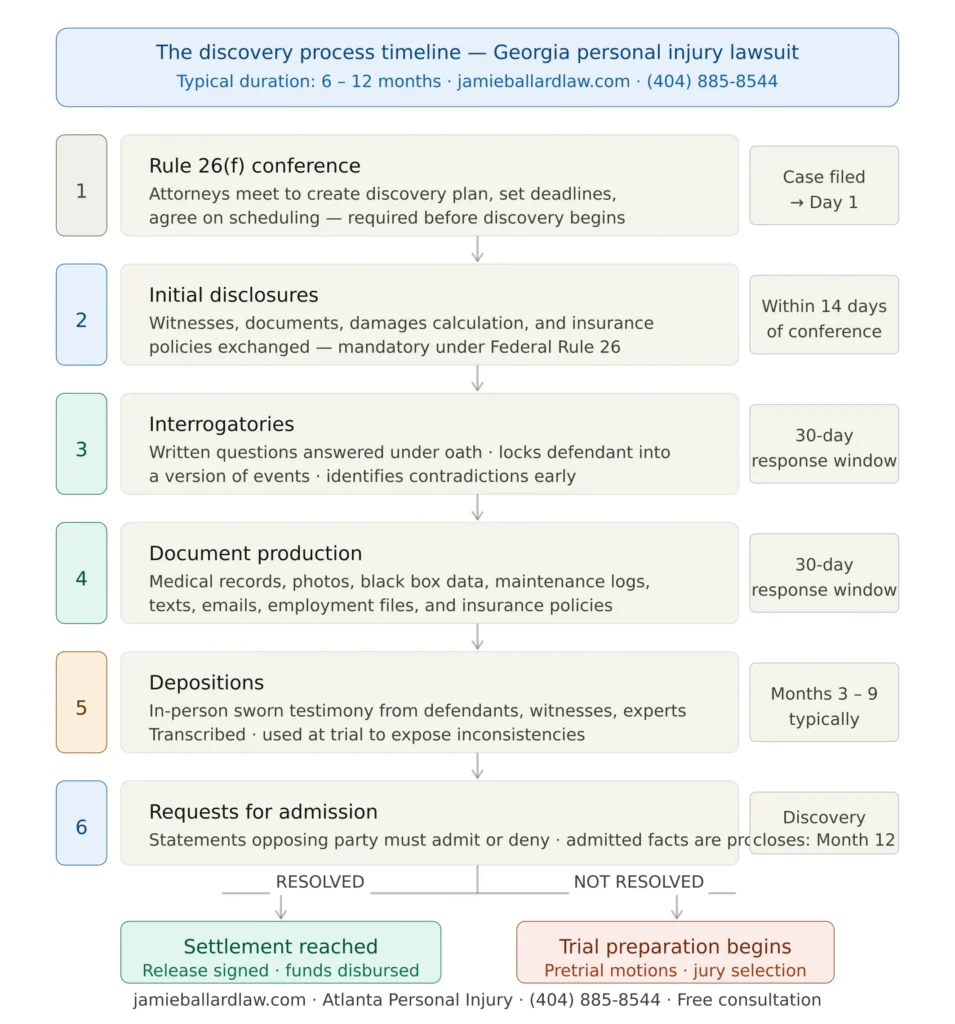
As you can see, providing these documents and written answers happens before your testimony. This approach allows us to build a solid factual foundation for your case first.
Preparing for Your Deposition
Your deposition is the most significant event for you during the discovery phase. This is a formal, recorded interview where the defense attorney will ask you questions under oath. It’s completely normal to feel nervous, but our job is to make sure you are prepared and confident.
We will dedicate as much time as necessary to get you ready. We’ll go over the kinds of questions they are likely to ask about the accident, your medical care, and how your injuries have impacted your life.
One of the most important pieces of advice we give every client for their deposition is this: listen to the full question, pause to think, and then answer only the question that was asked. Never volunteer extra information.
Thorough preparation enables you to give clear, truthful testimony that reinforces the facts of your case. It is one of the most direct ways you can help us prove the full extent of your personal injury claims and the damages you’ve sustained.
Remember, the defense attorney’s goal is to find inconsistencies in your story or get you to say something that downplays your injuries. Our goal is to ensure you present your account clearly and honestly, without falling into their traps. By working together, we present a powerful and consistent narrative of what happened.
Handling Common Discovery Objections and Disputes
In an ideal world, discovery would be a straightforward exchange of information. The reality is that the defense often resists providing the evidence we request. When you’re learning what is the discovery process in litigation, it’s important to understand that these disputes are a normal part of the legal fight.
These refusals are known as legal “objections.” An objection is a formal statement from the opposing attorney explaining why they believe they are not required to answer a question or produce a document. As your legal team, we anticipate these objections and are prepared to defeat them.
Common Objections from the Defense
Defense attorneys use several standard objections to try and limit the evidence we can obtain. It is helpful to understand these terms, as you will likely hear us discuss them.
Some of the most common objections include:
- Overly Broad or Unduly Burdensome: The defense claims a request is too wide-ranging or would require an unreasonable amount of effort to fulfill. We counter by demonstrating that the request is specific, targeted, and essential to proving your case.
- Vague and Ambiguous: The opposing side alleges they cannot understand what information our request seeks. We resolve this by providing clarification to eliminate any potential for confusion.
- Irrelevant: They argue the requested information has no connection to the case. We must then explain—first to them, and if necessary, to a judge—how the evidence directly proves their negligence or the full scope of your damages.
Another major category of objection involves a claim of “privilege,” which asserts that certain information is legally protected from disclosure.
What Is Privileged Information?
A claim of privilege is a common reason for the defense to withhold information. The most well-known example is the attorney-client privilege, which protects confidential communications between a lawyer and their client.
As the helpful Wikipedia article explains, this privilege exists to foster open and honest communication. The defense cannot demand to know the legal advice we provide to you, just as we cannot demand to know the advice their lawyer provides to them.
How We Resolve Discovery Disputes
When we receive an objection, our first step is not to involve the court. Georgia court rules mandate that we first attempt to resolve the dispute directly with the opposing counsel. This mandatory discussion is called a “meet and confer.”
Most discovery disputes are resolved during the meet and confer process. It’s a professional discussion where we explain our position and negotiate a solution without needing court intervention.
If the opposing lawyer remains uncooperative after this conference, we do not hesitate to take the next step: filing a Motion to Compel. This is a formal legal document asking the judge to order the other side to produce the evidence. We present our arguments, and the judge makes a ruling.
Disputes are a standard part of the process, and we are always ready to fight for the evidence your case demands. Understanding this aspect of what the discovery process in litigation involves should give you confidence that we are your steadfast advocates at every stage.
How Thorough Discovery Builds a Stronger Case for You
Now that you understand what is the discovery process in litigation, we can examine its strategic purpose. This is not simply a fact-finding exercise; it is how we methodically construct the leverage necessary to secure a favorable outcome for your personal injury claim.
A meticulously managed discovery process is what separates a weak claim from an undeniable one. Stating the other driver was negligent is an allegation. Proving it with their own deposition testimony or phone records is what forces an insurer to pay.
Turning Information into Leverage
Every document requested and every question asked during discovery has a specific strategic goal. We are not just collecting information—we are building an arsenal for negotiation and trial.
- A defendant’s admission in a deposition: When we get an at-fault party to admit under oath that they were distracted or speeding, that admission becomes powerful evidence of their liability.
- Falsified trucking company logs: Uncovering a commercial driver’s illegal hours or a company’s doctored maintenance records can fundamentally change the case, often opening the door to punitive damages.
- Contradictory statements: We meticulously compare a defendant’s written answers to their deposition testimony. Any inconsistencies are used to attack their credibility before a judge or jury.
Insurance carriers are financially motivated to dispute and deny claims. Their position, however, often shifts when confronted with a mountain of well-organized, incriminating evidence. A comprehensive file of damaging documents and testimony makes it exceedingly difficult to deny liability or justify a low settlement offer. They know we are prepared to win at trial. To analyze the information gathered during discovery and build a compelling narrative, an AI Legal Case Researcher can be a powerful ally, significantly contributing to the strength of your case.
Building Your Foundation for Trial
If settlement negotiations fail, the evidence gathered during discovery becomes the bedrock of our trial strategy. There are no surprises; every exhibit presented to the jury and every question posed to a witness is rooted in the facts we uncovered months prior.
This is why our approach is so diligent. We systematically build a case that is too strong for an insurer to ignore and too solid to be dismantled in court. From start to finish, we leave no stone unturned in our mission to secure the full and fair compensation you are owed.
Understanding what the discovery process in litigation truly entails shows you how methodically we work to build the strongest possible case on your behalf.
Frequently Asked Questions About the Discovery Process
Discovery is where the core evidence of a personal injury case is exchanged. For most clients, this stage is an unfamiliar process filled with specific legal duties and strategic challenges. We provide clear, direct answers to the most common questions our clients in Atlanta ask about discovery.
Our commitment is to ensure you understand your obligations and are prepared for every step.
What Happens if I Cannot Find a Document?
This is a frequent issue, but your legal duty is straightforward: you must perform a reasonable and diligent search for all requested documents. This means making a comprehensive effort to check your physical files, computer hard drives, cloud storage, and any other location where the document might exist.
If a document is genuinely lost after a good-faith search, or if it was destroyed long before the lawsuit as part of a routine practice, we will formally state this in our response. Honesty is non-negotiable. Never hide or destroy evidence once a lawsuit is anticipated or filed. This action, known as spoliation of evidence, carries severe court-imposed penalties, including the potential dismissal of your case. We will provide precise instructions for conducting your search and documenting the outcome correctly.
Will I Have to Go to Court for My Deposition?
No, depositions are not conducted in a courtroom, and a judge will not be present. This is a common misconception that often causes unnecessary stress for clients. In almost all cases, depositions take place in a professional but less formal setting, such as an attorney’s conference room.
While a deposition is a formal legal proceeding where you are under oath and a court reporter records your testimony, it is far less intimidating than testifying at trial. We will be at your side for the entire deposition to object to improper questions, protect your rights, and ensure the opposing counsel treats you fairly.
Can the Other Side See All My Private Medical Records?
Because your physical and mental condition is the foundation of your personal injury claim, the defense has the right to review medical records that are relevant to the injuries you claim in the lawsuit. The definition of “relevant,” however, is a key point of legal dispute.
We will aggressively fight to protect your privacy by objecting to overly broad requests. For example, if you suffered a broken leg in a car accident, the defense has no legal right to demand your entire life’s gynecological or psychiatric history. This is a common defense tactic used to find unrelated information to embarrass you or undermine your current injuries.
Our responsibility is to limit their access strictly to what is permissible under Georgia law and directly related to your case. We work diligently to shield your private health information from these intrusive fishing expeditions. This protection is a key component of what the discovery process in litigation means when we represent you.