When you're recovering from an injury, the last thing you should worry about is another bill. A personal injury lawyer contingency fee addresses that concern with a simple, powerful promise: we don't get paid unless you get paid. This is often called a "no win, no fee" arrangement, and it means our fee is entirely dependent on winning your case, either through a settlement or a court victory. This approach ensures that you can access quality legal help without upfront costs, making the process of seeking compensation for your injuries much more manageable.
How a Contingency Fee Agreement Actually Works

Think of a contingency fee agreement as a true partnership. It's a legal structure built on one shared mission: securing the best possible financial recovery for you. When my firm takes on a case, we are investing our own time, expertise, and resources to build it from the ground up, all because we believe it has merit.
This arrangement is a great equalizer. It gives anyone, regardless of their financial standing, the ability to hire top-tier legal representation and go toe-to-toe with massive insurance corporations. Your job is to focus on your health, not on coming up with retainers or paying hourly legal bills.
Aligning Our Goals for Your Success
The real beauty of the contingency model is how it aligns everyone's interests. Because my compensation is a percentage of the money we recover for you, I am personally and professionally driven to maximize your settlement or verdict. Every move we make—from gathering evidence to negotiating with insurance adjusters—is aimed at getting the highest possible value for your claim. It eliminates any conflict of interest and forges a strong, unified front.
You can see how this plays out in practice by reading our guide on the Atlanta car accident lawsuit process, which details the stages that contribute to a successful outcome. The model is so effective and client-focused that it has become the gold standard in personal injury law.
In fact, the data supports this. Legal industry studies show that the vast majority of personal injury lawyers work on a contingency fee basis because they recognize it as the fairest and most practical way to serve their clients.
A contingency fee isn't just a payment arrangement; it's a vote of confidence. When an attorney accepts your case on contingency, they are staking their own resources on the strength of your claim and their ability to win.
Contingency Fee at a Glance
To simplify it even further, let's look at a quick summary of what a standard contingency fee agreement means for you. This table breaks down the core features.
| Feature | What It Means for You |
|---|---|
| No Upfront Fees | You can hire an experienced attorney immediately without paying anything out of pocket. |
| Payment Is "Contingent" | Attorney fees are only paid if and when we win your case through a settlement or verdict. |
| Shared Risk | The law firm assumes the financial risk of pursuing your case, covering the costs of investigation and litigation. |
| Aligned Motivation | Our success is directly tied to your success, ensuring we are always working toward the best possible result for you. |
Ultimately, the personal injury lawyer contingency fee system is designed to give you peace of mind and powerful advocacy precisely when you need it most.
Calculating Standard Contingency Fee Percentages

One of the first, most practical questions clients ask is, "What percentage do you charge?" It’s a fair question. Understanding how a personal injury lawyer contingency fee works is key to feeling confident about your legal partnership. Let's pull back the curtain on the numbers.
In Atlanta, like in most of the U.S., the standard contingency fee lands somewhere between 33.3% and 40% of the total recovery. This isn't a random figure; it reflects the work, resources, and risk your legal team invests in your fight for fair compensation.
The American Bar Association offers solid, general information on legal fees, including contingency agreements, to help consumers understand their options. The fee percentage is always a core part of the agreement you sign with your attorney, highlighting just how important it is to get this right from the start.
How Case Progression Affects the Percentage
The exact percentage within that 33.3% to 40% range usually depends on when your case resolves. Think of it as a sliding scale that moves based on the legal work required. A case demanding more time, legal firepower, and resources will naturally have a higher fee percentage.
This tiered approach is standard practice. Many firms, for instance, offer a lower percentage if a case settles before a lawsuit is even filed. But once a lawsuit is filed and litigation begins—a process involving depositions, expert witnesses, and court motions—the percentage often increases to reflect that deeper commitment.
This structure is designed to be fair. It ensures the fee accurately mirrors the level of legal effort and financial risk taken to secure your recovery.
A common industry standard is a one-third (33.3%) fee if the case settles before going to trial. If it does proceed to trial, the fee often increases to 40% to account for the massive increase in time, risk, and costs involved.
Factors That Influence the Final Fee
Several key elements influence the specific percentage in your fee agreement. Every case has its own unique wrinkles, and a good lawyer will consider these factors when structuring their fee.
- Case Specifics: A straightforward rear-end collision with clear fault is a world away from a multi-vehicle truck accident or a medical malpractice claim. The latter requires extensive investigation and multiple expert testimonies, making them far more involved.
- Likelihood of Trial: If an insurance company digs in its heels from day one and a trial looks inevitable, the fee may be set at a higher percentage from the outset. This accounts for the significant resources a trial demands.
- Projected Costs: Cases that require expensive expert witnesses—like accident reconstructionists or life-care planners—involve a much greater financial risk for the law firm. That risk can be reflected in the fee.
It’s important to remember that these case costs are separate from the attorney's fee. You can get a clearer picture of how these expenses work by reviewing our breakdown of costs and the free consultation process.
Ultimately, the goal of the personal injury lawyer contingency fee is to give you access to powerful legal support without any upfront financial burden.
Understanding Case Costs and Expenses

It’s easy to get attorney's fees and case costs confused when discussing a personal injury lawyer contingency fee. They are two completely different things, and it’s important to understand the distinction to see the full financial picture of your case.
The contingency fee covers my time, legal expertise, and the work my team invests in your fight. Case costs, however, are the direct, out-of-pocket expenses needed to build and pursue your claim. Think of them as the raw materials—the evidence and procedural necessities—required to construct a winning case.
Attorney Fees vs. Case Expenses
Simply put, the fee pays for the lawyer's work, while case costs pay for the tools needed to win. This is a vital difference. These costs are completely separate from the percentage-based fee we agree on.
My firm, like many top firms in Atlanta, advances these costs on your behalf. This means we front the money for everything needed to move your case forward, so you don’t have to worry about a single bill. We are, in effect, investing in your case to give you the strongest possible chance of a successful outcome.
When the case is won, these advanced costs are reimbursed to the firm from the total settlement or verdict. This happens before the attorney's fee is calculated, ensuring you face absolutely no upfront financial burden.
This approach is central to how we manage https://jamieballardlaw.com/personal-injury-claims/, freeing you to focus on what matters most: your recovery.
What Expenses Can You Expect?
Building a powerful case doesn't come cheap. It involves gathering extensive evidence, consulting with professionals, and meeting strict legal requirements. Each step has a cost. Being transparent about these expenses is key, so there are no surprises when we finalize your settlement.
Here is a look at the most common case costs we handle for our clients:
- Court Filing Fees: Every lawsuit starts by filing documents with the court, and courts charge for this service.
- Medical Record Retrieval: We must obtain all your medical records to prove the extent of your injuries. Hospitals and clinics charge administrative fees for copying and sending these essential documents.
- Expert Witness Fees: This is often one of the biggest expenses. We might need an accident reconstructionist to prove what happened or a medical specialist to testify about your future care needs.
- Deposition Costs: Depositions are sworn testimony taken from witnesses, defendants, and experts outside of court. The costs cover a court reporter to create a transcript and sometimes a videographer.
- Investigation Costs: This can include hiring private investigators to locate witnesses, document the accident scene, or uncover key evidence.
- Administrative Expenses: This bucket covers smaller but necessary costs like postage, extensive copying, and legal research services.
How Reimbursement Works
Once we secure a settlement or a jury delivers a verdict, the funds are sent to our firm's secure trust account. From there, we manage the distribution in a clear, step-by-step process.
First, we pay off any outstanding liens, such as medical bills or health insurance claims. Next, the firm is reimbursed for the case costs we advanced. Only after those expenses are covered is our contingency fee calculated from the remaining amount.
The final balance is your net recovery—the money that goes directly into your pocket. This transparent process ensures you know exactly where every dollar goes and gives you a clear understanding of how your final recovery is determined from a personal injury lawyer contingency fee.
How Contingency Fees Compare to Other Payment Models
To really get why the personal injury lawyer contingency fee is such a big deal, it helps to see how it stacks up against the other ways attorneys get paid. While the contingency model is the go-to for injury cases, other fee structures exist. Understanding them makes it crystal clear why the "no win, no fee" approach is so powerful for clients like you.
Let's break down the alternatives you might run into in other areas of law and see why they just don't work for personal injury claims.
The Hourly Billing Model
The most traditional method is billing by the hour. With this model, you're paying a lawyer for every single minute they spend on your case—whether that’s writing a letter, making a phone call, or showing up in court. In Atlanta, experienced attorneys can charge anywhere from $200 to $500 or more per hour.
While that system has its place, it's a terrible fit for injury victims. The costs can spiral out of control fast, leaving you with unpredictable and massive bills. That's immense financial pressure when you’re already juggling medical expenses and lost income. It would be an impossible burden for most people, especially when you're up against an insurance company with deep pockets.
The Flat Fee Model
Another option is the flat fee, where a lawyer charges one set price for a specific, predictable legal task. This is common for straightforward services like drafting a basic will or handling a simple, uncontested divorce.
But personal injury cases are anything but predictable. They can drag on for months, sometimes years, and involve a huge amount of work—investigation, negotiation, and maybe even a full-blown trial. A flat fee just can't account for all the unknowns, which is why you almost never see it used for these claims.
The infographic below gives a quick snapshot of key data for cases that do use the contingency fee model.
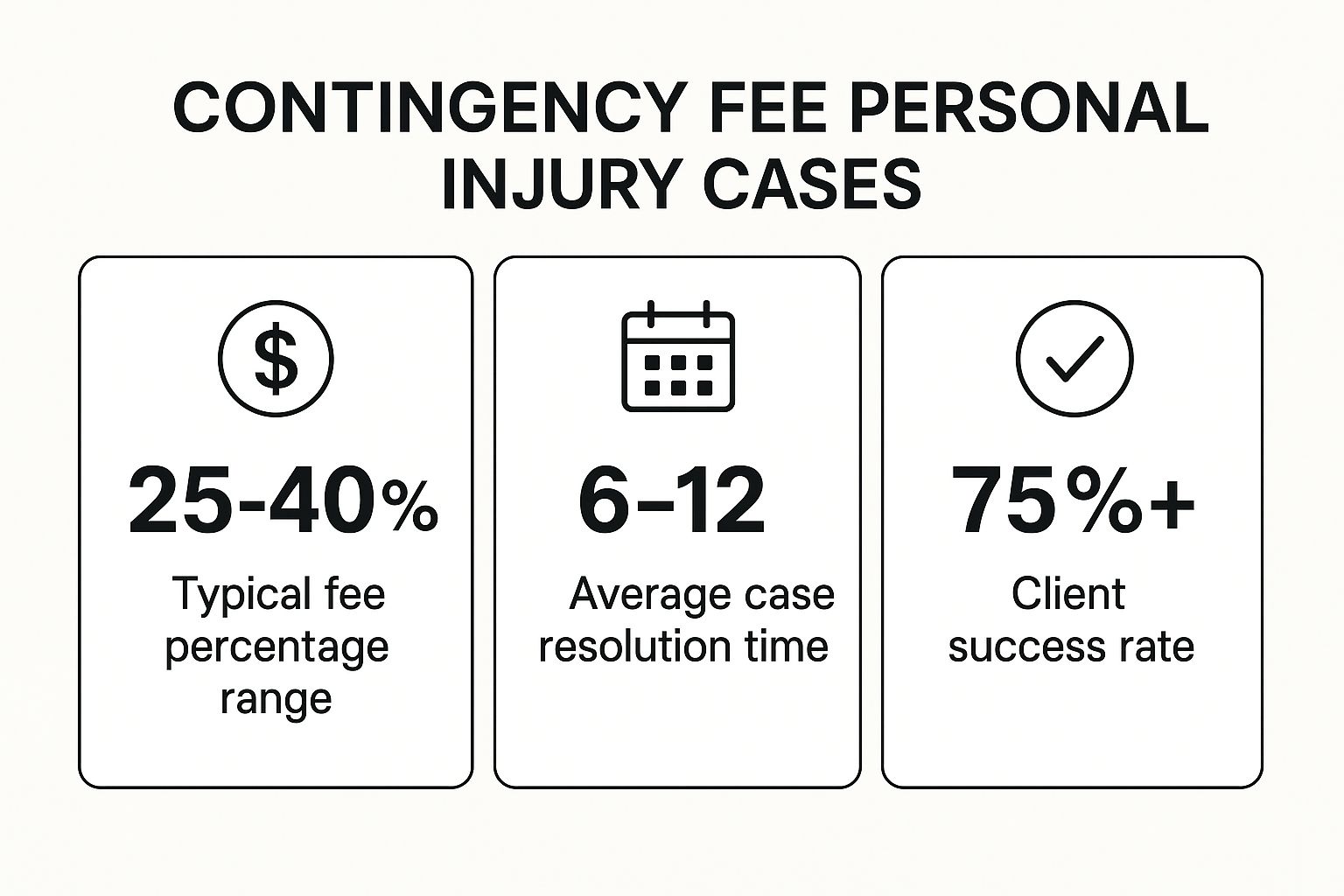
As you can see, this model doesn't just open the courthouse doors for everyone; it's also incredibly effective, with the vast majority of cases ending in a successful recovery.
How Different Legal Fee Structures Stack Up
Seeing the common attorney fee structures side-by-side makes it easier to grasp the pros and cons of each. Here’s a quick comparison to put everything in perspective.
Attorney Fee Structures Compared
| Fee Type | How It Works | Best For | Client Risk Level |
|---|---|---|---|
| Contingency Fee | The lawyer's fee is a percentage (33%-40%) of the final settlement or verdict. If you don't win, you don't pay a fee. | Personal injury, medical malpractice, and other cases where a monetary award is sought. | Low – No upfront costs or fees if the case is lost. |
| Hourly Rate | The client pays the lawyer an agreed-upon hourly rate for all time spent on the case. A retainer is often required upfront. | Business law, criminal defense, family law, and corporate matters. | High – Costs are unpredictable and can become very expensive, regardless of the outcome. |
| Flat Fee | A single, fixed price is charged for a clearly defined legal service. | Simple, predictable tasks like drafting a will, handling an uncontested divorce, or a basic bankruptcy filing. | Medium – You know the cost upfront, but you pay it whether the outcome is successful or not. |
This table highlights why the contingency fee is the only structure that truly protects an injury victim from financial risk while giving them access to top-tier legal help.
Why Contingency Is the Standard for Injury Claims
When you put these models next to each other, the reason contingency fees are the standard for personal injury law becomes obvious. It’s the only structure that truly levels the playing field.
- Zero Upfront Financial Risk: You pay absolutely nothing out of pocket. If we don’t win your case, you owe no attorney fees. Period.
- Perfectly Aligned Interests: My success is tied directly to yours. We share the exact same goal: to get you the maximum compensation possible.
- Access to Justice for Everyone: Your bank account balance doesn't determine whether you can afford to hire a skilled attorney to fight for your rights.
This structure removes the financial walls that would otherwise stop injured people from getting the justice and compensation they deserve.
If you come across unfamiliar terms in a fee agreement, our firm's legal dictionary can help clarify common definitions. Being informed helps you approach any legal document with confidence. The personal injury lawyer contingency fee isn't just a payment method; it's our commitment to fighting for you, no matter what.
Key Benefits of Using a Contingency Fee Lawyer
So, why is the personal injury lawyer contingency fee the standard for injury claims? The answer is simple: it puts you, the client, first. This structure isn't just about how an attorney gets paid; it’s about opening the doors to justice when you are most vulnerable.
The most significant benefit is immediate access to skilled legal counsel. After an accident, you’re buried in medical bills, lost wages, and physical pain. The last thing you need is the stress of finding thousands of dollars for a legal retainer. A contingency fee removes that barrier completely. You can hire an experienced attorney right away without paying anything upfront.
Your Success Is Our Success
Another core advantage is the built-in motivation. Since our firm only gets paid if we win your case, our success is directly tied to yours. This isn't just a business transaction; it’s a partnership focused on one goal: securing the best possible outcome for your physical and financial recovery.
This shared objective creates a foundation of trust and dedication. We are fully invested in your claim because our own success depends on it. That means we’re driven to fight harder, negotiate more aggressively, and commit the resources needed to build the strongest case possible.
This alignment of interests is the bedrock of the contingency fee model. It ensures your attorney is always working in your best interest, pushing for the maximum compensation the law allows.
This model also serves as a practical filter for cases. Because we invest our own time and resources, we have to be selective about the claims we accept. We only take on cases we genuinely believe have merit and a strong chance of success, which adds a layer of validation to your claim. The State Bar of Georgia has official rules that govern these fee agreements and attorney conduct.
A Level Playing Field Against Big Insurance
Without the contingency fee model, the legal system would be heavily stacked in favor of large insurance corporations. They have virtually unlimited resources and teams of lawyers ready to deny or lowball claims. An individual fighting them alone, or paying an attorney by the hour, would face an immense disadvantage.
The contingency fee levels that playing field. It gives you the same legal firepower as the opposition without the financial burden.
Here are the key advantages broken down:
- No Upfront Financial Risk: You can pursue justice without paying a dime from your own pocket to get started. If we don’t win, you owe us no attorney fees.
- Access to Top-Tier Talent: Your financial situation won’t stop you from hiring a skilled, experienced attorney to fight for your rights.
- Motivation for Maximum Recovery: Your lawyer is driven to secure the highest possible settlement or verdict because their payment is a percentage of that recovery.
- Focus on Your Healing: You can concentrate on your medical treatment and putting your life back together, knowing the legal fight is in capable hands.
This system is designed to empower you. It ensures your right to seek compensation is determined by the strength of your case, not the size of your bank account. By choosing an attorney who works on a personal injury lawyer contingency fee, you are choosing a true partner for your recovery journey.
What to Ask Before Signing a Fee Agreement
Choosing an attorney is a big decision, and you should feel completely comfortable with the terms before signing anything. Think of it like hiring someone for an important job—because you are. A transparent personal injury lawyer contingency fee agreement is the bedrock of a good partnership, and any lawyer worth their salt will welcome your questions.
Going into your first meeting with a list of questions is a smart move. It helps you cut through the legal jargon, compare different attorneys, and make a decision that feels right for you and your family.
Essential Questions About Fees and Costs
Let's start with the money. Getting clarity on the financial details from day one prevents stress and confusion later.
Here are the key questions you need answers to:
- What is your exact contingency fee percentage? Is it a flat rate, or does it change depending on when the case is resolved? For example, some firms charge a lower percentage if the case settles before a lawsuit is filed and a higher one if it goes to trial.
- How are case costs handled? Ask if the firm advances all litigation costs (like expert witness fees or court filing fees) and, importantly, if you have to pay them back if you lose. Most "no win, no fee" arrangements cover this, but you must confirm it in writing.
- Is the fee calculated before or after case expenses are deducted? This is a huge deal. It directly impacts how much money actually ends up in your pocket, so make sure you understand their method.
Questions About Experience and Communication
Once you've sorted out the finances, you need to be sure the lawyer has the right expertise for your specific case and that you'll be kept in the loop.
Having clear expectations for communication from the beginning is just as important as understanding the fee structure. It ensures you feel supported and informed every step of the way.
Don't be shy about asking:
- Have you handled cases like mine before? What were the results?
- Who will be my main point of contact at the firm? Will I be speaking with you directly or with a paralegal?
- How often should I expect to get updates on my case?
- What’s the best way to reach you—phone or email?
Asking these questions helps you fully grasp the personal injury lawyer contingency fee and, more importantly, find the right person to fight for you.
Common Questions About Contingency Fees
When you're deciding on legal representation, it’s normal to have a few questions. Here are some straightforward answers to what people most often ask about how a personal injury lawyer contingency fee actually works.
What Happens If We Lose the Case?
This is usually the first question on everyone's mind, and the answer gets right to the heart of the contingency fee model. If we don’t win your case—meaning we don’t secure a settlement or a verdict in your favor—you owe absolutely zero in attorney's fees. It's that simple.
Our "no win, no fee" promise means we take on the financial risk of litigation. It is important, however, to clarify how case costs are handled. In most of our agreements, you are not responsible for repaying the costs our firm advanced if the case is lost. We always make sure this is explicitly detailed in your fee agreement.
Is the Contingency Fee Percentage Negotiable?
The fee percentage is generally determined by the specifics of a case, including its particulars, anticipated duration, and the risks involved. While the standard in our industry often falls between 33.3% and 40%, this is something we must discuss openly during our initial consultation.
Transparency is key. A reputable attorney will explain precisely how they determined their proposed percentage and what factors justify it. This conversation is essential to ensure we are aligned from day one. You can find more general guidance on legal fee structures from consumer-focused resources provided by the American Bar Association.
Does the Fee Come from the Gross or Net Settlement?
This is a very important detail, as it directly impacts your final take-home recovery. An attorney's fee can be calculated in one of two ways, and the difference is significant.
- Gross Method: The fee is calculated from the total settlement amount before any case costs are subtracted.
- Net Method: The fee is calculated from the remaining amount after case costs have been paid.
Let's break down the math with a $100,000 settlement, $10,000 in case costs, and a 33.3% fee:
Gross Method Calculation:
- Attorney Fee: $33,333 (33.3% of $100,000)
- Case Costs: $10,000
- Your Net Recovery: $56,667 ($100,000 – $33,333 – $10,000)
Net Method Calculation:
- Deduct Costs First: $90,000 ($100,000 – $10,000)
- Attorney Fee: $29,970 (33.3% of $90,000)
- Your Net Recovery: $60,030
As the numbers show, the net method puts more money in the client's pocket. It's essential to understand which method a potential attorney uses before you sign any agreement. This is a vital element of understanding your personal injury lawyer contingency fee.
At Jamie Ballard Law, we prioritize complete transparency and are here to answer every one of your questions. If you've been injured and need a dedicated advocate in Atlanta, call us for a free, no-obligation case evaluation. Let us show you how we can fight for you. Visit us at https://jamieballardlaw.com to get started.