When an injury is caused by someone else's carelessness, the legal world calls it negligence. Proving a personal injury claim in Atlanta, however, isn't as simple as just pointing fingers. It requires a clear understanding of the specific legal standard we call the four core elements of negligence. You have to show that another party’s failure to act with reasonable care is what led to your harm.
What Are the Four Pillars of a Negligence Claim?
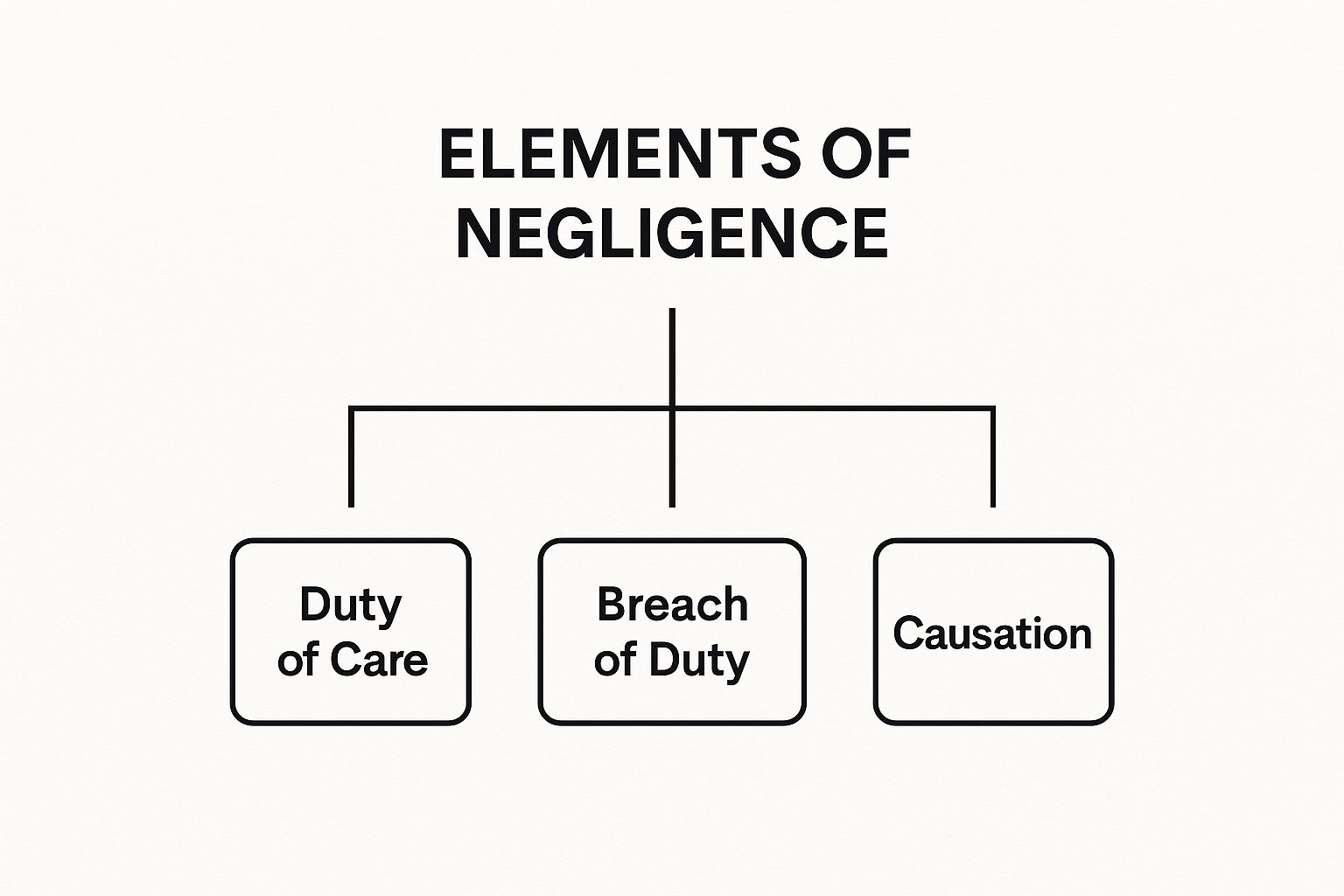
A valid negligence claim is like a sturdy, four-legged table. If even one leg is missing, the entire thing falls apart. To have a case, you must prove each of these four elements. An injury by itself doesn't automatically mean another party was legally negligent.
The foundation of any personal injury case is built on these four essential pillars. Let's briefly introduce them before we dive deeper into each one.
Here’s a quick look at the four pillars that must be proven in any personal injury case based on negligence.
The Four Pillars of a Negligence Claim
| Element | What It Means | Simple Example |
|---|---|---|
| Duty of Care | A legal responsibility to act with reasonable caution to avoid harming others. | A driver has a duty to follow traffic laws and pay attention to the road. |
| Breach of Duty | Failing to meet that legal responsibility through a careless action or inaction. | A driver texts while behind the wheel, taking their eyes off the road. |
| Causation | A direct link showing that the breach of duty is what actually caused the injuries. | Because the driver was texting, they ran a red light and T-boned another car. |
| Damages | The actual, provable harm and losses the injured person suffered. | The victim in the other car sustained a broken arm, medical bills, and lost wages. |
As you can see, each component must build logically on the last one to form a complete and compelling legal argument.
The Foundation of Your Claim
Understanding this structure is the first step in seeing how an accident transforms into a valid legal case.
For example, Georgia law says every driver on the Downtown Connector owes a duty of care to everyone else on the road. A driver who decides to send a text message breaches that duty. That breach directly causes a crash, leading to injuries and financial damages. All four parts must connect seamlessly.
If you come across unfamiliar terms, our online legal dictionary offers clear definitions to help you out.
In the next few sections, we'll take a much closer look at each of these four pillars. We’ll use real-world Atlanta examples to show exactly why proving all four elements of negligence is absolutely essential to your case.
Establishing the Legal Duty of Care
Before you can even begin to talk about negligence, you have to answer one fundamental question: did the person who caused the harm have a legal responsibility to act with reasonable care in the first place? This responsibility is called the legal duty of care, and it's the first building block of any successful personal injury claim in Atlanta.
Think of it like this: every single driver on I-285 has a duty to obey traffic laws and operate their vehicle safely. It’s not something they sign up for; it's an implicit obligation that comes with getting behind the wheel. This duty exists to protect everyone else on the road from foreseeable harm.
What Is the Standard of Reasonable Care?
The law doesn’t expect perfection. Instead, it measures conduct against the "reasonable person" standard. The key question is: what would a sensible, careful person have done in the same situation to avoid causing injury?
This standard isn't one-size-fits-all; it’s flexible and depends entirely on the context. A surgeon at Emory University Hospital owes a much higher duty of care to a patient than two people owe each other while walking down a sidewalk in Midtown.
A "duty of care" requires a person or entity to adhere to a standard of reasonable care while performing any acts that could foreseeably harm others. For an in-depth legal definition, you can refer to resources like the Legal Information Institute at Cornell Law School provides a clear overview.
When Is a Duty of Care Created?
In many situations, the relationship between two parties automatically creates a clear duty of care. These are relationships where the law recognizes one party has a special responsibility for the other's safety.
- Property Owners to Visitors: The owner of a business in Atlantic Station has a duty to keep the store reasonably safe for customers. That means cleaning up spills or fixing broken handrails.
- Doctors to Patients: A physician has a duty to provide medical care that meets the accepted standards of their profession.
- Drivers to Others on the Road: Every motorist owes a duty to everyone else on the road—other drivers, pedestrians, and cyclists—to operate their vehicle safely.

As you can see, the core idea is an obligation to act with the caution a reasonable person would use to avoid foreseeable harm.
Ultimately, proving this legal responsibility existed is the essential first step. Without a duty of care, there can be no negligence, no matter how severe the injury. It’s the cornerstone upon which all other elements of negligence are built.
Proving a Breach of That Duty

Once we’ve established that someone owed you a duty of care, the next piece of the puzzle is showing they failed to live up to that obligation. This failure is what lawyers call a breach of duty, and it's the second of the four core elements of negligence.
Essentially, a breach is the specific careless action—or even a failure to act—that violates the standard of what a reasonably careful person would have done. Did their conduct fall short of that baseline? If the answer is yes, they’ve likely breached their duty.
Think about a truck driver navigating I-75 through Atlanta. They have an undeniable duty to operate that rig safely. If that driver decides to text and drive, taking their eyes off the road for even a few seconds, they have breached their duty to every other person on that highway.
Identifying the Careless Act
The same principle applies on a smaller scale. Imagine a grocery store manager in Decatur is told about a large spill in Aisle 5. If they ignore that report for an hour and do nothing to clean it up or warn shoppers, that inaction is a breach. A reasonable store manager would have acted immediately.
A breach of duty happens the moment that standard of care is violated. According to the National Safety Council, preventable injuries are a leading cause of death in the United States, highlighting the severe consequences that can arise from these failures.
Common Examples of a Breach
A breach can be a split-second mistake or a long-term pattern of unsafe behavior. Here are a few clear, real-world examples:
- Speeding or Driving Recklessly: Someone flying down Peachtree Street at double the speed limit is not acting like a reasonable driver.
- Ignoring Stop Signs or Red Lights: Blowing through a controlled intersection is a textbook violation of a driver's duty to obey traffic laws.
- Failure to Repair a Known Hazard: A landlord who knows about a rotted, broken stair in an apartment complex but does nothing to fix it has breached their duty to keep tenants safe.
- Distracted Driving: This isn't just texting. It includes anything that pulls a driver’s focus from the road, from eating a meal to programming a GPS.
- Medical Errors: When a surgeon leaves a medical tool inside a patient, they have clearly fallen far below the accepted standard of care for their profession.
A breach isn't just a simple mistake; it's a failure to act with the level of caution that the law requires to protect others from foreseeable harm.
This specific act of carelessness is the necessary link between the general responsibility someone has and the actual incident that hurt you. Without proving this failure, the legal chain connecting the other elements of negligence breaks, and a personal injury claim can’t move forward.
Connecting the Breach to the Injury with Causation

It’s not enough to prove someone acted carelessly. To build a valid personal injury claim in Atlanta, you have to connect the dots. This brings us to causation, the third of the four elements of negligence. You must show that the other person’s negligent act—their breach of duty—is the direct reason you were harmed.
Think of it like a row of dominoes. The defendant’s action has to be the first domino pushed, starting a chain reaction that leads straight to your injury. If that link is weak, or if something else breaks the chain, your entire claim can fall apart.
The Two Sides of Causation
Georgia law splits causation into a two-part test. You must satisfy both to move forward. It might sound a bit technical, but the concepts are pretty straightforward.
-
Cause in Fact (The "But For" Test): This is the direct, factual link. The question is simple: but for the defendant’s action, would your injury have happened? If a driver hadn’t run that red light, the crash would not have occurred. Simple as that.
-
Proximate Cause (Foreseeability): This part is about whether the injury was a predictable outcome of the action. Was it reasonably foreseeable that running a red light could cause a serious accident? Absolutely. This test exists to stop people from being held liable for truly bizarre, unpredictable consequences.
Causation demands a clear, unbroken line between the defendant’s careless act and the injury you suffered. This connection is often the most contested part of a claim, requiring very specific evidence to prove.
When the Chain of Causation Breaks
Let’s look at a common scenario. A driver is speeding through a residential neighborhood, which is a clear breach of their duty to drive safely. Suddenly, a child runs out from behind a parked car to chase a ball and is struck.
- Is there "cause in fact"? Yes. But for the driver’s excessive speed, they likely could have stopped in time to avoid the collision.
- Is there "proximate cause"? This is where things get complicated. The defense attorney will almost certainly argue that the child darting into the road was an unforeseeable, intervening event that broke the chain of causation.
The strength of your causation argument can make or break a case. If a distracted driver causes a fender-bender, it’s entirely foreseeable that the other driver might suffer whiplash. It is not foreseeable that a meteor would strike the accident scene moments later, causing an unrelated injury. The driver is only responsible for the foreseeable harm—the whiplash.
Building this logical bridge is important. You have to prove the defendant's carelessness wasn't just some random event that happened near the time of your injury. You have to show it was the direct and predictable reason for it, completing the story of how all the elements of negligence fit together.
Calculating the Damages and Harm Suffered
The fourth and final piece of the negligence puzzle is damages. This represents the actual, legally recognized harm you suffered because of the at-fault party's actions. Even with a clear duty, breach, and causation, a case cannot move forward without provable damages.
Damages are not about punishment; they are about compensation. The goal is to provide the financial resources needed to restore you, as much as possible, to the position you were in before the injury happened. Under Georgia law, victims can recover a wide range of losses that stem directly from the negligent act.
Economic vs. Non-Economic Damages
To fully grasp what can be recovered, it helps to break damages into two primary categories. Each one covers a different type of loss, and both are equally vital in painting a complete picture of the harm you’ve endured.
- Special Damages (Economic): These are the tangible, out-of-pocket financial losses. Think of them as the black-and-white numbers that can be calculated with receipts, bills, and pay stubs.
- General Damages (Non-Economic): These are the intangible losses that don’t come with a neat price tag. They cover the very real human suffering that comes from a serious injury, like physical pain, emotional trauma, and a diminished ability to enjoy life.
The core purpose of damages is to make the injured party "whole" again. This principle, known as compensatory damages, is fundamental to civil law and ensures that any financial award is tied directly to the specific losses the victim incurred.
Here is a simple breakdown of the types of damages you might encounter in a Georgia personal injury claim.
Types of Damages in a Georgia Personal Injury Claim
The table below breaks down the economic and non-economic damages that can be recovered in a negligence case.
| Type of Damage | What It Covers | Examples |
|---|---|---|
| Special Damages | Measurable financial losses directly caused by the injury. | Medical bills, lost wages from missed work, future medical care costs, and property damage (e.g., car repairs). |
| General Damages | Non-economic harm and suffering resulting from the injury. | Pain and suffering, emotional distress, loss of enjoyment of life, and permanent disfigurement or disability. |
Proving the full extent of your damages is a detailed process. It often involves gathering extensive documentation and, in some cases, expert testimony to establish long-term costs. Successfully demonstrating all four elements of negligence is the only way to secure the compensation needed to move forward.
You can learn more about what this involves in our overview of Atlanta personal injury claims.
How These Elements Work Together in an Atlanta Injury Claim
Knowing the four elements of negligence is one thing, but seeing how they snap together in a real-world Atlanta case is what really makes the concept click. Think of them as links in a chain. If even one link is missing or weak, the entire claim falls apart. The sequence—duty, breach, causation, and damages—has to tell a complete, unbroken story.
Let's ground this with a scenario any Atlanta commuter will recognize: rush hour on GA-400.
A Real-World Car Accident Example
Every single person driving on that highway has a legal duty to operate their vehicle safely. That means following traffic laws, paying attention, and not putting others at risk. It’s a basic, shared responsibility.
Now, imagine the driver in the lane next to you glances down to read a text. That single act—taking their eyes off the road—is a clear breach of their duty. They've broken the promise of safe driving that the law demands of them.
Because they were looking at their phone, they don't see the brake lights ahead. They slam into the back of your car. That impact is the causation. Their breach (texting) directly caused the collision, which in turn caused your injuries—say, whiplash and a herniated disc.
The harm you've suffered is the final piece: damages. This isn't just an abstract concept. It’s the very real medical bills from Grady Memorial Hospital, the paychecks you lost because you couldn't work, the cost to get your car fixed, and the physical pain you're forced to live with.
When all four of these elements line up, you have the foundation of a solid personal injury claim. For more on what to do immediately after a crash, check out our guide on how to file a car accident claim in Atlanta.
In every case, the burden is on the injured party to prove that each of these four elements exists. The defendant doesn't have to prove their innocence; you have to prove their liability by connecting every dot from their duty to your damages.
While you're building this case, life doesn't stop. Bills pile up, and the financial pressure can be immense. It's often helpful to explore legal funding options that can provide a lifeline while your claim moves forward.
This same logical sequence applies to virtually all injury cases, whether it's a slip and fall at a local business or a complex medical malpractice claim. Proving these four elements of negligence is the only reliable path to securing the compensation you deserve.
Frequently Asked Questions About Georgia Negligence Laws
When you're trying to heal from an injury, the last thing you want to do is decipher legal codes. It’s natural to have questions about how the law actually works here in Georgia, and getting straight answers can help you understand your options.
Here are some of the most common questions we hear about the elements of negligence and what they mean for a real-world case in Atlanta.
What if I Was Partially at Fault for the Accident in Georgia?
This is probably the most frequent question we get, and for good reason. Very few accidents are 100% one person's fault. Georgia law understands this and uses a rule called modified comparative negligence, which you can find in the Official Code of Georgia Annotated (O.C.G.A.) § 51-12-33.
The rule is pretty simple: you can still recover damages as long as you are found to be less than 50% at fault for what happened. Your final compensation, however, will be reduced by your percentage of fault. For example, if a jury awards you $100,000 but decides you were 20% responsible, your award is cut to $80,000.
The important takeaway? If you are found to be 50% or more at fault, you are completely barred from recovering anything.
How Long Do I Have to File a Negligence Claim in Atlanta?
Georgia, like all states, has a strict clock ticking on your right to file a lawsuit. For most personal injury claims, the deadline is two years from the date of the injury. This is legally known as the statute of limitations.
This deadline is not a suggestion—it's a hard stop. If you miss that two-year window, the court will almost certainly refuse to hear your case, and you lose your right to seek compensation forever. While a few very rare exceptions exist, you should always treat the two-year deadline as absolute. To get a more detailed look, you can learn more about the statute of limitations for personal injury in Georgia.
Can a Business Be Held Liable for Negligence?
Absolutely. Businesses and other organizations have a legal obligation—a duty of care—to keep their customers and visitors safe. This is the foundation of what’s known as premises liability law.
Think about it in practical terms:
- A restaurant must serve food that won’t make you sick.
- A grocery store needs to clean up spills promptly to prevent slip-and-falls.
- A retail shop has to fix broken shelving or flooring that could cause an injury.
If a business or one of its employees fails in this duty and their negligence hurts someone, the business itself can be held legally and financially responsible for the damages.
Is It Hard to Prove All Four Elements of Negligence?
Proving negligence is more than just feeling you were wronged; it’s about presenting cold, hard evidence for each of the four elements.
While a breach of duty might seem obvious—like a driver blowing through a red light—the real work comes in legally connecting that action to your specific injuries (causation) and then proving the full extent of your financial and personal losses (damages). This is often the most challenging part of a claim.
A successful case relies on solid proof. This means gathering police reports, medical records, witness statements, and sometimes bringing in experts to explain complex issues. Each of the four elements of negligence is a pillar of your claim, and all four must be standing strong for you to win.
If you've been injured and are trying to make sense of your options, you don't have to figure it all out alone. The team at Jamie Ballard Law is here to provide clarity and support. For a free, no-obligation case evaluation, visit us at https://jamieballardlaw.com.