Here in Atlanta, when you're recovering from an injury, the last thing you should have to worry about is how you're going to afford a lawyer. This is where the personal injury attorney contingency fee comes into play. Simply put, it's our "no win, no fee" promise. You pay absolutely nothing for our legal help unless we successfully recover money for you. This approach is designed to make sure everyone has access to quality legal support without any upfront financial stress.
Understanding the No Win, No Fee Promise

After an accident, medical bills can stack up fast, especially when you can't work. The thought of adding legal fees to that pile is overwhelming for most families. The contingency fee model was designed specifically to remove that financial barrier. It ensures everyone has access to justice, no matter what their bank account looks like.
Think of it like hiring a real estate agent. You don't pay them by the hour for every open house they run. Their payment is contingent on them selling your home. Our fee structure works the same way. We only get paid if we secure a positive outcome for you, whether that’s a settlement with an insurer or a verdict in court.
How It Aligns Our Goals
This arrangement does more than just make legal help affordable—it perfectly aligns our goals with yours. Since we only get paid if you win, we are completely invested in the success of your case from day one. This creates a true partnership where we both have the exact same objective: to get you the maximum possible compensation for your injuries.
This model delivers several key benefits:
- No Upfront Costs: You don’t need any money out-of-pocket to hire us. We cover all the initial costs of building and litigating your case.
- Zero Financial Risk: If we don't win your case for any reason, you owe us absolutely nothing. You will never get a bill for our time or the resources we invested.
- Shared Motivation: Because our fee is a percentage of your total recovery, we are motivated to fight for every last dollar you deserve.
The Standard in Personal Injury Law
The contingency fee isn't just common practice; it's the standard payment model for personal injury law across the United States. In fact, studies show that about 97% of lawyers handling personal injury cases do so exclusively on a contingent basis. This system is built on the core belief that a person’s right to legal representation should never be limited by their ability to pay. For more on legal terms, our helpful legal dictionary is a great resource.
Ultimately, the contingency fee is about fairness. It levels the playing field, allowing you to go up against massive insurance companies with an experienced legal team fighting for you. This system guarantees we are committed partners in your recovery, focused on securing the justice and compensation you are owed under the personal injury attorney contingency fee agreement.
How Contingency Fee Percentages Are Calculated
After understanding the "no win, no fee" promise, the next question is always the same: "Okay, so what's the percentage?" A standard personal injury attorney contingency fee will usually be somewhere between 33% and 40% of the total settlement or verdict we secure for you. This isn't a fixed number, though.
The final percentage is directly tied to the stage where your case resolves. Think of it as a sliding scale—it reflects the time, work, and resources your legal team pours into the fight. A case that settles quickly after a few phone calls with an insurance adjuster is a very different animal from a case that requires a full-blown jury trial.
The Sliding Scale Explained
Most fee agreements are tiered, with the percentage changing at key legal milestones. For example, a straightforward claim that we resolve before ever filing a lawsuit will sit at the lower end of the percentage range.
If the insurance company digs in its heels and forces us to file a lawsuit, that kicks off the discovery process—gathering evidence, taking depositions, and hiring experts. The percentage may increase to reflect that intensified effort. If the case proceeds all the way to trial, the fee will be at the higher end to account for the immense preparation and risk involved.
This tiered approach is the industry standard. Data from groups like the American Bar Association shows the average contingency fee is around 33%, which is right in line with the starting point for most pre-litigation settlements.
This infographic breaks down how the percentages often shift as a case progresses.
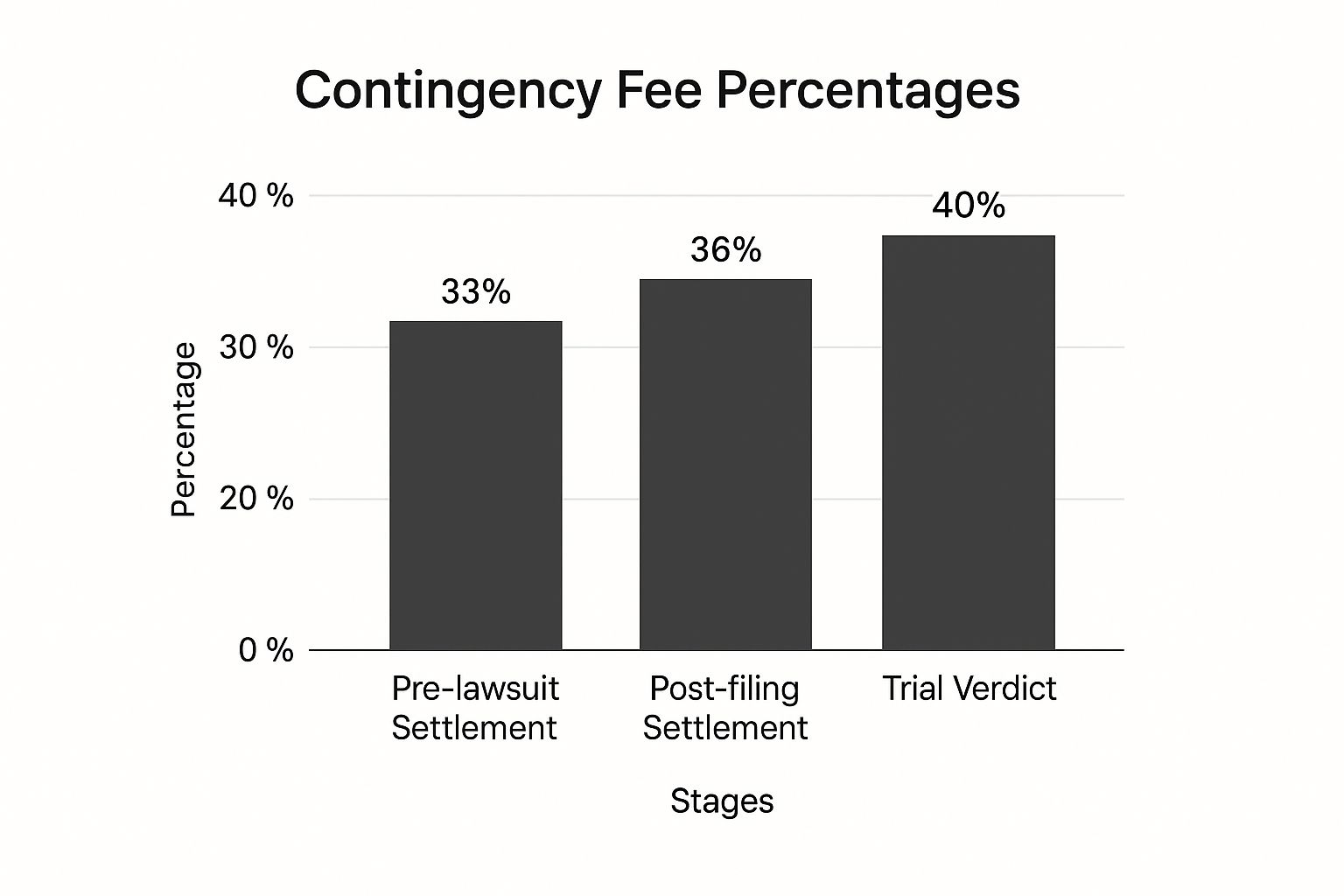
As you can see, the fee percentage goes up as more legal heavy lifting is needed to get you the compensation you are owed.
To make this crystal clear, let's look at a hypothetical $100,000 settlement and see how the numbers might play out at different stages.
Example Contingency Fee Calculations at Different Case Stages
| Case Stage | Typical Fee % | Attorney's Fee | Your Recovery (Before Costs) | Description of Work Involved |
|---|---|---|---|---|
| Pre-Litigation Settlement | 33.3% | $33,300 | $66,700 | Initial investigation, evidence gathering, demand letter, and negotiations with the insurance adjuster. |
| Settlement After Filing Suit | 35% – 38% | $35,000 – $38,000 | $62,000 – $65,000 | Filing the complaint, formal discovery (interrogatories, depositions), and mediation. |
| Settlement Before Trial | 40% | $40,000 | $60,000 | Intensive trial preparation, expert witness coordination, and last-minute settlement conferences. |
| Verdict After Trial | 40% | $40,000 | $60,000 | Full trial presentation, including opening statements, witness examinations, and closing arguments. |
This table shows why the fee adjusts—the legal work involved grows substantially as a case moves from simple negotiation toward a courtroom battle.
No Surprises Down the Road
The most important thing here is transparency. Your written fee agreement will spell out these percentages and the exact triggers for any changes. We make sure everything is on the table from day one so you never have to worry about hidden fees or surprises.
A clear fee structure is a key part of all successful personal injury claims. It aligns our goals perfectly. We are motivated to get your case resolved as efficiently as possible while fighting for every dollar you deserve. This partnership is the foundation of how a personal injury attorney contingency fee puts your interests first.
Distinguishing Between Fees and Case Costs

It’s a common point of confusion. When people hear "contingency fee," they often assume it covers every single expense related to their case. But it's important to understand the difference between attorney's fees and case costs—they are two separate things.
Think of it like hiring a contractor to build a house. The attorney's fee is the payment for the contractor's expertise, time, and labor. Case costs, on the other hand, are the raw materials needed for the job: the lumber, nails, and wiring.
What Are Case Costs?
Case costs are the direct, out-of-pocket expenses required to build and prove your claim. As your law firm, we advance these funds on your behalf, so you still pay nothing upfront. We essentially front the money for all the "raw materials" needed to fight for you.
These expenses often include:
- Court Filing Fees: Every lawsuit starts with filing official documents with the court, and each filing comes with a fee. You can get an overview of these legal processes from the State Bar of Georgia.
- Expert Witness Payments: To prove a case, we often need to hire professionals like accident reconstructionists or medical experts to provide testimony. Their time and expertise come at a cost.
- Record Retrieval: This covers the administrative fees for gathering essential documents like police reports, ambulance records, and your complete medical history from various hospitals and clinics.
- Deposition Expenses: These are the fees paid to court reporters who create an official transcript of sworn testimony from witnesses, defendants, and experts before a trial.
A clear agreement should always detail how these costs are managed. We make it a point to front these necessary expenses, removing another financial burden from your shoulders while you focus on recovery.
How Costs Affect Your Final Settlement
A very important detail in your fee agreement is understanding how these costs are deducted from your final settlement or verdict. The standard practice is to calculate the attorney's fee from the gross (total) settlement amount. After the fee is calculated, the case costs we advanced are reimbursed to the firm from the remaining balance.
Here’s a simple breakdown:
- Gross Settlement: $100,000
- Attorney's Fee (33.3%): $33,300
- Case Costs Advanced: $5,000
- Your Net Recovery: $61,700 ($100,000 – $33,300 – $5,000)
Total transparency here is non-negotiable. A trustworthy attorney will ensure this calculation is laid out plainly in the written agreement. This kind of financial clarity is the cornerstone of a successful personal injury attorney contingency fee arrangement.
Why the Contingency Model Benefits You
The **personal injury attorney contingency fee** is the standard in our field for one simple reason: it is designed with your best interests at heart. After an injury, you face a powerful insurance company with deep pockets and teams of lawyers. The contingency model is what levels that playing field.
It gives you the power to challenge a massive corporation without needing to pay thousands of dollars upfront. You can secure experienced legal representation immediately, ensuring important evidence is preserved and your rights are protected from day one.
Aligning Our Interests for a Shared Goal
This system creates a true partnership. Because our payment is directly tied to the outcome of your case, our interests are perfectly aligned with yours. We only succeed when you do.
This shared goal provides several powerful advantages:
- Zero Financial Risk: If we don't secure a settlement or verdict for you, you owe us nothing in legal fees. You will never receive a bill for our time if your case is unsuccessful.
- Maximum Motivation: Since our fee is a percentage of the total recovery, we are highly motivated to fight for the absolute maximum compensation possible. We are truly partners in the outcome.
- Focus on Efficiency: We invest our own firm's time and resources into your case. This encourages us to pursue your claim as effectively and strategically as possible to achieve a favorable resolution.
The core idea is to provide access to justice for everyone. This model allows individuals who couldn't otherwise afford the high costs of litigation to have their day in court and hold negligent parties accountable.
This structure is built to protect and empower people who have been harmed through no fault of their own. Legal research confirms that across the U.S., contingency fees make legal representation accessible. Lawyers agree to bear the upfront costs and risk, receiving payment only if they secure compensation, which aligns their efforts toward achieving the best possible results for their clients. You can read more about these legal findings.
Ultimately, a personal injury attorney contingency fee is more than just a payment plan. It’s a system that ensures your focus can remain on your physical and emotional recovery while we handle the fight for your financial future.
What to Look for in Your Fee Agreement

Before a lawyer can start working on your case, you’ll sign a written contingency fee agreement. This isn't just a routine form—it's a legally binding contract that defines your entire professional relationship. It is very important that you read it, understand it, and feel comfortable with every term before you sign.
A well-drafted agreement is often the first sign of a trustworthy attorney. It should be written in plain English, not bogged down with confusing legal jargon. Think of it as the blueprint for your partnership, designed to make sure there are no financial surprises down the line.
Key Elements to Identify
Your fee agreement should spell out the core terms with absolute clarity. Ambiguity is a red flag. Take your time and find the sections that explain these three things:
- The Fee Percentage: The exact percentage the attorney will receive must be stated. The agreement should also note any conditions that could change it, like if the case goes to trial.
- How Costs are Handled: It needs to detail how case costs are paid upfront by the firm and then reimbursed from the settlement. Importantly, it must specify whether the attorney's fee is calculated before or after those costs are deducted.
- The Scope of Work: The contract should clearly define what legal services are included. Most agreements cover the claim and trial but may not cover a subsequent appeal.
It's also a good idea to ask what happens if you need to switch attorneys and how that would affect fees and costs. The State Bar of Georgia has strict rules of professional conduct that require attorneys to be transparent in their fee agreements.
Questions to Ask Before You Sign
Treat this review process like you're hiring someone for a very important job—because you are. You have every right to feel 100% confident in your decision.
This agreement is the foundation of trust and transparency between you and your attorney. Asking direct questions is the best way to ensure you feel secure and informed from the very beginning.
Here is a simple checklist of questions to ask any attorney you are considering:
- Can you show me a sample breakdown of how a final settlement check is divided?
- Do I owe anything for case costs if we lose the case?
- What are the specific circumstances that would cause the fee percentage to increase?
- Who will be my primary point of contact for case updates?
Our firm believes in total transparency. That starts with a clear explanation of all financial aspects, just as we do when discussing the costs associated with a free consultation. A straightforward personal injury attorney contingency fee agreement empowers you to focus on your recovery, not on hidden fees.
Common Questions About Contingency Fees
To give you more confidence as you consider your next steps, we've laid out clear answers to the questions we hear most often about the personal injury attorney contingency fee. Knowing how it all works is the first step toward making the best decision for you and your family.
Can I Negotiate the Contingency Fee Percentage?
While the standard rates—usually 33% to 40%—reflect the risk and resources our firm invests to take on large insurance companies, there can sometimes be room for discussion. A very straightforward case that looks like it will settle quickly might be an instance where we can talk about the fee.
However, for cases that will likely demand extensive litigation, expert witnesses, and maybe even a full-blown trial, the fee is usually firm. This ensures the firm can cover the significant upfront investment needed to build the strongest case possible on your behalf. The best way forward is always an open conversation. A reputable attorney will gladly walk you through their fee structure so you understand the value it represents.
What Happens if I Lose My Case?
This is the core promise of a contingency fee agreement. If we don’t win your case and you don't recover any money, you owe us zero in legal fees. It’s a risk we willingly take on when we believe in your case.
You should also get clarity on how case costs are handled. Most established Atlanta firms, including ours, will also waive reimbursement for any case-related expenses if there's no recovery. That means you can truly walk away owing nothing. This important detail must be clearly written into your fee agreement.
The "no win, no fee" promise should be absolute. This gives you complete protection, ensuring you don't face a financial penalty for seeking justice after an accident.
How Does This Differ From Court-Awarded Attorney Fees?
These are two entirely different things. In a few specific types of law, a statute might allow a judge to order the losing side to pay the winner's legal fees. This is extremely rare in typical personal injury claims like car accidents or slip and falls. You can find out more about the different types of legal fees on sites like Wikipedia.
Instead, your attorney's payment comes directly out of the settlement or verdict we secure for you, based on the percentage you agreed to in your contract. The agreement you sign is what dictates how your lawyer gets paid, not a separate court order. This provides clear, predictable terms right from the start.
Is the Fee Calculated on the Gross or Net Settlement?
This is one of the most important questions you can ask, as it directly affects how much money you take home. The "gross" amount is the total settlement figure before any deductions. The "net" is what’s left after case costs are subtracted.
The vast majority of contingency agreements calculate the attorney’s percentage from the gross settlement amount. For instance, on a $100,000 settlement with a 33.3% fee, the attorney's fee is $33,300. Case costs are then taken out of the remaining balance. A good agreement will always include a clear example showing this math, so there are no surprises when the final numbers are run.
How Long Do I Have to File a Claim in Georgia?
This question isn't about fees, but it’s an important part of the legal process. Georgia has strict deadlines, known as the statute of limitations, for filing a lawsuit. If you miss this window, you could lose your right to seek compensation forever, no matter how strong your case is. Understanding the statute of limitations for personal injury in GA is an essential first step. This deadline is a key reason why it's so important to speak with an attorney sooner rather than later.
We hope these answers bring some clarity to the process. The entire purpose of the personal injury attorney contingency fee is to remove the financial burden from your shoulders so you can focus on what’s most important—your recovery.
At Jamie Ballard Law, we believe in complete transparency and are always here to answer your questions with no obligation. If you've been injured and are unsure about your next steps, we invite you to reach out for a free, confidential case evaluation. Let us help you understand your rights and how we can fight for the compensation you deserve. Visit us at https://jamieballardlaw.com to learn more.