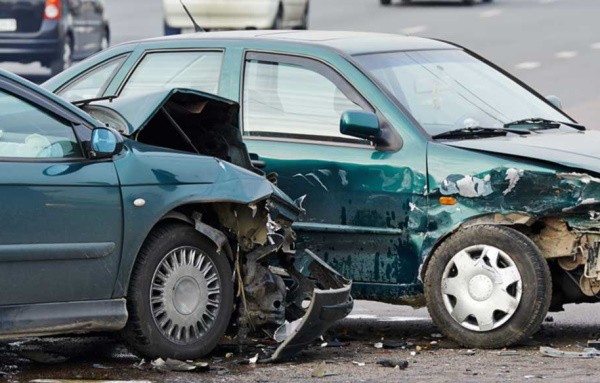
A car crash is jarring enough on its own. But when you are involved in a wreck without a valid license, a wave of confusion can set in. You’re probably wondering, "Can an unlicensed driver in accident not at fault still get compensation?"
From my experience helping people in Atlanta, I can tell you the short answer is: yes. In Georgia, your right to recover damages hinges on who caused the crash, not who had a valid driver's license in their wallet.
Separating Fault from Licensing Status
After any crash in Atlanta, the single most important question is: who was negligent? Negligence is just the legal term for careless behavior that hurts someone else. Think of it this way: if a driver blows through a red light and T-bones someone who had the green, the red-light runner was negligent. Their action directly caused the collision.
The fact that the other driver didn't have a license is an entirely separate issue. Driving unlicensed is a violation of state law, and that person will almost certainly face tickets and other penalties from law enforcement. However, that’s between them and the state—it doesn't automatically make them responsible for the crash itself.
The Core Distinction
To make this crystal clear, let's break down how Georgia law views these two separate concepts.
| Fault vs Licensing Status in a Georgia Accident |
| :— | :— | :— |
| Concept | What It Determines | Relevance to a Compensation Claim |
| Fault (Negligence) | Who is financially responsible for the damages (injuries, vehicle repairs, lost wages). | Primary Factor. This is what your entire claim is built on. You must prove the other party was negligent. |
| Licensing Status | Whether a driver was legally permitted to operate a vehicle on public roads. | Secondary Factor. This is a legal violation that leads to separate penalties, but it does not determine who caused the wreck. |
This distinction is everything. The at-fault driver's insurance is still on the hook to cover the damages for the person who wasn't at fault, even if that person was driving without a license.
Key Points to Remember
Here are the takeaways you need to keep in mind:
- Fault is about actions: Liability is decided by who broke a traffic law or acted carelessly at the moment of impact—things like speeding, texting, or failing to yield.
- Licensing is about permission: Driving without a license is a separate legal problem that results in penalties, but it doesn't assign blame for the collision.
- Compensation follows negligence: The person who caused the wreck is responsible for the fallout, regardless of the other driver's license status.
After all, if you were obeying every traffic law—stopped at a red light, for instance—and someone else plowed into you, you are still the victim of that crash.
In Georgia, we operate under a comparative negligence rule. This means fault can be split, but as long as you are less than 50% at fault, you can still recover damages for your losses.
Imagine a licensed driver gets distracted and rear-ends an unlicensed driver who was properly stopped at a light. The licensed driver is 100% at fault. In this case, the unlicensed driver has a completely valid claim for their vehicle damage and injuries.
The claims process involves several important steps, including procedural requirements like getting proper document notarization after car accidents for official statements. If you want a more detailed look at the overall process, our guide on how to file a car accident claim in Atlanta is a great resource.
Ultimately, when you're dealing with an unlicensed driver in accident not at fault, the focus always comes back to the specific actions that led to the collision.
How Insurance Companies Approach These Claims
When you're hit by another driver but don't have a valid license yourself, the insurance claim process can feel like a maze. It’s natural to worry that your licensing status will affect things. But for insurance companies, it almost always boils down to two simple questions: who caused the crash, and who has coverage?
The fact that you were unlicensed is a legal issue between you and the state. For the insurer, the primary focus stays locked on proving negligence.
This decision tree breaks down how fault and licensing status are typically weighed after a collision.
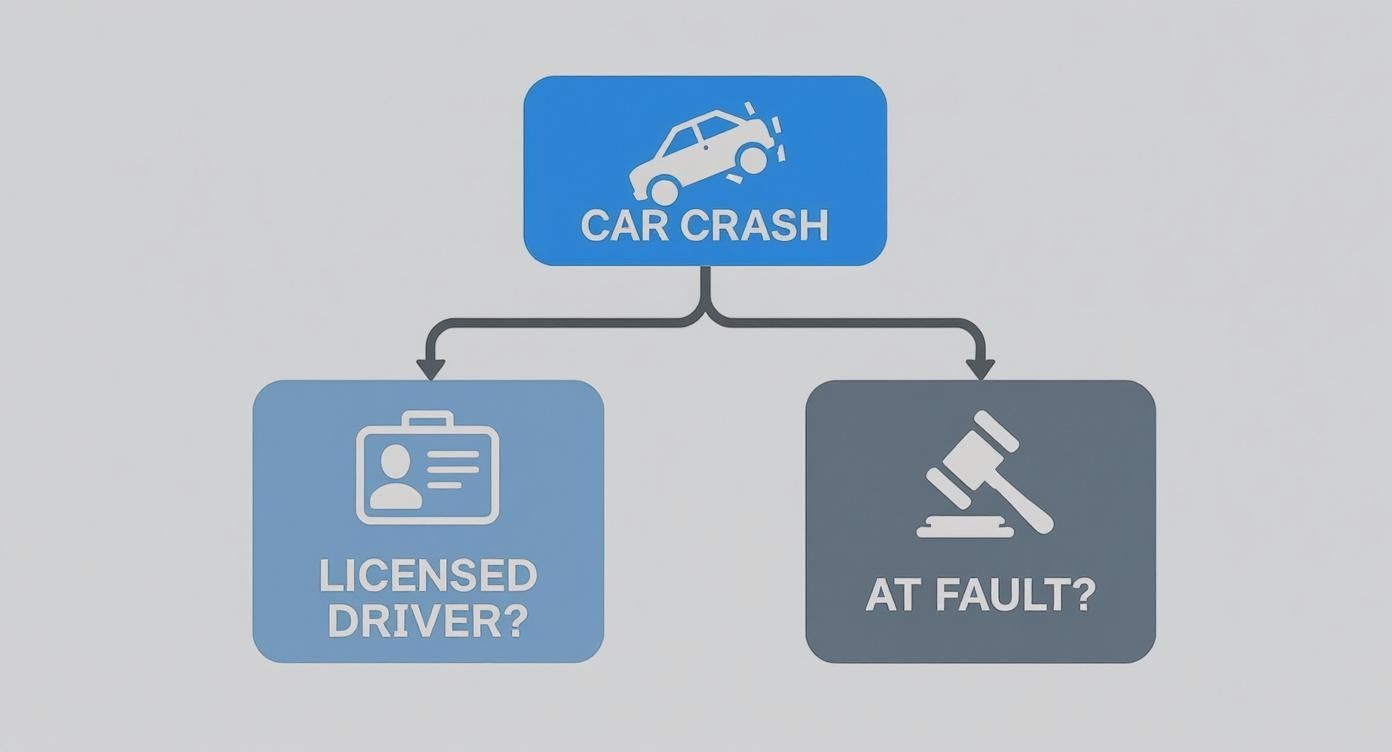
As you can see, the path to resolving any claim always starts with establishing who was at fault—not who was licensed to drive.
When the At-Fault Driver Has Insurance
It might seem counterintuitive, but it's entirely possible for an at-fault driver to be insured even if they're unlicensed. For example, their license may have recently expired, or they could be a listed driver on a family member's policy.
If the driver who hit you has a valid insurance policy, their provider is generally on the hook for your damages. You should expect the insurer to scrutinize the claim, looking for any potential policy violations. However, their fundamental duty is to cover the damages caused by their policyholder's negligence.
Working through the claims process is key. Even when you're clearly not at fault, you may still need to negotiate an insurance settlement to get the fair compensation you're entitled to.
When the At-Fault Driver Is Uninsured
More often than not, a person driving without a license also lacks car insurance. This is precisely where your own insurance policy becomes your financial lifeline. In Georgia, Uninsured/Underinsured Motorist (UM/UIM) coverage was designed for this exact situation.
Think of your UM/UIM coverage as a safety net you bought for yourself. When the at-fault driver has no insurance, your policy steps in to fill that gap.
Your UM/UIM coverage is there to pay for your medical bills, lost wages, and pain and suffering up to your policy limits, just as the other driver's insurance would have.
To activate this coverage, you'll file a claim directly with your own insurance company. You must provide them with all the evidence from the crash, including:
- The official police report documenting the other driver's fault and lack of license.
- Photos and videos you took at the accident scene.
- Contact information for any witnesses who saw what happened.
- All medical records and bills related to your injuries.
Your insurer will then process your claim and pay for your losses. From there, they may decide to pursue the at-fault, unlicensed driver directly to get back the money they paid you—a process called subrogation. This lets you get the compensation you need without the headache of chasing down an uninsured person yourself.
To see how these situations fit into the bigger picture, you can learn more about the fundamentals of personal injury claims right here on our site. This process ensures you have a clear path to financial recovery, even when an uninsured motorist is at fault.
Why Unlicensed Drivers Are a High-Risk Group
While a driver’s license doesn't determine who was at fault in a wreck, it helps to see the bigger picture from a safety standpoint. Even if you were an unlicensed driver in an accident not at fault, understanding why this group is viewed as high-risk can explain the immediate assumptions from insurance companies and law enforcement.
The data is clear and consistent: there's a strong link between unlicensed driving and more severe crashes. This isn't about assigning blame in your specific case. It’s about recognizing that driving without a license is often part of a larger pattern of risky behavior behind the wheel.
The Statistical Link to Higher Risk
Research from all over the world confirms that unlicensed drivers are involved in a surprisingly high number of serious collisions. It's a global road safety problem, not just a local one.
For instance, one major study found that 12% of drivers involved in crashes causing hospitalization or death were unlicensed. Compare that to just 1% of drivers in a control group who weren't involved in crashes. That's a massive difference. The research suggests that even after you account for other factors, unlicensed drivers are a significant high-risk group. You can dig into these road safety findings and their implications for yourself.
This data points to a clear trend: the act of driving without a license often correlates with other unsafe driving habits, leading to a higher likelihood of being involved in a severe or fatal crash.
This connection is exactly what shapes the views of insurers and police. They don't just see the lack of a license as a paperwork issue; they see it as a red flag for elevated risk.
Common Unsafe Driving Behaviors
The increased risk isn't a coincidence. It's tied to specific, dangerous actions that are far more common among drivers who operate a vehicle illegally.
These behaviors frequently include:
- Higher Rates of Impairment: Unlicensed drivers are much more likely to be driving under the influence of alcohol or drugs. Drunk driving dramatically increases the odds of a crash, and our firm regularly handles cases involving these exact circumstances. You can learn more about how we help victims in our guide to handling a claim with an Atlanta drunk driving accident lawyer.
- Tendency to Speed: Studies show a clear pattern of excessive speeding among unlicensed drivers.
- Lower Seatbelt Usage: This group is also less likely to wear seatbelts, a simple step that directly contributes to more severe injuries when a crash happens.
- Previous Violations: Many unlicensed drivers have had their licenses suspended or revoked for prior serious offenses, like DUIs or a history of moving violations.
When safety experts look at these factors together, the picture becomes very clear. They see that while being an unlicensed driver in an accident, not at fault, is your specific situation, the overall trend for this group points toward significant public safety challenges.
Legal Penalties for the Unlicensed Driver
Even if an unlicensed driver isn't at fault for a crash, they’ve still got a completely separate legal problem to deal with. Your focus might be on the civil claim for damages, but the other driver is facing criminal penalties for being on the road without a valid license.
It’s important to understand this distinction: their traffic violation doesn't just erase your liability for causing the wreck. But it definitely means they will face consequences from the state.
For someone in the tough spot of being an unlicensed driver in an accident not at fault, things get tricky. They have every right to seek compensation for their injuries and property damage, but they also have to answer to the state for the licensing offense.
Georgia's Driving While Unlicensed Law
In Georgia, the rules are crystal clear. Getting behind the wheel without a valid license is a misdemeanor. The specific law covering this is Georgia Code § 40-5-20, which flat-out states that no person can drive a motor vehicle on a Georgia highway unless they have a valid driver's license.
Here's a direct look at the statute that lays down the law for every driver in the state.
This code makes it plain: having a license isn't optional. It’s a basic requirement. Because of this, when the police show up at an accident scene and find out a driver is unlicensed, they will issue a citation. That ticket kicks off a whole separate legal process.
The key takeaway is that the civil claim for the accident and the criminal charge for unlicensed driving proceed on two different tracks. One process doesn't cancel out the other.
Specific Penalties the Unlicensed Driver Faces
When a driver gets a ticket for violating O.C.G.A. § 40-5-20, they can expect a range of penalties handled by the criminal courts. These consequences are meant to punish the act of driving illegally and have absolutely no bearing on who caused the collision.
The potential penalties are serious and can include:
- Significant Fines: A conviction for driving without a license usually comes with a fine between $500 to $1,000.
- Jail Time: Since it's a misdemeanor, a judge has the power to sentence the driver to jail for up to 12 months. Shorter sentences are more common for a first offense, but the risk is real.
- Vehicle Impoundment: Police have the authority to impound the car being driven by the unlicensed person, which means racking up towing and storage fees.
- Probation: A judge might also order a period of probation, which involves regular check-ins and following a strict set of rules.
These legal troubles are a powerful reminder that the state takes road safety seriously. Even if you were an unlicensed driver in an accident not at fault, these are the legal hurdles you would face, entirely separate from your injury claim.
The Connection Between Unlicensed Driving and Fatal Crashes
When we start looking at fatal accidents, the safety issues tied to unlicensed driving become far more serious. While your situation as an unlicensed driver in an accident not at fault is unique, the broader statistics paint a sobering picture. There's a clear, tragic link between unlicensed drivers and some of the worst collisions on our roads.
This data isn’t just for show; it’s the reason why licensing laws are taken so seriously. They are a fundamental tool for keeping everyone safe.
When you dig into national crash data, a disturbing pattern quickly appears. Unlicensed drivers are consistently involved in a disproportionate number of deadly accidents. These aren't just abstract numbers—they represent devastating, preventable losses for families and entire communities.
The Sobering Statistics on Youth Fatalities
The connection between youth, unlicensed driving, and fatal crashes is particularly alarming. Over a seven-year period, national crash data revealed that drivers under 20 without a license were involved in 4,947 fatal crashes. That single group accounted for a staggering 12.1% of all fatal crashes nationwide during that time.
The numbers are even more troubling for the youngest drivers. Studies show that 57% of 15-year-olds and 10% of 16-year-olds involved in deadly crashes were unlicensed. You can explore these findings on youth road safety for a closer look at the research.
This disproportionate involvement in fatal crashes highlights a significant public safety challenge. The loss of life in these accidents is a tragedy that underscores the importance of proper driver training and licensing.
When a family loses someone in a preventable crash, the grief is unimaginable. Understanding the legal path forward, often with the guidance of an Atlanta wrongful death attorney, becomes an important step toward finding justice for their loss.
A Pattern of Risky Behavior
This heightened risk isn't a coincidence. It’s often linked to a pattern of dangerous behaviors that go hand-in-hand with driving illegally. These actions dramatically increase the odds of a catastrophic outcome.
Common risk factors seen with unlicensed drivers in fatal crashes include:
- Lower Seatbelt Use: A significant number of unlicensed drivers killed in collisions were not wearing seatbelts.
- Speeding: Driving well over the speed limit is a frequent factor, slashing reaction times and multiplying the force of impact.
- Substance Use: Driving under the influence of alcohol or drugs is far more common among this group.
These behaviors create a perfect storm on the road. For anyone involved in a wreck, even an unlicensed driver in an accident not at fault, this context helps explain why the legal system treats licensing with such gravity. It’s all about preventing the next tragedy.
Common Questions About Unlicensed Driver Accidents

After a crash, your mind is racing. When an unlicensed driver is involved, the situation can feel even more uncertain. It's natural to have a lot of questions, so we've put together some straightforward answers to the ones we hear most often from folks here in Atlanta.
Can I Still File a Claim If I Was Unlicensed?
Absolutely. If another driver’s negligence caused the accident, your right to recover damages for your injuries and vehicle damage remains intact.
Your lack of a driver's license is a separate legal matter. It doesn't give the at-fault driver a free pass to avoid responsibility for the harm they caused. The other driver’s insurance adjuster will definitely note your license status, but their main job is to determine who was at fault for the collision itself.
What if the At-Fault Driver Was Also Unlicensed?
This scenario is more common than you might think. If the driver who hit you was also unlicensed, the process of determining fault doesn't change one bit. You still need to prove they were negligent and caused the crash.
The real challenge here is that an unlicensed driver is often an uninsured driver. If that's the case, you'll need to turn to your own insurance policy and use your Uninsured Motorist (UM) coverage to pay for your damages. This is precisely why having UM coverage is so important for your own protection.
Can an Unlicensed Driver’s Insurance Deny the Claim?
Generally, no. An insurer can't deny a claim based only on the driver's license status. If the at-fault driver has a valid insurance policy on their vehicle, that policy is obligated to cover the damages they caused, up to the policy limits.
However, there can be a complication. The insurer might investigate to see if the unlicensed driver was specifically named as an "excluded driver" on the policy. If they were, the insurance company could try to deny coverage, but that requires a very close look at the policy's fine print.
A helpful point to remember is that insurance follows the vehicle first, and then the driver. The policyholder’s obligation to cover damages caused by their vehicle usually remains, even if they allowed an unlicensed person to drive it.
Why Do Unlicensed Drivers Have a Bad Reputation?
This isn't just a stereotype; it's a perception backed by some sobering data. National statistics consistently show that unlicensed drivers are involved in a shockingly high number of fatal accidents. In 2021, they were behind the wheel in 18.4% of all deadly crashes.
For many, driving without a license isn't a simple oversight. It's often part of a larger pattern of risky behavior, including prior license suspensions, collisions, or multiple speeding convictions. You can discover more about these road safety statistics and the dangers involved. It's this data that explains why the issue of an unlicensed driver in accident not at fault is still treated with such seriousness by authorities and insurers alike.
At Jamie Ballard Law, we believe everyone deserves clear answers and strong representation. If you've been injured in an accident, don't let confusion about your rights stop you from seeking the compensation you need. Contact us for a free, no-obligation case evaluation at https://jamieballardlaw.com.